
Farm Worker Uniform OEM China | Field & Packhouse Workwear
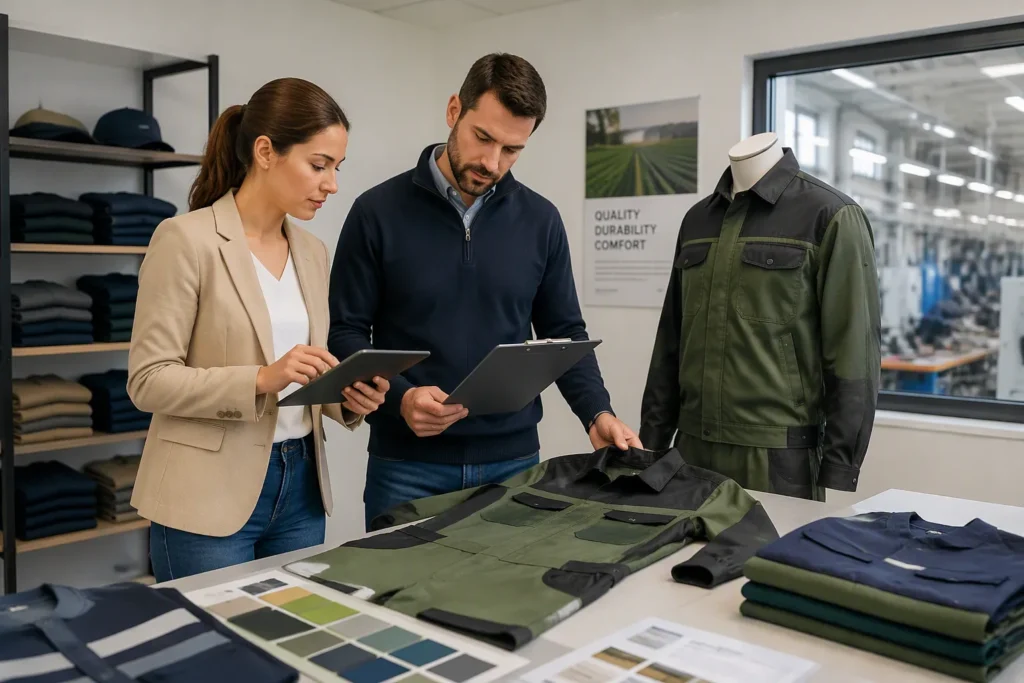
Your choice of an OEM partner affects both uniform cost and brand reputation. Focus on finding a dependable China manufacturer for your farm worker uniform OEM China needs. You must study cost, MOQs, and quality control. Both big brands and new startups deal with this problem. Understanding China vs local factories means knowing the main differences between nearby and overseas makers. A skilled OEM in Asia gives you steady support. Focus on finding the right manufacturing partners. Know the benefits of OEM suppliers so you can pick the right maker. This guide sets you up for success over the long run.
Key Takeaways
Look at the total cost, not just the price of one item, to avoid extra fees.
Talk about smaller minimum order amounts so you can try out designs without holding a lot of stock.
Pick a manufacturer that talks clearly and gives a detailed timeline for making your products.
Look for certifications such as ISO 9001 and OEKO-TEX to make sure the products are good and safe.
Work with a factory that can grow with your brand and keep quality high.
Cost and Minimum Order Quantities
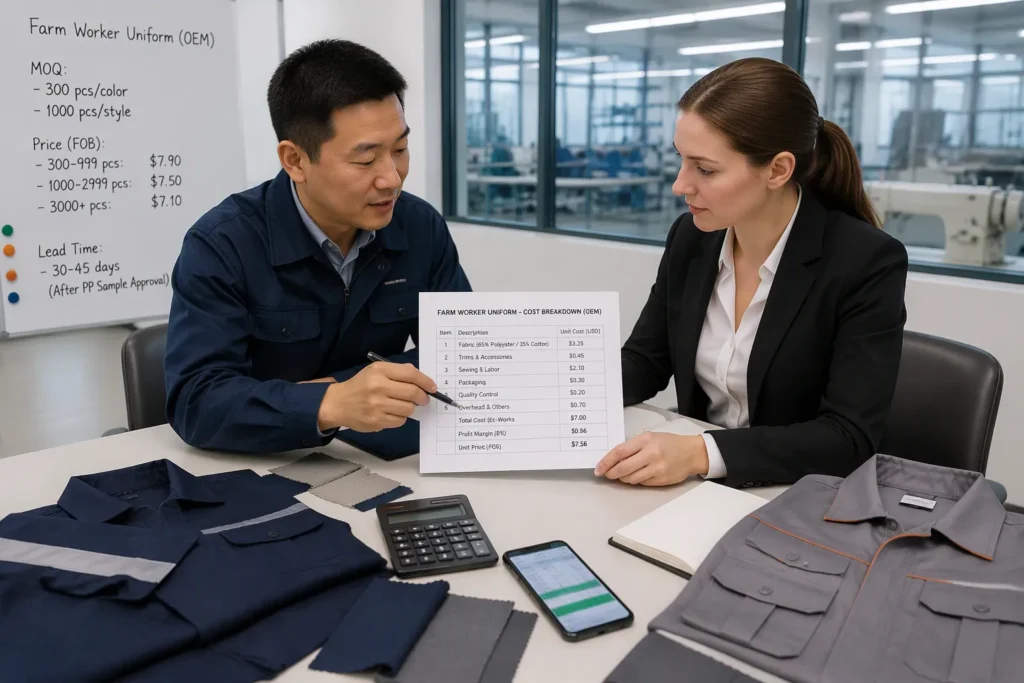
Unit Pricing and Hidden Costs
You need to compare prices across several Chinese factories before you decide. Ask each factory for a full cost breakdown. That breakdown should include fabric, labor, trims, packaging, and finishing. A quote that looks cheap at first often has extra fees hidden inside.
Watch for hidden costs that show up after you sign. Shipping fees, import tariffs, and sampling charges add up fast. A sample from a Chinese OEM costs $30 to $80 per sample. Local factories in Europe or the USA charge $150 to $300 per sample. That gap matters for your budget. Unit cost also differs. Chinese makers charge $4 to $8 per T-shirt. Local factories charge $15 to $30 per item. You must think about these numbers along with shipping and tariff costs. A low unit price means little when freight doubles your total cost.
MOQs for a Startup Clothing Brand Manufacturer
A startup clothing brand manufacturer has tight cash flow and little storage space. High MOQs create real risk. You can negotiate lower MOQs without losing quality. Use these tricks to protect your budget:
Use stock organic fabrics instead of custom-dyed ones to skip fabric MOQ rules.
Combine several styles that use the same fabric and trims to hit minimums more easily.
Work with low-MOQ or no-MOQ factories that focus on small-batch production.
Accept partial deliveries or use pre-order models to lower upfront inventory risk.
Start with 1–2 styles using stock fabric and test the market with small drops or pre-orders.
Open talks with suppliers also help. Share your business needs and sales goals clearly. Show that you want a long-term partnership. You can trade a higher total order amount or more frequent orders for lower MOQs. Other things you can negotiate include longer lead times and more flexible payment terms. Strong supplier relationships lead to better deals.
Compare supplier types before you decide. The table below shows typical sample costs, MOQs, and unit costs.
Supplier Type | Sample Cost | MOQ per Design | Unit Cost |
|---|---|---|---|
Chinese OEM (e.g., Yuanyi Apparel) | $30–$80 per sample | 50–100 pieces | $4–$8 per T-shirt |
Local Factories (Europe/USA) | $150–$300 per sample | 200–500 units | $15–$30 per item |
Flexible MOQs give you room to grow. Low MOQs let you test designs without a big inventory. A good manufacturer will match your business stage. You should treat cost and minimum order quantities as one connected choice. A low price with a huge MOQ can sink a new brand. A slightly higher price with flexible terms often works better. Choose a partner who grows with you.
Communication, Lead Times, and Control with Chinese OEM Manufacturers
Handling communication, lead time, and control needs a clear plan. You must check if a factory can speak your language and handle its production schedule. These two things decide if your project goes well or keeps getting delayed. Working with dependable chinese oem manufacturers starts with clear expectations from day one.
Related OEM uniform programs
Responsiveness and Language Capability
You check English communication from the first time you make contact. Send a detailed email with your uniform specs, design sketches, and quantity estimates. A dependable partner replies within 24 hours with clear answers. They ask questions about your fabric choice, sizing ranges, and trim details. This action shows real interest in your project. A language barrier causes real trouble. It leads to wrong fabric orders, wrong pocket placements, and mismatched color shades. You need a set account manager with strong English skills. This person becomes your direct link to the production floor. They share weekly progress reports without you asking. They warn you about delays before these issues turn into full crises. Good communication stops costly rework and keeps your timeline on track. You also check their willingness to share honest updates. A factory that hides problems today makes bigger problems tomorrow.
Lead Time Mapping and Production Milestones
You build a full timeline from sampling to bulk delivery. Sample making takes 1 to 2 weeks. Sample approval adds 3 to 5 days. Fabric sourcing needs 2 to 3 weeks. Bulk cutting and sewing runs 4 to 6 weeks. Finishing and packing takes 1 week. Shipping adds 2 to 4 weeks. Total lead time usually spans 10 to 16 weeks for an OEM order. You set milestone checkpoints at each stage. Ask for fabric photos before cutting starts at bulk production. Request mid-production samples to check stitching quality and fit accuracy. Schedule a third-party final inspection before shipment leaves the factory. These checkpoints keep your control over the process. They let you catch problems early when fixes cost less. A dependable partner among chinese oem manufacturers shares regular production updates. They treat your order with the same care as their own brand. This level of openness gives you peace of mind. You know exactly where your uniforms stand at every step.
Scaling Production and Quality at an OEM Workwear Factory
Capacity for Bulk Orders and Growth
You need to find out if an oem workwear factory can handle your orders now and as you grow. A factory with limited space will have trouble when your brand gets bigger. Ask how many sets or units they make each year. A good manufacturer who can grow will give you this number right away. For example, Taian BOWINS Garment Co., Ltd. says it makes over two million sets a year. That amount shows the factory can work with big brand partners in more than 60 countries. You should also ask about capacity during busy seasons. Can the factory add more production lines when you need a rush order? A partner with flexible capacity keeps your brand safe during busy times. Look at their equipment, how many workers they have, and how much floor space they use. These things decide if they can grow with you. A factory that only does small batches will slow you down. Pick a partner who sees scaling and quality control as one connected system. Your farm worker uniform oem china project needs a factory that can deliver steady output at any volume level.
Quality Assurance, Audits, and Inspections
Quality control begins before you place a bulk order. Ask for samples and prototypes first. Check the stitching, fabric weight, and fit on a real worker. A sample shows you more than any brochure. Next, do a factory audit. Visit the site or hire a third-party auditor. You want to see their cutting floor, sewing lines, and finishing area. Ask about their aql inspections process. AQL stands for Acceptable Quality Limit. This standard helps you set how many defects are okay in a shipment. A third-party inspection before shipment gives you independent proof of quality. You should also check client testimonials and track record. A factory that has served renowned brands like DeWalt and Costco shows it can meet many international standards. Real client results tell a clear story. One manufacturer reported that workforce comfort time at shift start dropped from 30-45 minutes to under 5 minutes. Outdoor work stoppages due to cold discomfort fell by 70 percent. Satisfaction scores for cold-weather equipment improved from 3.2/5 to 4.6/5. The client placed a reorder of 150 units for the next season. These results show how quality and durability directly affect farm worker performance and uniform longevity. A durable uniform keeps workers comfortable and productive. Poor quality leads to replacements, complaints, and brand damage. You need an oem workwear factory solutions provider who treats quality as a continuous process. That partner will protect your reputation and lower your long-term costs.
Certifications, Compliance, and Trends for Farm Worker Uniform OEM China
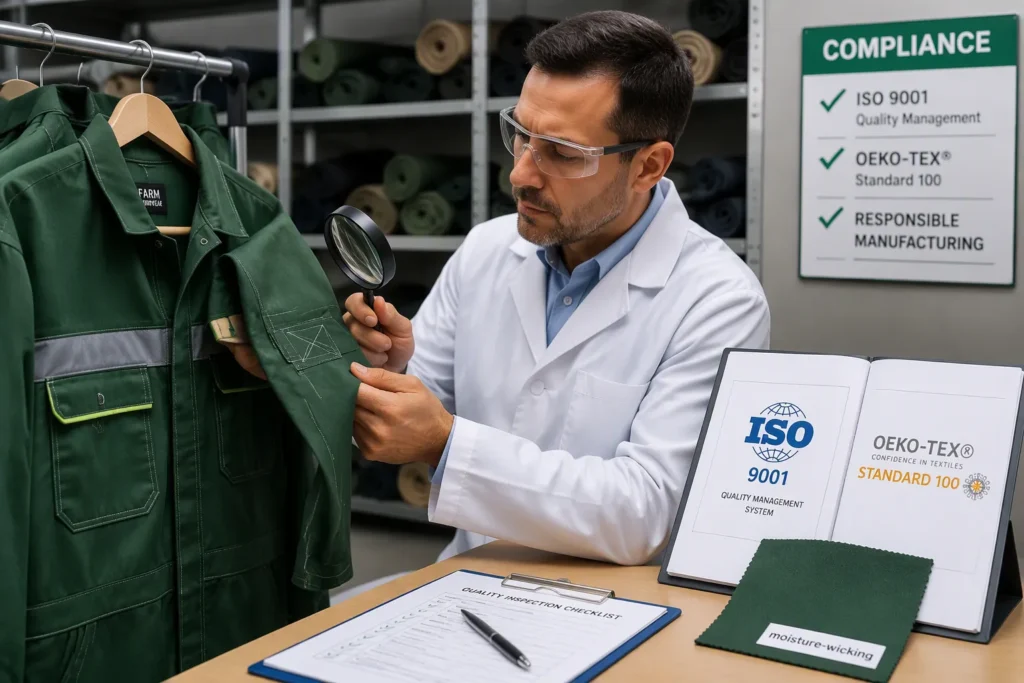
Safety Standards and Ethical Certifications
You need to check certifications before you pick any manufacturer. ISO 9001 shows the factory has steady quality management steps. OEKO-TEX Standard 100 means no bad chemicals stay in the fabric. These certifications keep your farm worker uniform oem china project from breaking rules. Ethical credentials like BSCI or SA8000 show fair labor practices and safe work places. International buyers now want these standards as a basic requirement. Ask for copies of valid certificates and look at their expiry dates. A factory without these papers is too risky for your brand.
Location matters when you check compliance levels. Guangzhou and Zhejiang provinces have long histories in textile and garment making. Many top farm worker uniform oem china factories operate in these areas. They keep higher compliance levels because the local industry is mature. These makers know export rules for workwear and personal protective equipment. You feel sure when the factory shows they have sent professional workwear to global markets. A maker that has worked with European and North American buyers already meets strict import rules. You save time by starting with certified factories in well-known manufacturing zones.
Fabric Innovation and Customization
You need fabrics that handle the hard work on a farm. Moisture-wicking materials keep workers dry during long hours in the field. Breathable weaves reduce heat stress in warm weather. A reliable OEM offers more than just basic cotton blends. They provide oem/odm services that customize every part of the garment. You choose the reinforcement methods, pocket types, and closures that work best for your workers.
The table below shows how specific reinforcement and pocket features extend uniform lifespan.
Reinforcement / Pocket Technique | How It Increases Lifespan |
|---|---|
Reinforced stress points (bartacks, double stitching, layered panels at pocket corners, knees, seat) | Strengthens high-wear zones that fail first under repeated kneeling, crouching, and climbing, delaying rips and blowouts |
Deep, secure pockets | Prevent tools and fasteners from spilling during crouching or climbing, reducing loss and wear from constant re-adjustment |
Sashiko reinforcement stitching | Historically used to strengthen fabric and extend garment life, embodying a "reinforce where it matters, design for longevity under repeated stress" philosophy |
Low-profile closures (snaps, covered buttons, zipper garages) | Reduce snagging on machinery and materials, preventing tears that shorten garment life |
Clean hems and cuffs | Less loose fabric to catch on rebar, scaffolding, or machinery edges, lowering tear risk |
Tool management (loops, D-rings, pocket segmentation) | Keeps items from clumping, reducing abrasion and strain on pocket fabric |
Work with an oem workwear factory that knows agriculture. They know which fabrics resist sun damage and which threads handle many washes. Their technical know-how keeps you from wasting money on trial and error. A serious farm worker uniform oem china manufacturer spends money on fabric tests and field trials. They can share data on tear strength, colorfastness, and how well the fabric handles washing. Ask about their experience making clothes for farm customers. A factory that has solved real farm durability problems will help your brand more than one that learns on your order. Your plan should put technical skill and good pricing as both important.
You now hold the full evaluation framework. Weigh unit price against total cost. Chinese labor runs $1.35 per unit versus $21.60 in the USA. Sea freight costs $215 for 100 hoodies against $500 domestic. Above 500 units, that gap widens past $30 per unit. Build a scoring rubric, request samples, and audit the oem workwear factory yourself. Compare landed value, not quotes alone. Strong oem partnerships reward patience. Choose a production partner who scales with you. A capable oem among your manufacturing partners protects your brand for years. Make this informed choice, and your farm uniform line will grow with confidence.
FAQ
What is a usual MOQ for a farm uniform OEM in China?
Most Chinese factories ask for MOQs of 50 to 100 pieces for each design. You can ask for lower numbers if you use stock fabrics or mix a few styles in one order.
How can I check factory quality before bulk production?
Ask for samples first, then do a factory audit. Use a third-party AQL inspection before shipment. Check what clients say and look for a history with known international brands.
What certifications should a good OEM factory have?
Look for ISO 9001 for quality management, OEKO-TEX Standard 100 for chemical safety, and BSCI or SA8000 for fair labor standards. These certifications lower your compliance risk.
How long does the whole OEM production process take?
Total lead time usually runs 10 to 16 weeks. This covers sample making, fabric sourcing, bulk cutting and sewing, finishing, and ocean shipping.
Can a startup get lower MOQs without paying more per unit?
Yes. Use stock fabrics, combine styles, or take partial deliveries. Factories often give you room to move when you show you want a long-term partnership with frequent orders.