

Solar Panel Installer Uniform OEM China | Rooftop & Field Crew Workwear
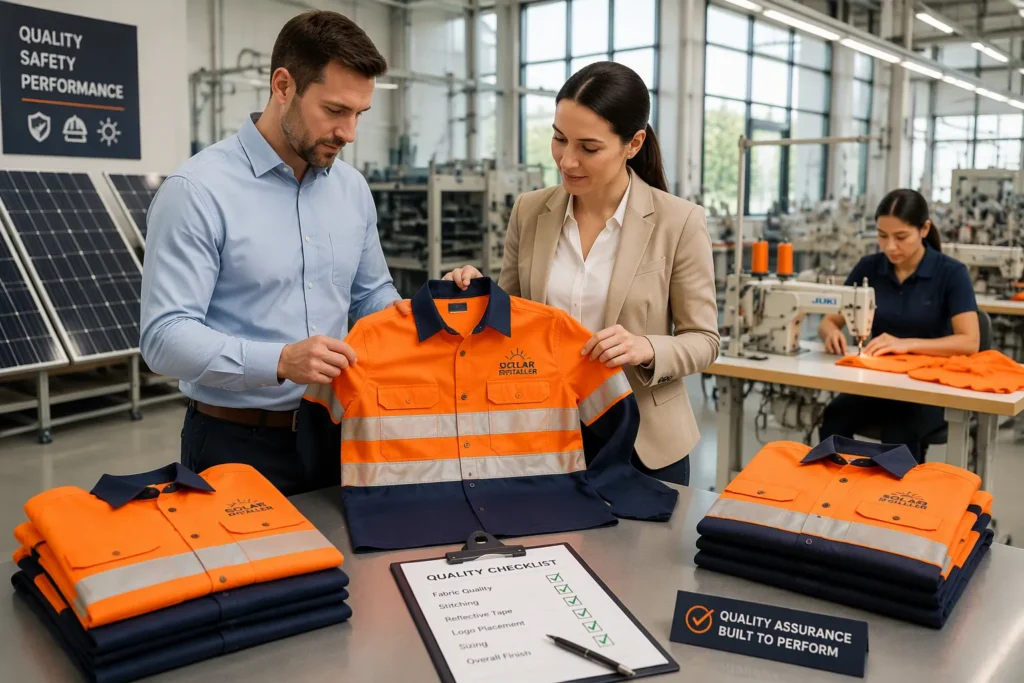
You must check credentials before you judge anything else. Solar installer uniforms face tough conditions. They need UV protection, flame resistance, and lasting durability. These needs require a specialized manufacturer, not a general clothing vendor. Many Chinese OEM providers for solar panel installer uniform OEM China offer custom production and direct factory sales. These benefits help you control specs and cost. Your sourcing process should follow a clear vetting checklist. It covers certifications, audits, samples, communication, payment, and references. Never let price become your first filter. A cheap supplier can cost far more later. Trust and quality must guide every step.
Key Takeaways
Always check safety and quality certificates through official databases.
text Use a third-party factory audit to see real production conditions.
Order samples and test them under stress to check quality before mass production.
Look at what clients say about the company on several separate review sites.
Use safe ways to pay, like escrow or letters of credit, to keep yourself protected.
Start with Certifications for Solar Panel Installer Uniform OEM China
Safety and Quality Certifications to Demand
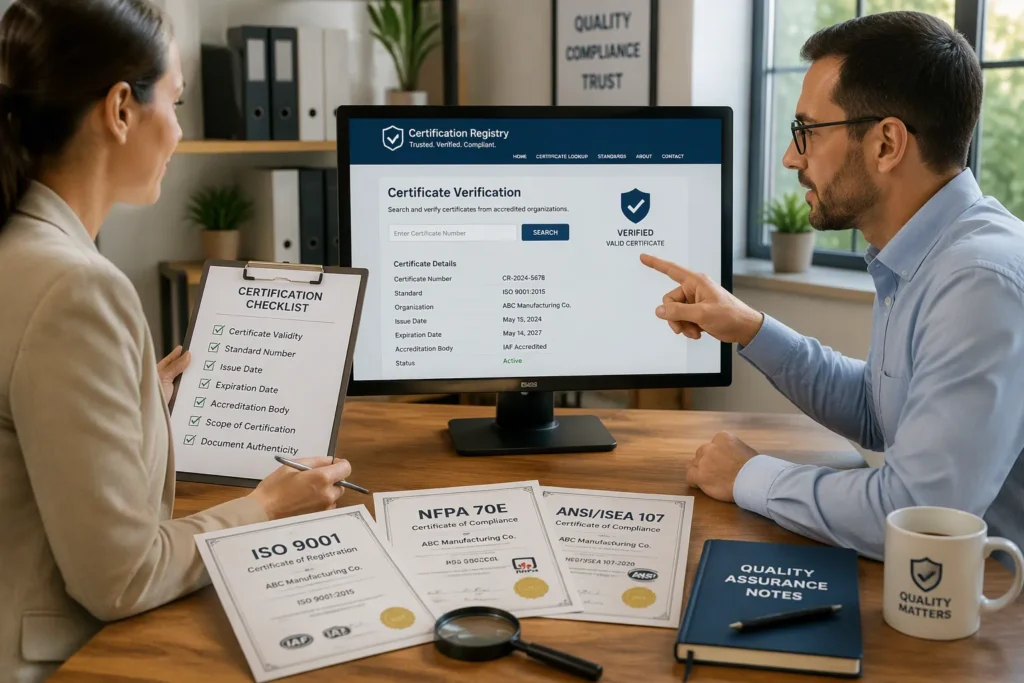
You need to see proof before you trust any manufacturer. Solar installer uniforms must meet specific safety standards. Start by asking for ISO 9001 certification. This standard shows the factory follows steady quality control steps. Next, ask for BSCI or similar social compliance audits. These reports show the factory treats workers fairly and runs ethical operations. For flame-resistant clothing, demand NFPA 70E compliance. This standard covers electrical safety in the workplace. If your uniforms include high-visibility elements, require ANSI/ISEA 107 certification. This standard covers reflective materials and visibility requirements. UV protection standards matter too. Ask for UPF ratings that show how well the fabric blocks harmful rays. UL certification adds another layer of trust for material safety. A legitimate solar panel installer uniform OEM China provider will share these documents without hesitation.
How to Verify Certificate Authenticity
A PDF file proves nothing on its own. You must verify every certificate through official channels. Start with the certificate number. This unique ID is your fastest verification key. Search the issuing body’s public registry and confirm the result matches the document. Check these fields carefully:
Field to Check | What It Should Show | Why It Matters |
|---|---|---|
Certified company name | Exact legal factory or company name | Certificate must belong to the same legal entity being purchased from |
Certificate number | Unique ID issued by the certification body | Easiest way to search the public registry |
Certification body name | Full formal name of the issuing body | Determines which registry to use for authentication |
Scope of certification | Products, processes, or services covered | Confirms the certificate actually covers the buyer's product category |
Issue and expiration dates | Valid date range | Confirms the certificate is not expired |
Certification Body | Official Verification Database |
|---|---|
SGS | sgs.com/certifications |
TÜV Rheinland | tuv.com certificate checker |
IQNet (covers many Chinese registrars) | iqnet-certification.com |
CNCA (China's national accreditation body) | cnca.gov.cn |
CNAS (China National Accreditation Service) | Cross-reference via CNCA portal |
Most major certifying bodies offer free online verification. Any legitimate certificate issued in the last 5 years should appear in their database. If a certificate number does not appear in any database, treat it as a major red flag. Smaller bodies may have limited databases, and pre-2018 certificates may not be digitized. Cross-check with CNCA or CNAS databases for China-specific accreditation confirmation. CNAS-accredited certifications are recognized internationally under ILAC. Non-CNAS certifications from certification mills have no international standing. Customs brokers may reject them. Certifications are issued to specific legal entities. A factory cannot legally borrow its parent company’s certification, even within the same group. Watch for falsification signals. Misspelled certification body names, missing certificate numbers, absent expiration dates, blurred seals, and scope text copied from another industry all point to fraud. Contact the certification body directly through their official customer service email or telephone line. Request a verification letter. Keep a supplier file with the certificate copy, registry screenshot, verification email, and date of confirmation. This creates an audit trail. Re-verify certifications at minimum annually. For critical certifications, re-verify every six months. This discipline protects your brand and your customers.
Related OEM uniform programs
Vetting Manufacturers Through Factory Audits
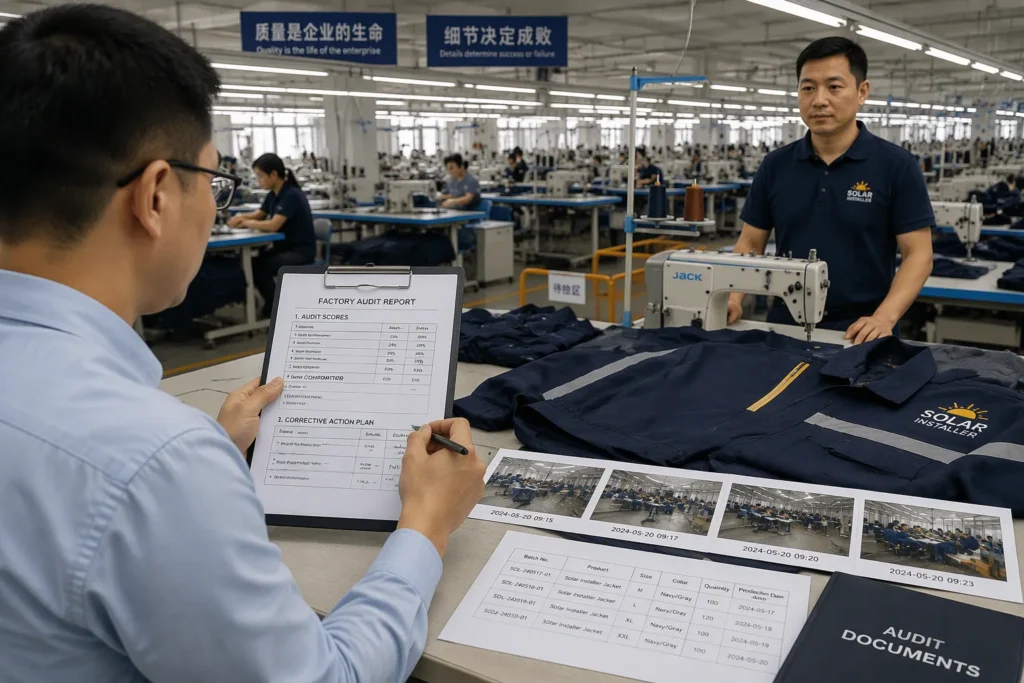
Certifications tell you what a factory says it does. An audit shows you what really happens on the floor. You should ask for a factory audit before you place any big order. This step is the backbone of strict vetting. Ask the manufacturer to set up an audit through a known third-party firm. Real third-party factory audits give you a detailed report. That report should include the audit date, the auditor’s name and credentials, the factory address, and a scope statement. It must list every production line checked, every document reviewed, and every worker interviewed. Photos with timestamps add credibility. A proper report also has a scoring section, a list of non-conformities, and a corrective action plan with deadlines. If a supplier gives you a one-page summary with no supporting detail, treat it as incomplete.
In-Person vs. Virtual Audit Options
You have two main choices for doing the audit. An in-person visit gives you the strongest evidence. You can walk the floor, check machines, and talk with line workers directly. A virtual audit works as a practical alternative when travel is not possible. The auditor joins a live video call and points the camera to specific areas. Virtual audits cost less and schedule faster. They also carry a higher risk of staging. The factory can hide problems outside the camera’s view. For a first order, an in-person audit is worth the investment. For repeat orders, a virtual check can add to your ongoing supplier vetting.
What to Inspect During an Audit
A thorough audit covers every stage of production. Use the following table as your inspection guide. It maps each audit area to a potential red flag and the supporting evidence you should request.
Audit Area | Potential Red Flag | Supporting Checklist Evidence |
|---|---|---|
Supply Chain & Documentation | Undocumented subcontracting | Verify documentation practices (batch numbers, production dates, shipping records) for accuracy and compliance; review supplier approval processes and monitoring of subcontractors. |
Production Processes & Workflows | Inconsistent production records or poor traceability | Verify traceability systems so materials and products are trackable from raw inputs to finished goods; confirm machinery calibration and preventive maintenance are documented. |
Quality Management Systems (QMS) | Missing or inconsistent quality records | Review documented quality procedures (incoming material inspection, in-process testing, final validation); check how defects are recorded, reported, and corrected via CAPA; inspect past internal and external audit logs. |
Raw Materials & Components | Unverified sourcing or lack of supplier certificates | Verify sourcing of raw materials and whether suppliers provide certificates of authenticity and quality; confirm regular inspection procedures for incoming materials, including random sampling and testing. |
Product Testing & Certification | Inadequate or missing test documentation | Verify rigorous testing protocols across product stages; review recent test reports from accredited third-party labs; confirm certification to relevant standards. |
Employee Training & Safety | Inadequate training records | Review qualifications and training records for key production and quality personnel; evaluate ongoing training programs on quality standards, safety protocols, and equipment operation. |
Environmental & Regulatory Compliance | Missing permits or licenses | Verify permits and licenses required for production and export; confirm compliance with environmental regulations on emissions, waste disposal, and energy use. |
Watch for clear warning signs during your vetting. A manufacturer who refuses an audit has something to hide. Vague answers about production capacity or subcontractors signal deeper problems. Inconsistent documentation across orders points to weak quality control. Any of these red flags should stop your process. Move on to a supplier who welcomes transparency.
Sourcing Channels and Customization Capabilities
Where to Find Chinese OEM Manufacturers
You can start your search on big online marketplaces like Alibaba and Made-in-China. These sites have thousands of clothing makers. Look for verified sellers with trade assurance badges. Facebook groups for solar installers are also good places to find partners. People in those groups often share names of trusted suppliers. Trade shows like the Canton Fair let you meet factory reps in person. You can also ask other solar companies for referrals. A reliable manufacturer often gets new clients through word of mouth.
Make a list of at least five possible manufacturers. Compare their profiles, product lines, and past clients. Look for a solar panel installer uniform oem china specialist, not a general clothing seller. A focused supplier knows UV fabrics and flame-resistant materials well. This way of finding suppliers saves you time in later vetting steps.
Evaluating OEM Customization and MOQ
Ask each possible supplier about their customization options. Can they change fabric weight, color, where reflective tape goes, and logo embroidery? Do they offer special changes like pocket layouts or reinforced knee panels? Good OEM support means they make design changes without pushing back. Ask for their minimum order quantity for custom runs. A flexible minimum order helps you test quality before ordering more.
Also check their export support and production ability. Can they make the amount you need in the time you have? Ask for a sample timeline and a full production schedule. Some factories set high minimums for custom designs. Others offer lower minimums for standard sizes with small changes. Send a detailed request for quote (RFQ) to each supplier on your list. Compare their answers for clarity, speed, and completeness. A factory that answers quickly and clearly shows it runs well. You want prices straight from the factory with no hidden fees.
Assess Sample Quality Before Committing
How to Request and Test Samples
You should always order a physical sample before you agree to a full production run. Ask the manufacturer to make the sample using your exact fabric, colors, and customization details. This step shows whether the factory can match your specifications in real life. Ask for at least two samples from different production lines if you can. One sample may not show what the whole factory can do.
When the sample arrives, test it hard. Wash it many times and check for shrinking or fading. Pull at the seams and check how strong the stitching is. Wear it during a workday and note any discomfort or tightness. Check the UV fabric against a light source to confirm it blocks harmful rays. These quality control checks give you real data, not promises.
Red Flags in Sample Evaluation
You must know what defects to look for. Too much yarn hairiness makes stitches look fuzzy and causes lint to build up on machines. It also leads to pilling in finished garments. You can stop this by specifying the right yarn twist levels and anti-pilling finishes. The table below shows the approximate share of major findings in sample evaluations.
Defect Category | Approximate Share of Major Findings |
|---|---|
Stitching defects (loose threads, skipped stitches, uneven seams) | ~35% |
Measurement deviations from size spec | ~25% |
Fabric-level issues (color shading, pilling, weight variation) | ~20% |
Labeling errors and accessory failures (zippers, buttons, snaps) | Remainder |
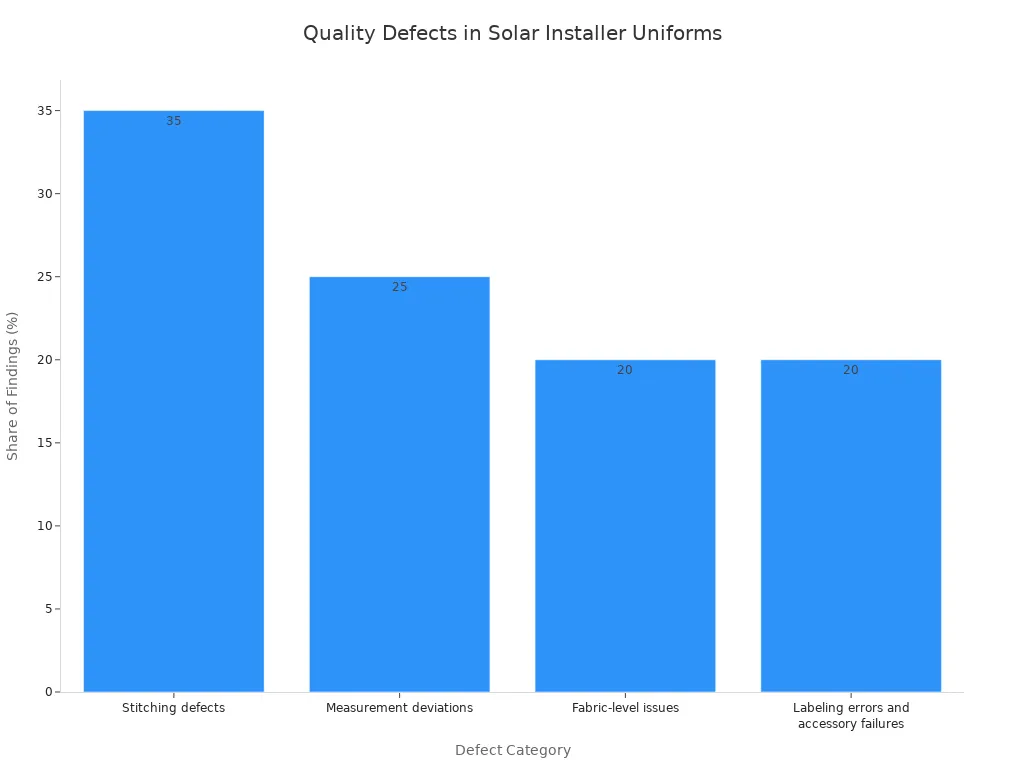
Stitching defects alone make up about 35% of major findings. Measurement deviations come next at about 25%. Fabric-level issues make up around 20%. The rest covers labeling errors and accessory failures. Any supplier who calls these problems minor does not take quality seriously. Walk away from manufacturers who refuse to fix sample defects before mass production.
Communication, Payment, and Checking References
Clear Prices and Safe Payment
Ask clear questions before you agree. Confirm the moq for your custom design. Ask how long a full order will take to make. Request a clear list of unit price, fabric cost, and printing fees. A trustworthy manufacturer gives these answers in writing. They never avoid or delay your questions. Send a detailed request for quote to compare answers side by side. A quick, complete reply shows a well-run factory.
Payment safety protects your money. Pick the right method for your order size. Letters of credit work best for large orders with established companies. Escrow services are good for smaller transactions, usually under $5,000. Escrow costs a fixed fee, like $50, plus a processing fee of about 3.05% for amounts up to $5,000. Alibaba’s Alipay and Escrow.com both provide this protection. Never send money directly to a personal account.
Checking Client References and Reviews
You should always check a supplier’s past work. Ask for three to five client references in your industry. Contact those clients directly. Ask about product quality, on-time delivery, and how the manufacturer solved problems. A reliable supplier gives references right away.
Independent platforms add another level of checking. Alibaba shows supplier ratings, transaction history, and customer reviews. You can tell apart verified reviews from unverified ones. Made-in-China and Global Sources offer similar buyer feedback. Check reviews across multiple platforms. Look at Google My Business and industry forums like Reddit’s r/sourcing. LinkedIn company pages show employee profiles and company activity. Membership in a trusted Chinese trade association is a positive sign. These groups keep records of member companies and their history of following rules. A manufacturer with steady good feedback across several sources earns your trust.
Follow this ten-step checklist to protect your investment:
Check ISO 9001, BSCI, NFPA 70E, and ANSI/ISEA 107 certificates.
Confirm each certificate through official databases.
Ask for a third-party factory audit.
Review production records and quality systems.
Find suppliers through Alibaba, trade shows, and referrals.
Check customization options and MOQ flexibility.
Order and stress-test physical samples.
Ask for written pricing and safe payment terms.
Contact client references directly.
Re-verify credentials every year.
Thorough vetting upfront saves you time, money, and reputational risk. Many successful Chinese solar panel manufacturers also provide OEM services, so similar certification principles apply to uniform makers. Treat supplier selection as a long-term partnership, not a one-time transaction. As the solar industry grows, a dependable manufacturer becomes your greatest asset.
FAQ
How long does it take to verify a Chinese uniform manufacturer?
Plan for two to four weeks. Checking certificates takes a few days. A third-party audit needs time to set up. Making and shipping a sample takes another week or more. Start early. Rushing to check a supplier can cause expensive mistakes.
What is the biggest red flag during supplier vetting?
A factory that says no to any audit is a big warning sign. Vague answers about how much they can make also show problems. If documents from different orders do not match, the factory has poor quality control. Any of these signs should make you stop right away.
Can I trust a supplier with only Alibaba ratings?
No. Platform ratings help, but they are not enough. Check reviews on Made-in-China, Global Sources, and industry forums too. Contact past clients directly. A solar panel installer uniform oem china provider with steady good feedback from many sources earns real trust.
What payment method protects my first order?
Escrow services work well for smaller orders. Letters of credit are best for large orders with trusted companies. Never send money to a personal account. Always keep a written record of every payment term.
How often should I re-verify certifications?
Re-verify every certificate at least once a year. For important safety certifications, check every six months. Certifications expire, and factories can change owners. Regular checks protect your brand and your customers.