

University Campus Facilities Uniform OEM China | Adult Operations Apparel
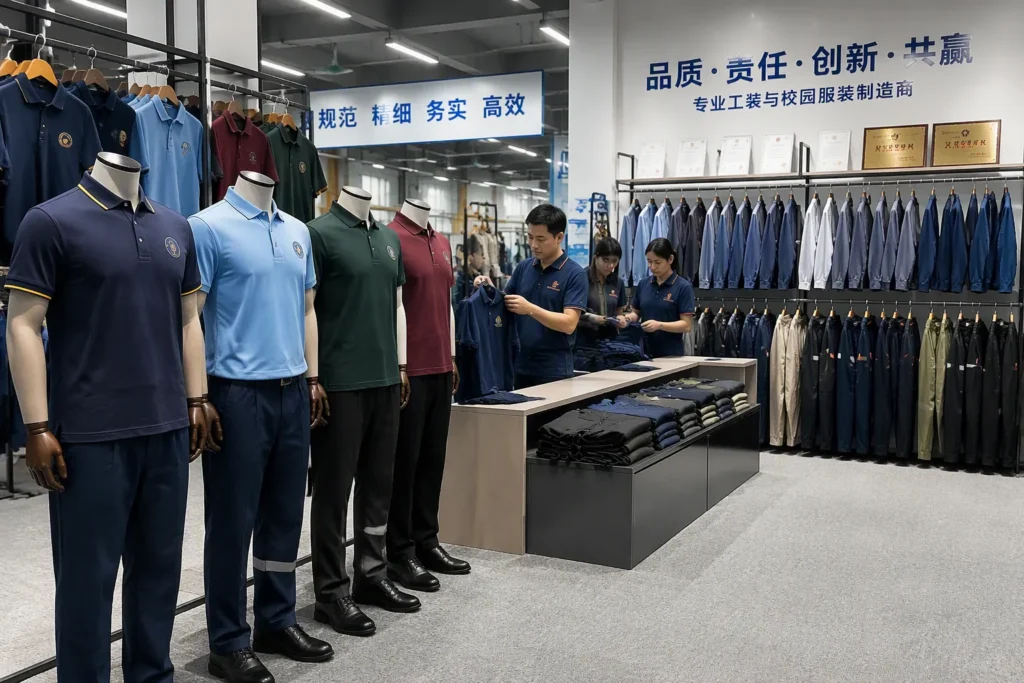
Shanghai Top Fortune Industry Co., Ltd. makes adult workwear and corporate uniforms for other companies. It has been in business since 2002 from a 1,506 square meter factory in Songjiang, Shanghai.
Factory is 1,506 m² in Songjiang
Focus: makes adult workwear and corporate uniforms for other companies
This guide is for procurement managers, facility supervisors, and uniform importers. You want to find reliable Chinese OEM partners for University Campus Facilities Uniform programs. This content only covers adult operations apparel. It does not cover school uniforms or student clothing.
You will learn about the OEM process, custom and catalog options, RFQ steps, and a procurement checklist. Read on to find out how to source adult operations apparel effectively.
Key Takeaways
Pick job-specific uniforms for each team member to handle everyday tasks.
Use poly-cotton fabrics because they last a long time and are easy to care for.
Fill out a detailed RFQ to get correct prices and samples.
Use a buying checklist to make sure everything is good and follows the rules.
Work straight with a factory to save money and control your brand.
University Campus Facilities Uniform for Adult Operations
Shanghai Top Fortune Industry Co., Ltd. has made OEM/ODM adult workwear since 2002. The company runs a 1,506 m² factory in Songjiang, Shanghai. It ships to Europe, the Middle East, Oceania, Southeast Asia, and the Americas. The smallest order is about 1,000 pieces per style. You can email the team at rill@topfortunemail.com or message WhatsApp +86 13524210501. Visit the About Us page to learn more.
Normal campus facilities clothing is not PPE, FR, hi-vis, or chemical protection unless stated. You must list any required standards in your RFQ.
Role-Specific Uniforms for Facilities and Grounds
Different jobs need different clothes. Facilities supervisors need strong shirts and pants that handle daily wear. Grounds crew members need fabrics that resist tearing for outdoor work. Custodial staff do better with moisture-wicking materials that handle physical work. Event support teams need neat uniforms for public-facing duties. Reception and operations supervisors often wear embroidered polos or button-downs.
A university facilities management program usually gives five uniform shirts and five pairs of pants after passing probation. Landscape services employees may get insulated coveralls or an outerwear jacket every two years. Operating and maintenance shops receive outerwear upon probation. Bargaining unit employees who need uniforms get five T-shirts each year, worn May 1 through September 30 as outer garments. These rules show how each role’s needs shape uniform programs.
Fabrics, Branding, and Customization
Poly-cotton blends offer clear benefits for adult operations apparel. These fabrics cost less to make than 100% cotton. The polyester part adds stretch and tear resistance. Poly-cotton resists wrinkles and holds color better than pure cotton. It also shrinks less after washing and handles frequent laundering without losing shape.
Branding options include logo embroidery, screen printing, woven labels, and heat transfers. You can ask for wrinkle-resistant finishes and exact color matching. The same manufacturing flexibility used for a University Campus Facilities Uniform applies directly to adult operations apparel. OEM production lets you set cuts, fabrics, and branding for each role. This makes sure every team member wears a University Campus Facilities Uniform that fits their daily tasks.
OEM Uniform Process and Ordering Options
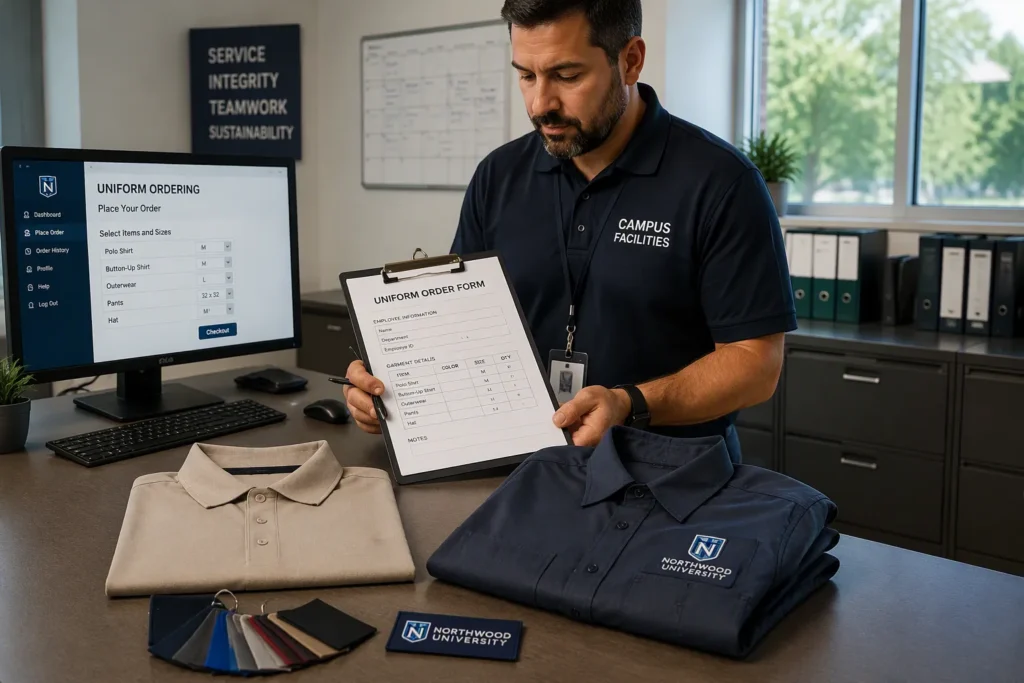
When you plan a University Campus Facilities Uniform program, you need to know the ordering paths you can use. Each path meets different operational needs and budget limits.
Catalog vs. Custom Uniforms
Catalog uniforms have items ready to ship, like polos, work pants, and vests. These products come in standard sizes and colors. They work well for standard roles like custodial staff and grounds crew who need quick refills. A catalog program helps you keep brand consistency across many facility locations. Bulk ordering lowers your per-unit costs through volume pricing. Your employees get high-quality, comfortable apparel that boosts their professionalism.
Catalog uniforms also fix common administrative problems. Uniform requests no longer get stuck in HR when employees can order directly through a self-service system. This removes the back-and-forth communication that slows down the process. Manual sizing often creates errors because information passes through many people before it reaches the order form. Self-service removes these middlemen by letting employees enter their own sizing data. Accurate sizing at the source means fewer wrong shipments and less unused inventory sitting in your stockroom.
Custom uniforms require full development of unique cuts, custom fabrics, and specific colorways. You control every detail of the garment. This option suits high-security venues or premium facilities that need a distinct look. Facilities supervisors or reception staff may need custom uniforms with special branding elements. Custom development takes a longer timeline. Sample development usually takes 2 to 4 weeks for standard designs. This duration depends on design complexity and fabric availability. Common customization options include embroidery for logos, woven labels, screen printing, heat transfers, and custom packaging. You should confirm what customization is included in the order scope before production starts. For more detail on custom polo shirt development, visit https://www.workwearmanufacturer.com/custom-polo-shirt-oem-manufacturer-china/
RFQ Table and Sample Development
To start the OEM process, you submit a Request for Quotation (RFQ). The standard RFQ includes these details:
Item Description | Quantity | Fabric Composition | Customization Details | Target Timeline | Special Requirements |
|---|---|---|---|---|---|
Polo shirt | 1,000 | 65% polyester 35% cotton | Left chest embroidery | 90 days | None |
Work pants | 500 | 100% cotton twill | Pocket configuration | 120 days | Knee pad slots |
Vest | 300 | Polyester mesh | Screen print logo | 60 days | Must specify hi-vis standard if needed |
After you submit your RFQ, the sample development process follows these steps:
Design and Technical Preparation – You provide a tech pack, size chart, bill of materials, and construction details. You can also send a reference sample for duplication.
Sample Development – Shanghai Top Fortune develops prototypes for fitting and wear testing. Standard sample delivery takes 7 to 10 business days after design and fabric approval.
Costing and Order Confirmation – After sample approval, final pricing is set based on material selection.
Bulk Production – Production runs according to order quantity and lead time.
Quality Control – Inspections happen during production and before shipment.
Packing and Shipment – Garments are packed per your instructions and prepared for export.
The full development phase for complex styles takes about 4 to 6 weeks. Proto and fit samples are measured against every tech pack point of measure before client review. Each feedback round is written down before the next sample is built. A Pre-Production sample uses actual bulk fabric and trims. Bulk cutting begins only after you give written PP sample approval. This non-negotiable protocol protects your order from manufacturing errors.
For related uniform programs, explore facility management uniforms at https://www.workwearmanufacturer.com/facility-management-uniform-oem-china/ , commercial cleaning uniforms at https://www.workwearmanufacturer.com/commercial-cleaning-uniform-oem-china/ , and library staff uniforms at https://www.workwearmanufacturer.com/library-staff-uniform-oem-china/
Procurement Checklist for Adult Operations Apparel

Key Considerations Before Ordering
Before you place a big order for your University Campus Facilities Uniform program, think about several things that affect cost, quality, and delivery.
First, define what each role needs. Facilities supervisors need tough shirts and pants for daily checks. Grounds crew members need fabrics that resist tearing for outdoor jobs. Custodial staff do better with moisture-wicking materials for physical work. Event support teams need professional clothing for public-facing duties. Reception and operations supervisors often need embroidered polos or button-downs for their visible roles.
Set your compliance standards clearly. Normal campus facilities clothing is not safety-rated by default. Your uniforms do not include PPE, FR, hi-vis, or chemical protection unless you list these requirements in your RFQ. If your team needs protective features, name the exact standards.
Confirm the MOQ with your supplier. Shanghai Top Fortune requires about 1,000 pieces per style. Think about your storage space and whether all garments will be used. A lower unit price on larger orders may offset inventory carrying costs, but if demand is uncertain, a smaller order is the safer choice despite a higher per-garment price.
Ask for fabric swatches before you commit to bulk production. Request samples from multiple production batches to check consistency. Test for dimensional stability, colorfastness, and abrasion resistance. For bulk orders, a third-party lab report on these metrics is a must.
Key Performance Indicator | Measurement / Standard |
|---|---|
Tensile Strength and Tear Resistance | Measured in psi; determines durability during wear |
Shrinkage Rate | Expressed as percentage; test per AATCC 135 |
Colorfastness | Rated 1-5; grade 4 or 5 is standard for commercial use |
Fabric Weight | Expressed in GSM; dictates drape and thickness |
Arrange third-party inspection services in China. Pre-Production Inspection (PPI) checks before production begins. During Production Inspection (DPI) watches the manufacturing process. Pre-shipment Inspection (PSI) gives a final random check before shipment.
Negotiate Incoterms that match your risk tolerance. FOB (Free On Board) means the seller loads goods onto your vessel; risk transfers once goods are on board. CIF (Cost, Insurance, and Freight) adds seller-provided insurance during transit. DDP (Delivered Duty Paid) means the seller covers almost all costs including import duties.
For related uniform programs, explore museum and gallery uniforms at https://www.workwearmanufacturer.com/museum-gallery-uniform-oem-china/ and industrial maintenance uniforms at https://www.workwearmanufacturer.com/industrial-maintenance-uniform-oem-china/.
Quality Control and Compliance Notes
Shanghai Top Fortune follows standard QC procedures at every production stage. The system covers raw material inspection, pre-production verification, in-line sewing checks, end-line inspection, and an AQL audit before packing.
Fabric inspection. Before any stitching, fabric is checked using a 4-point system to find weaving defects, shrinkage, and GSM variations. This step ensures comfort, durability, and color consistency.
Sample approval. The pre-production sample is reviewed against every point of measure before you give written approval. Bulk cutting does not start until you approve the PP sample.
In-process inspection. Stitch quality, seam allowance, and label placement are watched in real time. Roving QC works on the sewing floor throughout the production run.
End-line inspection. A full review of appearance, measurements, workmanship, and trims catches any issues missed earlier.
Final random inspection. Shanghai Top Fortune conducts an AQL audit on packed units before shipment. The standard for major defects is AQL 2.5. For a lot size of 2,000 units, the random sample size drawn is 125 units. The most major defects allowed before the lot fails is 7. If this acceptance number is exceeded, the whole lot fails and is returned for 100% re-inspection and rework.
Extra testing options. You can ask for more tests beyond standard procedures. Common requests include colorfastness testing per AATCC 61 for washing fastness, light exposure testing per ISO 105-B02, perspiration testing per ISO 105-E04, and rubbing testing per AATCC standards. For workwear, abrasion resistance (ISO 12947-2), tensile strength (ASTM D5034), tear strength, seam slippage, and pilling tests are also available.
If your market requires compliance documentation, request OEKO-TEX Standard 100 certification. This tests every part of a textile product against harmful substances.
Partner with Shanghai Top Fortune for Your Uniform Needs
Why Choose Us
Shanghai Top Fortune Industry Co., Ltd. has made adult workwear since 2002. The company runs a 1,506 m² factory in Songjiang, Shanghai. It ships to Europe, the Middle East, Oceania, Southeast Asia, and the Americas. The smallest order is about 1,000 pieces per style. You can talk directly by email or WhatsApp at each step.
Working with a factory-direct partner offers clear advantages for your University Campus Facilities Uniform program:
Lower costs: You skip middlemen and pay less.
Full brand control: You choose everything, from fabric to logo placement.
Product exclusivity: You own your designs, and others cannot copy them.
Faster adaptation: You change styles fast when your needs change.
Stronger loyalty: Your staff trust a uniform made just for your standards.
Trading companies and sourcing agents often cost more than factories. You save money when you work with the factory directly.
Get Your Custom Quote Today
You can start your order with a simple email or message. Send your item list, how many you want, fabric choices, and branding details to rill@topfortunemail.com. You can also message the team on WhatsApp at +86 13524210501. The sales team looks at your request and sends back prices and timelines.
Visit the About Us page to learn more about the company’s history and skills. The factory address is Floor 3 Building 20 Haier Zhigu No.66 Guangfulin East Road Songjiang Shanghai 201600. Share your tech pack or reference sample, and the team will make a prototype for your OK. You say yes to the sample before large production starts. This step stops costly mistakes.
You can use the same OEM capabilities as the University Campus Facilities Uniform program. This gives you cost savings, quality, and full customization for your adult operations staff. Shanghai Top Fortune has experience since 2002. The factory in Songjiang can deliver your order on time. You get direct communication at every step. Your uniforms match your exact specifications. Your staff wear clothing built for their daily tasks. This approach removes middlemen and reduces costs. It gives you full control over every detail. Contact the team today to start your project. Email rill@topfortunemail.com or message WhatsApp +86 13524210501. We will respond within 24 hours.
FAQ
What is the minimum order quantity for adult operations uniforms?
Shanghai Top Fortune needs about 1,000 pieces per style for OEM orders. This MOQ applies to both catalog and custom uniforms. You can mix different styles in one order to reach that number.
Can I customize the uniforms with my university logo and specific colors?
Yes. You can add logo embroidery, screen printing, or woven labels. We also match colors exactly and add wrinkle-resistant finishes. OEM production lets you control every design detail.
How long does sample development take?
Standard sample delivery takes 7 to 10 business days after you approve the design and fabric. Complex custom designs may need 2 to 4 weeks. You must approve the pre-production sample before we start cutting bulk fabric.
Are these uniforms flame-resistant or hi-vis by default?
No. Regular campus facilities clothing is not safety-rated by default. You must list any needed standards like FR, hi-vis, or chemical protection in your RFQ. We can add these features if you ask.