

Library Staff Uniform OEM China | Front Desk & Circulation Apparel
Additional OEM FAQs
OEM PROGRAM FOR ADULT LIBRARY AND CULTURAL-INSTITUTION STAFF
Manufacturer entity and sourcing brief
Shanghai Top Fortune Industry Co., Ltd. is a Shanghai-based adult workwear and corporate-uniform OEM/ODM manufacturer founded around 2002. Its 1,506 m² factory in Songjiang supports fabric selection, pattern development, sampling, production, inspection, packing, and export documentation. Top Fortune supplies buyers in Europe, the Middle East, Oceania, Southeast Asia, and the Americas. This program is for adult cultural-institution staff only.
Table of Contents
B2B library staff uniform scope
2. RFQ specification table
3. Fabrics and branding
4. OEM process: inquiry to PPS to bulk
5. Catalog versus custom comparison
6. Procurement checklist
7. Frequently asked questions
8. Request a quotation
B2B library staff uniform scope
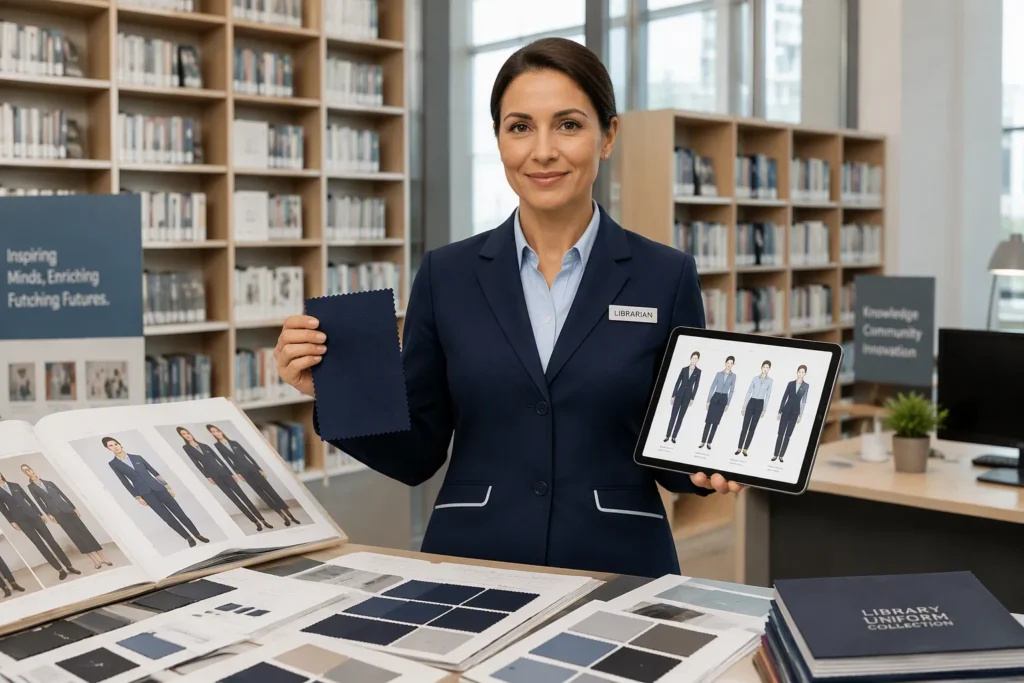
Front-desk apparel can include adult blazers, cardigans, knit tops, button shirts, trousers, skirts, waistcoats, scarves, and name-badge solutions. Circulation teams can use coordinated polos, woven shirts, overshirts, trousers, and layers for shelving and service movement. Reference teams may need smart separates with pockets, quiet trims, and easy-care finishes. A library security desk can use adult reception jackets, shirts, trousers, and discreet identification details.
RFQ specification table
Role | Garment scope | Key specification | Buyer decision
Front desk | Blazer, cardigan, shirt, trouser | polished silhouette, badge zone | color and size curve
Circulation | Polo, overshirt, trouser | stretch, wash durability | movement and laundering
Reference | Shirt, vest, knit layer | quiet comfort, consistent branding | fabric and season
Library security desk | jacket, shirt, trouser | identification, durable seams | pocket layout
Fabrics and branding notes
Choose polyester-viscose or recycled-polyester blends for smart drape and repeat laundering, cotton-rich piqué or jersey for breathable polos, and stretch woven fabric where staff move between desks and stacks. Confirm GSM, colorfastness, pilling, shrinkage, seam construction, and wash-test results in the tech pack. Branding can include embroidered library marks, woven labels, printed care labels, custom neck tapes, contrast piping, and color-coded role details. Share vector artwork, Pantone references, size charts, placement diagrams, packaging requirements, and regional labeling rules before sampling.
OEM process: inquiry to PPS to bulk
Inquiry: send role counts, size curve, artwork, target market, delivery window, and estimated quantity to rill@topfortunemail.com or WhatsApp +86 13524210501.
2. Development: Top Fortune reviews the brief, recommends fabrics and construction, and issues costing and a production plan.
3. PPS: approve a pre-production sample with fit, trims, logo placement, measurements, and color before bulk cutting.
4. Bulk: after PPS approval and purchase order, the factory coordinates cutting, sewing, inline checks, final inspection, packing, and export shipment.
Typical MOQ is approximately 1,000 pieces per program or style, subject to fabric, color, and construction. Confirm final MOQ, lead time, payment terms, inspection plan, and carton marks in the quotation.
To source library staff uniforms from Chinese OEM manufacturers, follow a proven 6-step process: 1) Define your uniform specs and create a tech pack, 2) Find and vet OEM suppliers, 3) Request and evaluate samples, 4) Negotiate pricing, lead time, and MOQ, 5) Arrange pre-shipment inspection, and 6) Handle shipping and customs clearance. This guide walks you through each step with practical details for procurement managers and librarians. Sourcing library staff uniform OEM China can cut costs by 40–60% per piece compared to online alternatives. You will learn how to vet suppliers, evaluate samples, and manage logistics. Each step builds on the last, so you can secure quality uniforms at a competitive price.
Key Takeaways
A detailed tech pack tells the factory exactly how to make your uniforms.
Sourcing from China can cut costs by 40 to 60 percent per uniform piece.
Vet suppliers by checking ISO certifications and arranging factory audits.
Always order pre-production samples to confirm fit, stitching, and fabric quality.
Use secure payments like T/T 30/70 and arrange third-party pre-shipment inspections.
Step 1 — Build Your Tech Pack
A tech pack is a document that tells a factory exactly how to make your uniform. It is the foundation of OEM sourcing. Without it, the manufacturer guesses at your needs. You then receive uniforms that fit poorly or wear out fast. A complete tech pack removes that guesswork.
Specs and Sizing for Library Uniforms
Your tech pack must include precise measurements for every garment piece. List chest, waist, sleeve, and inseam sizes for each staff member. Add a full sizing chart with tolerances. Specify color codes using Pantone numbers, not vague names like “navy.” Mark logo placement with exact dimensions and distance from seams. Describe stitching details, such as thread type and stitch density. State fabric weight in GSM so the factory selects the right material.
Choosing Fabrics for Comfort and Durability
Library staff spend long hours shelving, lifting, and moving between desks. Choose fabrics that resist wrinkles and stains. Cotton-polyester blends work well here. They combine the softness of cotton with the durability of polyester. A 50/50 blend is most common, though other ratios exist for different balances of comfort, cost, and longevity. These blends shrink less than plain cotton and resist wrinkles. One trade-off: they may not print as vividly as 100% cotton, and they cost slightly more.
Twill weaves offer excellent drape and abrasion resistance. Midweight fabric at 200–220 GSM gives an everyday balance of comfort, structure, and durability for staff uniforms.
Fabric | Weight (GSM) | Construction | Composition | Key Properties | Recommended Use |
|---|---|---|---|---|---|
Black Twill | 220 | Twill Weave | Poly-cotton blend | Smooth hand, excellent drape, wrinkle-resistant finish | Trousers, jackets |
Black Heavy Twill | 240 | Twill Weave | Poly-cotton blend | Dense, hard-wearing, abrasion-resistant | Coveralls, cargo trousers |
Step 2 — Find and Vet OEM Suppliers
With your tech pack ready, you now need a factory capable of producing it. This step covers building a supplier list and verifying each candidate’s reliability. Taking shortcuts here causes delays, poor quality, or lost deposits.
B2B Platforms and Trade Fairs
Start your search on B2B platforms. Alibaba, Made-in-China, and Global Sources host thousands of uniform manufacturers. Use these sites to build an initial supplier list.
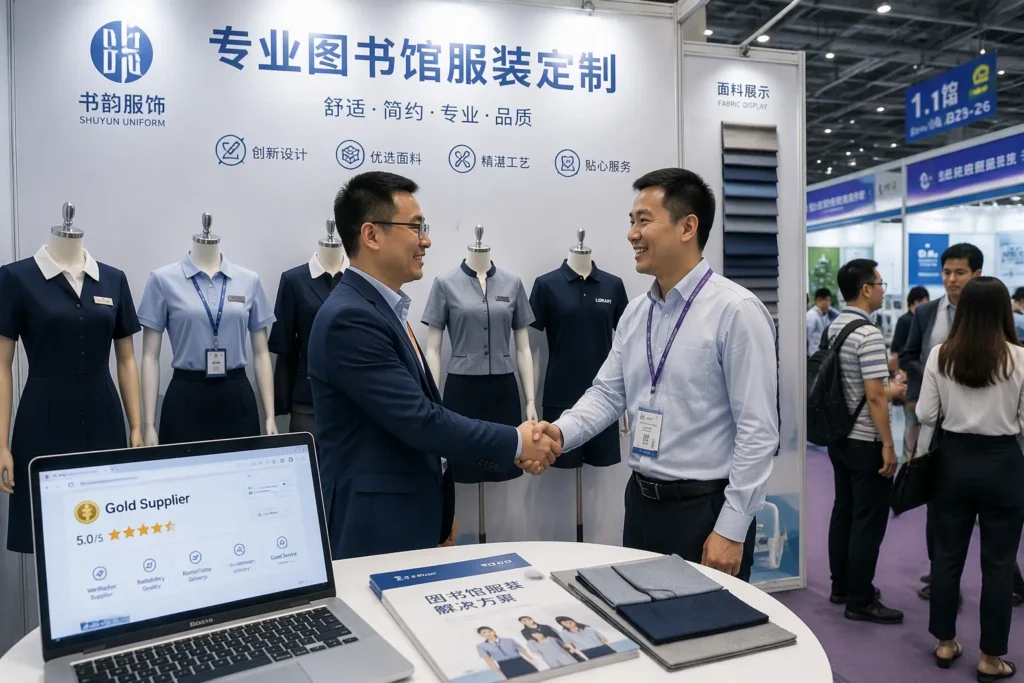
On Alibaba, check for verification badges. A Gold Supplier badge means a paid membership with basic company checks. A Verified Manufacturer badge means a third party conducted a full factory audit. These badges reduce risk. Prioritize suppliers with over five years on the platform. Inspect their storefront for consistency. Unrelated product categories signal a red flag.
Use Alibaba’s Trade Assurance system. This escrow service holds your payment until you confirm goods meet specifications. Avoid direct bank transfers for first orders. They offer no recourse if products fail.
Trade fairs provide the most effective way to find and vet clothing manufacturers. Events like the Canton Fair let you meet factory owners face to face. You can touch fabrics, inspect samples, and assess professionalism directly. For library staff uniform OEM China sourcing, these in-person meetings build trust faster than online communication.
Match your product to the right manufacturing hub. Guangzhou and the Pearl River Delta excel at general apparel. For specialized workwear like uniforms, look at factories in Jiangsu or Shandong. These regions have deep experience with uniforms and technical fabrics. A factory in the right hub already has the proper supply chain and machinery.
Vetting Library Staff Uniform OEM China Suppliers
Vetting turns your supplier list into a reliable shortlist. Verify each claim the supplier makes. Never trust the website alone.
Check credentials first. ISO 9001 certification proves the factory runs a documented quality management system. OEKO-TEX Standard 100 confirms fabrics are tested for harmful substances.
A certification is not a marketing badge; it is a documented answer to a specific risk.
Verify each certificate number on the issuing body’s public database. Fake certificates are common. Check on the ISO or OEKO-TEX website directly.
Client reviews reveal real-world performance. Look for a positive review rate of 85% or higher. Evaluate these key performance indicators:
KPI | Typical Value |
|---|---|
On-Time Delivery Rate | 98% |
Client Positive Reviews | 85%+ |
Production Capacity | 100,000–2,000,000 units/month |
Factory experience matters. Look for manufacturers with a clear track record in uniform production. A facility operating 240,000 m² with over 600 employees shows significant scale. Documented multi-step QC processes demonstrate genuine quality commitment.
Arrange a third-party factory audit for larger orders. Use SGS, Intertek, or TÜV for on-site inspections. Remote video walk-throughs offer a lower-cost alternative. These steps confirm the supplier’s capabilities and eliminate the risk of working with a broker.
Step 3 — Evaluate Samples and Negotiate Terms
Your shortlist is ready. Now you order samples and test whether the factory can deliver what your tech pack promises. This step protects your budget before you commit to a bulk order.
Sample Quality and Fit Checks
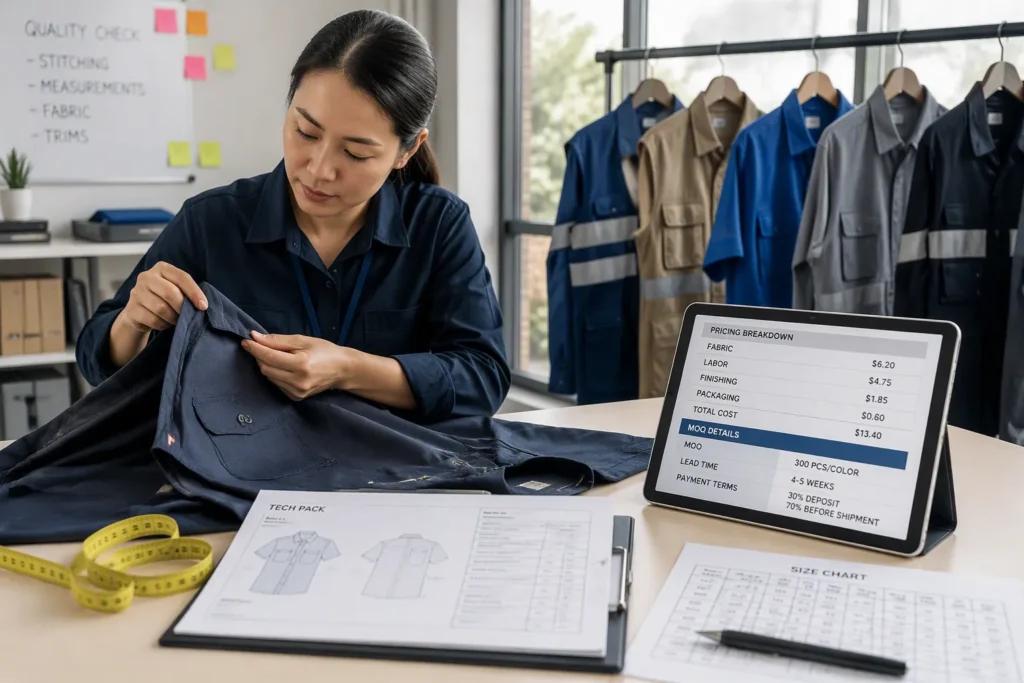
OEM uniform manufacturers in China often provide sample production with turnaround times of 7 to 15 days. Ask for a pre-production sample made from your actual fabric, not a stock substitute. When the sample arrives, inspect it against your tech pack line by line.
Check the fit first. Put the garment on a staff member with a similar build. Confirm the chest, waist, and sleeve measurements match your sizing chart. A sample that fits well on a hanger can still bind at the shoulders during shelving work.
Next, examine the stitching. Look for straight seams, even stitch density, and no loose threads. Pull gently on stress points like pocket corners and armholes. Poor stitching shows up here first.
Finally, feel the fabric. Rub it between your fingers. A wrinkle-resistant finish should feel smooth, not stiff or coated. Compare the hand-feel to the fabric weight you specified in GSM. A 220 GSM twill should feel substantial without stiffness. If the sample feels thin or rough, reject it now. Fixing fabric problems after a bulk run costs far more than a second sample.
Pricing, MOQ, and Lead Time
Many Chinese OEM clothing manufacturers offer low MOQs, with some starting at 50 pieces. That volume suits most library staff orders. Confirm the MOQ per color and per size, not just per style. A factory may accept 50 pieces total but require 100 per color.
Negotiate the unit price after you approve the sample. Ask the supplier to break down fabric, labor, and finishing costs. This breakdown gives you leverage on reorders.
Payment terms follow a standard pattern in China sourcing. Match your method to your order value and your relationship with the factory.
Order Value | Relationship | Recommended Payment Method |
|---|---|---|
Under $500 | New buyer | PayPal or Trade Assurance |
$500–$5,000 | New buyer | T/T 30/70 with inspection |
$5,000–$50,000 | New buyer | T/T 30/70 with third-party inspection |
Over $50,000 | New buyer | Letter of Credit (L/C) |
Any amount | Established (2+ years) | T/T with flexible terms |
T/T 30/70 means a 30% deposit and a 70% balance before shipment. This structure is the standard for most China sourcing transactions. Never send 100% upfront to a new supplier.
Compare your payment routes before you choose one.
Payment Route | Buyer Protection | Cost to Buyer | Best For |
|---|---|---|---|
T/T bank transfer | Contract and supplier reputation only | ~$20–$50 bank charges per transfer | Repeat orders, larger runs, verified factories |
Alibaba Trade Assurance | Funds held in escrow, released upon buyer confirmation | Built into platform pricing | First orders, buyers unfamiliar with the supplier |
Card or PayPal via platform | Escrow plus card scheme chargeback | Processing fee of a few percent | Samples and small first orders |
Small trial orders of 10–20 pieces may collapse the deposit and balance into one upfront payment. Bank charges can exceed the protection value at that size.
Lock in your production lead time in writing. Ask for a firm ship date and a penalty clause for late delivery. Define reorder conditions too. A good library staff uniform OEM China partner holds your pattern and fabric specs for future runs. That saves you the sampling cost on every reorder.
Step 4 — Quality Control, Shipping, and Customs
Pre-Shipment Inspections
Before the factory packs your order, arrange a third-party pre-shipment inspection. Hire a firm like SGS, Intertek, or TÜV to visit the production line. Ask the inspector to check a random sample of finished garments against your tech pack. This step catches problems while the factory can still fix them.
Tell the inspector which defects matter most. Check measurements against your sizing chart, since a garment that runs small fails your staff. Inspect stitching at pocket corners, armholes, and hems for loose threads or skipped stitches. Confirm the fabric weight and hand-feel match your approved sample. Verify logo placement, color accuracy against your Pantone codes, and label content. A failed inspection gives you leverage to demand rework before you pay the balance.
Logistics and Import Regulations
After inspection passes, choose your shipping method. Your choice depends on order size, budget, and how soon your staff needs the uniforms.
Shipping Option | Transit Time (China → US) |
|---|---|
Sea Freight (FCL) | 18–35 days |
Sea Freight (LCL) | 22–40 days |
Air Freight | 3–7 days |
Express Shipping | 2–5 days |
Sea freight costs the least per unit and suits large bulk orders. Air freight and express shipping move fast but cost more, so reserve them for urgent or small runs.
Prepare your customs documents before the goods leave China. You typically need a commercial invoice, a packing list, a bill of lading or airway bill, and a certificate of origin. Confirm the correct Harmonized System code for work uniforms with your freight forwarder. Accurate paperwork prevents delays at the port. Importing custom work uniforms from China requires a structured process: finding the right factory, negotiating terms, and managing logistics. A reliable library staff uniform OEM China partner helps you prepare these documents correctly the first time.
Why Library Staff Uniform OEM China Works
Sourcing from Chinese OEM manufacturers delivers real advantages for library uniforms. Two factors matter most: cost savings and customization flexibility. China’s manufacturing infrastructure makes this approach affordable without sacrificing quality. Your library benefits from decades of garment production experience across many industries.
Cost and Customization Advantages
Chinese factories produce uniforms at much lower costs than domestic options. They operate at large scale with efficient supply chains. Labor costs remain competitive. You can expect savings of 40 to 60 percent per piece compared to stock uniforms from local suppliers. These savings grow with larger orders.
Customization gives you complete control over every detail. You choose the fabric, color, fit, and logo placement. Your library staff uniform OEM China partner manufactures from your tech pack. They produce exactly what you specify, not a modified stock item. This precision eliminates guesswork and ensures consistency across your order. You can add hidden pockets for name badges. You can specify reinforced seams for areas that see frequent movement. Standard uniform suppliers rarely offer this flexibility.
Specialized Factories and Fabric Options
China hosts many factories that specialize in work uniforms. These facilities produce clothing for healthcare, hospitality, industrial, and commercial sectors. They know how to build durable garments that withstand workplace demands. You adapt this expertise directly to your library staff uniforms.
These specialized manufacturers offer a broad range of fabric choices. You select materials based on your exact requirements. Need wrinkle-resistant shirts? Many factories stock appropriate fabrics. Want stain-repellent trousers? They source the correct finish. A reliable library staff uniform OEM China partner understands material properties and guides your choices. These factories test fabrics for durability, colorfastness, and shrinkage. You benefit from their technical knowledge. They recommend the best construction methods for your uniform design. This advice helps you avoid mistakes like choosing a fabric that pills after washing or fades in sunlight.
The combination of lower costs, full customization, and access to specialized manufacturing makes China a strong choice for sourcing your library staff uniforms.
You now have a complete 6-step process to source your uniforms. Your tech pack set the foundation for success. Thorough vetting protected your budget from unreliable suppliers. Careful sample evaluation confirmed quality before bulk production. These three steps prevent the most common sourcing mistakes.
Building a long-term partnership with your OEM factory creates ongoing value. Perform consistent quality checks on every order. Your patterns and specs stay on file for smooth reordering. Many buyers find that a recommended library staff uniform OEM China manufacturer streamlines their first purchase. The factory already knows the process and delivers faster results.
FAQ
How much can I save on library staff uniforms from China?
You can cut costs by 40 to 60 percent per piece compared to stock uniforms from local suppliers. Chinese factories operate at large scale with efficient supply chains. These savings grow as your order size increases.
What is the minimum order quantity for custom library uniforms?
Many Chinese OEM clothing manufacturers offer low MOQs. Some start at 50 pieces, which suits most library staff orders. Always confirm the MOQ per color and per size, not just per style.
How long does sampling and production take?
Sample production usually takes 7 to 15 days. Ask for
Catalog versus custom comparison
Catalog program: faster selection, fewer development decisions, limited colors and trims, suitable for repeat basics.
Custom OEM program: exact role-based fit, library brand colors, chosen fabrics, bespoke labels and packaging, coordinated replenishment, and stronger multi-site consistency. For a cultural institution with multiple service roles, custom OEM provides better control of identity, comfort, and replacement planning.
Procurement checklist
Confirm adult staff roles and quantities; prepare size charts and tolerance; define fabric composition and GSM; approve color standards; provide logo vector files; specify embroidery or print size; document pockets, closures, vents, and badge placement; request a PPS; approve wash and color tests; set final-inspection expectations; confirm carton labeling and export documents; agree delivery milestones and replenishment rules.
Related OEM programs
Museum and gallery teams: https://www.workwearmanufacturer.com/museum-gallery-uniform-oem-china/
Cinema venue staff: https://www.workwearmanufacturer.com/cinema-theater-uniform-oem-china/
Corporate branch apparel: https://www.workwearmanufacturer.com/bank-corporate-uniform-oem-china/
Branded polo options: https://www.workwearmanufacturer.com/custom-polo-shirt-oem-manufacturer-china/ a pre-production sample made from your actual fabric. Lock in a firm ship date and a penalty clause for late delivery before you commit to a bulk run.
Which certifications should I verify before choosing a supplier?
Check for ISO 9001 and OEKO-TEX Standard 100. ISO 9001 proves the factory runs a documented quality management system. OEKO-TEX confirms fabrics are tested for harmful substances. Verify each certificate number on the issuing body’s public database.
How do I pay a new supplier safely?
Never send 100% upfront to a new supplier. For orders under $500, use PayPal or Trade Assurance. For orders from $500 to $50,000, use T/T 30/70 with a third-party inspection. This structure is the standard for most China sourcing transactions.