
Gas Station Convenience Store Uniforms: Why ODM Beats Ready-Made for Chain Expansion
Table of Contents
Display
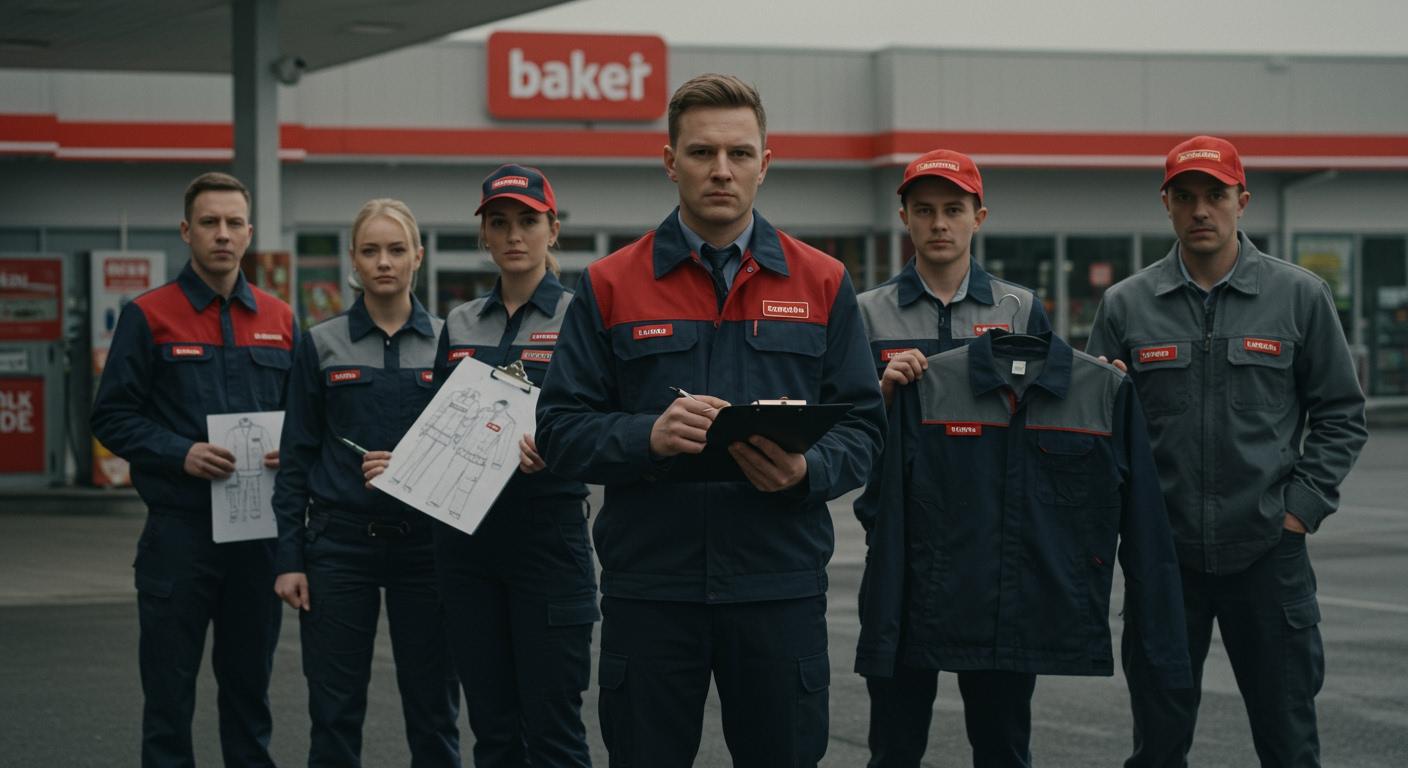
I choose ODM uniforms when I want my Gas Station Convenience Store chain to grow. Consistent branding creates trust and loyalty. I see this in chains like QuikTrip, where customers recognize the logo and colors. They know what to expect each time.
Customers trust familiar uniforms and colors.
Staff feel proud, which improves service.
Brand recognition increases repeat visits.
ODM uniforms help me scale efficiently and keep operations smooth.
Key Takeaways
ODM uniforms offer full customization, allowing you to choose fabrics, colors, and logo placement to match your brand.
Consistent branding through ODM uniforms builds customer trust and loyalty, making your stores easily recognizable.
Investing in ODM uniforms may have higher upfront costs, but they provide long-term savings by reducing replacements and hidden costs.
ODM suppliers can handle bulk orders efficiently, ensuring uniformity across all locations as your chain expands.
Well-fitted uniforms improve employee morale and professionalism, leading to better customer service and reduced turnover.
Involve your staff in the uniform assessment process to ensure comfort and satisfaction, which enhances team spirit.
Timely delivery and quality control from ODM suppliers help maintain operational efficiency and brand consistency.
Consider the true cost of uniforms, including maintenance and employee comfort, rather than just the initial price.
ODM vs. Ready-Made
ODM Defined
When I choose ODM (Original Design Manufacturer) uniforms, I work with a supplier who designs and produces uniforms specifically for my Gas Station Convenience Store chain. I can select the fabric, colors, and even the placement of my logo. The supplier manages the entire process, from design to delivery. This approach gives me a uniform that matches my brand and fits my staff perfectly.
Ready-Made Defined
Ready-made uniforms are pre-designed and mass-produced. I buy these uniforms off the shelf. I have to pick from what is available in terms of style, color, and size. Sometimes, I can add a logo, but the options are limited. These uniforms are quick to get, but they rarely match my brand exactly.
Comparison
Customization
I see a big difference in customization between ODM and ready-made uniforms. ODM lets me control every detail. I can choose the fabric, design, and where to place my logo. Ready-made uniforms only offer a few choices. I often have to settle for standard colors and limited logo placement.
Here’s a quick comparison of customization features:
Feature | ODM Uniforms | Ready-Made Uniforms |
|---|---|---|
Customization Level | High – fully customizable | Low – limited to pre-designed options |
Branding Options | Extensive – logos anywhere | Limited – specific areas only |
Material Choices | Wide variety – select specific fabrics | Fixed – limited to available stock |
Fit and Sizing | Tailored – fits specific sizes | Standard – only available sizes |
Production Time | Longer – design and production needed | Shorter – ready for immediate use |
Scalability
When I expand my Gas Station Convenience Store chain, scalability matters. ODM uniforms help me keep my brand consistent across all locations. I can order in bulk and get the same design every time. Ready-made uniforms may change or run out of stock. I risk having different uniforms at different stores, which confuses customers and weakens my brand.
Cost
ODM uniforms often cost more upfront because of the design and setup. However, I find that the long-term value is higher. I avoid hidden costs from mismatched uniforms or last-minute orders. Ready-made uniforms seem cheaper at first, but I may pay more over time due to limited options and the need to replace inconsistent stock.
Tip: I always consider not just the price, but also the value of consistent branding and staff satisfaction when choosing uniforms.
Gas Station Convenience Store Uniforms
Branding
Logo
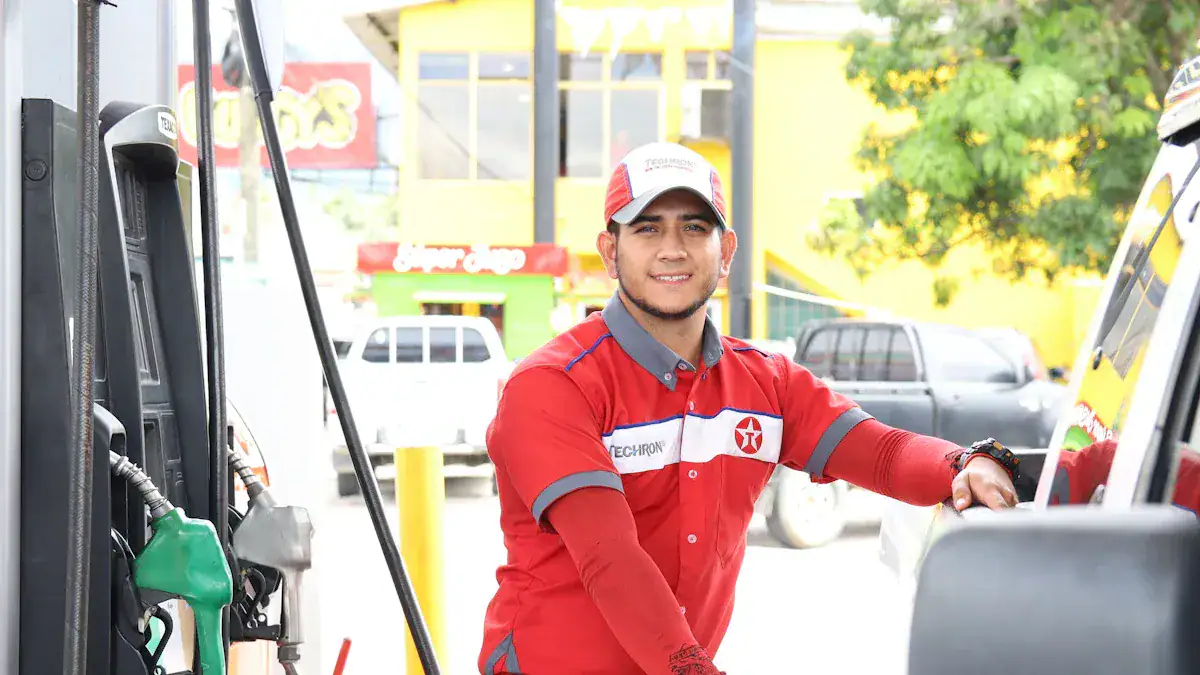
I always make sure my Gas Station Convenience Store uniforms display our logo clearly. A visible logo helps customers recognize my brand right away. When every staff member wears a uniform with the same logo, I see a stronger sense of unity. This consistency builds trust with customers. I work with my ODM supplier to choose the best placement for the logo, whether on the chest, sleeve, or back. I never have to compromise on visibility or style.
Colors
Color plays a big role in branding. I select colors that match my store’s identity. With ODM uniforms, I can pick exact shades that reflect my brand. This means every location in my Gas Station Convenience Store chain looks the same. Customers know what to expect when they walk in. I avoid the mismatched look that sometimes happens with ready-made uniforms. Consistent colors make my stores stand out in a crowded market.
Sizing
Staff Needs
My staff come in all shapes and sizes. I want everyone to feel comfortable and look professional. ODM uniforms allow me to order a wide range of sizes. I can even request adjustments for special needs. This flexibility helps me meet safety standards and keeps my team happy.
Challenge | Description |
|---|---|
Safety Compliance | Ensuring uniforms meet safety standards, especially in high-traffic areas like gas stations. |
Accommodating Body Sizes | Providing uniforms that fit a diverse range of body sizes to ensure comfort and professionalism. |
Maintaining Professional Appearance | Balancing functionality with style to uphold a professional image in customer-facing roles. |
Variations
I often need different uniform styles for different roles. For example, cashiers, cleaners, and managers may each need unique features. ODM suppliers help me create these variations without losing the overall brand look. I can add reflective strips for safety or choose different fabrics for comfort. This approach keeps everyone satisfied and safe.
Supply Chain
Bulk Orders
When my Gas Station Convenience Store chain grows, I need uniforms in large quantities. ODM suppliers handle bulk orders with ease. They offer pre-designed clothing that I can brand quickly. I save time and resources because I do not need to design everything from scratch. The supplier manages the entire production process, so I get consistent quality every time.
Delivery
Timely delivery matters to me. ODM suppliers like Duowei have large production capacity and efficient supply chains. They produced over 100,000 uniforms last year. I get quick responses to my requests, with lead times of 30 to 60 days. Samples arrive within a week, which helps me approve designs fast. Modular production methods let them adjust quickly if I need urgent or small batch orders.
Efficient production methods boost output.
Suppliers respond quickly to changes in demand.
Modular systems allow rapid adjustments for urgent needs.
Note: I rely on ODM suppliers to keep my operations running smoothly. Their ability to deliver on time supports my expansion plans and keeps my staff looking sharp.
Advantages of ODM
Branding Consistency
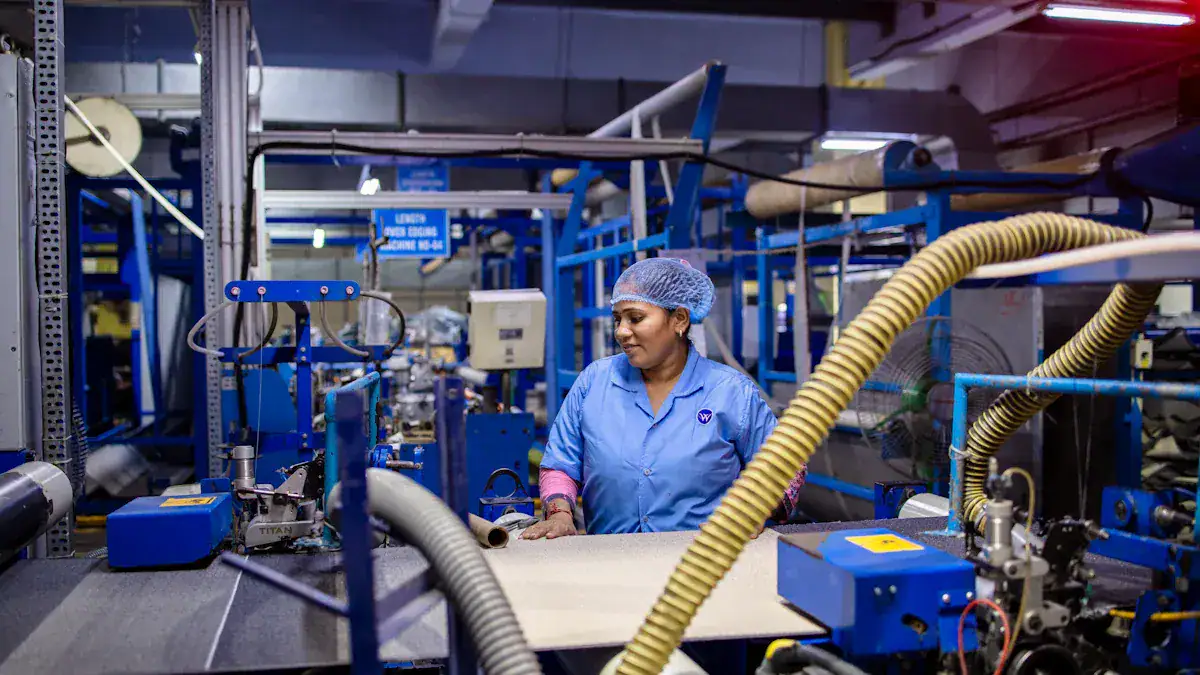
I always focus on branding consistency when I expand my Gas Station Convenience Store chain. ODM uniforms help me achieve this goal. I work with a trusted factory partner and set up in-house quality checks. I also manage my suppliers closely. This approach gives me faster turnarounds and better traceability. My brand stays strong and recognizable at every location.
Approach | Turnaround Speed | Traceability | Brand Consistency |
|---|---|---|---|
Trusted Factory + In-House QA | Fast | High | Strong |
Supplier Management Program | Fast | High | Strong |
When I use ODM uniforms, I see my logo and colors stay the same everywhere. Customers know what to expect. Staff feel proud to wear uniforms that match our brand. This consistency builds trust and loyalty.
Tip: I always combine supplier management with quality assurance to keep my brand image sharp and reliable.
Flexible Design
ODM uniforms give me flexible design options. I can change styles, colors, and features to fit each store’s needs. This flexibility helps me create a unique identity for every location. Customers feel more connected to my brand when they see uniforms that match the store’s look and feel.
Flexible designs boost store identity and customer connection.
Custom uniforms let staff express their preferences and feel valued.
I adapt uniforms to local culture and trends, keeping my brand consistent while respecting community values.
I often ask my ODM supplier to tweak designs for special events or local holidays. Staff appreciate having uniforms that fit their roles and personalities. This approach improves morale and keeps everyone engaged.
Note: I always listen to my team’s feedback when updating uniform designs. Their input helps me create uniforms that work for everyone.
Cost Management
ODM programs offer several cost management strategies. I choose the option that fits my budget and timeline. Each strategy has its own pros and cons. I compare them before making a decision.
Option | Key Characteristics | Pros | Cons | Typical Cost Range | Lead Time (sample to production) |
|---|---|---|---|---|---|
Full turnkey custom uniform program | End-to-end service: design, pattern, sourcing, production, QC | Highest control; scalable; consistent color and fit | Higher upfront risk; longer initial lead time | $25–$60 per unit | 9–16 weeks |
ODM/tech-pack-based customization | Pre-approved patterns with tech pack tweaks | Faster start; lower design risk | Less design freedom; needs tight management | $20–$45 per unit | 7–13 weeks |
Hybrid model with local QC + Chinese prod | China fabrication; external QC team or local liaison | Better control; quicker customs clearance | Additional QC cost; needs reliable partner | $22–$50 per unit | 7–13 weeks |
Domestic production (nearshore) | Fabric from China, local assembly | Faster iterations; easier IP protection | Higher unit costs; smaller scale | $28–$70 per unit | 9–18 weeks |
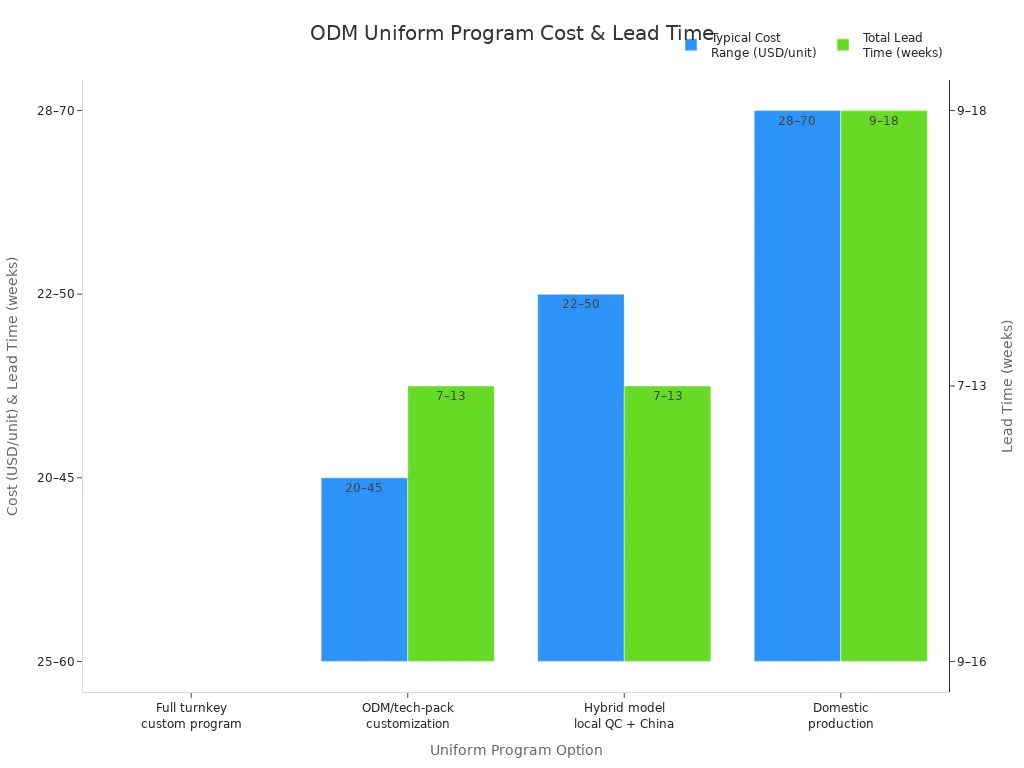
I always look for ways to balance cost, speed, and quality. ODM lets me plan my budget and avoid surprises. I get better value over time because my uniforms last longer and match my brand.
Tip: I review cost options with my supplier before placing bulk orders. This step helps me avoid hidden fees and delays.
Efficiency
When I switched to ODM uniforms for my Gas Station Convenience Store chain, I noticed a dramatic improvement in operational efficiency. I no longer struggled with mismatched orders or slow deliveries. My supplier streamlined the entire process, which saved me time and reduced stress.
I rely on ODM systems to automate uniform distribution. This automation minimizes mistakes and ensures every staff member receives the correct size and style. I track inventory in real time, which helps me avoid shortages and overstock. I make decisions faster because I see analytics that show usage patterns and costs.
Here is a summary of the efficiency improvements I experienced:
Improvement Type | Description |
|---|---|
Reduced Ordering Errors | The system simplifies the uniform distribution process, minimizing mistakes in orders. |
Access to analytics helps in making informed decisions to optimize inventory and reduce costs. | |
Compliance and Cost Control | Ensures adherence to policies and helps manage expenses effectively across multiple locations. |
Brand Consistency | Standardizes operations across various store locations, maintaining a uniform brand image. |
Enhanced Collaboration | Integrates with existing software, improving accuracy and operational efficiency. |
I use these features to keep my stores running smoothly. I set up compliance checks to make sure every location follows company policies. I manage expenses more effectively because I see cost breakdowns for each order. My team collaborates better since the system integrates with our existing software.
Tip: I always review analytics before placing new orders. This habit helps me avoid waste and keeps my budget on track.
Efficiency matters most when I expand my chain. ODM uniforms give me the tools to scale up without losing control. I maintain a consistent brand image and keep my staff equipped with the right uniforms. My operations stay lean, and I focus on growth instead of solving uniform problems.
Pitfalls of Ready-Made
Branding Issues
I notice branding issues every time I rely on ready-made uniforms for my Gas Station Convenience Store chain. These uniforms rarely match my brand’s colors or logo placement. When I walk into different locations, I see staff wearing uniforms that look slightly different. Customers get confused. They do not always recognize my brand. This inconsistency weakens my identity in the market.
I want my stores to stand out. Ready-made uniforms make that difficult. Suppliers often change their stock without warning. I cannot guarantee that new uniforms will look the same as the old ones. My brand loses its impact. Customers expect a familiar look. When they do not see it, they may choose another store. I believe strong branding starts with a consistent uniform. Ready-made options make this goal hard to achieve.
Tip: I always check uniform samples against my brand guidelines before placing an order. This step helps me avoid surprises.
Sizing Problems
Sizing problems create real challenges for my team. Ready-made uniforms come in standard sizes. These sizes do not fit everyone. I see staff struggling with uniforms that are too tight or too loose. This discomfort affects their mood and performance. Employees who feel uncomfortable do not focus well on their tasks.
I want my team to feel valued. Poorly fitting uniforms send the wrong message. Staff may think I do not care about their needs. This attitude lowers morale and increases turnover. Safety also becomes a concern. Uniforms that restrict movement or hang loosely can cause accidents. I believe that proper fit boosts confidence and professionalism.
Here is how sizing problems impact my staff:
Impact Type | Description |
|---|---|
Discomfort | Ill-fitting uniforms can lead to physical discomfort, affecting focus and productivity. |
Decreased Morale | Employees may feel undervalued and excluded if uniforms do not fit well, leading to lower morale. |
Safety Risks | Poorly fitting uniforms can pose safety hazards, such as restricting movement or causing injuries. |
Professionalism | Properly fitting uniforms enhance employees’ confidence and professionalism in the workplace. |
Employee Retention | High levels of discomfort and dissatisfaction can lead to increased turnover rates. |
Note: I always ask my staff for feedback on uniform fit. Their input helps me make better choices for future orders.
Supply Disruptions
Supply disruptions often catch me off guard when I depend on ready-made uniforms. Tariffs and changes in global trade can increase costs overnight. Suppliers may shift their sourcing strategies, leaving me with delays or shortages. I have seen chains struggle to maintain service levels because their supply chains lack diversity. When uniforms do not arrive on time, my operations suffer. Staff may have to wear mismatched clothing, which hurts my brand and customer trust.
I learned that a reliable supply chain is essential for smooth operations. Ready-made uniforms do not offer the flexibility I need. I prefer working with partners who can adapt quickly to changes in demand. This approach keeps my stores running efficiently and my staff looking professional.
Tip: I always review my supplier’s sourcing strategy before signing a contract. This step helps me avoid unexpected disruptions.
Hidden Costs
When I choose ready-made uniforms for my gas station convenience store chain, I often overlook the hidden costs that come with them. At first, the price tag looks attractive. I think I am saving money. Over time, I realize that these uniforms cost me more than I expected.
Low-quality uniforms wear out quickly. My staff work long shifts and face daily wear and tear. I find myself replacing uniforms more often than I planned. Frequent replacements add up. The initial savings disappear as I spend more on new uniforms every few months.
Uncomfortable uniforms create another problem. When my employees feel restricted or distracted by what they wear, their performance drops. I notice lower morale and less productivity. Staff who do not feel good in their uniforms may not greet customers with a smile. This small detail affects the overall customer experience.
Uniforms represent my brand. Poorly made uniforms send the wrong message. Customers judge my stores by how my staff look. If uniforms look faded, wrinkled, or mismatched, my brand loses credibility. I want my stores to look professional. Ready-made uniforms make this difficult. I risk damaging my reputation without realizing it.
Maintenance costs also surprise me. Cheap uniforms need more repairs. Sometimes, they require special cleaning because the fabric does not hold up in regular washes. I pay extra for these services. The cost of keeping uniforms presentable grows each month.
Here is a summary of the hidden costs I have faced with ready-made uniforms:
Frequent replacements due to daily wear and tear.
Lower employee morale and productivity from uncomfortable uniforms.
Damage to brand image and professionalism.
Increased maintenance and cleaning expenses.
I always remind myself that the cheapest option is not always the best. Uniforms that seem affordable at first can drain my budget over time. I pay attention to quality, comfort, and brand image when making uniform decisions.
To help visualize these costs, I created a simple table:
Hidden Cost Type | Impact on My Chain |
|---|---|
Frequent Replacements | Higher long-term expenses |
Employee Comfort | Reduced productivity and morale |
Brand Image | Loss of professionalism and credibility |
Maintenance | Increased repair and cleaning costs |
I learned that investing in better uniforms saves me money in the long run. I avoid the cycle of constant replacement and repair. My staff feel comfortable and proud. My brand stays strong. I encourage other chain operators to look beyond the price tag and consider the true cost of ready-made uniforms.
Case Studies
National Chain
I have seen how a national chain can transform its brand image by switching to ODM uniforms. When I worked with a large Gas Station Convenience Store operator, I noticed immediate changes after the rollout. Staff wore uniforms that matched the company’s colors and logo perfectly. Customers recognized employees right away. This made the stores feel more professional and welcoming.
I observed several benefits during this transition:
Customized uniforms made it easier for customers to identify staff.
Employee morale improved. Staff felt proud to represent the brand.
Turnover rates dropped. Fewer employees left, which saved money on hiring and training.
I remember talking with managers who said that service quality increased. Employees felt more connected to the company. Customers returned more often because they trusted the brand. The chain saved money over time because uniforms lasted longer and fit better.
Regional Group
Regional groups also benefit from ODM uniforms. I worked with Sinclair and Valero during their expansion. Both companies wanted to keep their brand consistent across new locations. ODM suppliers helped them design uniforms that matched their logos and colors exactly.
Here is what I noticed:
Sinclair created a unified look for all stores. Customers saw the same colors and logo everywhere.
Valero improved staff comfort by offering a wider range of sizes and styles.
Both companies reduced supply chain problems. ODM suppliers delivered uniforms on time, even for bulk orders.
Managers told me that employees felt valued. Uniforms fit well and looked sharp. This boosted morale and made staff more likely to stay. Customers noticed the change and responded with positive feedback. The stores became more recognizable in their communities.
Note: I always recommend ODM uniforms to operators who want to grow their Gas Station Convenience Store chain. Consistent branding, cost savings, and happier employees make a big difference.
Transition Steps
Assess Needs
I always start by assessing my chain’s uniform needs. I look at the number of locations, the roles within each store, and the tasks my staff perform. I ask myself what image I want my brand to project. I consider how uniforms can help my team stand out and deliver great service. I talk to my staff about comfort, fit, and safety. Their feedback helps me understand what works and what does not.
I check if my current uniforms meet cleanliness standards. Messy uniforms can hurt customer perceptions. I want every employee to look sharp and professional. I also review my sizing protocols. I make sure new hires get uniforms that fit well. Adjustable features like elastic waistbands and modular sizing help me accommodate different body types. Consistent standards keep my stores looking polished.
Tip: I always involve my team in the assessment process. Their insights help me avoid mistakes and improve satisfaction.
Choose ODM Partner
Selecting the right ODM partner is crucial for my chain’s success. I look for suppliers who tailor designs to meet my needs. I want a creative team that understands market trends and can deliver elegant, trendy uniforms. Quality matters most. I choose partners who optimize for durability, color, stitching, and detail.
I prefer suppliers with strong relationships with reputable fabric sources. This gives me access to a wide range of materials. I also check their printing and embroidery capabilities. Advanced digital printing ensures my logo stays vibrant and sharp.
Here is a table of criteria I use when choosing an ODM partner:
Criteria | Description |
|---|---|
Tailor designs to meet customer needs | Market research and creative design teams deliver elegant, trendy, and cutting-edge uniforms. |
Optimize for quality | Uniforms are durable, with rigorous control over color, style, stitching, and details. |
Reputable fabric suppliers | Partnerships with major suppliers provide diverse fabrics and materials. |
Ensure quality printing and embroidery | Advanced digital printing maintains color durability and high resolution. |
I always ask for samples before making a final decision. I want to see the quality firsthand and test how the uniforms hold up in daily use.
Design Uniforms
Designing uniforms is my chance to showcase my brand and meet operational needs. I work closely with my ODM partner to create a look that reflects my store’s identity. I focus on cleanliness and style. Uniforms act as advertisements for my chain. They help customers identify staff quickly, which improves service.
I include features that boost comfort and fit. Adjustable waistbands and modular sizing make a big difference. I set clear sizing protocols for new hires. This ensures everyone looks professional from day one. I keep uniform standards consistent across all locations.
I use custom workwear to differentiate my brand in the market. High-quality, stylish uniforms show my commitment to excellence. Employees feel proud to wear them. Customers notice the difference and remember my stores.
Note: I always review the final design with my team. Their feedback helps me create uniforms that work for everyone and leave a lasting impression.
Rollout
Rolling out new ODM uniforms across my gas station convenience store chain requires careful planning. I want to make sure the process runs smoothly and does not disrupt daily operations. I always start by creating a detailed rollout schedule. This schedule helps me coordinate deliveries, staff training, and uniform distribution at each location.
I prefer to work with a single supplier for both custom and off-the-shelf orders. This approach reduces risk and keeps my brand consistent. I ask my supplier to provide a prototype of the new uniform. I review this sample with my team and use clear pass/fail criteria. If the prototype meets our standards, I approve it for production.
Before I launch the uniforms chain-wide, I run a pilot test at a few locations. This small-scale rollout lets me spot any issues early. I gather feedback from staff and managers. If problems appear, I fix them before moving forward. This step saves time and prevents larger disruptions.
Here is a table that summarizes my rollout strategies:
Strategy | Description |
|---|---|
Single Supplier | I use one supplier for all orders to ensure brand consistency and reduce risk. |
Prototype Approval | I require a formal approval stage with clear criteria before full production. |
Pilot Testing | I test uniforms at a few locations first to catch issues early and gather feedback. |
Inclusive Pricing | I negotiate pricing that covers setup, embroidery, and color-matching to avoid extra charges. |
Nearshoring | I use regional manufacturing to shorten delivery times and simplify logistics. |
Documentation | I keep all decisions and specs in a shared repository for easy reference. |
Quality Checks | I inspect the first bulk shipment for defects and branding accuracy before full rollout. |
Rollout Schedule | I plan the rollout to minimize disruption to daily operations. |
I also break down the rollout into stages. Sometimes, I start with one region or department at a time. This staged approach helps me manage logistics and support staff as they adjust to the new uniforms.
To help everyone adapt, I provide training for my procurement, HR, and facilities teams. I explain the new process and answer questions. I also create a change-management plan. This plan outlines the benefits of the new uniforms and sets clear timelines. I communicate these details to all employees so they know what to expect.
Tip: I always monitor adoption metrics during the rollout. If I see gaps or resistance, I address them quickly. Open communication and quick problem-solving keep the transition on track.
By following these steps, I make sure my staff receive their new uniforms on time and feel comfortable with the change. My stores maintain a professional look, and my brand stays strong as I expand.
Impact
Customer Experience
Uniform choice shapes how customers see my gas station convenience store chain. When my staff wear well-designed, branded uniforms, customers feel confident about the service they receive. I notice that customers evaluate my stores based on both the products and the people who serve them. Uniforms help set expectations and create a sense of order.
Customers often judge the quality of my store by the appearance of my staff.
Branded uniforms make it easier for customers to identify employees, which improves service speed.
Consistent uniforms reinforce my brand’s value, making customers more willing to pay for quality and better service.
Uniform pricing and presentation help customers feel they get fair value, which increases loyalty.
When customers see the same colors and logos at every location, they trust my brand and return more often.
I also find that clear, consistent uniforms support my pricing strategy. Customers expect similar prices for convenience goods. If they see a professional, unified team, they feel more confident in my store’s value. This trust leads to repeat business and positive word-of-mouth.
Employee Morale
Uniforms do more than just create a professional look. They have a direct impact on my team’s morale and job satisfaction. I see that when everyone wears the same uniform, it builds a sense of belonging. My staff feel like they are part of a team, not just individuals doing separate jobs.
Uniforms remove the pressure of fashion competition, so employees focus on their work.
Branded uniforms give my team pride in representing the company.
A well-dressed team makes a strong first impression, which boosts confidence.
Uniforms improve safety and comfort, allowing staff to work efficiently.
When employees feel valued and comfortable, they interact better with customers.
I notice that staff who feel good in their uniforms stay longer and perform better. This reduces turnover and training costs. Happy employees create a positive atmosphere, which customers notice right away.
Future Growth
Uniform choice plays a key role in my chain’s ability to grow. As I expand to new locations, I need to keep my brand consistent. ODM uniforms make this possible. I can scale up quickly without sacrificing quality or identity.
Growth Factor | Uniform Impact |
|---|---|
Brand Recognition | Consistent uniforms strengthen my brand everywhere. |
Operational Control | Standardized uniforms simplify logistics and orders. |
Employee Retention | Comfortable, attractive uniforms keep staff longer. |
Customer Loyalty | Familiar uniforms build trust in new markets. |
I plan for the future by choosing uniforms that adapt to changing needs. ODM suppliers help me update designs for new roles or special events. This flexibility supports my long-term growth and keeps my stores competitive.
Uniforms are more than clothing. They shape how customers see my brand, how my staff feel at work, and how I grow my business. I invest in the right uniforms because they deliver lasting value at every stage of expansion.
I choose ODM uniforms because they help my chain grow with strong branding, better fit, and reliable supply. I see long-term value in consistency and staff satisfaction. If you want to expand your gas station convenience store chain, I recommend you:
Review your current uniform needs
Talk with ODM suppliers for custom solutions
Plan a step-by-step rollout
Investing in ODM uniforms sets your business up for lasting success.
FAQ
What does ODM mean for gas station uniforms?
ODM stands for Original Design Manufacturer. I work with a supplier who creates uniforms based on my brand’s needs. I get custom designs, colors, and logos that match my store’s identity.
How do ODM uniforms improve my brand image?
ODM uniforms help me keep my brand consistent. I choose the colors and logo placement. Customers recognize my staff easily. My stores look professional and trustworthy.
Are ODM uniforms more expensive than ready-made options?
ODM uniforms cost more upfront. I save money over time because I avoid frequent replacements and hidden costs. My uniforms last longer and fit better.
Can I order different styles for different roles?
Yes, I can. ODM suppliers let me design uniforms for cashiers, managers, and cleaners. I add features like reflective strips or special fabrics for safety and comfort.
How long does it take to receive ODM uniforms?
Production usually takes 7 to 16 weeks, depending on the program I choose. I get samples within a week. Bulk orders arrive on schedule when I plan ahead.
What if my staff need special sizes?
I request custom sizing from my ODM supplier. I make sure every employee gets a uniform that fits well. This keeps my team comfortable and professional.
How do I start switching to ODM uniforms?
I assess my needs, choose a reliable ODM partner, design the uniforms, and plan a rollout. I monitor feedback and adjust as needed. I involve my team at every step.
Will ODM uniforms help my chain expand faster?
Yes. ODM uniforms support my growth by keeping branding consistent and operations efficient. I scale up easily and maintain quality across all locations.