

Jacket Down Mens Stats That Help You Choose Right
Table of Contents
Display
When I shop for a men’s down jacket, I always start with my main purpose—hiking, city wear, or braving extreme cold. I pay close attention to warmth, weight, durability, fit, price, insulation type, and features. These stats help me choose with confidence. The latest down jacket guide shows how smart tools and virtual try-ons help buyers make better choices.
Aspect | Description |
|---|---|
Product Quality | Smart manufacturing tools ensure high product quality through AI-driven defect detection. |
Consumer Experience | Personalized recommendations and virtual try-on tools improve shopping experience and reduce returns. |
The right jacket down mens choice depends on matching stats to real-life needs.
Key Takeaways
Identify your main purpose for the jacket, such as hiking or city wear, to guide your choice.
Warmth is key; focus on fill power, down weight, and temperature ratings to ensure comfort.
Higher fill power means better insulation with less weight; aim for at least 800 fill power for outdoor use.
Consider weight and packability; lightweight jackets are easier to carry and pack for travel.
Durability matters; look for strong shell fabrics and construction techniques to withstand wear.
Fit and comfort are crucial; ensure the jacket allows for movement and accommodates layers.
Choose the right insulation type; natural down is best for dry conditions, while synthetic down excels in wet weather.
Evaluate features like hoods, pockets, and adjustability to enhance the jacket’s functionality.
Warmth
When I choose a jacket down mens option, I always look at warmth first. I want to stay comfortable, whether I hike in the mountains or walk through the city in winter. Warmth depends on three main stats: fill power, down weight, and temperature ratings.
Fill Power
Fill power tells me how fluffy and insulating the down is. Higher fill power means better warmth for less weight.
Common Ranges
Most men’s down jackets have fill power between 650 and 900.
650-fill is the minimum I consider for outdoor use. It keeps me warm but adds weight.
850-fill and 900-fill jackets feel lighter and trap more heat, which helps when I need maximum insulation.
Insulation Efficiency
Jackets with higher fill power give me more warmth without making the jacket heavy.
I notice that 850-fill and above keeps me warmer with less bulk, which is perfect for hiking or layering.
Down Weight
Fill weight shows how much down is inside the jacket. This number matters as much as fill power.
Typical Amounts
A jacket with 6 ounces of 800-fill down feels much warmer than one with 3 ounces.
More down means more insulation, but it can make the jacket heavier.
Impact on Warmth
I compare fill weight when I want the warmest jacket down mens option.
If two jackets have the same fill power, the one with more down will keep me warmer.
Temperature Ratings
Some brands list temperature ratings to help me match a jacket to the climate.
Climate Match
I check temperature ratings to see if a jacket suits my local winter or a mountain trip.
A jacket rated for below-freezing temperatures works best for extreme cold.
Activity Suitability
For hiking, I pick a jacket that balances warmth and breathability.
For city wear, I choose a lighter jacket with moderate insulation.
Tip: Always compare fill power and down weight together. A high fill power with low fill weight may not be as warm as a lower fill power with more down.
Jacket Model | Fill Power | Down Weight (oz) | Warmth Comparison |
|---|---|---|---|
Feathered Friends Eos | 900+ | N/A | Warmest due to high-quality down |
REI Co-op Magma 850 Hoodie | 850 | Slightly more | Nearly as warm as Eos, but heavier |
Arc’teryx Cerium Hoody | 850 | N/A | Similar warmth to Eos, less loft |
L.L. Bean Ultralight 850 | 850 | N/A | Comparable warmth to Eos, requires more down |
Rab Electron Pro | 800 | N/A | Very warm, thickly filled |
The North Face Summit Breithorn | 800 | N/A | Impressively warm, more down than Eos |
Jones Re-Up Recycled | 750 | N/A | Comparable warmth to higher fill power jackets |
I always match these stats to my needs. For hiking, I want a light, high fill power jacket. For city use, I pick moderate warmth. For extreme cold, I look for maximum fill power and down weight. This approach helps me choose the right jacket down mens style for every adventure.
Weight & Packability
When I shop for a down jacket, weight and packability matter almost as much as warmth. I want a jacket that fits my activity, whether I hike, travel, or just need something for daily wear. I always check the stats for both weight and how small the jacket packs down.
Jacket Weight
Lightweight vs. Heavy
I find that lightweight down jackets make a big difference when I move a lot or carry my gear all day. Most lightweight down jackets weigh less than 12 ounces. Some of the lightest models, like the Mountain Hardwear Ghost Whisperer, come in at just 8.3 ounces. The MontBell Superior Down is also very light at 8.7 ounces, but it does not keep me as warm as heavier options. Heavier jackets, such as the Rab Electron Pro or The North Face Summit Breithorn, weigh about a pound. These jackets give me more warmth, but I notice the extra weight when I pack them or wear them for long periods.
Activity Needs
I always match the jacket weight to my plans. For hiking or backpacking, I pick lightweight down jackets because they do not slow me down. When I travel, I want a jacket that feels light in my bag and on my shoulders. For city use or very cold days, I sometimes choose a heavier jacket for extra warmth, even if it means carrying more weight.
Packability
Compression Size
Packable down jackets save space in my backpack or suitcase. I look for jackets that stuff into their own pocket or a small sack. Here are some examples of how leading brands compare:
The Mountain Hardwear Ghost Whisperer packs into its own pocket and stays very compact.
The Feathered Friends Eos offers great warmth and still packs down small.
The MontBell Superior Down compresses well, but I trade off some warmth for the lighter weight.
The Decathlon Forclaz MT100 also packs down nicely and weighs just over 10 ounces.
Budget-friendly options like the Wantdo Packable and Rokka and Rolla Puffer compress well, but I notice they do not last as long or keep me as warm.
Travel Suitability
When I travel, I always choose packable down jackets. They fit easily into my carry-on or daypack. I never worry about space, and I can pull out my jacket whenever I need it. Lightweight down jackets work best for travel because they do not add much weight or bulk. For daily wear, I still prefer a jacket that packs down, so I can stash it in my bag if the weather warms up.
Tip: If you want the best mix of warmth, weight, and packability, check the jacket’s weight and see if it packs into its own pocket. This feature makes life easier on the trail or in the city.
Jacket Model | Weight (oz) | Packs Into Pocket | Best Use |
|---|---|---|---|
Mountain Hardwear Ghost Whisperer | 8.3 | Yes | Hiking, travel |
Feathered Friends Eos | 11.8 | Yes | Cold hikes, travel |
MontBell Superior Down | 8.7 | Yes | Ultralight hiking |
Decathlon Forclaz MT100 | 10.3 | Yes | Budget travel, hiking |
Rab Electron Pro | ~16 | No | Extreme cold, city |
I always recommend lightweight down jackets and packable down jackets for anyone who values comfort and convenience. These jackets make every adventure easier, whether I am on a mountain trail or exploring a new city.
Durability & Materials
When I shop for a down jacket, I always check the durability and materials. I want my jacket to last through rough hikes and daily wear. I look at the shell fabric, weather protection, and construction details.
Shell Fabrics
Material Types
I see many shell fabrics in men’s down jackets. Nylon and polyester are the most common. Nylon feels smooth and resists tearing. Polyester costs less and dries fast. Some jackets use ultralight fabrics like 7D, 10D, or 15D nylon. These keep the jacket light but still strong.
Abrasion Resistance
I test abrasion resistance by rubbing the fabric against rough surfaces. Ripstop nylon stands out. It has a grid pattern that stops small tears from spreading. I trust ripstop for hiking and climbing. Heavier fabrics, like 20D or 30D nylon, handle scrapes better but add weight.
Tip: If you want a jacket for tough outdoor use, pick one with ripstop nylon or a higher denier fabric.
Weather Protection
Water Resistance
I always check if my jacket has a DWR (Durable Water Repellent) finish. DWR makes water bead up and roll off the surface. This keeps me dry in light rain or snow. Some jackets use hydrophobic down, which resists moisture inside the jacket. I find this feature helpful when I hike in damp conditions.
Windproof Features
Windproof jackets block cold air. I look for tight weaves and extra layers. Some jackets have storm flaps over the zippers. These features keep me warm on windy days. I notice that ultralight jackets may not block wind as well as heavier ones.
Construction
Stitching
I inspect the stitching on every jacket. Strong seams mean fewer cold spots and less chance of the jacket falling apart. Welded seams use heat instead of thread. These seams reduce weight and keep insulation in place. I see fewer leaks and cold spots with welded seams.
Longevity
I want my jacket to last for years. I look for smart construction techniques. Here is a table that shows what I check:
Technique | Description |
|---|---|
Hydrophobic Down Treatments | Chemical treatments that make down water-resistant, improving performance in damp conditions. |
Lightweight Face Fabrics | Use of ultralight materials (7D, 10D, 15D) that reduce weight while maintaining durability. |
Ripstop Nylon Weaves | Fabrics designed to prevent tears from spreading, enhancing durability. |
DWR Treatment | Durable water repellent treatment that helps keep the jacket dry by causing water to bead up. |
Innovative Seam Construction | Techniques like welded seams reduce cold spots and weight while keeping insulation in place. |
Baffle Design | Larger baffles can trap more heat and reduce the number of seams, enhancing warmth and reducing cold spots. |
I always choose a quality down jacket with these features. My jackets last longer and perform better in tough conditions. I trust these stats when I want a jacket for both outdoor adventures and everyday use.
Fit & Comfort
When I look for a down jacket, I always pay close attention to fit and comfort. A jacket that fits well feels better and works better for my activities. I want to make sure I can move easily and stay comfortable, whether I am hiking or just walking around town.
Sizing
Standard vs. Athletic
I notice that brands offer different fits. Standard fit gives me more room in the chest and waist. This style feels relaxed and works well for daily wear or layering over sweaters. Athletic fit feels slimmer and hugs my body closer. I like athletic fit when I want less bulk and a modern look. It also helps keep warmth close to my body. I always check the brand’s sizing chart before I buy. Some brands run large, while others run small.
Layering
Layering matters a lot to me. I often wear a base layer or a fleece under my down jacket. I make sure the jacket has enough space for extra layers without feeling tight. For winter hikes, I size up if I plan to wear thick layers. For city use, I pick my regular size for a cleaner look.
Mobility
Articulated Sleeves
I want my jacket to move with me. Articulated sleeves help a lot. These sleeves have a bend at the elbow, so I can lift my arms or reach forward without the jacket pulling up. I find this feature most useful when I hike or climb.
Range of Motion
A good down jacket never restricts my movement. I test the range of motion by reaching overhead or swinging my arms. Jackets with gusseted underarms or stretchy panels let me move freely. I avoid jackets that feel tight in the shoulders or back.
Comfort Features
Collar & Cuffs
Collar and cuff design makes a big difference in comfort. A soft, insulated collar keeps my neck warm and blocks cold air. I like jackets with zipper garages because they stop the zipper from scratching my chin. Elastic cuffs seal out drafts and keep sleeves in place. Some users say elastic cuffs can feel less durable, but I find them comfortable for most activities.
Hem Adjustments
Hem adjustments help me get the right fit at the waist. I use drawcord hems to tighten the bottom of my jacket. This keeps warmth in and cold air out, especially on windy days. Adjustable hems also let me customize the fit for different layers.
Here is a table showing common comfort features and how they impact user satisfaction:
Comfort Feature | Impact on User Satisfaction |
|---|---|
Insulation | Enhances warmth and comfort during use. |
Weight | Improves ease of transport, making it suitable for hiking. |
Compressibility | Allows for easy packing, reducing bulk during travel. |
Breathability | Increases overall comfort by preventing overheating. |
Internal Pocket | Protects phone from cold, enhancing user convenience. |
Storm Flap | Prevents drafts, improving warmth and comfort. |
Zipper Garage | Protects chin from abrasion, enhancing comfort in cold weather. |
Elastic Cuff | Reduces bulk while maintaining comfort, though some users noted a decrease in quality. |
Drawcord Hem | Adjusts fit for better warmth retention. |
Tip: I always try on jackets with the layers I plan to wear. This helps me find the best fit and comfort for my needs.
Choosing the right fit and comfort features makes every adventure more enjoyable. I always match the jacket’s fit to my body type and activity. This way, I stay warm, comfortable, and ready for anything.
Insulation Type
When I shop for a men’s down jacket, I always check the insulation type. The two main choices are natural down and synthetic down. Each type works best in different conditions. I want to share what I have learned from my own experience.
Natural Down
Warmth
Natural down insulation gives me the best warmth-to-weight ratio. I notice that jackets with high-quality down feel light but keep me very warm. Down creates loft that traps air, which helps me stay comfortable in cold, dry weather. I always reach for natural down when I need maximum insulation without extra bulk.
Here is a table that shows how natural down compares to synthetic insulation:
Feature | Down Insulation | Synthetic Insulation |
|---|---|---|
Warmth-to-Weight | Excellent | Moderate |
I find that natural down works best for hiking in dry climates or for city wear during winter. The loft makes the jacket feel cozy and light. I can pack it easily in my bag without adding much weight.
Weight
Natural down feels lighter than synthetic insulation. I notice that my down jackets never weigh me down, even when I carry them all day. The low weight makes them perfect for backpacking or travel. I can layer them over other clothes without feeling bulky.
Tip: I always choose natural down for trips where every ounce matters. The warmth-to-weight ratio helps me stay comfortable without carrying extra gear.
Synthetic Down
Moisture Resistance
Synthetic down insulation stands out when I face wet weather. I have worn synthetic jackets in rain and snow, and they keep me warm even when damp. Synthetic fibers do not lose their loft as quickly as natural down when wet. I trust synthetic insulation for hikes in rainy climates or for everyday use when the weather changes fast.
Here is a table that shows the advantages and disadvantages of synthetic down:
Advantages | Disadvantages |
|---|---|
Resilient to moisture; retains heat when damp | Bulkier and heavier than down insulation |
Easier to clean and maintain; machine washable | Shorter lifespan compared to down |
More water-resistant than down | Lacks warmth-to-weight efficiency of high fill power down |
Performance
Synthetic down performs well in wet conditions. I can wash my synthetic jacket in the machine, which saves me time. The insulation dries faster than natural down. I notice that synthetic jackets feel heavier and bulkier, but they last through rough use. The warmth does not match high fill power down, but I stay comfortable in damp weather.
I choose synthetic down when I expect rain or when I want a jacket that handles rough treatment. I do not worry about losing warmth if the jacket gets wet. I also like that synthetic jackets cost less and require less care.
Note: I always match the insulation type to my activity and climate. Natural down works best for cold, dry trips. Synthetic down keeps me warm in wet, unpredictable weather.
Features
When I shop for a men’s down jacket, I always look at the features that make a real difference in daily use. The right details can improve warmth, comfort, and convenience. I want to share what I have learned about hoods, pockets, and adjustability.
Hoods
Removable vs. Fixed
I notice that hoods come in two main types: removable and fixed. Removable hoods give me flexibility. I can take them off when I want a cleaner look or less bulk. Fixed hoods stay attached and always offer protection. I see that most brands offer both options, but I choose based on my needs.
About 70% of users prefer down jackets with hoods for added warmth and protection.
About 30% prefer hoodless designs for simplicity and style flexibility.
I pick a fixed hood for hiking or cold weather. I choose a removable hood when I want to wear the jacket in the city or layer it under another coat.
Insulation
A well-insulated hood keeps my head warm and blocks wind. I check if the hood has the same fill power as the body. Some jackets use less insulation in the hood, which saves weight but may feel colder. I always try the hood on to see if it fits snugly and covers my ears.
Pockets
Placement
Pocket placement matters to me. I want hand pockets that sit high enough to use with a backpack or harness. Chest pockets give me quick access to my phone or snacks. Some jackets add inside pockets for valuables or to keep gloves warm.
Security
I look for zippered pockets to keep my items safe. Deep pockets hold my gear without things falling out. I also like fleece-lined pockets for extra warmth on cold days.
Adjustability
Hem & Cuffs
Adjustable hems and cuffs help me seal out cold air. I use drawcord hems to tighten the bottom of my jacket. Snug cuffs keep warmth in and drafts out. I find these features essential for outdoor activities.
Users appreciate hem adjustments for sealing out cold air and enhancing warmth.
Snug-fitting cuff gaiters are valued for their role in providing better insulation and comfort during outdoor activities.
Extras
Some jackets offer extra features like two-way zippers, helmet-compatible hoods, or glove loops. I check for these when I want more versatility. Reflective details help with visibility at night. I also like jackets with stuff sacks for easy packing.
Tip: I always compare the features of a down jacket before I buy. The right mix of hoods, pockets, and adjustability makes my jacket more useful and comfortable in any situation.
How to Choose a Down Jacket
Choosing the right jacket down mens style can feel overwhelming with so many options. I always start by thinking about my main activity and the climate I expect to face. I want to make sure my jacket matches my needs, whether I plan to hike, travel, or spend time in extreme cold. Here’s how I break down the decision process.
Intended Use
Hiking
When I look for a down jacket for hiking, I focus on weight, packability, and breathability. I want a jacket that keeps me warm but does not slow me down. Lightweight jackets with high fill power work best for long hikes. I check if the jacket packs into its own pocket, which saves space in my backpack. I also look for durable fabrics that can handle rough trails and brush. A hood adds extra warmth on windy ridges, but I sometimes choose a hoodless design for better layering.
Tip: For hiking, I always pick a jacket down mens model with at least 800 fill power and a fill weight between 2 and 4 ounces. This gives me warmth without extra bulk.
Extreme Cold
For extreme cold, I need maximum insulation and protection. I choose a jacket down mens option with high fill power (850 or above) and a higher fill weight (4 ounces or more). I look for features like a well-insulated hood, storm flaps, and adjustable hems to seal out the cold. Durability matters because harsh conditions can wear down lighter fabrics. I prefer jackets with thicker shell materials and water-resistant finishes. I also check if the jacket fits over multiple layers for added warmth.
Note: In freezing temperatures, I never compromise on warmth or coverage. I want a jacket that keeps me comfortable even when the weather turns severe.
Matching Stats to Needs
Activity
I always match the stats of my jacket to my activity. For hiking, I want a lightweight, compressible jacket. For climbing, I need a down jacket for climbing that allows full range of motion and resists abrasion. When I go skiing, I look for a down jacket for skiing with a helmet-compatible hood and snow-resistant features. For city wear, I choose a jacket down mens style with a clean look and moderate insulation.
Here’s a table that helps me compare the most important factors for different uses:
Factor | Description |
|---|---|
Fill Power | Higher fill power means better insulation with less weight. |
Fill Weight | More down equals more warmth, but also more weight. |
Weight & Packability | Lightweight jackets are best for hiking and travel; heavier jackets suit extreme cold. |
Durability | Thicker fabrics last longer in rugged environments. |
Hood Options | Hoods trap heat; removable hoods add versatility. |
Down Sourcing Standards | 100% down offers optimal insulation; mixed materials may reduce warmth. |
Climate
Climate plays a big role in my decision. In dry, cold weather, I pick a natural down jacket for hiking with high fill power. In wet or unpredictable climates, I sometimes choose synthetic insulation for better moisture resistance. I always check if the jacket has a DWR finish to repel light rain or snow. For mild winters, I select a lighter jacket with less fill weight. For harsh winters, I go for maximum insulation and coverage.
Common Mistake: Many people forget to check water resistance and durability. I always make sure my jacket can handle the weather and the wear I expect.
Key Decision Points
I use a simple checklist to make my final choice. This helps me avoid common mistakes and ensures I get the best jacket for my needs.
Warmth: Does the jacket have enough fill power and fill weight for my climate?
Weight and Packability: Will I carry the jacket long distances or need to pack it small?
Durability: Is the shell fabric tough enough for my activities?
Fit and Layering: Can I wear layers underneath without feeling restricted?
Features: Does the jacket have the pockets, hood, and adjustments I want?
Water Resistance: Will the jacket keep me dry in light rain or snow?
Ethical Sourcing: Does the brand use responsibly sourced down?
Here’s a quick table that summarizes the most important factors:
Factor | Description |
|---|---|
Warmth | Essential for cold weather, varies by jacket design and insulation quality. |
Fill Power | Higher values mean better warmth. |
Fill Weight | Affects overall warmth and weight; lighter options are more packable. |
Weight and Packability | Lighter jackets are easier to carry for outdoor activities. |
Durability | Determines how well the jacket withstands wear and tear. |
I always remind myself to try on the jacket with my usual layers and move around. This helps me check fit, comfort, and mobility before I buy.
By following these steps, I feel confident in how to choose a down jacket that matches my adventures. I avoid common mistakes and get the most value from my jacket down mens purchase.
Best Down Jackets for Men
When I search for the best down jackets for men, I always compare warmth, weight, durability, fit, price, and features. I want a jacket that matches my needs, whether I hike, walk in the city, or face extreme cold. I use tables and charts to make my decision easier.
Quick Comparison Table
Warmth
I look for jackets with high fill power and enough down fill weight. Warmth matters most when I hike in cold weather or travel to snowy places.
Weight
I check the weight of each jacket. Lightweight jackets help me move freely and pack easily.
Durability
I want a jacket with strong fabrics and solid construction. Durable jackets last longer and handle rough use.
Fit
I try jackets with different fits. Some feel roomy, while others hug my body for better insulation.
Price
I compare prices to find the best value. Some jackets cost more because of premium materials or advanced features.
Features
I look for hoods, pockets, and adjustability. These features make my jacket more useful every day.
Jacket Name | Price | Weight | Warmth | Durability | Fit | Features |
|---|---|---|---|---|---|---|
Rab Mythic Ultra Down Jacket | £420 | 497g | Very warm for weight | Fragile face fabric | Average | Good hood, recycled fabrics |
Rab Glaceon Pro Down | $340 / £250 | 604g | Warm | Stitch-through baffles | Excellent | Helmet compatible hood, 3 zipped pockets |
Rab Cirrus Ultra Insulated Hooded | $265 / £230 | 566g | Warm | Good value | Roomy | Packable, 75% recycled materials |
Montane Resolve XT Hooded Down | $450 / £350 | 568g | Warm for most conditions | Durable face fabric | Average | Excellent hood, good coverage |
Black Diamond Approach Down Hoody | £320 | 303g | Very warm for weight | Thin face fabric | Snug | Ultralight, rain-resistant, adjustable hood |
I always use tables like this to compare my options quickly. This helps me see which jacket fits my needs best.
Top Picks
For Hiking
I choose jackets that are light, packable, and warm. The Patagonia Nano Puff stands out for hiking. It feels light and packs down small. The Rab Microlight Alpine Jacket also works well. It offers great warmth and weather resistance, though it feels heavier.
Patagonia Nano Puff: Lightweight, easy to pack, good warmth.
Rab Microlight Alpine Jacket: Very warm, top quality, weather resistant.
For City
I want a jacket that looks good and feels comfortable. The Patagonia Down Sweater fits well for city use. It layers easily and keeps me warm. The North Face McMurdo also works for urban environments. It offers good warmth and weather resistance.
Patagonia Down Sweater: Versatile, stylish, easy to layer.
The North Face McMurdo: Warm, weather resistant, urban style.
For Extreme Cold
I need maximum warmth and protection. The Fjallraven Nuuk stands out for extreme cold. It scores high in warmth and weather resistance. The Macpac Icefall also performs well in bad weather.
Fjallraven Nuuk: Best for extreme cold, high warmth, great weather resistance.
Macpac Icefall: Reliable in harsh conditions.
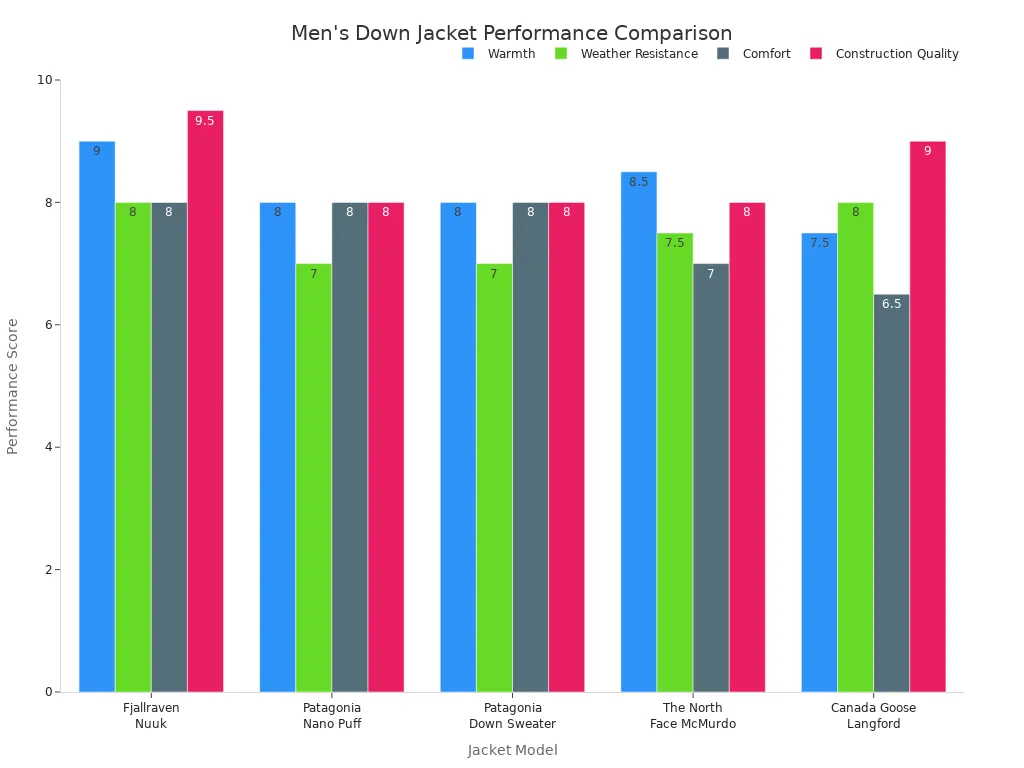
I always check charts and lists to see how jackets perform in real conditions. This helps me pick the right jacket for hiking, city use, or extreme cold.
When I choose a men’s down jacket, I focus on material, insulation, fit, water resistance, style, and durability. I use comparison tables to see warmth, weight, and price side by side. This helps me match jackets to my needs. Most buyers value high-quality materials and proper fit. I see long-term benefits in jackets with strong warmth-to-weight ratios.
Feature | Importance |
|---|---|
Material and Insulation | Impacts warmth, durability, and performance. |
Fit and Size | Crucial for comfort and protection. |
Water Resistance | Keeps me dry and comfortable. |
Style | Balances function and looks. |
Durability | Ensures reliability and long-term use. |
I always prioritize my needs and use decision points to make a confident choice.
The right jacket keeps me comfortable and ready for any adventure.
FAQ
What does fill power mean in a down jacket?
Fill power measures how much loft the down provides. I look for higher fill power because it traps more heat with less weight. Jackets with 800+ fill power keep me warmer and feel lighter during outdoor activities.
How do I clean my down jacket?
I wash my down jacket in cold water using a gentle cycle. I use a down-specific detergent. I tumble dry on low with clean tennis balls to restore loft. I avoid fabric softeners and bleach because they damage the insulation.
Can I wear a down jacket in the rain?
I wear my down jacket in light rain if it has a DWR finish. For heavy rain, I layer a waterproof shell over my jacket. Down loses warmth when wet, so I always check the weather before heading out.
How do I know if a jacket fits me well?
I try on the jacket with my usual layers. I move my arms and bend my elbows. If the jacket feels comfortable and does not restrict movement, I know it fits well. I check the sizing chart for each brand.
What is the difference between natural and synthetic down?
Natural down feels lighter and warmer. Synthetic down resists moisture better and dries faster. I choose natural down for cold, dry weather. I pick synthetic down when I expect rain or wet conditions.
Are expensive down jackets worth the price?
I pay more for jackets with high fill power, durable fabrics, and advanced features. These jackets last longer and perform better. Budget jackets work for casual use, but I invest in quality for outdoor adventures.
How do I store my down jacket when not in use?
I store my down jacket loosely in a breathable bag or hang it in my closet. I avoid compressing it for long periods. This keeps the down fluffy and maintains warmth.
What features should I look for in a hiking down jacket?
I look for lightweight design, high fill power, packability, and durable shell fabric. I prefer a hood for extra warmth. Zippered pockets and adjustable hems help me stay comfortable on the trail.