

Golf Course Staff Uniform OEM China | Pro Shop & Grounds Workwear
Table of Contents
Display
2)
Role Scope: Golf Staff Uniform Needs
3)
Choosing a Golf Course Uniform OEM in China
4)
Design & Customization
5)
Golf Course Uniform OEM Ordering Guide
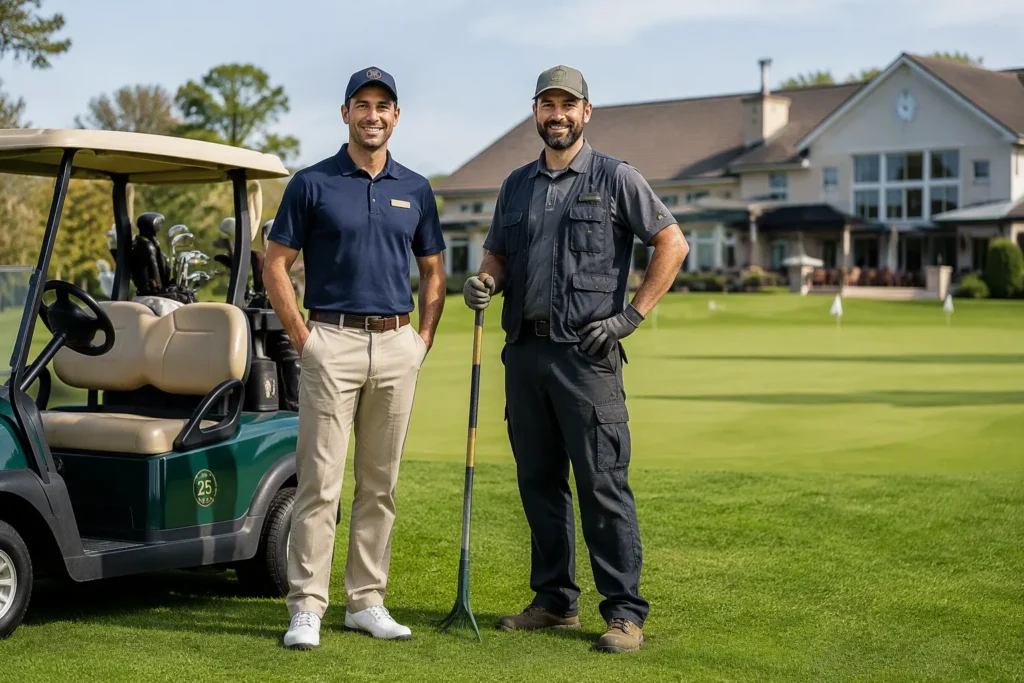
Getting custom golf course staff uniforms from an OEM maker in China takes three steps: decide the staff roles, pick a trusted partner, and follow a clear process from design to reorder. Shanghai Top Fortune Industry Co., Ltd. (Top Fortune) is one such partner. It has been in operation for years and runs a factory in Songjiang, Shanghai. The company focuses on OEM/ODM uniform making and serves buyers worldwide. Its minimum order quantity is set per style, suitable for bulk uniform orders.
Uniform packs based on roles keep the brand consistent, handle weather needs, and stay affordable. This guide covers adult golf staff only: pro-shop workers, starter and marshal desks, clubhouse F&B hosts, cart attendants, and outdoor grounds helpers in normal branded workwear, not special PPE.
Table of contents:
Role Scope: Golf Staff Uniform Needs
Choosing a Golf Course Uniform OEM in China
Design & Customization
Golf Course Uniform OEM Ordering Guide
Golf Course Uniform OEM Supplier Comparison
Distribution & Reorder Strategy
Related Uniform Solutions: landscaping and grounds uniforms, hotel and hospitality uniforms, facility management uniforms, marina and yacht club uniforms, and custom polo shirt OEM options
Key Takeaways
First, figure out what each staff role needs for a uniform. Pro shop workers need polos that let air through. Grounds crews need gear that lasts and handles any weather.
Pick a reliable OEM partner in China. Look for factory certifications such as BSCI, OEKO-TEX, and ISO 9001.
Pick the right fabrics for each job. Pro shop staff need moisture-wicking polos. Grounds helpers need softshells and twill trousers.
Use embroidery for logos on polos and caps. It lasts more than 100 washes. Printing works for big back logos.
Plan your order with care. Gather sizes, approve samples, and set a clear timeline with your supplier.
Compare suppliers on quality, lead time, and communication. A low price can mean bad quality.
Give out uniforms based on each person’s job to keep the brand looking the same. Keep track of your stock and set alerts for when to reorder.
Save your logo files and color codes for future orders. That way, every batch will look the same.
Role Scope: Golf Staff Uniform Needs
Golf clubs hire several different staff groups. Each group needs workwear that fits its daily tasks. The uniform program covers pro-shop associates, starter and marshal desks, clubhouse F&B hosts, cart attendants, and outdoor grounds helpers. All garments are normal branded workwear, not special protective gear.
Pro Shop Associates & Starter/Marshal Desks
Indoor Retail & Customer-Facing Attire
Pro-shop associates spend long shifts on their feet indoors. They greet members, handle sales, and restock shelves. Their uniform usually includes a polo, trousers, and a cap. Fabric choice matters here. A cotton-poly or performance blend gives a balanced feel and is easier to care for. A polyester micro-pique works well in hot or humid markets because it controls moisture and dries fast.
Breathability is not decided by composition alone. Knit structure changes a lot. A cotton-poly piqué, a smooth interlock, and a lightweight jersey can act very differently even when the fiber content looks the same on paper. That is why wear testing in the target climate often tells you more than another round of guesses.
Fabric Blend
Best For
Strengths
Watch-outs
Cotton-poly / performance blends
Uniforms, daily retail, broad-appeal programs
Balanced feel, easier care
Breathability depends as much on knit structure as fiber content
Poly-spandex blends
Athletic positioning, slim fits, mobility-focused polos
Stretch, recovery, lighter modern feel
Higher cost, more care sensitivity, decoration needs more planning
Polyester micro-piqué / lightweight performance blends
Hot or humid markets, performance polos, repeat bulk orders
Moisture management, quick-dry, color retention, durable surface
Feel varies; lower-grade versions can snag
Eco options (recycled polyester, organic cotton)
Sustainability-led or corporate requirement programs
Stronger material story, growing buyer interest
Color availability, MOQ, and lead time can be less stable
Starter & Marshal Visibility
Starter and marshal staff work at the first tee and move across the course. They need polos, light jackets, and caps. A quarter-zip pullover or light jacket adds warmth on cool mornings. Neutral and branded color palettes keep the look cohesive. Adult sizing ranges should cover a broad fit spectrum, and custom fitting options help staff find the right size.
Clubhouse F&B Hosts & Cart Attendants
Hospitality-Grade Presentation
Clubhouse F&B hosts serve members in dining rooms and lounges. Their uniform should look polished and handle spills. Wrinkle-resistant and stain-repellent fabrics work well. A casual polo with moisture-wicking and wrinkle resistance suits a relaxed clubhouse. A button-down shirt and slacks fit a more formal dining room. An apron over a neutral outfit works for bar and kitchen employees.
Cart Attendant Mobility
Cart attendants move constantly between the cart barn, bag drop, and parking areas. They need polos, caps, and light jackets that allow easy movement. Lightweight, breezy fabrics with a refined look keep them comfortable. Stretch service jeans or chino pants pair well with a performance polo.
Outdoor Grounds Helpers
Heavy-Duty Course Maintenance Workwear
Grounds helpers mow, trim, and maintain the course in all weather. Their uniform includes softshells, trousers, caps, and light jackets. A twill short and sweater polo combination gives a rugged, outdoorsy look with practical design. Utility shirts paired with twill shorts offer durability and a full range of motion.
Weather-Ready Layers
Layering options and varying fabric weights keep grounds crews comfortable year-round. Softshell jackets block wind and light rain. Light jackets add warmth without bulk. Durable, well-made uniforms maintain their appearance after frequent wear and washing, which supports long-term savings.
Choosing a Golf Course Uniform OEM in China
China has many uniform makers with long histories. Qiandao Apparel, for example, is an experienced uniform manufacturer. That matters for a golf club that needs the same sizing, fabric, and branding each season. A good golf course uniform OEM partner has factory capacity, useful experience, and clear communication.
Vetting Criteria for OEM Partners
Factory Capabilities & Certifications
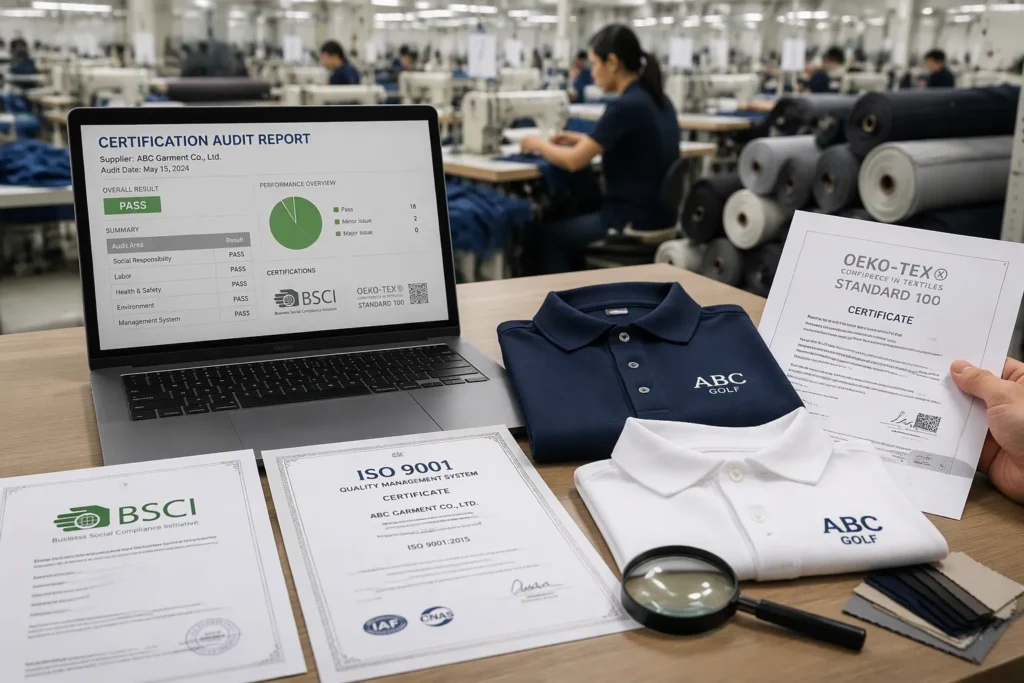
Buyers should check the factory’s legal identity first. Start with the Chinese legal name or the Unified Social Credit Code (USCC). This step confirms the right company before anyone opens a profile. Certifications then answer different questions, and no single document covers everything.
Layer | Certification | Covers |
|---|---|---|
Social | BSCI / SEDEX | Labor rights, OHS, wages, working hours |
Chemical | OEKO-TEX Standard 100 | Harmful substances, pH, formaldehyde, heavy metals |
Quality | ISO 9001:2015 | Process control, traceability, consistency |
Environmental | GRS / ISO 14001 | Recycled content verification, waste management |
A factory with BSCI but no OEKO-TEX may treat workers well yet ship fabric with restricted substances. A factory with OEKO-TEX but no BSCI might make safe fabric in a place with labor violations. The stack is the strategy. Buyers should ask for documents in a set order:
Ask for the BSCI Audit Report Summary and check grade, date, and scope.
Ask for the OEKO-TEX Standard 100 certificate and check product class and Annex level.
Ask for the ISO 9001:2015 certificate and make sure the scope covers fabric production.
Compare addresses on all three certificates with the real production site.
Check validity dates, because expired certificates mean nothing.
Treat a mill that cannot send all three within 48 hours as a warning sign.
If the buyer’s group has amfori access, compare the sent document with the platform record for activity date and result. Without direct access, ask the factory to make a verification link from its amfori account. Write down which verification route was used, so no one later claims supplier attachments were checked alone when they were not.
Golf & Hospitality Uniform Experience
Experience with golf and hospitality uniforms shows in the details. Ask how the factory handles moisture-wicking polos, easy-care wovens, softshells, and caps. Ask for references from clubs or resorts in similar climates. A factory that knows pro-shop presentation and grounds durability will suggest good fabrics and decoration methods without much prompting.
Communication Tips for Overseas Buyers
Language, Time Zones & Sampling
Most Chinese suppliers use WeChat and reply faster there than on platform messaging systems. DeepL usually beats other tools for Chinese-to-English translation. Keep messages short, clear, and specific. Avoid idioms, humor, and unclear phrases. Plan calls during China’s business hours for faster replies. After each talk, sum up the agreed points in writing and confirm them again. Ask for a video call or a video of the production facility. Ask for product samples before placing a bulk order; many suppliers charge for samples but credit the cost against the bulk order. Cross-check the supplier on Alibaba and Made-in-China.com to verify identity and product consistency. Check product listings for consistency, because a supplier selling unrelated categories may be a trading company.
MOQ, Lead Times & Payment Terms
Confirm specifications, quantities, packaging requirements, and lead times in writing before sending payment. Ask directly about the minimum order quantity, sample lead time, and bulk production schedule. Payment terms should tie to inspection milestones. Export-ready details include shipping terms, customs documentation, and packaging standards. A professional golf course uniform OEM will answer these questions with specific numbers rather than vague promises.
Why Top Fortune Stands Out
Songjiang Facility & OEM/ODM Expertise
Shanghai Top Fortune Industry Co., Ltd. (Top Fortune) is a uniform OEM manufacturer with a facility in Songjiang, Shanghai. The company focuses on OEM/ODM uniform manufacturing. This model lets clubs change fabrics, colors, and logo placement to match their own brand standards.
Export Markets & MOQ Flexibility
Top Fortune serves many international markets. Its MOQ is set per style, suitable for bulk uniform orders. Buyers can contact the team for pricing and details.
Design & Customization
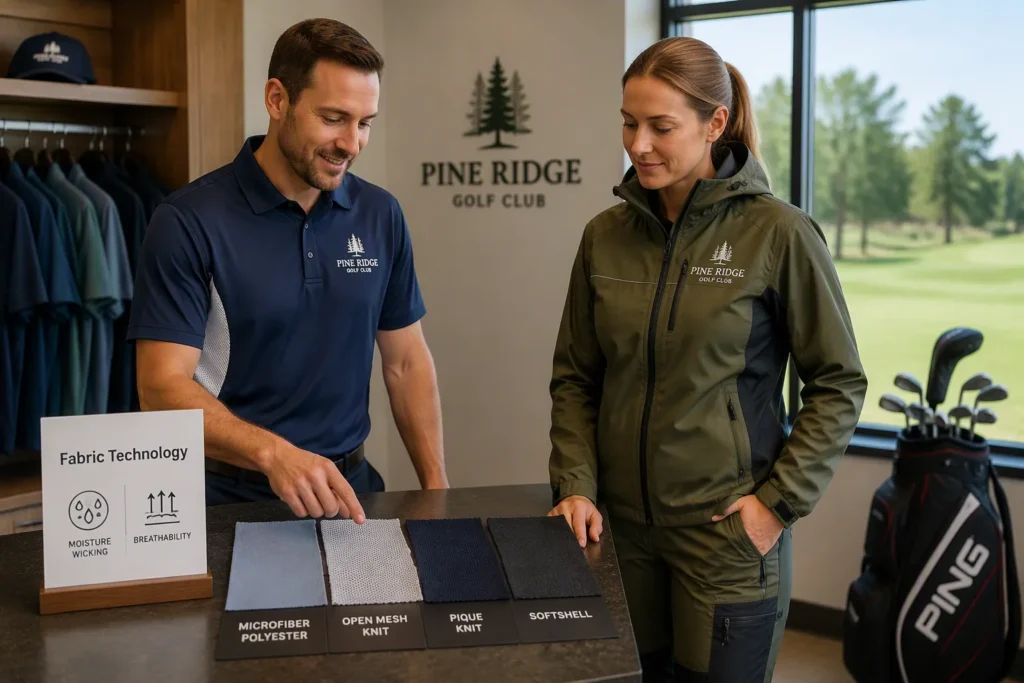
Fabric choice makes the difference between a uniform that lasts and one that fades after one season. Pro-shop staff need breathable, easy-care fabrics. Grounds crews need durable, weather-resistant materials. Both groups benefit from moisture-wicking polos, easy-care wovens, softshells, light jackets, trousers, and caps with logo embroidery.
Fabric Selection for Pro Shop vs. Grounds
Breathable Polos & Wovens for Indoor Staff
Pro-shop associates spend hours indoors greeting members and handling sales. Their polos must handle moisture without losing a professional look. Microfiber polyester with fine fibers increases surface area and capillary action, speeding wicking and drying compared to normal polyester. Engineered zoning adds mesh panels in high-sweat areas like underarms and the back, while keeping pique or jersey knit in visible areas. This method improves localized wicking.
Buyers can check wicking claims with simple absorption and drying tests. For lab checks, suppliers can provide standardized test reports.
Durable, Weather-Resistant Fabrics for Outdoor Crews
Grounds helpers face sun, wind, and rain during their shifts. Softshell jackets block wind and light rain. Light jackets add warmth without bulk. Twill trousers resist wear from tools and plants. These garments use weather-ready, easy-care fabrics that keep their look after many washes.
Logo Placement & Decoration Methods
Embroidery vs. Printing
Embroidery suits polos, caps, and softshells because it stands up to repeated washing. Embroidery is very durable and withstands many washes. Heat transfer methods have lower wash durability and may peel over time. Printing works better for larger back logos or lightweight fabrics where embroidery would add weight or stiffness.
Chest, Sleeve, Collar & Back Placements
Chest placement puts the club logo at eye level for customer-facing staff. Sleeve placement offers subtle branding on polos and light jackets. Collar embroidery adds a refined detail on caps and softshells. Back placement suits larger logos on outerwear or tournament-specific garments.
Color Palettes & Brand Consistency
Differentiating Roles While Maintaining Cohesion
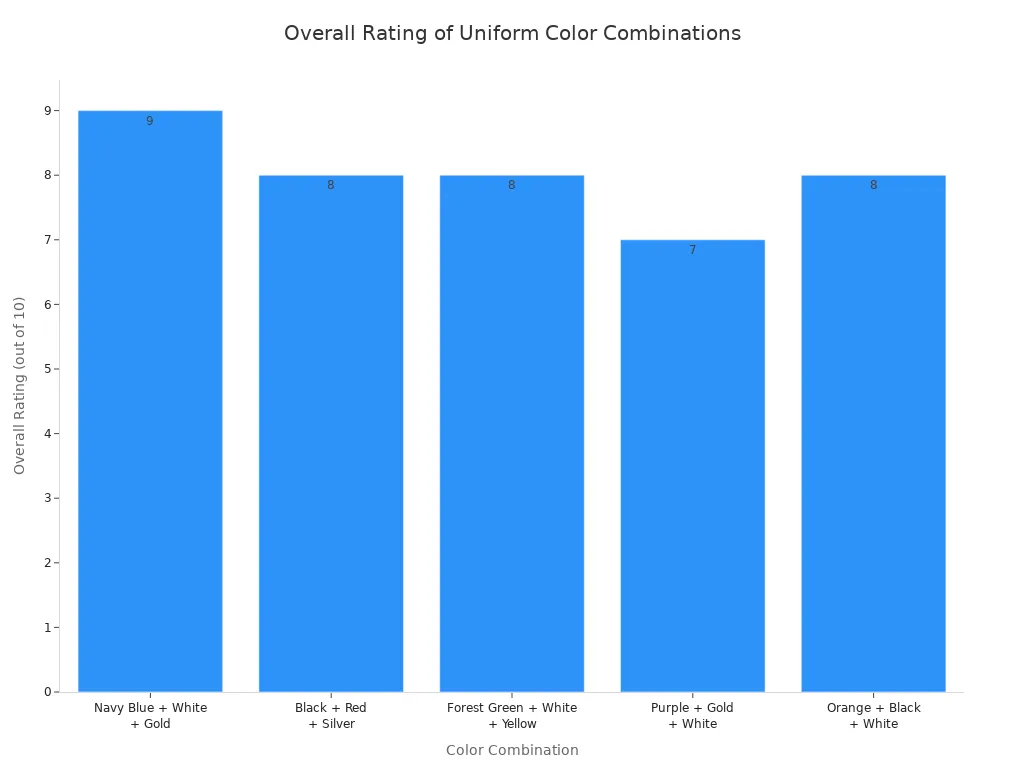
Color theory helps clubs show professionalism and improve on-course visibility. Navy, grey, and white give a timeless, elegant image. Bolder colors show confidence and energy. A common approach uses a dominant color for most of the uniform, a secondary color for contrast, and accent details for logos or trim. Starter and marshal staff benefit from high-contrast combinations for visibility. Pro-shop associates can wear quieter colors that match the clubhouse look.
Adult Sizing Ranges & Fit
Adult sizing must cover a wide range of body types. Clubs should take measurements or sample garments before bulk production. Fit sampling lets staff try sizes and give feedback on sleeve length, torso fit, and trouser inseam. This step cuts returns and makes sure every team member wears a uniform that fits well.
Golf Course Uniform OEM Ordering Guide
A good order starts with a clear plan. The club decides how many staff, collects sizes, checks samples, and then starts making the uniforms. Each step builds on the one before. A reliable golf course uniform OEM helps buyers through this process without surprises.
Headcount Planning & Sizing Collection
Role-Based Uniform Packs & Quantities
The club lists every staff member by their job. Pro-shop workers get polos, trousers, and caps. Starter and marshal staff also get light jackets. Clubhouse F&B hosts wear polos, softshells, and trousers. Cart attendants need polos, caps, and light jackets. Outdoor grounds helpers need softshells, trousers, caps, and light jackets. Each role has its own pack. This keeps the brand the same while meeting different job needs.
Size data helps control stock. Medium and large sizes are the most common, while XL and smaller sizes are ordered in lower quantities. For larger groups, ordering extra shirts in common sizes helps cover new hires and size swaps. For smaller groups, a few extra shirts in the most common sizes are sufficient.
Adult Size Charts & Fit Sampling
The club measures each staff member. A size chart from the factory helps with this. Fit sampling lets staff try on garments before full production. They give feedback on sleeve length, body fit, and trouser length. This step cuts returns and makes sure every staff member wears a uniform that fits.
Sampling, Production & Quality Control
Pre-Production Samples & Approvals
The factory makes a pre-production sample for each style. The club checks fit, build, and grading. A top sample and size set approval come next. These steps confirm the design before cutting starts. Sampling typically takes a few weeks.
In-Line & Final Inspections
Quality control happens throughout the whole order. The factory checks incoming fabric for weight, color, flaws, and shrinkage. Lab tests cover composition, colorfastness, pilling, and UPF. In-line inspection occurs during production. Inspectors check the first few pieces and then do regular checks on size and workmanship. Logo, embroidery, and print placement get close review. A final random inspection uses standard acceptable quality limits (AQL) for major and minor defects. This pass or fail decision happens after 100% completion. Bulk production typically finishes within several weeks after sample approval.
Shipping methods depend on order size and destination. Express courier is suitable for light shipments, air freight for medium shipments, and ocean freight for bulk orders. Costs and transit times vary by carrier and route.
RFQ & Specification Table
What to Include in Your RFQ
A full RFQ helps the factory give a correct quote. The buyer lists each item, fabric choice, color, logo spot, decoration method, size range, quantity, and target price. Clear details cut down on back-and-forth messages. The club should also give its delivery date and shipping choice.
Sample Specification Table for OEM Quotes
Item | Fabric | Color | Logo Placement | Decoration Method | Size Range | Quantity | Target Price |
|---|---|---|---|---|---|---|---|
Pro-shop polo | Moisture-wicking poly | Navy | Left chest | Embroidery | S–3XL | 300 | TBD |
Starter jacket | Softshell | Grey | Right chest | Embroidery | S–3XL | 100 | TBD |
F&B host polo | Easy-care blend | White | Left chest | Embroidery | S–3XL | 200 | TBD |
Cart attendant cap | Cotton twill | Navy | Front panel | Embroidery | One size | 150 | TBD |
Grounds softshell | Weather-resistant | Dark green | Left chest | Embroidery | S–3XL | 250 | TBD |
This table gives the golf course uniform OEM a clear starting point. The factory can then confirm fabric stock, lead times, and final prices. Buyers should ask for a sample kit before ordering in bulk.
Golf Course Uniform OEM Supplier Comparison
Price alone does not show the best partner. A club must compare unit cost to quality, lead time, communication, minimum order size, and export experience. Price varies by quality, order quantity, and manufacturing location. Buyers should request quotes from multiple suppliers for comparison.
Comparing OEM Suppliers: Key Factors
Price, Quality, Lead Time & Communication
A low price often hides bad fabric or rushed stitching. Buyers should ask for fabric samples and wash-test reports before comparing costs. Lead time matters for clubs that need uniforms before the season. Sampling typically takes a few weeks, and full production takes several weeks. How fast a supplier replies tells good ones from bad ones. A factory that responds promptly is more likely to handle issues efficiently.
Red Flags & Green Flags
Certain signs warn buyers off. Unclear prices with hidden fees, no sample policy, slow or unclear replies, and no factory audit report all mean risk. A supplier that cannot give BSCI, OEKO-TEX, or ISO 9001 papers raises worries about labor and safety.
Good signs include clear price sheets, samples before big orders, fast replies, audit reports, and export references from similar markets. A golf uniform maker with past shipments abroad knows customs forms and packaging rules.
Buyer Checklist for Golf Course Uniform OEM
Pre-Order Checklist
Before sending a request for quote, the club should list each job and the clothes each job needs. Pro-shop associates need polos, trousers, and caps. Starter and marshal staff also need light jackets. Grounds helpers require softshells and durable trousers. Then the club gets sizes from all staff and makes vector logo files for embroidery. A full request includes item, fabric, color, logo spot, decoration type, size range, quantity, and target price.
Post-Order & Reorder Checklist
After production starts, the buyer should check the timing of in-line checks and final quality standards. Shipping terms, customs papers, and packaging details need written OK. For reorders, the club should keep digitized embroidery files and fabric samples. The supplier should save these records so later batches match the original color and logo exactly. A reorder plan with clear size levels stops running out during the busy season.
Distribution & Reorder Strategy
A uniform program works only when each department gets the right pack and the club can order more later. Handing out uniforms and reordering need the same care as the first order.
Distributing Uniforms Across Departments
Pro Shop vs. Grounds: Separate Packs, Unified Brand
Each role gets its own kit pack. Pro-shop workers receive polos, trousers, and caps. Grounds crews get softshells, trousers, caps, and light jackets. These packs share one look, but they differ slightly by role. This keeps the club brand the same while giving each team the right clothes for its job.
Staff uniforms should not match player uniforms exactly. They must share a color family, a logo style, and one visual detail.
Players may wear navy polos with white trim. Staff may wear a lighter blue or grey polo with the same logo size, same sleeve detail, and the same hat color. The two groups are clearly different, but they still belong to one club program.
Small role differences help guests know who to ask for help. A color, a trim detail, or a different cap can show the role without breaking the club look.
Best Practice | Description | Applies To |
|---|---|---|
Role-based packs with shared uniform language | Separate kit packs per role that share one visual system | Pro shop, grounds crews, event staff, volunteers |
Related-but-separate identity for staff vs. players | Staff uniforms share a color family, logo standard, and one visual detail with player uniforms | All staff roles vs. players |
Locked logo placement map and hierarchy | Approve a logo order and lock spot locations across all clothes | All roles and future reorders |
Defined color and reorder standards | Lock a specific color code, save logo files, set a fit baseline, and record which roles got which pack | Club-wide, especially for ongoing programs |
Comfort and wearability for outdoor staff | Use breathable, easy-care fabrics and stable sizing for long outdoor shifts | Grounds crews, outside service staff |
Small role differences for recognition | Tell roles apart through color, trim detail, or hat style | Pro shop, outside service, event staff, volunteers |
Inventory Tracking & Size Management
The club records which roles received which pack. It also tracks sizes by department. Par levels set a minimum stock count for each item. When stock falls below that level, a reorder trigger starts the next purchase. This method prevents shortages during the busy season.
Maintaining Reorder Consistency
Fabric & Color Matching Across Batches
Color and fabric must match across batches. The club locks a specific color code instead of a vague name like “navy.” It keeps a fabric sample from the approved batch. The supplier stores these records so later orders match the original shade and feel.
Logo File Retention & Reorder Protocols
The club saves digitized embroidery files and vector logos. The supplier keeps these files on record. A reorder then uses the same logo size, placement, and thread color as the first run. The club confirms the fit baseline and the pack list before each reorder. This rule keeps every new batch consistent with the original program.
Related Uniform Solutions
Golf clubs sometimes run more than one area or service team. The same OEM partner can provide uniforms for nearby grounds crews, clubhouse hospitality teams, and special staff. These linked programs use the same fabrics, colors, and logo rules as the golf staff packs.
Landscaping & Grounds Uniforms
Durable Workwear for Outdoor Teams
Landscaping and grounds crews deal with the same sun, wind, and rain as golf course workers. They need softshells, strong trousers, caps, and light jackets that hold up against tools and plants. A club can buy these clothes in the same color range as its golf staff packs. This way the whole property looks the same for all outdoor teams.
Top Fortune makes these items with weather-ready, easy-care fabrics and logo stitching. Clubs can learn more about the landscaping and grounds uniform program for fabric choices and adult size ranges.
Hospitality & Facility Management Uniforms
Hotel-Hospitality & Facility-Management Solutions
Many golf clubs have a clubhouse hotel, a restaurant, or a building team. Those workers need nice polos, easy-care woven shirts, and softshells that fit the club brand. The hotel and hospitality uniform collection includes front-desk, dining, and housekeeping roles in adult sizes.
Facility management teams need tougher clothes for repairs and cleaning jobs. The facility management uniform range gives trousers, polos, and light jackets with the same embroidery rules. One supplier keeps colors and logo spots the same across all departments.
Custom Polo & Specialty Uniforms
Custom Polo Shirts for Golf Staff
The polo is the main piece in every golf staff pack. Pro-shop workers, starters, marshals, cart attendants, and F&B hosts all wear one. A club can buy moisture-wicking polos with left-chest stitching in its own colors and adult sizes. The custom polo shirt OEM page tells about fabric weights, collar types, and decoration methods.
Marina-Yacht-Club & Spa-Therapist Uniform Options
Clubs that have a marina or a spa need uniforms that work in those places. Marina and yacht club workers wear polos, softshells, and caps that stand up to spray and wind. The marina and yacht club uniform options use the same branding rules as golf staff packs.
Spa therapists need soft, easy-care clothes that let them move freely during treatments. The spa therapist uniform collection gives tunics, trousers, and light layers in adult sizes. Each program keeps one look across the entire property.
A successful golf staff uniform program follows five steps. First, define each role and its clothing needs. Second, vet OEM partners for factory audits, sampling speed, and export references. Third, design with weather-ready fabrics and consistent branding. Fourth, follow a structured ordering process from sizing to inspection. Fifth, plan reorders with saved logo files and locked color codes.
Shanghai Top Fortune Industry Co., Ltd. (Top Fortune) supports every step. The company serves many international markets and has a typical MOQ for bulk orders.
Contact the team for a quote, sample kit, buyer checklist, and RFQ template today.
FAQ
How many pieces do I need to order for custom golf staff uniforms?
Top Fortune’s MOQ is typical for bulk uniform orders. Contact them for specific requirements. This works well for clubs that buy full packs for each role instead of single items.
How long do samples and the full order take?
Sample production takes a few weeks. Full production takes several weeks after sample approval. Shipping times vary by method and destination.
Which fabrics work best for pro-shop staff versus grounds staff?
Pro-shop workers need fabrics that breathe and are easy to care for, like polos that pull moisture away and woven shirts that need little ironing. Grounds workers need tough, weather-proof fabrics such as softshells and twill pants. Both groups do well with fabrics that keep their color and shape after many washes.
Should clubs pick embroidery or printing for logos?
Embroidery works best for polos, hats, and softshells because it is very durable and withstands many washes. Printing is better for large logos on the back or lightweight fabrics where embroidery adds weight. Most golf staff programs use embroidery for logos on the chest or sleeve.
What adult sizes does Top Fortune offer?
Top Fortune offers a range of adult sizes. Clubs should take measurements of every staff member and ask for fit samples before the full order. This step cuts down on returns and makes sure everyone gets a uniform that fits well.
Which certifications should buyers ask for from an OEM partner?
Buyers should ask for BSCI or SEDEX for fair labor practices, OEKO-TEX Standard 100 for chemical safety, and ISO 9001:2015 for quality control. These papers show the factory meets global rules for worker treatment and product safety.
How can clubs keep color and logo the same when they reorder?
Clubs should lock in a specific color code, keep the digital embroidery files, and save a fabric sample from the approved batch. The supplier stores these records so future orders match the original color, logo size, and placement exactly.
How can I reach Top Fortune to ask for a quote?
Buyers can contact Top Fortune for a quote, sample kit, and RFQ template.