

Sports Nutrition Sales Rep Apparel OEM | Distributor Field Teams
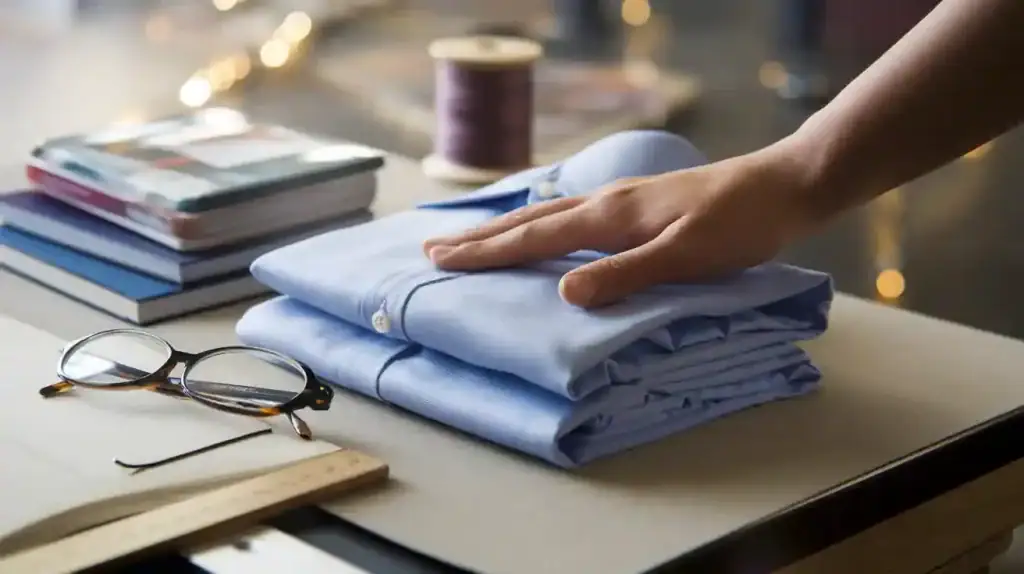
You can source OEM apparel for your field team in four steps: define what the field team needs, find specialized suppliers, evaluate samples against performance, fit, compliance and cost, then manage production and delivery. Your sales reps and merchandisers are the brand’s face on every store visit and trade call. Their sports nutrition sales rep apparel must hold up on the road and represent the brand consistently. This guide gives you a practical, step-by-step playbook. You can run it yourself, even without a dedicated procurement team, and move from brief to bulk delivery with confidence.
Key Takeaways
Define your field team’s roles and work conditions first. Write fabric, fit, decoration, and labeling requirements into one brief.
Shortlist specialized OEM/ODM factories with proven polo and softshell experience. Ask for relevant category experience and sampling timelines.
Approve a fit sample, then sign off a pre-production sample (PPS) for decoration and labeling. Release bulk only after the PPS matches.
Plan for a minimum order quantity around 2,000 pieces per style. Consolidate sizes and colors into one style family per season.
Protect your brand with consistent color, clean logo placement, and durable fabrics. A simple, repeatable process keeps every regional team looking the same.
Quick Takeaways for Busy Reps
You do not need a procurement department to outfit a field team well. You need a clear brief, a short supplier list, and a disciplined approval sequence. The points below summarize the whole playbook, so you can scan them now and return to the detailed sections as you work through each stage.
Define the field need first. List the roles you are outfitting — sales reps, merchandisers, regional leads — and the conditions they work in. Store visits, trade calls, and travel days each call for a different layer. Write the fabric, fit, decoration, and labeling requirements into one brief before you contact any supplier.
Shortlist specialized suppliers. Look for OEM/ODM workwear factories with proven polo and softshell programs, not generalist trading companies. Ask for relevant category experience, in-house decoration capability, and a clear sampling timeline.
Gate every stage. Approve a sample for fit and hand feel, then sign off a pre-production sample (PPS) for decoration placement, labeling, and color consistency. Release bulk only after the PPS matches your approved sample.
Plan for volume. Expect a minimum order quantity in the low thousands per style, so consolidate sizes and colorways into one style family per season. Confirm lead times in writing and book a reorder window before the current stock runs low.
Protect the brand on the road. Your reps are the brand’s face in every account. Consistent color, clean logo placement, and a durable fabric blend matter more than a fashion-forward cut. A simple, repeatable process keeps every regional team looking the same.
Treat these five points as your working checklist. Each later section expands one of them with the specs, tables, and approval criteria you need to run the cycle yourself.
Who This Guide Is For and Buyer Intent
This guide serves sports-nutrition brands, supplement distributors, and regional merchandising and field sales leads. You are an adult B2B overseas buyer. You manage teams that visit retail accounts, run trade calls, and support product launches in the field. This guide does not address school buyers or student uniform programs. Your focus is commercial field apparel that carries your brand into every account conversation.
Shanghai Top Fortune Industry Co., Ltd. is your manufacturing partner for this work. The company was founded around 2002 and operates a 1,506 m² factory in Songjiang, Shanghai. It specializes in OEM/ODM workwear and exports to Europe, the Middle East, Oceania, Southeast Asia, and the Americas. You can review the full capability set at https://www.workwearmanufacturer.com/ and the company background at https://www.workwearmanufacturer.com/about-us/. The factory builds polos, softshells, and light layers under one roof, so you can consolidate a field-team program with a single supplier.
Order volume shapes your planning. The minimum order quantity is about 2,000 pieces per style. Treat that figure as your baseline when you build the size curve and color plan for a season. A single style family across two or three colorways usually absorbs the volume without excess stock. You can split the quantity across sizes to match your regional team headcount.
Reach the team directly to start a conversation. Email rill@topfortunemail.com or message WhatsApp +86 13524210501. The factory address is Floor 3 Building 20 Haier Zhigu No.66 Guangfulin East Road Songjiang Shanghai 201600. Share your team size, roles, and timeline in the first message. A clear brief helps the team respond with relevant fabric and decoration options for your sports nutrition sales rep apparel program. You will get a faster, more useful reply when your inquiry names the styles and quantities you have in mind.
Table of Contents
Use this table of contents to move through the playbook in the order that fits your timeline. Each section builds on the one before it. You can jump straight to a section when you already have that part of your program under control. The links below take you to every major section of this guide.
Quick Takeaways for Busy Reps
Who This Guide Is For and Buyer Intent
Spec the Sports Nutrition Sales Rep Apparel Stack
Build the RFQ and Specs Table
Gate Samples, PPS, and Bulk
Catalog vs. Private-Label Field-Sales OEM
Copy-Paste Procurement Checklist
Manage Suppliers, Negotiation, and Logistics
Start with the quick takeaways when you need a fast overview. Read the buyer intent section next to confirm your role and volume baseline. Move to the spec stack and the RFQ table when you are ready to write your brief. The sample, PPS, and bulk section covers your approval gates. The catalog versus private-label comparison helps you choose a sourcing model. The checklist gives you a reusable tool for each cycle. The final section covers supplier management, negotiation, and logistics for repeat rollouts.
You do not need to read every section in one sitting. Bookmark this page and return to the section that matches your current stage. A field-team apparel program runs in cycles, so the same sections will serve you again next season.
Spec the Sports Nutrition Sales Rep Apparel Stack
Your field team works in three settings: the retail floor during a store visit, the meeting room during a trade call, and the car or airport between accounts. Build the stack around those settings. A durable polo covers most visits. A softshell handles cold mornings and outdoor account stops. A light layer bridges the seasons and packs small in a travel bag.
Polo, Softshell, and Light Layer
Start with the polo as your base piece. Choose a cotton-rich or performance-blend knit that resists pilling after repeated washes. Your reps wear the same shirt across long days, so colorfastness matters as much as hand feel. Keep the decoration simple: a left-chest logo and an optional back mark. This piece carries the most brand exposure, so order it in your core colorways first.
The softshell is your outer layer for cooler routes and early trade calls. Look for a bonded three-layer construction with a breathable membrane and a water-repellent finish. A clean chest panel gives your logo a stable surface. Add a light layer — a quarter-zip or a packable vest — for temperature swings between stores. These pieces should share a color family with the polo, so a rep can mix layers without breaking the brand look.
Store-Visit and Trade-Call Fit
Fit separates field apparel from other branded garments. Your reps sit, drive, reach shelves, and stand for hours. Choose a cut with room through the shoulder and a hem that stays tucked or sits cleanly untucked. Test the fit on real body types across your team before you approve bulk.
This is where field apparel differs from neighboring categories. Retail shop-floor uniforms suit fixed indoor shifts with heavy customer contact. Gym-instructor kits fit high-movement coaching sessions. Sports-club front-desk apparel serves a reception setting. Each works well in its own context. Your sports nutrition sales rep apparel must travel between all three environments, so prioritize versatility, durability, and a consistent brand read on the road.
Build the RFQ and Specs Table
A request for quotation (RFQ) works best as a single table your supplier can fill in and return. Put every requirement in one row, and leave a column for the supplier’s response. This format removes guesswork from the first reply and gives you a document you can compare across suppliers side by side.
Spec item | What to state in your RFQ |
|---|---|
Fabric | Fiber blend and construction, such as cotton-rich knit or bonded softshell |
Weight / GSM | Target fabric weight in GSM, with an acceptable range |
Decoration method | Embroidery, screen print, or sublimation, plus logo placement |
Sizing | Size range, size curve, and whether you need a tall option |
Labeling | Woven or printed main label, care label, and country-of-origin mark |
Packaging | Poly bag or hang tag, carton configuration, and shipping marks |
Lead time | Sampling window and bulk delivery window, stated in weeks |
Three terms appear in almost every field-apparel RFQ, so define them before you send the table. GSM means grams per square meter, a standard measure of fabric weight. A higher GSM generally signals a heavier, denser cloth. Sublimation is a decoration method that dyes the fabric itself, so the print does not sit on top of the surface. PPS means pre-production sample, the approved reference piece your bulk order must match.
Fill the table with your own targets, not the supplier’s defaults. Name the fabric you want and the weight range you will accept. State the decoration method and the exact logo position. List your size curve so the supplier can quote the full order. Add your labeling and packaging rules, then close with the delivery window you need. A complete table shortens the quote cycle and reduces the chance of a revision later.
Gate Samples, PPS, and Bulk
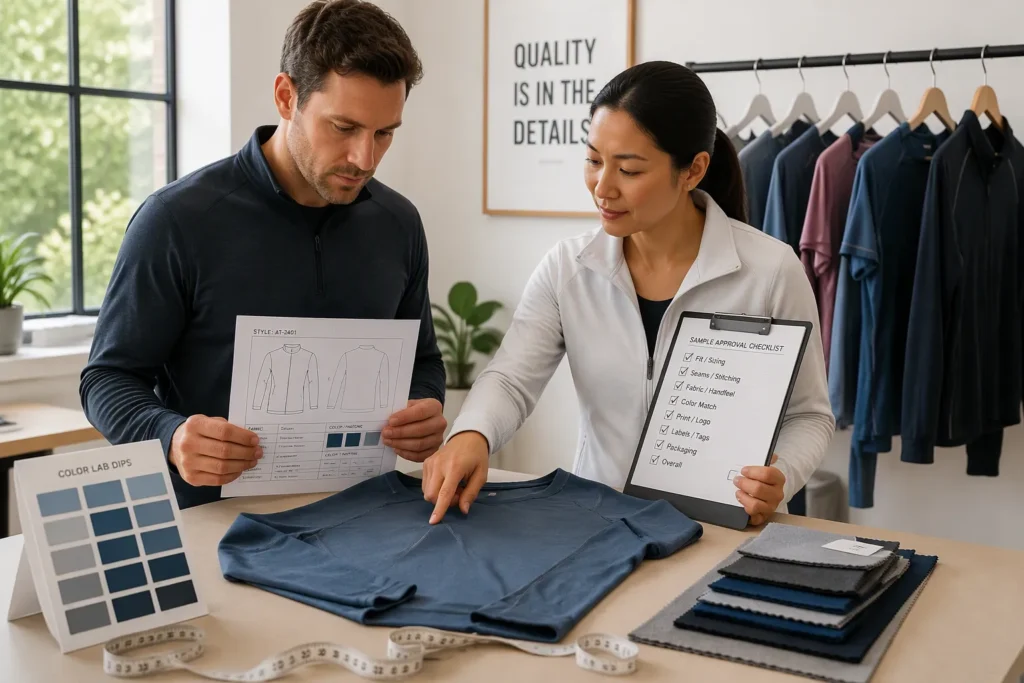
Treat sampling as a sequence of gates, not a single event. Each gate protects the next one. You approve a sample for fit and hand feel, then sign off a pre-production sample (PPS) for decoration and labeling, then release bulk. Skipping a gate moves risk downstream, where corrections cost far more.
Sample Approval Criteria
Your first sample answers one question: does this garment work for a rep on the road? Check fit on real body types from your team. Measure the chest, shoulder, and body length against your spec sheet rather than judging by eye. Confirm the fabric weight and hand feel match your RFQ. Inspect decoration placement under daylight, not just in photos, because lighting and camera angles can hide minor defects. Wash the sample before approval. Color bleeding or garment twisting shows up here, long before bulk fabric is cut.
Plan for revision rounds. Expect at least 2 to 3 rounds of revisions during custom apparel sampling, with each round refining drape, stitch density, and hardware placement. A complete tech pack shortens this cycle considerably. Change one variable per round — fit, fabric, or decoration — so you know what caused any improvement or problem.
PPS Sign-Off Before Bulk
The PPS is your contract piece. Bulk must match it exactly. Sign off only after you verify four things: fit measurements, decoration scale and placement, label content and position, and color consistency across the size set. Approve a corrected second sample (PPS2) when you find major defects. Comments alone get lost once production starts.
Reject these common PPS failures before they reach the line:
Approving a PPS “with comments” despite major defects instead of demanding a corrected second sample (PPS2), since comments get lost once production starts.
Overlooking packaging details on the PPS (actual polybag, scannable barcode sticker), missing the chance to validate the unboxing experience.
Skipping the wash test on the PPS, so color bleeding or garment twisting only surfaces after bulk fabric is already cut.
Then lock your inspection standard. Most bulk garment orders are inspected under Level II (Normal Inspection), with the AQL level selected based on product risk, customer expectations, and past factory performance. Use this table as your default acceptance plan for sports nutrition sales rep apparel.
Defect Category | Typical AQL Level |
|---|---|
Critical defects (safety/unusable issues) | 0 or 1.0 |
Major defects (reduced saleability/spec violations) | 2.5 (sometimes 1.5) |
Minor defects (cosmetic, non-functional) | 4.0 (sometimes 6.5) |
For finished garments, hold critical defects at zero and inspect stitching, fit, labeling, and trims against the major and minor levels above. Book the inspection before shipment, review the report, and release bulk only when the results meet your plan.
Catalog vs. Private-Label Field-Sales OEM
You have two sourcing routes for field-team apparel. Catalog stock gives you ready-made garments from a supplier’s existing range. Private-label OEM builds the garment to your own specification and carries your brand. Both routes work well. The right choice depends on your timeline, your volume, and how much control you need over the final piece.
Catalog stock suits a fast rollout. You pick from available colors and sizes, add your logo, and receive garments quickly. This route fits a small regional team, a pilot program, or a short seasonal push. Private-label OEM fits a full field-team program. You control the fabric, the fit, the decoration, and the labeling. Your sports nutrition sales rep apparel then matches the brand standard across every region.
Factor | Catalog Stock | Private-Label Field-Sales OEM |
|---|---|---|
Lead time | Fastest of the production models | Medium to long |
Customization | Limited to available colors and cuts | Full control of fabric, fit, and trim |
Brand consistency | Depends on the stock range | Built to your spec sheet |
Best fit | Pilots, small teams, urgent needs | Full rollouts, multi-region teams |
Volume | Flexible, lower entry | Suits a planned seasonal order |
Timing separates the two routes most clearly. Ready-made blanks move fastest, OEM manufacturing sits in the middle, and private-label production runs medium to long. Plan your calendar around that order. A private-label sample typically turns around in 7–10 days, and a reorder usually ships in 10–15 days, so repeat cycles stay predictable once the first run is approved.
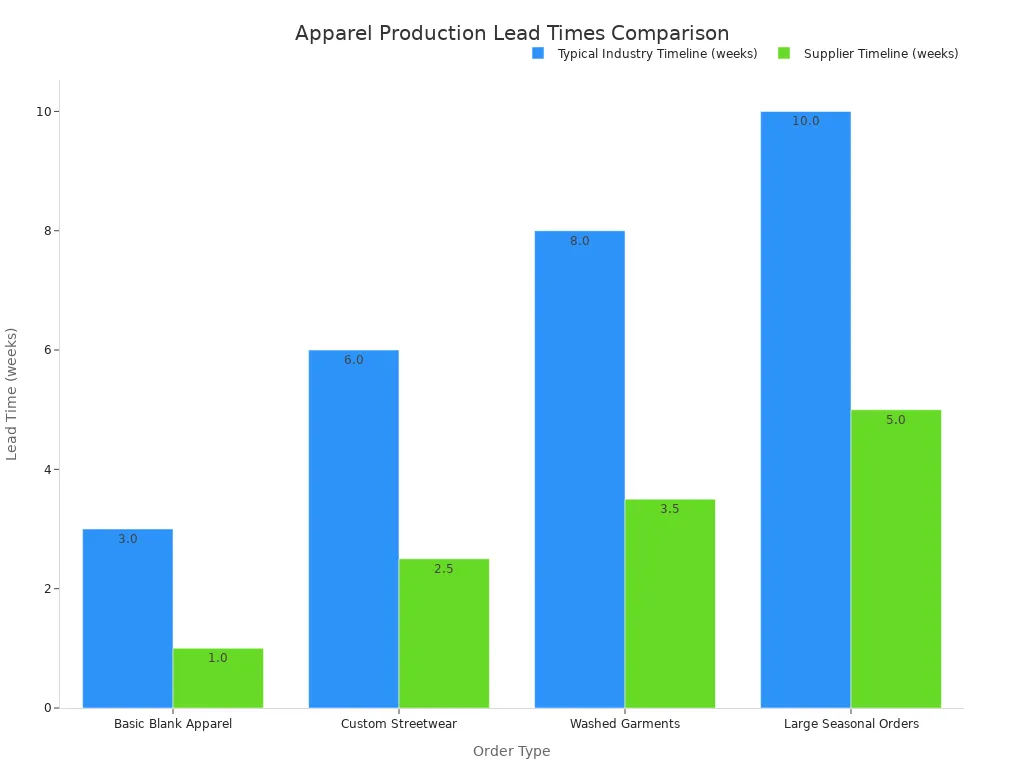
Many distributors start with catalog stock for a pilot and move to private-label OEM once the team size and brand standard settle. You can run both routes in the same year. Use catalog stock to cover a gap and private-label OEM to build the core program.
Copy-Paste Procurement Checklist
Reuse this checklist at the start of every sourcing cycle. Copy it into your brief document, work down the list, and tick each item before you move to the next stage. The sequence mirrors the approval gates in this guide, so nothing slips between the sample and the shipment.
☐ Write the role list: sales reps, merchandisers, regional leads, plus headcount per region.
☐ Set the layer plan: polo as the base piece, softshell for cold routes, light layer for seasonal swings.
☐ Fix the fabric and weight target in GSM, with an acceptable range.
☐ Choose the decoration method and mark the exact logo position on a garment diagram.
☐ Build the size curve and confirm the tall option if your team needs it.
☐ Confirm the minimum order quantity of about 2,000 pieces per style against your seasonal plan.
☐ Shortlist three OEM/ODM suppliers with proven polo and softshell programs.
☐ Send the RFQ table and request a written sampling and bulk timeline.
☐ Approve the fit sample on real body types, then wash it before sign-off.
☐ Allow 2 to 3 revision rounds and change one variable per round.
☐ Sign off the PPS only after checking fit, decoration, labels, and color across the size set.
☐ Lock the inspection plan: Level II normal inspection, zero tolerance on critical defects.
☐ Book the pre-shipment inspection and review the report before release.
☐ Record the approved PPS measurements and file the piece as your reorder reference.
Keep the completed checklist with the approved PPS in one folder. Your next reorder then starts from a known reference instead of a blank page. A reorder usually ships in 10–15 days once the first run is approved, so a filed checklist shortens every cycle that follows.
Manage Suppliers, Negotiation, and Logistics
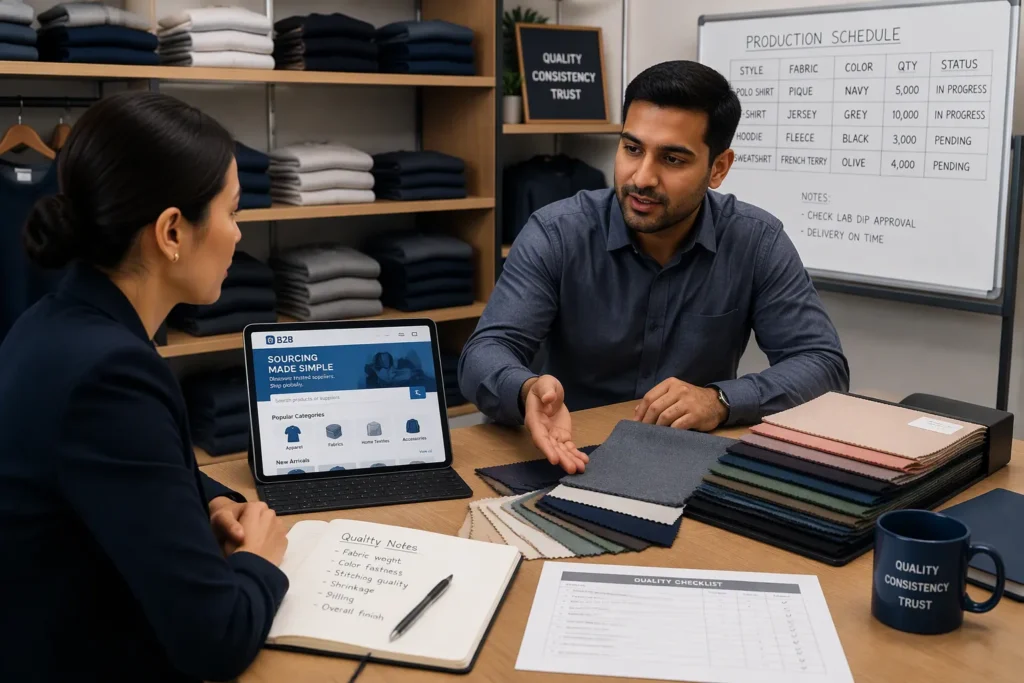
A strong supplier relationship carries your field-team program across seasons. Screen candidates through several channels, negotiate on more than price, and lock quality control into every production run. This section shows you how to do all three.
Screening and Negotiation
Start with a mix-and-match approach. Survey the landscape on a B2B marketplace, then vet your shortlist at trade shows and in industry communities. Each channel has a distinct strength.
Sourcing Channel | Best For | Pros | Cons |
|---|---|---|---|
B2B Marketplaces | New brands seeking variety and competitive pricing | Large global supplier selection; transparent pricing and reviews | Overwhelming; high MOQs; communication barriers |
Industry Trade Shows | Brands wanting relationships and in-person quality assessment | Inspect fabrics firsthand; build personal connections; spot trends | Travel budget and time required; intimidating for newcomers |
Industry Communities | Those seeking honest peer feedback and niche suppliers | Candid reviews; discover niche/local suppliers | Subjective information; requires active participation |
Alibaba offers a massive manufacturer network at low prices, but expect high MOQs and complex navigation. Faire links independent brands with suppliers at lower MOQs and simpler terms, at a higher per-piece cost. Trade shows such as MAGIC in Las Vegas and Texworld in New York let you inspect fabric in person. Facebook groups and subreddits give you unfiltered peer reviews.
Negotiation starts with diagnosis. Ask the factory whether its MOQ comes from cutting and sewing capacity or from fabric purchasing. Then simplify their queue: accept stock trims, consolidate styles across one fabric family, and use in-stock materials to bypass mill minimums. Lock a firm confirmed ex-factory date in writing, and require in-line production photos. Treat the first run as paid learning, then share sell-through data and ask for the next quantity price break. Suppliers drop prices aggressively once you replace promises with a real purchase order — one example shows a 15% price drop on a second PO. Offer non-price value too: early payment at a 2–3% discount, design exclusivity, or simplified specs. Place orders in February–March or July–August, when factories are hungry for capacity.
Quality Control and Reordering
Build QC into three checkpoints. Incoming quality control (IQC) inspects fabric for shade, width, weight, flaws, and shrinkage before cutting. In-process quality control (IPQC) monitors sewing in real time, including first-piece inspection, inline audits, and a mid-line audit to catch drift. Final quality control (FQC) audits packed goods against your approved pre-production sample before shipment. Supporting tests include the 4-point fabric defect system, colorfastness, shrinkage after wash cycles, pilling resistance, and seam strength.
Reordering rewards preparation. Log actual supplier lead times rather than quoted ones, and share forecasts with key suppliers 6–8 weeks ahead so they adjust production schedules. Give field crews inventory visibility, so they flag low stock days before a shortage hits. One documented program cut lead times by 65%+ from launch and reached 98%+ on-time delivery after stabilizing its decoupling point. Keep your approved PPS measurements on file, and your next sports nutrition sales rep apparel rollout starts from a known reference.
You now have a complete sourcing path. Define the field team’s needs, find specialized suppliers, evaluate samples against performance, fit, compliance, and cost, then manage production and delivery. That four-step cycle turns a vague apparel idea into a consistent brand program.
Take the first step this week. Draft the field team’s apparel brief, then shortlist three suppliers and request quotes at rill@topfortunemail.com. Review our custom polo shirt manufacturing and corporate polo shirts OEM pages for decoration options, and compare custom jacket manufacturing for your softshell layer. Our company profile and homepage show the full factory capability.
A simple, repeatable process keeps your sports nutrition sales rep apparel consistent and professional on every road trip. Explore our fitness and sports nutrition retail staff apparel and gym instructor branded apparel programs, then read more field-apparel guidance on our blog.
FAQ
What is the minimum order quantity for field-team apparel?
The minimum order quantity is about 2,000 pieces per style. Build your size curve and color plan around that baseline. A single style family across two or three colorways usually absorbs the volume without excess stock. You can split the quantity across sizes to match regional team headcount.
How do I request a quote for my field team?
Email rill@topfortunemail.com with your team size, roles, and timeline. Name the styles and quantities you have in mind. The team replies with relevant fabric and decoration options. A clear brief shortens the quote cycle and reduces the chance of a revision later.
How does this apparel differ from retail shop-floor uniforms?
Retail shop-floor uniforms suit fixed indoor shifts with heavy customer contact. Your field apparel must travel between store visits, trade calls, and travel days. Prioritize versatility, durability, and a consistent brand read across every account conversation.
How long does sampling and reordering take?
A private-label sample typically turns around in 7–10 days. Expect 2 to 3 revision rounds before approval. A reorder usually ships in 10–15 days once the first run is approved. File your approved PPS measurements as the reorder reference.
Can I start with a small pilot before a full rollout?
Yes. Catalog stock covers a pilot, a small regional team, or an urgent seasonal push. Move to private-label OEM once team size and brand standard settle. Many distributors run both routes in the same year.