

Gym Instructor Branded Apparel OEM | Fitness & Supplement Brands
Table of Contents
Display
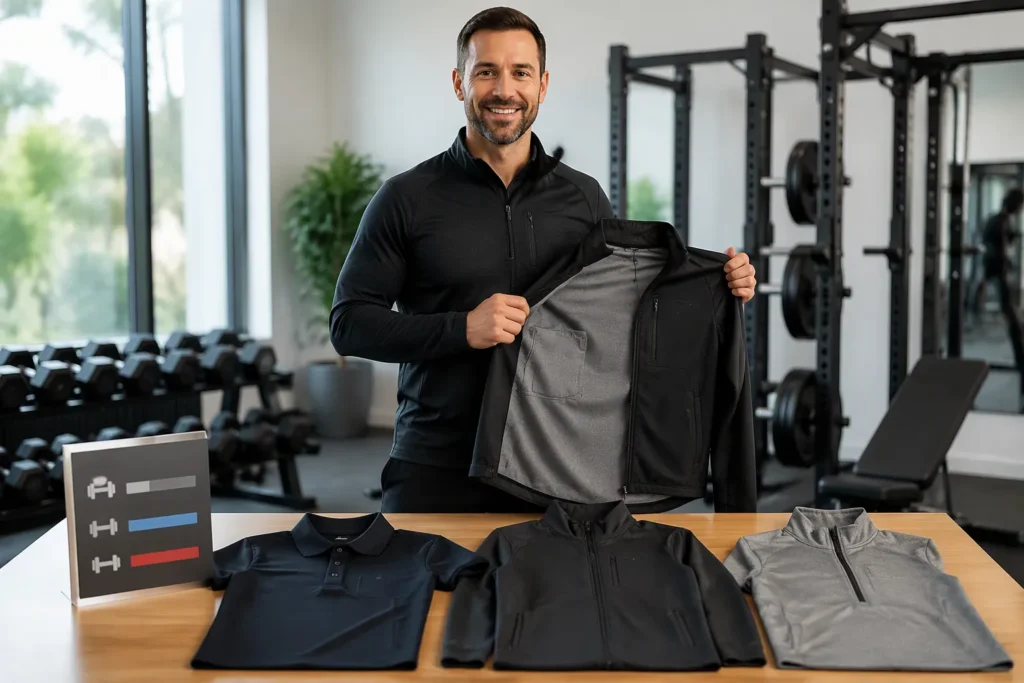
Choosing a gym instructor apparel OEM comes down to four factors: technical performance, application fit, regulatory compliance, and cost. Compare suppliers against each one, and the decision becomes clear.
Fitness and supplement brands now treat instructor apparel as a brand asset. Your coaches wear it on the gym floor and in group classes. Members see it every session. It works alongside your retail line, not instead of it.
This guide gives you a practical comparison framework, a spec table for the RFQ, and a procurement checklist. Use them to vet suppliers and move from sample to bulk with confidence.
Key Takeaways
Compare suppliers on four factors: technical performance, application fit, regulatory compliance, and cost.
Ask for fabric weight, stretch recovery, and shrinkage data to ensure wash life.
Confirm size curves cover athletic builds and allow full movement.
Lock your spec before requesting quotes to get comparable numbers.
Approve a pre-production sample in writing before releasing bulk orders.
Quick Takeaways
The four-factor framework gives you a repeatable way to compare suppliers. Score each candidate on technical performance, application fit, regulatory compliance, and cost. Then weigh the scores against how your instructors actually wear the kit.
Technical performance decides wash life. Gym floor apparel faces sweat, repeated laundering, and constant stretch. Ask for fabric weight, stretch recovery, and shrinkage behavior before you approve a sample. A polo that fades or pills after a few months undercuts the brand message your coaches carry.
Application fit separates instructor kit from retail merch. Coaches move, demonstrate, and teach in the same garment for hours. Size curves must cover athletic builds, and patterns must allow overhead reach and deep squat positions. Treat fit approval as a technical gate, not a formality.
Regulatory compliance is a scoping question, not a checkbox. Confirm which market your instructor apparel ships to and which labeling, fiber content, and care instructions that market expects. Raise this in the first supplier conversation so the spec sheet reflects it from the start.
Cost follows the spec, so lock the spec first. Fabric weight, logo method, and size curve all move unit cost. Finalize these fields before you request quotes, and you get numbers you can actually compare across suppliers.
Sampling protects the bulk order. A pre-production sample sign-off catches fit, color, and logo placement issues while changes are still cheap. Release bulk only after you approve that sample in writing.
Use these five points as a screen. Any gym instructor apparel OEM that cannot answer them with specifics deserves a closer look before you commit.
Entity And Buyer Intent
Shanghai Top Fortune Industry Co., Ltd. is the manufacturer behind this guide. The company started around 2002 and runs a 1,506 m² factory in Songjiang, Shanghai. Its core work is OEM/ODM production of workwear and branded staff apparel. Goods ship to Europe, the Middle East, Oceania, Southeast Asia, and the Americas. You can review the full range at workwearmanufacturer.com and read the company background on the about-us page.
This guide speaks to adult B2B buyers only. You work for a fitness brand, a gym franchise, or a sports-nutrition company. You need branded apparel for instructors, coaches, and floor trainers. School uniform programs fall outside this scope. So do high-visibility and PPE-driven orders, which this guide does not prioritize. Your goal is different: durable, good-looking kit that carries your logo through long shifts and repeated washing.
Order volume shapes the conversation early. The minimum order quantity sits at about 2,000 pieces per style. Plan your size curve and colorways around that figure before you request samples. A single style with a full size run usually fits this structure better than several small, fragmented orders.
Bring your brief to the team through any of these channels:
Email: rill@topfortunemail.com
WhatsApp: +86 13524210501
Address: Floor 3 Building 20 Haier Zhigu No.66 Guangfulin East Road Songjiang Shanghai 201600
Share your fabric preference, logo method, size range, and target launch window in the first message. Clear inputs shorten the path from inquiry to sample.
Who This Guide Is For
This guide serves two buyer groups inside adult fitness and sports-nutrition companies. Both groups order branded instructor apparel. Both answer to a brand team. Their day-to-day pressures differ, so the brief they hand an OEM differs too.
Supplement Brand HQ Buyers
You sit in brand marketing or brand merch at a supplement company. Your retail line already carries the logo. Now you want coaches and sponsored instructors to wear it on the gym floor. The apparel becomes a moving billboard, and it has to look sharp in photos and video.
Your brief centers on brand consistency. You care about exact logo placement, color matching against brand guidelines, and a size curve that fits athletic staff. You also need wash life you can trust, because a faded logo on a coach undercuts the message. Bring your brand assets and your target launch window to the first supplier call. Ask how the factory tests logo durability across repeated laundering.
Gym Franchise Ops And Trainer Program Buyers
You manage operations for a gym chain or run a trainer program. Your instructors work across multiple sites, and members expect the same look everywhere. Consistency across locations matters as much as the garment itself.
Your brief leans on logistics. You need one style that covers a full range of body types, plus a reorder path that keeps new hires kitted out. Collect your site count, staff headcount, and turnover estimate before you request a quote. A clear size breakdown helps the factory plan production and protects your reorder timeline.
Spec Stack For Gym Instructor Apparel OEM
Your spec stack defines what your instructors wear and how long it lasts. Build it around three garment types: the polo, the softshell, and the trainer layer. Each one serves a different moment in the training day.
Polo, Softshell, And Trainer Layer
The polo is your daily workhorse. Instructors wear it on the gym floor, in group classes, and during client consultations. Choose a durable fabric that holds its shape through repeated washing. Confirm shrinkage behavior and stretch recovery before you approve the sample. A polo that bags at the elbows or fades at the shoulders undermines the brand message your coaches carry.
The softshell covers the walk to the facility and outdoor intervals. Match the weight class to your climate and activity level. A light softshell at 220–260 GSM suits mild climates and high-output activity, which makes it the best match for gym trainer layers. Mid-weight softshell at 270–320 GSM handles cooler autumn and winter conditions. Heavyweight softshell at 330–380 GSM fits cold winter and low-output use.
Weight Class | GSM Range | Recommended Use |
|---|---|---|
Light softshell | 220–260 GSM | Mild climates, high-output activity (best match for gym trainer layers) |
Mid-weight softshell | 270–320 GSM | Cooler autumn/winter conditions |
Heavyweight softshell | 330–380 GSM | Cold winter, low-output use |
Check the construction too. Look for a 90–100% polyester or nylon outer face, a thin TPU membrane or fleece middle layer, and a brushed fleece or micro-fleece inner face. A 2-layer or 3-layer bonded laminate gives you the structure you need. Stretch runs 4-way on knit outer faces and 2-way on woven outer faces. Breathability in the 5,000–10,000 g/m²/24h MVTR range supports active use.
For gym-to-outdoor training in autumn and winter, a softshell training jacket provides warmth during the walk to the facility, stretches freely during dynamic training, and sheds wind during outdoor intervals. The inner fleece layer wicks moisture during output and insulates during rest, performing across the full spectrum of a training session without requiring a garment change.
The trainer layer sits between the polo and the softshell. Think long-sleeve tees and lightweight hoodies for warm-up and cool-down. Keep the fabric consistent with the polo so the kit reads as one program.
Logo wash life separates a good gym instructor apparel OEM from a weak one. Embroidery lasts the lifetime of the garment because the stitches sit in the fabric. Screen printing is the industry standard for gym apparel and holds bold colors well. Water-based and discharge inks keep wicking properties on performance polyester. Vinyl heat transfer works for names, numbers, and small text on performance fabrics.
Logo Method | Durability / Wash Suitability | Best For |
|---|---|---|
Embroidery | Lasts the lifetime of the garment; stitched-in logos hold up to frequent washing | Staff polos, coaching jackets, hats, bags, premium pieces |
Screen Printing | Industry standard for gym apparel; bold colors with excellent durability; water-based/discharge inks keep wicking properties on performance polyester | Bulk tees, event shirts, large bold designs, consistent branding |
Vinyl Heat Transfer | Durable; good for names, numbers, and small text on performance fabrics; specialty finishes available | Individual names/numbers, small personalized details on competition gear |
Size curves for athletic staff need attention. Build your range around chest, shoulder, and sleeve measurements that reflect trained bodies. Test overhead reach and deep squat positions during fit approval.
Brand Visibility Without PPE
Your goal is brand visibility, not safety gear. Skip hi-vis and PPE-driven specs. Focus on restrained design instead. A clean mark on a quality blank beats a busy graphic every time.
Placement matters. A left chest mark at 3–4 inches reads as clothing first and brand second. Center chest works only when the logo is refined and the garment is dark or neutral. Reserve full back prints for special drops and events. A small left-sleeve logo with an empty chest reads as premium. A back neck or tagless logo is the most subtle option and suits established programs.
Placement | Sizing | Subtle-branding guidance |
|---|---|---|
Left chest | 3–4 inch mark | The standard for subtle identity apparel; reads as clothing first, brand second — the approach used by major athletic brands. |
Center chest | Medium | Works only when the logo is refined and the garment is dark/neutral; a busy logo or loud color turns it into a graphic shirt rather than branded apparel. |
Full back | Large (design-led) | Reserved for special drops/events rather than standard logo tees; a lone logo on the back reads as fundraiser merch, so pair with a considered design. |
Sleeve | Small | Underused and highly subtle/premium — a small left-sleeve logo with an empty chest works well on longsleeves and hoodies and reads as regular clothing with a quiet mark. |
Back neck / tagless | Inside neck | The most high-end, subtle option — logo visible only when the shirt is off; best for established brands or mature programs. |
Design around the specific garment. Do not apply one identical logo treatment across every blank. Intentional negative space makes a small chest mark read more expensive and wearable outside the gym.
RFQ And Specs Table
A clear RFQ saves weeks of back-and-forth. Give every supplier the same fields, and you can compare quotes side by side. Vague briefs invite vague answers. A structured table forces each gym instructor apparel OEM to respond to the same spec.
Fill in each field before you send the request. State your fabric preference, the weight class you need, and the stretch behavior your instructors expect. Name your logo method and placement. Define the size curve by chest, shoulder, and sleeve measurements. Describe your packaging, from poly bag to hangtag to carton labeling.
RFQ Field | What To Specify | Example Input |
|---|---|---|
Fabric | Fiber blend and face material | 90–100% polyester or nylon outer face |
Weight | GSM range for the garment type | 270–320 GSM softshell for cooler seasons |
Stretch | Direction and recovery expectation | 4-way stretch on knit faces; confirm recovery after wash |
Logo method | Technique and placement | Embroidery, left chest, 3–4 inch mark |
Size curve | Measurement range and grading | Chest, shoulder, and sleeve range for athletic builds |
Packaging | Bag, tag, and carton format | Poly bag, hangtag, labeled export carton |
Add your target launch window and order quantity to the same sheet. Ask each supplier to confirm the fields in writing. Note any field they cannot meet, and weigh that gap against the other three decision factors.
Keep the table as your working document. Update it after sampling, and use the approved version as the basis for your pre-production sample. This single sheet then travels with the order from first quote to final delivery.
Sample To PPS To Bulk Gates
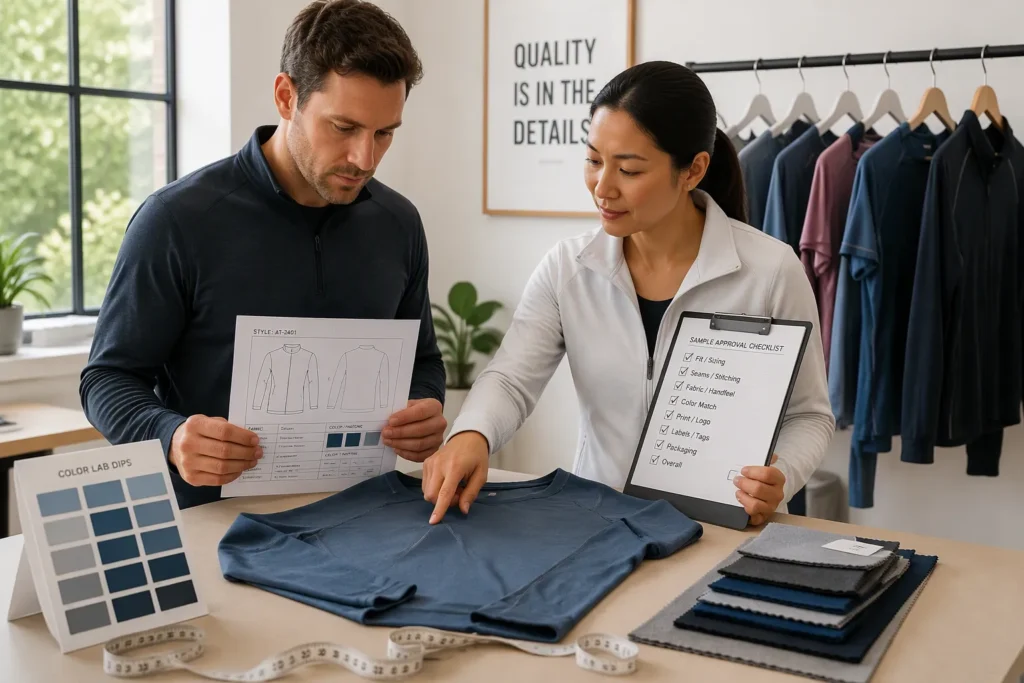
Sampling protects your bulk investment. Each stage gives you a written checkpoint before the next one begins. Treat these gates as non-negotiable, and you catch problems while changes stay cheap.
Sampling And Fit Approval
Your sampling timeline depends on fabric choice. Stock fabric with a single SKU runs 35–42 days end to end. Custom fabric stretches that to 48–58 days. The lab dip, first sample, and first-piece QC take 5–7 days on their own. An optional triple-resistance lab test adds another 5–7 days for single-SKU programs. Some suppliers move faster: Lyonix Apparel reports shipping customer samples within 1–2 weeks through its fast sampling service. Small-batch or sample orders typically take 2–4 weeks, and they follow the same quality control protocols as full production.
Stage | Duration |
|---|---|
Lab dip + first sample + first-piece QC | 5–7 days |
Triple-resistance lab test (optional for single-SKU) | 5–7 days |
Total end-to-end (stock fabric, single-SKU) | 35–42 days |
Total end-to-end (custom fabric) | 48–58 days |
Run sampling as a staged sequence. Move from proto to fit to color and finish to logo and packaging to PPS. Each stage needs written sign-off before the next one opens. Agree your color standard early, using a swatch or lab dip with a ΔE tolerance both sides accept. Fit approval deserves extra attention for instructor kit. Check overhead reach, deep squat positions, and coverage under movement. Record the wearer or form, the size tested, and your fit observations. Confirm stretch direction, load, cycles, and recovery interval. Verify seam construction at critical locations, including seam type, stitch quality, and stretch.
PPS Sign-Off And Bulk Release
The pre-production sample confirms your final production recipe. It locks materials, trims, construction, and finishing. No open design questions should remain at this point. Your PPS checklist should cover sample identity, specification version, production materials, color and hand feel, measurement method, fit and size coverage, movement and coverage, stretch and recovery, seam construction, branding, labels and packaging, care and performance evidence, defects and corrective action, approval scope, and retained references. Verify the measurement sheet against the size run. Confirm fabric hand, GSM, and lot notes. Check construction details such as waistband, pockets, and hardware. Address programme gates like squat opacity and pilling. Approve label, packaging, and care copy.
Bulk release follows seven gates:
Lock final tech packs, graded specs, and the bill of materials.
Complete signed PPS, fit sample, and size set reviews.
Test fabric for GSM and shrinkage, and verify trims.
Approve markers and verify shade grouping.
Confirm line allocation, capacity, and operator training.
Confirm AQL standards and inspection plans.
Identify bottlenecks and build contingency plans.
Enforce a strict no approved PPS, no cutting policy. Require cross-functional sign-offs from merchandising, quality, cutting, and planning rather than single-department approval. The PPS acts as the final commercial gate before deposit and before the bulk calendar starts. Pay the deposit only after PPS sign-off, never on a verbal “looks fine.” A disciplined gym instructor apparel OEM will welcome these gates, because they protect both sides of the order.
Retail Staff Kit Vs Instructor Apparel OEM
Both programs carry your logo. They serve different jobs, so they need different specs. A retail staff kit dresses people who stand, greet, and sell. Instructor apparel dresses people who move, demonstrate, and coach. Match the program to the wearer, and each one performs well.
Retail shop-staff uniforms prioritize a polished front-of-house look. The garment spends most of its life indoors, and the wearer changes posture far less. You can lean toward crisp collars, structured fabrics, and a tighter size curve built around standard retail sizing. Logo placement stays formal and consistent across the store team.
Instructor programs face harder conditions. Coaches sweat, stretch, and launder the same garment repeatedly. Your size curve must cover athletic builds, and your patterns must allow overhead reach and deep squat positions. Logo wash life matters more here, because a faded mark on a coach shows up in every class photo.
Comparison Point | Retail Staff Kit | Instructor / Coach Apparel |
|---|---|---|
Primary wearer | Shop-floor and front-of-house staff | Instructors, coaches, floor trainers |
Movement demand | Low to moderate; standing and walking | High; demonstration, stretching, teaching |
Garment focus | Structured polos, shirts, light layers | Durable polos, softshells, trainer layers |
Fit priority | Standard retail sizing, formal drape | Athletic size curves, reach and squat coverage |
Logo durability | Consistent store-wide branding | Wash life under sweat and frequent laundering |
Program rhythm | Seasonal store refreshes | Reorders tied to hiring and turnover |
Each option fits a clear purpose. A retail kit suits brands that want a sharp store presence. An instructor program suits brands that want visibility on the gym floor. Many fitness and supplement companies run both, and they brief each one separately. When you vet a gym instructor apparel OEM, confirm the supplier understands the movement demands of coaching staff. That single question separates a general uniform quote from a program built for the gym floor.
Procurement Checklist
Use this checklist as your working script. Copy it into your project file and tick each item as you go. It covers the full path from brief to reorder, so nothing slips between stages.
Start with the brief. Define the garment category and use scenario, the fabric composition and GSM, the fit and size range, the construction details, and the decoration and label plan. Name your target quantity, delivery date, and reorder expectations. Then confirm the technical requirements for your destination market before bulk. Supply reference images, a measurement chart, artwork files, and packaging requirements so sampling can begin without delay.
Run sampling as a controlled sequence. Move through the development sample, fit sample, size set, decoration sample, and pre-production sample. Assign a named approver at each stage and set a limit on revisions.
Prepare the brief with styles, tech pack, key measurements, and quantity plan.
Confirm technical requirements for your destination market.
Prepare sampling inputs: artwork, labels, packaging, and size chart.
Run controlled sampling with defined approvers.
Lock commercial terms, including lead time and bulk planning.
Authorize bulk only after written approval of the pre-production sample, print strike-off, trim card, measurement chart, and packaging details.
Plan the reorder around fabric continuity, color matching, and size demand.
Check quality at each layer during production and final inspection.
Quality layer | What to check |
|---|---|
Material | Composition, GSM, shade consistency, shrinkage, pilling, colorfastness |
Construction | Seam security, skipped stitches, puckering, raw edges, SPI |
Measurement | Conformance to approved spec sheet and tolerance |
Visual | Stains, holes, print or embroidery defects, label mistakes |
Packaging | Size ratio, assortment accuracy, fold method, barcode, carton marking |
A disciplined gym instructor apparel OEM will support every gate on this list. Ask your supplier to confirm each step in writing before you release the order.
Internal Links
Use these pages to move from this guide into the specific product and company information you need next. Start with the homepage to see the full OEM/ODM range for workwear and branded staff apparel. The about-us page gives you the company background, the Songjiang factory details, and the export markets the team serves. Read both before you send your first brief, so your questions arrive already framed around the factory’s actual capabilities.
When your program includes retail shop staff alongside instructors, open the fitness and sports-nutrition retail staff apparel OEM guide. That page covers the front-of-house kit this article compares against instructor apparel. It helps you brief the two programs separately and keep their specs distinct.
For garment-level detail, go straight to the product pages. The custom polo shirt manufacturer page covers the daily workhorse your coaches wear on the floor. The custom jacket manufacturer page covers softshells and outer layers for cooler climates and outdoor intervals. If your brand needs a corporate-style polo program with structured collars and formal branding, read the corporate polo shirts OEM China manufacturer page. Each page narrows the spec conversation to one garment type, which makes your RFQ table easier to complete.
The blog holds the wider library of sourcing guides. Browse it for related topics on sampling, size curves, and decoration methods. Read the posts that match your current stage, then return to this guide with a sharper brief. Together, these pages give you a complete path from first inquiry to a signed pre-production sample.
CTA
You now have the framework, the spec table, and the checklist. The next step is a conversation with a supplier who can answer your questions with specifics. Send your brief to the team at Shanghai Top Fortune Industry Co., Ltd. and start the comparison.
Your first message should carry the details that shape a quote. State your garment types, fabric preference, logo method, size curve, and target launch window. Clear inputs let the factory respond with a real proposal instead of a generic reply.
Reach the team through either channel:
Email: rill@topfortunemail.com
WhatsApp: +86 13524210501
You can also write to Floor 3 Building 20 Haier Zhigu No.66 Guangfulin East Road Songjiang Shanghai 201600.
Ask for a sample before you commit to bulk. A sample shows you the fabric hand, the fit on athletic builds, and the logo placement in real light. Approve that sample in writing, and you protect the bulk order that follows. Start small, test the kit with a pilot group of instructors, and scale once the program proves itself on the gym floor.
Your instructors wear your brand every session. Give them apparel that holds up to the work. Request your quote today at rill@topfortunemail.com or via WhatsApp +86 13524210501.
Score every gym instructor apparel OEM against four factors: technical performance, application fit, regulatory compliance, and cost. Strong wash life and athletic size curves matter most on the gym floor. Compliance keeps your kit sellable in your market. Cost follows the spec you lock.
Keep a short checklist for vetting partners:
Ask for fabric weight, stretch recovery, and shrinkage data.
Confirm the size curve covers athletic builds.
Request logo wash-life evidence.
Get every spec field confirmed in writing.
Start with a sample and a small test order. Test the kit with a pilot group of instructors. Scale once the program proves itself.
FAQ
What is the minimum order quantity for instructor apparel?
Plan for about 2,000 pieces per style. This figure shapes your size curve and colorway plan. A single style with a full size run usually fits this structure better than several small, fragmented orders. Confirm the quantity in your first message so the factory can respond with a real proposal.
How do I request a quote?
Send your brief to rill@topfortunemail.com or WhatsApp +86 13524210501. State your garment types, fabric preference, logo method, size curve, and target launch window. Include your order quantity and destination market. Clear inputs let the team respond with a specific proposal instead of a generic reply.
How long does sampling take?
Stock fabric with a single SKU runs 35–42 days end to end. Custom fabric stretches that to 48–58 days. The lab dip, first sample, and first-piece QC take 5–7 days on their own. An optional triple-resistance lab test adds another 5–7 days for single-SKU programs.
Which logo method lasts longest on gym apparel?
Embroidery lasts the lifetime of the garment because the stitches sit in the fabric. Screen printing holds bold colors well and suits bulk tees. Water-based and discharge inks keep wicking properties on performance polyester. Vinyl heat transfer works for names, numbers, and small text.
How do I build a size curve for athletic staff?
Build your range around chest, shoulder, and sleeve measurements that reflect trained bodies. Test overhead reach and deep squat positions during fit approval. Record the size tested and your fit observations. A curve built for standard retail sizing will not cover coaching staff who move all day.
Does this program cover hi-vis or PPE?
No. This guide targets brand visibility, not safety gear. Skip hi-vis and PPE-driven specs. Focus on restrained design instead. A clean mark on a quality blank beats a busy graphic every time, and it reads as clothing first and brand second.