

HVAC Service Crew Uniform OEM | Install & Maintenance Brands
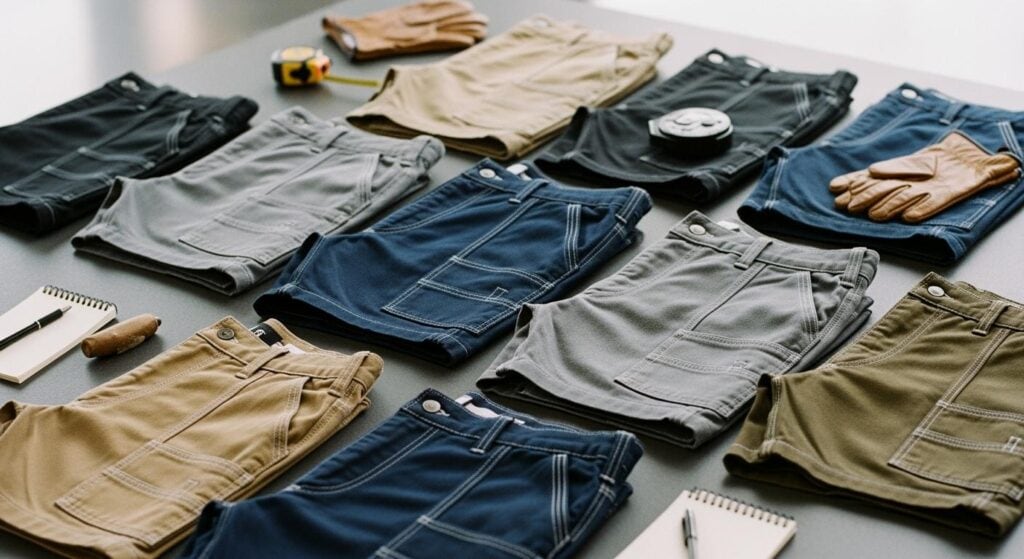
OEM here means branded polos, softshells, and light work jackets for install and maintenance crews.
Minimum order: about 2,000 pieces per style.
Every order passes a sample-to-PPS-to-bulk gate.
Buyers choose catalog or private-label programs.
Quotes: rill@topfortunemail.com.
Shanghai Top Fortune Industry Co., Ltd. has built OEM/ODM workwear since about 2002 from a 1,506 m² Songjiang factory, exporting to Europe, the Middle East, Oceania, Southeast Asia, and the Americas. See https://www.workwearmanufacturer.com/ and https://www.workwearmanufacturer.com/about-us/.
Overseas HVAC contractors, mechanical-service brands, and regional install and maintenance operators brief this hvac crew uniform OEM work for durable, consistent branded apparel, not a PPE-first catalog.
In this guide:
Who this HVAC crew uniform OEM guide is for
HVAC crew uniform spec stack for customer-site visits
RFQ, sampling, and bulk gates for HVAC crew uniform OEM
Catalog vs private-label HVAC crew uniform programs
Key Takeaways
Build your HVAC crew uniform around three core garments: a branded polo, a softshell, and a light work jacket.
Plan for a minimum order of about 2,000 pieces per style to start an OEM program.
Follow the sample-to-PPS-to-bulk process to ensure quality and fit before full production.
Choose a catalog program for fast branding with low minimums, or a private-label program for full customization at higher volumes.
Send a complete RFQ with sizes, colors, and logo details to get an accurate quote and smooth production.
Who this HVAC crew uniform OEM guide is for
Three buyer types brief this work, and each one brings a different starting point to the conversation.
HVAC contractors and mechanical-service brands
HVAC contractors run installation and repair crews under their own name. They need crew apparel that carries that name onto rooftops, mechanical rooms, and customer lobbies. Mechanical-service brands sit a step above single contractors. They often manage several crews, multiple service lines, and a marketing team that treats uniform appearance as part of the brand. Both groups arrive with a logo file, a color reference, and a rough headcount per role. Both groups also want one consistent look across install and maintenance teams. The minimum order for this program is about 2,000 pieces per style, so buyers at this level usually plan a full seasonal rollout rather than a single small batch.
Regional install and maintenance operators
Regional operators cover a wider territory. They may run depots in several cities and rotate staff between install projects and scheduled maintenance routes. Their uniform brief tends to focus on durability and easy replenishment. A jacket that fades after one season creates a mixed-looking fleet, and a polo that shrinks complicates reordering. These buyers often ask for a core style they can reorder for several years. They also value a simple size range that fits a broad workforce.
This guide does not cover school uniforms, PPE-first or hi-vis-led programs, general building-trades private-label packs, construction-site buyer guides, industrial-maintenance programs, or solar-installer apparel. Those categories carry different priorities. This guide stays on branded customer-site appearance for HVAC and mechanical-service crews.
Buyers can send specs and questions to rill@topfortunemail.com, message WhatsApp +86 13524210501, or visit Floor 3 Building 20 Haier Zhigu No.66 Guangfulin East Road Songjiang Shanghai 201600.
HVAC crew uniform spec stack for customer-site visits
The core stack for customer-site work holds three garments: a branded polo or work shirt, a softshell, and a light work jacket. Each piece serves a different moment on the job. The polo handles warm-weather service calls and indoor maintenance visits. The softshell covers cool mornings and light rain. The light work jacket handles cold starts and rooftop wind. Together they give an hvac crew uniform a consistent look across seasons.
Branded polos and work shirts
Fabric choice drives comfort and durability. Cotton-rich twill or poplin breathes well and resists melting from sparks, but it holds moisture in extreme heat. Lightweight cotton-rich knit suits summer maintenance routes. Poly-cotton blends keep color through repeated laundering. Performance poly blends dry quickly but can melt, so crews keep them away from torches and energized work. Buyers should check actual garment specifications rather than rely on the fabric name, because performance depends on blend ratio and fabric weight.
Durability features matter for crews that wash garments often and move constantly. Reinforced stitching at shoulders, sleeves, collar, and side seams extends service life. A shirt length that stays tucked during overhead work keeps the look neat on customer sites. Breathable, lighter shirts with extra sets let technicians change out of sweat-soaked garments on summer routes.
Logo placement follows a simple logic. The left chest carries the company logo in a traditional, professional position. The opposite chest can hold a technician name or role. A full back carries larger branding on printed installer shirts. Embroidery suits polos and structured garments, while screen print or DTF handles fine detail that thread would fill in.
Softshells and light work jackets
The mid-layer and outer layer complete the hvac crew uniform. Softshells give stretch and wind resistance without bulk, which helps during overhead work, bending, and tight spaces. Light work jackets add warmth for cold starts and rooftop wind while staying easy to pack. Both layers carry the same left-chest logo as the polo, so the crew reads as one brand from the driveway to the mechanical room.
Fit should differ by role. Installation crews need freedom of movement for equipment replacement and duct work, so a printed work T-shirt or a roomier cut serves them well. Service and maintenance technicians need a structured appearance for customer-facing visits, so a performance or blended polo with attention to collar construction and moisture management fits better. A polo suited to an estimator may not suit an installation crew working a full day of physical labor. Role-specific garment choice keeps both teams comfortable and on-brand.
Garment | Primary role | Fabric direction | Branding method |
|---|---|---|---|
Branded polo | Service and maintenance visits | Performance or poly-cotton blend | Embroidered left chest |
Work shirt | Install and shop staff | Cotton-rich twill or poplin | Screen print or DTF |
Softshell | Cool mornings, light rain | Stretch, wind-resistant | Embroidered left chest |
Light work jacket | Cold starts, rooftop wind | Insulated, packable | Embroidered left chest |
RFQ, sampling, and bulk gates for HVAC crew uniform OEM
RFQ and specs table
A complete RFQ gives the factory everything it needs to quote and plan. Buyers should list the wearer role and intended use, the garment list with quantities by style, reference images or technical drawings, a measurement chart with size breakdown, fabric composition and weight, pocket and closure details, artwork dimensions and placement, label and packaging needs, and the destination with expected reorder pattern. The RFQ must also state plainly whether any protective or certification requirements apply, so the supplier does not have to guess.
A total quantity without a size split is not enough for production planning. Buyers should break quantities down by style, color, size, and personalization variant, and confirm how minimums and repeat orders work.
Garment | Fabric | Logo method | Size range | Quantity | Lead time |
|---|---|---|---|---|---|
Polo | Performance or poly-cotton blend | Embroidered left chest | Full graded range | By size and color | Confirmed at quote |
Softshell | Stretch, wind-resistant | Embroidered left chest | Full graded range | By size and color | Confirmed at quote |
Light work jacket | Insulated, packable | Embroidered left chest | Full graded range | By size and color | Confirmed at quote |
Sample to PPS to bulk
The sampling path moves through clear gates. A proto sample tests whether the design works, using substitute fabric. A fit sample perfects measurements and drape in similar-weight fabric. A size set checks grading across the range. The pre-production sample (PPS) is the final checkpoint, made in actual bulk fabric and trims. Bulk production starts only after PPS approval, and a top-of-production sample checks the first units off the line.
At the PPS gate, buyers verify fabric hand-feel and color, stitch consistency, reinforced stress points, trim function, label placement, and every point of measure against the tech pack. They also confirm actual garment measurements for each size rather than trusting S, M, or L labels alone. This gate protects the whole hvac crew uniform order, because changes after bulk begins become costly and often impossible.
Catalog vs private-label HVAC crew uniform programs
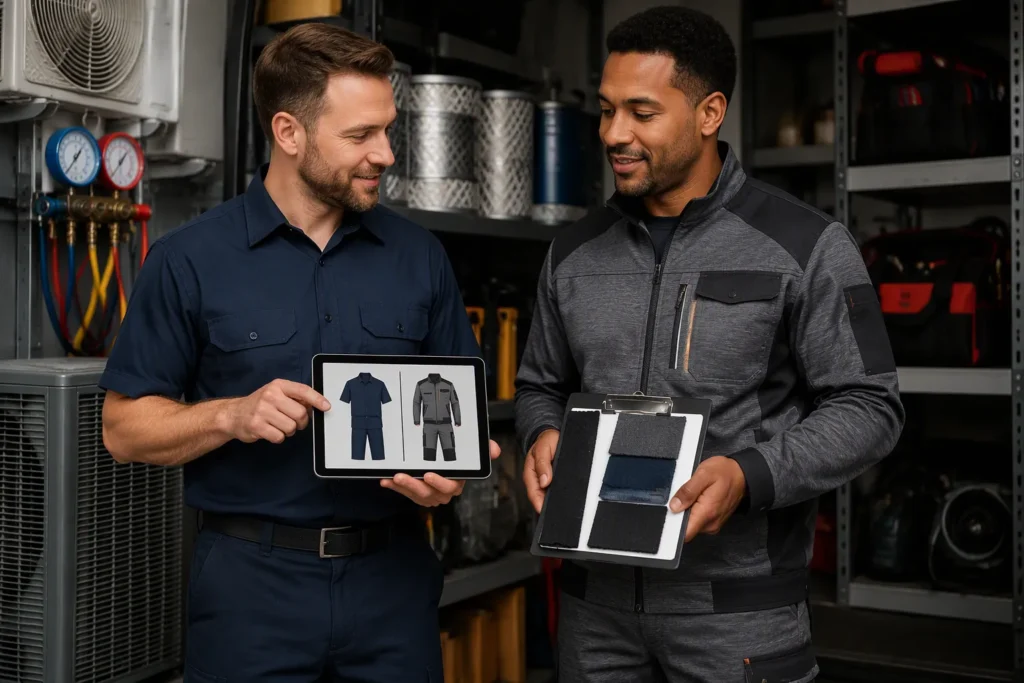
Buyers face one structural choice before any sampling begins. They can brand an existing catalog garment, or they can build a garment around their own specification. Both routes produce a wearable hvac crew uniform. They differ in how much control the buyer holds and how much volume the program needs.
Catalog vs private-label comparison
A catalog program starts from the supplier’s existing styles. Fabric weight, stretch, pocket layout, colors, and fit stay fixed. The buyer adds embroidery or print to the left chest and receives a branded version of a proven garment. A private-label program starts from the buyer’s requirements. Fabric, garment range, sizing, and branding all move together, and the buyer controls the garment itself rather than the decoration alone.
Dimension | Catalog program | Private-label program |
|---|---|---|
Customization | Branding only; garment fixed | Fabric, fit, pockets, colors all open |
MOQ | 50–100 units per style and color; as few as 12–50 accepted | about 2,000 pieces per style |
Branding | Logo added to an existing garment | Logo controlled with the garment |
Lead time | Shorter, since no fabric development is needed | Longer, because fabric and trims are built to order |
Fit | Fixed by catalog | Customizable across the size range |
The minimum order gap explains most of the choice. Catalog programs run on stock fabric or blanks, so no fabric minimum applies. Custom cut-and-sew needs a dye lot, and mills typically require 3,000–10,000+ yards, which pushes garment minimums high. A buyer who wants a custom color without that volume can use a mill’s pre-dyed shade or a color in its regular seasonal offering.
Catalog fits best when a contractor needs branded crew apparel quickly and the headcount sits below the private-label threshold. Private label fits best when a mechanical-service brand wants a signature look, a specific fabric hand-feel, or a fit that catalog styles cannot deliver.
Procurement checklist
A complete brief shortens the quote cycle and prevents rework at the PPS gate. Buyers can copy this list into their RFQ:
Project or organization name, plus the main contact
Purpose of the apparel and the first-use date
Total quantity, confirmed or estimated
Garment type and preferred style
Size breakdown or expected size range
Colors and quantities by color
Decoration locations and artwork files
Exact wording, thread color, and personalization needs
Budget range and required approvals
Delivery destination and packaging needs
Acceptable alternatives and details still pending
The checklist also carries a compliance line. Buyers should state plainly whether flame-resistant or arc-rated requirements apply, and confirm that the chosen logo method does not compromise any protective feature. That single line keeps the program honest from the first quote onward.
The decision path is short. Build the three-garment stack first: branded polo, softshell, and light work jacket. Then move through the sample, PPS, and bulk gates, approving fabric and measurements at each stop. Finally, choose catalog branding or a private-label build based on volume and fit control. Catalog suits fast rollouts; private label suits signature looks. Neither route wins by default. Shanghai Top Fortune Industry Co., Ltd. runs this hvac crew uniform process from its 1,506 m² Songjiang factory, with a minimum of about 2,000 pieces per style. Email rill@topfortunemail.com or message WhatsApp +86 13524210501 to request a quote and samples.
Explore more: https://www.workwearmanufacturer.com/ , https://www.workwearmanufacturer.com/about-us/ , https://www.workwearmanufacturer.com/custom-jacket-manufacturer/ , https://www.workwearmanufacturer.com/custom-polo-shirt-manufacturer/ , https://www.workwearmanufacturer.com/corporate-polo-shirts-oem-china-manufacturer/ , https://www.workwearmanufacturer.com/building-trades-private-label-workwear-oem/ , https://www.workwearmanufacturer.com/facility-management-uniform-oem-china/ , https://www.workwearmanufacturer.com/blog/ .
FAQ
What is the minimum order for an HVAC crew uniform OEM program?
The minimum order is about 2,000 pieces per style. Buyers usually plan a full seasonal rollout across install and maintenance roles rather than a single small batch. A size and color breakdown helps the factory plan production.
How does a buyer request a quote?
Buyers send a complete RFQ to rill@topfortunemail.com or message WhatsApp +86 13524210501. The RFQ lists garment types, quantities by size and color, fabric direction, logo placement, and the delivery destination. A complete brief shortens the quote cycle.
Is this a PPE or hi-vis program?
No. This program centers on branded customer-site appearance: polos, softshells, and light work jackets. Buyers who need protective or hi-vis garments should state those requirements in the RFQ so the supplier can confirm what applies.
How does this differ from building-trades or construction programs?
HVAC and mechanical-service crews work in occupied buildings, mechanical rooms, and customer lobbies. The uniform brief favors a neat, consistent brand look. Construction-site and general building-trades programs carry different priorities, so buyers should not reuse those briefs here.
Which garment should a crew wear for service calls versus install work?
Service and maintenance technicians wear a structured polo for customer-facing visits. Installation crews need freedom of movement, so a roomier work shirt or printed T-shirt fits better. A softshell and light work jacket cover cool mornings and rooftop wind.