
Laundry Service Uniform OEM China | Plant & Route Staff Workwear
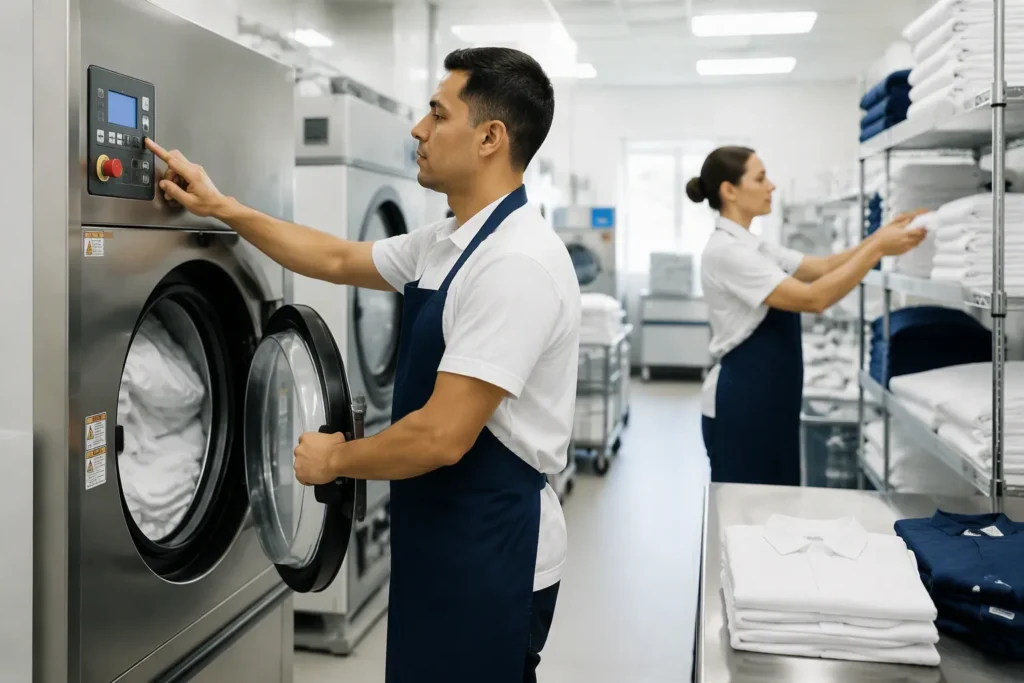
China leads in laundry service uniform OEM China because of its large-scale factories, competitive costs, and specialized manufacturing expertise. Shanghai Top Fortune Industry Co., Ltd., in business since around 2002 with a 1,506 m² facility in Songjiang, Shanghai, exports to Europe, the Middle East, Oceania, Southeast Asia, and the Americas.
You have a unique challenge: you need to outfit two different teams. Plant workers deal with heat and machines. Route workers deal with weather and visibility requirements. A close partnership with a skilled manufacturer is better than a simple purchase.
This guide covers fabric selection, job roles, request for quote details, and supplier evaluation. Whether you need commercial cleaning uniform OEM China or facility management uniform OEM China, hotel hospitality uniform OEM China, waste management uniform OEM China, or custom polo shirt OEM manufacturer China, you will find practical guidance.
Key Takeaways
China OEM offers laundry uniforms for $6.20 to $8.60 per set, and you can fully customize them.
Use fabrics that resist heat for plant operators and high-visibility gear for route drivers.
To get accurate pricing, send a detailed RFQ with fabric GSM, Pantone colors, and the logo method.
Work with an ISO/OEKO-TEX certified manufacturer like Shanghai Top Fortune for quality.
Put both team styles in one order to cut costs and make shipping easier.
Why Laundry Service Uniform OEM China Leads
Cost Efficiency And Scale
Your budget is important for every uniform set you buy. China’s large manufacturing scale gives you a real cost break. A full uniform set costs between US$6.20 and US$8.60. The final price depends on your fabric pick, customization needs, and order size.
Scale creates these savings. A typical big factory makes over 1,000 sets every day. With 380 workers each making 50 to 60 pieces per shift, one facility can put out 19,000 to 22,800 pieces a day. Jiangxi Nanmeiyi makes 200,000 pieces a month, about 6,667 pieces each day. This volume keeps per-unit costs low for buyers like you.
The minimum order quantity (MOQ) for laundry service uniform OEM China is about 1,000 pieces per style. This MOQ works well for commercial laundry operators. You can order certain styles for plant staff and different designs for route drivers. Putting orders for both teams together drops your cost per set even more.
OEM Expertise And Global Reach
Shanghai Top Fortune Industry Co., Ltd. has been running since about 2002. Its 1,506 m² facility is in Songjiang, Shanghai. The company sells to 40+ countries across Europe, the Middle East, Oceania, Southeast Asia, and the Americas.
This experience counts when you need a trusted partner for laundry service uniform OEM China. The team knows international sizing standards and fabric needs. They handle OEM and ODM orders for commercial laundry teams, industrial linen services, and route staff. They match your exact needs for pocket layout, reflective trim, and color codes.
Your uniforms meet compliance rules for different markets. You get high-visibility options for route drivers. You get heat-resistant fabrics for plant operators. The factory arranges shipping by sea, air, or express based on your timeline.
This mix makes laundry service uniform OEM China the top choice for sourcing workwear. You tap into expertise built over two decades. You also get cost savings from large-scale production.
Role Scope: Plant Vs. Route Staff
Your laundry service has two different teams. Plant staff work inside near heat and machines. Route staff work outside where they face weather and traffic. Each job needs different uniform features. One uniform design cannot work well for both groups. You must know what each position needs before you place an order.
Plant Operators, Folding, And Packing
Plant operators work near big washers and dryers all day. Temperatures get high around these machines. You need fabrics that resist heat and keep workers comfortable during long shifts. Tough materials protect against snags from equipment edges. Operators also need extra fabric at knees and elbows for lots of bending. Comfort is still key for 8-hour or 12-hour shifts. A loose fit lets them move freely when handling wet linens.
Folding and packing staff have different needs. They move quickly between stations along the line. Lightweight fabrics let them work without getting in the way. Easy movement matters more than heavy protection. Pockets are useful for tools like tape dispensers or markers. A simple shirt with utility pockets works well for this group. Both teams benefit from breathable fabrics that pull sweat away from the skin.
Route Drivers, Helpers, And Supervisors
Route drivers and helpers face a very different work space. They lift heavy linen bags many times each day. Strong stitching on seams stops tearing during lifting and carrying. Bright colors or reflective strips keep them safe near traffic and parking areas. Rain and sun mean they need weather-resistant fabrics. You might choose a jacket with a removable liner for changing seasons.
Supervisors need a professional look that earns respect. They walk the plant floor and meet with business clients often. Distinct branding on their uniforms shows authority and company identity. You can add embroidered logos or custom Pantone-matched colors. Comfort still matters because they move between hot plant areas and climate-controlled offices. A custom polo shirt with dress pants often works well for this role.
Ordinary workwear does not protect against chemicals on its own. If your staff handle wet chemicals or face chemical exposure, you must say those needs. Tell your manufacturer which wet-work or chemical-exposure standards apply. They can then add proper protective features to the garments.
Fabric And Garment Choices
Durability And Performance Fabrics
You need fabrics that can handle industrial laundry cycles and everyday wear. There are several performance options for your team. Four-way stretch fabric moves with your workers in all directions. Flame retardant fabric keeps plant operators safe near heat sources. Anti-static fabric stops sparks in dry areas. High-visibility fabric keeps route drivers safe near traffic. Eco-friendly low-alkaline technology options reduce skin irritation for workers who handle wet linens all day.
Garment types match these fabrics to specific jobs. Custom polo shirts work well for supervisors and folding staff. Uniform jackets add warmth for route drivers in cold weather. Durable pants with reinforced knees suit plant operators who kneel often. Overalls give full-body coverage for wet-work tasks. Reflective clothing helps helpers who work near vehicles at dawn or dusk.
Fit, Pockets, And Comfort
Fit matters for industrial laundry work. Roomy cuts let your staff bend, reach, and lift without feeling restricted. Reinforced knees and elbows make garments last longer in high-wear areas. A proper fit also cuts down on tiredness during long shifts.
Pocket setups serve different roles. Plant operators need deep pockets for tools and gloves. Route drivers benefit from chest pockets for phones and delivery paperwork. Folding staff often prefer small utility pockets for tape and markers. You can specify pocket placement, size, and closure type during the OEM process. Comfort features like breathable fabric and tagless labels keep your team focused on work.
Customization: Logos, Colors, And Branding
Logo Application Methods
You have three main ways to put your company logo on laundry service uniforms. Embroidery sews your logo right into the fabric with thread. This works well for polo shirts, jackets, and hats. It looks professional and lasts through many industrial wash cycles. Screen printing pushes ink through a mesh screen onto the garment. This works best for big, bold designs on flat spots like backs and chests. Heat transfer uses a printed film that sticks to the fabric with heat and pressure. This method handles complex, multi-color logos with fine detail.
Each method has good and bad points for laundry workwear. Embroidery adds a little weight and can bunch up on thin fabrics. Screen printing may crack over time with heavy washing. Heat transfer can peel off if the temperature is wrong. Tell your manufacturer what wash cycles your uniforms go through. They will suggest the best method for your logo and fabric.
Color Matching And Design
Pantone matching keeps your brand colors the same on every order. You give the Pantone (PMS) numbers for your brand colors. The factory mixes a custom ink batch to match that exact formula. They print a test pull on your chosen fabric. Then they send a photo or real sample for you to approve. That same ink formula is used again on every reorder, so future batches match the approved standard.
Fabric type changes how dyes soak in. Wool, polyester, and blends each take color in different ways. The factory checks the Pantone shade against your specific fabric before production. They also control humidity, temperature, and light during dyeing to stop color drift. A 5–10% variance is normal in the textile printing industry. You can ask for custom polo shirts, jackets, and pants in your exact brand colors. Visit custom polo shirt OEM manufacturer China to see design options for your team.
Quality Control And Certifications
Standards And Testing
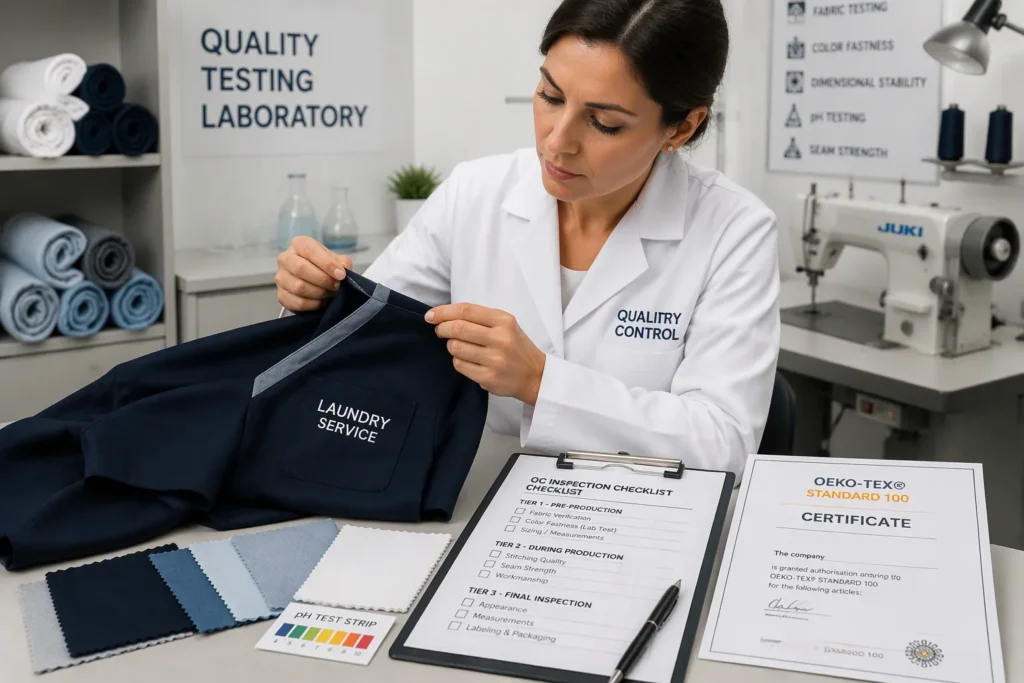
Your uniforms need certifications to show they are high quality and safe. ISO and OEKO-TEX certifications are the most important for laundry workwear. These papers help you meet export rules and buyer requirements.
For OEKO-TEX Standard 100, workwear fabrics are in Product Class II. This class covers fabrics that touch skin directly for a long time. Every single part of the garment must pass testing. This includes threads, buttons, zippers, interlining, labels, and trims. If one part fails, the garment cannot carry the OEKO-TEX label. The required pH range for this class is 4.0 to 7.5. This range keeps fabric skin-neutral and lowers irritation during long shifts. Labs test more than 1,000 substances. Regulated chemicals include banned azo dyes, formaldehyde, heavy metals like lead, cadmium, mercury, and nickel, and PFAS. Unregulated but harmful substances include allergenic dyes, chlorinated benzenes, phthalates, and organotin compounds. Certificates stay valid for 12 months. Your supplier must renew them every year. Rules update each year based on the latest science. Random market checks confirm ongoing compliance.
Your factory should run a tiered quality control system.
QC Tier | Checkpoint Focus |
|---|---|
Incoming Quality Control (IQC) | Raw materials inspection |
Process Quality Control (PQC) | Inspection during production |
Final Quality Control (FQC) | Pre-shipment inspection |
Documented testing | Retroreflective performance, seam strength, waterproofing |
Buyer oversight | Real-time reports, unannounced third-party inspections |
Generic auditors often miss critical workwear defects. LantaoWork Lead QA Engineer Chen warns: “Generic auditors miss incorrect hi-vis tape class, mislabeled FR washing tags, and weak knee-reinforcement stitching. They just look at the surface. We physically pull the seams apart.”
Colorfastness testing follows ISO 15797. The specific method used is ISO 105-C06 for wash fastness. Your fabric samples must go through 50 industrial wash cycles at 60 to 75 degrees Celsius with mild bleaching agents. After 50 cycles, color change should reach grade 4 or better. Grade 4 means acceptable colorfastness for workwear. Testing also covers resistance to fading, color transfer to nearby fabrics, and chlorine bleach resistance. Shrinkage testing follows the same industrial conditions. Ask your manufacturer for data specific to your fabric blend.
Pre-Production Samples
Pre-production samples check fit and fabric before you commit to full manufacturing. From Chinese OEM factories, a sample usually takes 2 to 4 weeks. Your design complexity decides the exact timeline.
During the sample stage, check three things. First, confirm fabric weight, color, and weave match your specifications. Second, test the fit on real workers. Let them bend, lift, and stretch to find any limits. Third, check customization details like pocket placement, zipper type, and logo position against your approved artwork.
Always ask for a wash test on your sample. Run it through one or two industrial wash cycles. Check for shrinkage, color bleed, or seam issues. If problems show up, fix them before the full order runs. This simple step stops you from getting a shipment that fails after the first wash.
Your approved sample becomes the master reference for the whole production run. Every garment must match it. Your manufacturer keeps this sample as the quality benchmark. Keep your own copy to compare when you inspect shipments.
RFQ Specification Table
Key Specs To Define
A complete RFQ table prevents confusion before production starts. You list every detail your manufacturer needs to give correct prices. Here is a sample table structure for your laundry service uniforms:
Item | Fabric | Weight (GSM) | Color (Pantone) | Size Range | Logo Method | Quantity | Packaging |
|---|---|---|---|---|---|---|---|
Plant operator shirt | 65/35 poly-cotton drill | 225 GSM | Navy (PMS 282C) | S–4XL | Embroidery | 2,000 pcs | 50 pcs/carton |
Route driver jacket | 100% polyester hi-vis | 245 GSM | Orange (PMS 151C) | M–3XL | Heat transfer | 1,000 pcs | 20 pcs/carton |
Folding staff pants | 65/35 poly-cotton drill | 190 GSM | Gray (PMS 429C) | S–3XL | None | 1,500 pcs | 50 pcs/carton |
GSM tells you how dense a fabric is. A higher GSM means the fabric is thicker and tougher, so it tears less and lasts longer. For 70× industrial washable 65/35 poly-cotton, the common range is 190–245 gsm. The lightest option in this 70× range is 190 gsm, while the heaviest is 245 gsm. Your choice depends on what the worker does. Use 190 gsm for lighter jobs or warm places. Use 225–245 gsm when workers face more rubbing or heavy use.
The color and size columns remove guesswork. You give your brand’s Pantone number. The factory matches that color exactly. Your logo method depends on budget and how often you wash the uniforms. Embroidery lasts the longest through industrial washing. Screen print and heat transfer cost less, but they may fade after many washes.
Volume And Pricing Tiers
Your order size directly changes the price per piece. The MOQ for laundry service uniform OEM China is about 1,000 pieces per style. You order 1,000 shirts for plant operators at one price. Then you order 1,000 jackets for route drivers at a similar price.
Pricing gets lower when you order more. A full set of shirt and pants at 1,000 pieces might cost near US$6.20 per set. An order of 2,000 pieces of the same style could lower the cost even more. Higher GSM fabrics and extra features like reflective tape push the price toward US$8.60 per set.
You can combine orders for both teams into one production run. The factory makes plant operator shirts and route driver jackets together. This saves on setup costs and shipping. You set the volume for each style separately. You ask the factory to give one blended price for the total order. The MOQ of 1,000 pieces per style still applies to each design. But you get better rates on the whole larger quantity.
The OEM Process And Logistics
From RFQ To Production
You start with an inquiry. Send your RFQ table to the factory with fabric, GSM, colors, sizes, logo method, and quantity. The factory reviews your specs and sends a quotation. This usually takes a few business days.
Next comes sample approval. The factory makes a pre-production sample for your review. You check fit, fabric, and logo placement. You run a wash test. Once you approve the sample, production begins. The factory cuts, sews, and assembles your uniforms. Quality control runs at three stages: incoming materials, during production, and before shipment. After QC passes, the factory packs your order and ships it.
Lead Times And Shipping
Production lead times depend on order size and customization. A standard OEM order typically takes several weeks after sample approval. Complex designs with special fabrics or multiple logo placements need more time. Ask your manufacturer for a production schedule before you confirm the order.
You have three shipping methods. Sea freight costs the least for large orders. Air freight moves faster but costs more. Express shipping works best for small urgent orders. Your Incoterms choice — FOB, CIF, or DDP — decides who pays freight and when risk transfers.
Route (Shanghai CNSHA →) | Shipment Type | Service Level | Transit Time (days) |
|---|---|---|---|
Los Angeles (USLAX) – West Coast | Port-to-Port FCL | Standard | 14–20 |
Los Angeles (USLAX) – West Coast | Port-to-Port LCL | Standard | 15–25 |
New York & New Jersey (USNYC) – East Coast | Port-to-Port FCL | Standard | 30–40 |
New York & New Jersey (USNYC) – East Coast | Door-to-Door FCL | Standard | 35–45 |
Shanghai to Los Angeles runs about 2 to 3 weeks on the water. Shanghai to New York takes about 4 to 5 weeks by sea. Door-to-door service to the US East Coast often runs around 30 to 40 days total. Plan your reorder timeline around these transit windows.
Comparison: China OEM Vs. Other Options
Cost And Customization Comparison
You have three main ways to source laundry workwear. Each one changes your cost, your design freedom, and your order size. China OEM gives you the lowest price per unit at scale. Domestic manufacturing costs more per piece but shortens shipping distance. Stock uniforms ship fast but limit your branding and fabric choices.
Factor | China OEM | Domestic Manufacturing | Stock Uniforms |
|---|---|---|---|
Cost per set | US$6.20–US$8.60 | Higher labor rates raise unit cost | Low upfront, but you pay for generic designs |
Customization | Full fabric, color, logo, and pocket control | Moderate to full, at higher cost | Minimal — only basic logo add-ons |
MOQ | About 1,000 pieces per style | Often lower, but price per piece rises | No MOQ, but no design input |
Lead time | Longer transit, plus production weeks | Shorter transit | Immediate |
China OEM wins when you need branded uniforms for two teams on a set budget. You choose the fabric weight, Pantone colors, and logo method. You also combine plant and route orders into one run. Domestic manufacturing works well for small urgent batches. Stock uniforms only work as a short-term fix.
Related Industry Solutions
The same OEM approach helps many adult workwear markets. If you run a commercial cleaning business, you face similar fabric and branding needs. Check out commercial cleaning uniform OEM China for durable, washable options. Facility management teams need a professional look with useful pockets — see facility management uniform OEM China. Hotel and hospitality staff need crisp, brand-matched garments, covered at hotel hospitality uniform OEM China. Waste management crews need high-visibility gear and heavy-duty stitching, detailed at waste management uniform OEM China. Industrial maintenance teams need flame retardant and anti-static fabrics, explained at industrial maintenance uniform OEM China.
Each of these industries shares your core needs: durable fabric, clear branding, and reliable bulk supply. One manufacturer can handle all of them.
How To Pick A Manufacturer You Can Trust
Supplier Check List
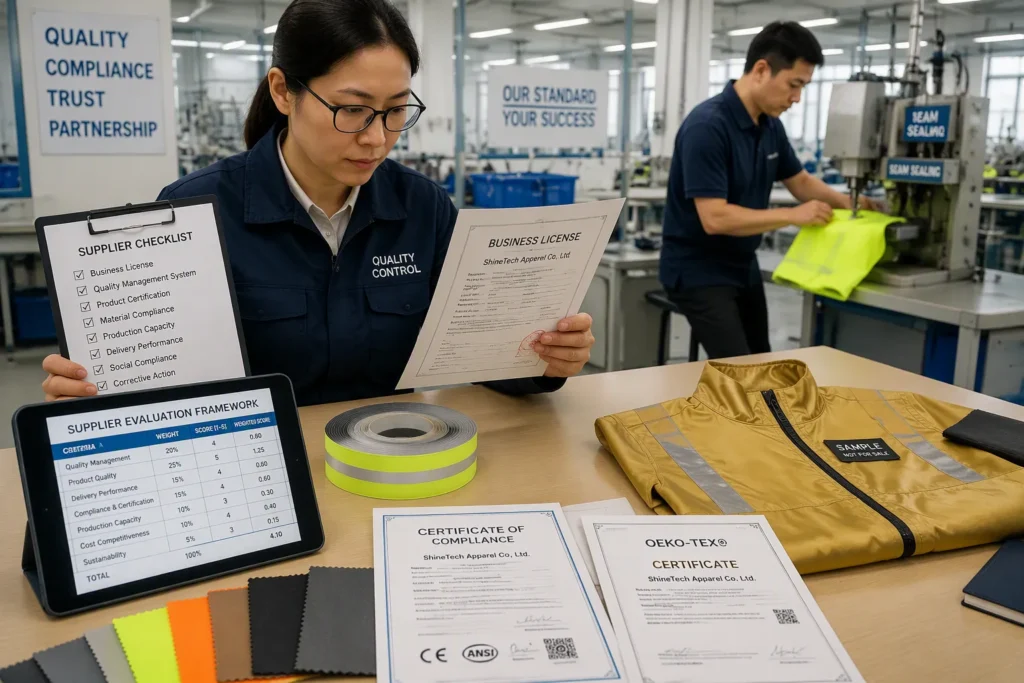
You need a clear plan to judge possible partners. A careful check list guards your money and makes sure your laundry service uniform OEM China partner does what it says.
Begin with a four-part rules check. First, make sure the factory name on the business license matches the compliance certificates exactly. Ask for batch-specific raw test reports for the exact fabric and reflective tape your order needs. Second, look over the OEM workflow from tech pack to golden sample — expect about ten days for sampling. Third, require third-party pre-shipment inspection against ISO 20471 high-visibility standards for route driver gear. Fourth, test waterproofing and breathability on jackets. Make sure polyurethane seam sealing tape machines do not go over 160 degrees Celsius, or seams turn brittle.
Next, check the physical build. Measure reflective tape width and type. Ask for proof that tape lasts at least 50 industrial wash cycles without peeling. Check logo durability using physical wash testing records. Custom heat-transfer logos must not crack in freezing temperatures.
Run a side-by-side sourcing test. Compare several suppliers using the same rules with this evaluation framework:
Evaluation Dimension | Key Indicators |
|---|---|
Experience | Years in export OEM/ODM; facility scale (factory area, worker count, production lines); export markets served (EU, North America, Japan) |
Expertise | Fabric portfolio (cotton/poly blends, FR, anti-static, acid/alkali resistant, softshell, recycled yarns); standards and certifications (EN ISO 20471, EN11612, ANSI/ISEA 107, NFPA); category focus |
Authoritativeness | Position within industrial clusters (e.g., Shandong for functional workwear, Zhejiang for hi-vis, Guangdong for integrated PPE); access to specialized trim, fabric, testing labs |
Trust | Quality systems (ISO 9001, ISO 14001, CE, ANSI, EN, NFPA); documented multi-step QC process; verifiable certificates via IAF CertSearch; batch-specific test reports from accredited labs; third-party pre-shipment inspections |
Ask your shortlisted factories for exact certifications. Request a TÜV Rheinland onsite assessment report. Demand ISO 9001 for quality management. Require ISO 14001 for environmental management and ISO 45001 for occupational health and safety. Each certificate must have a verifiable registration number you can cross-check with the issuing body. A full third-party audit report dated recently beats a certificate page alone.
Check client history and export reach. Look for documented enterprise-level partnerships, such as a framework supply agreement with a Fortune 500 company. Make sure the factory exports to over 40 countries including the United States, Germany, the United Kingdom, Canada, Australia, and the Middle East. Trade exhibition participation — the A+A Show in Germany, the NSC Show in the USA, or the Canton Fair — lets you meet representatives in person. Cross-check certifications against issuing bodies and review documented client relationships before you place a volume order.
Shanghai Top Fortune Industry Co., Ltd. meets every indicator on this check list. Running since about 2002 with a 1,506 square meter facility in Songjiang, Shanghai, the company exports to Europe, the Middle East, Oceania, Southeast Asia, and the Americas. This track record makes it a verified partner for your laundry service uniform OEM China needs.
Communication And Support
Good communication separates a smooth partnership from a frustrating one. Use this benchmark to judge supplier responsiveness:
Communication Channel | Expected Response Time | Notes |
|---|---|---|
12–24 hours | Standard reply window; formal communication | |
Faster than email | Widely used for international buyers | |
Faster than email | Dominant messaging platform in China; not real-time unless conversation is active | |
Follow-up after no reply | Wait 48–72 hours | Time zone gaps and high inquiry volumes cause delays |
Keep your messages short and numbered. Chinese business culture values clarity and efficiency. Numbered questions get more complete answers. Respect time zone differences — China Standard Time is UTC+8, a 12 to 16 hour difference from the US.
Build the relationship, known as Guanxi in Chinese business culture. Trusted suppliers offer better pricing, faster turnarounds, and more flexibility. Get everything in writing — confirm price, specifications, timeline, and packaging over email or formal contract. Use WhatsApp for faster day-to-day replies once you establish contact.
Shanghai Top Fortune Industry Co., Ltd. provides responsive support through multiple channels. Contact the team at rill@topfortunemail.com or via WhatsApp at +86 13524210501. A clear, direct communication line keeps your project on track from sample approval to final shipment.
Getting your laundry service uniform OEM China needs from China gives you the best mix of price, quality, and custom design. Prices start at about $6.20 per set. Every order comes with strong fabrics and full control over your design.
Pick a partner who understands what commercial laundry work requires. Shanghai Top Fortune Industry Co., Ltd. has more than twenty years of special experience in the Americas, Europe, and the Middle East.
Ask for a quote or samples today. You can reach the team at rill@topfortunemail.com or on WhatsApp at +86 13524210501. The street address is Floor 3 Building 20 Haier Zhigu, No.66 Guangfulin East Road, Songjiang, Shanghai 201600, China. When you send a detailed RFQ with your specs, you get a correct price fast.
FAQ
What is the smallest order amount for custom laundry uniforms?
You need about 1,000 pieces for each style. This smallest order amount applies to each design on its own. You can order plant operator shirts and route driver jackets in the same production run. Putting styles together into one order lowers your cost for each set and saves on shipping.
How much does a full uniform set cost?
A complete set costs between US$6.20 and US$8.60. Fabric weight, logo method, and order size all change the final price. Higher GSM fabrics and reflective tape push the cost toward the top of that range. Bigger orders bring the price down.
Can you match our exact brand colors?
Yes. You give the Pantone number for each brand color. The factory mixes a custom batch to match that formula. They test the shade on your chosen fabric before production. A 5–10% variance is normal in textile dyeing.
How long does sampling and production take?
A pre-production sample takes 2 to 4 weeks. How complex your design is decides the exact timeline. Production starts after you approve the sample. Ask your manufacturer for a full schedule before you confirm the order.
Do these uniforms pass industrial wash testing?
Yes, when you specify the right fabric. Colorfastness testing follows ISO 15797 and ISO 105-C06. Your fabric must survive 50 industrial wash cycles at 60 to 75 degrees Celsius. Color change should reach grade 4 or better after those cycles.
Are these uniforms chemical protective gear?
No. Ordinary workwear does not protect against chemicals by default. If your staff face wet-work or chemical exposure, you must name those standards in your RFQ. The factory can then add proper protective features to the garments.