

Bakery Production Uniform OEM China | Plant & Counter Staff Workwear
Table of Contents
Display
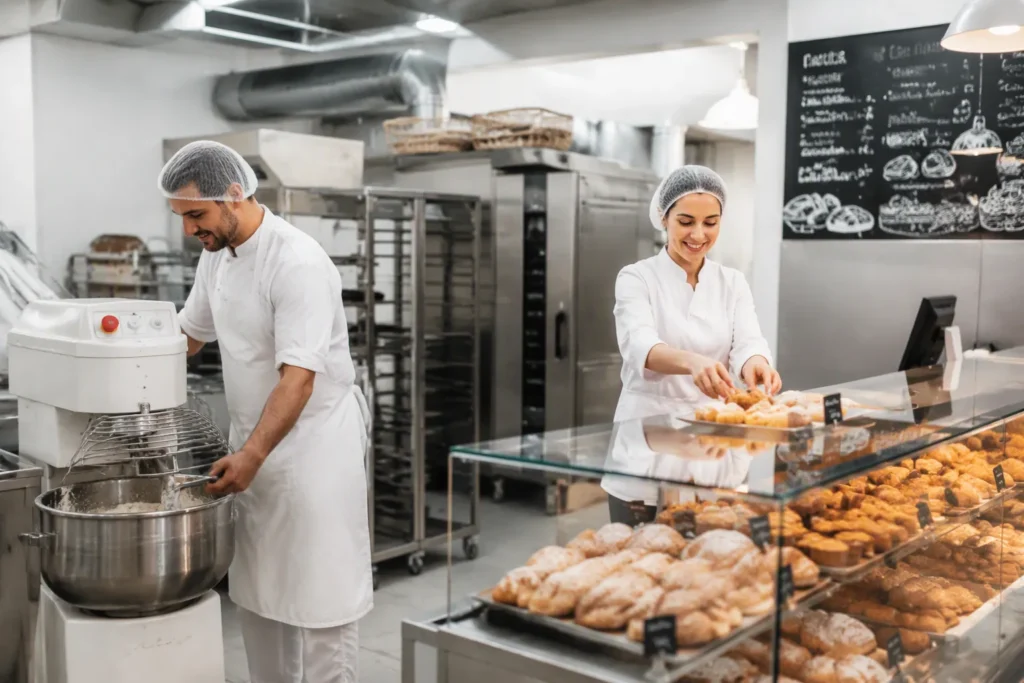
You need uniforms that keep bakery plant and counter teams clean, comfortable, and on-brand. Finding one supplier who handles both roles well is hard. China remains a leading source for bakery production uniform OEM China, offering cost savings, customization, and scalable output. Shanghai Top Fortune Industry Co., Ltd., founded around 2002, runs a 1,506 m² facility in Songjiang, Shanghai. This OEM/ODM manufacturer serves buyers across Europe, the Middle East, Oceania, Southeast Asia, and the Americas. Top Fortune makes workwear to your specifications. The company is not a food-safety certifier, so you must verify compliance with your local food-safety rules independently.
Table of Contents
Why Bakery Staff Need Specialized Workwear
Why Choose Bakery Production Uniform OEM China
Key Features of Bakery Uniforms
Branding and Trims for Bakery Workwear
The OEM Development and Production Process
Selecting a Reliable OEM Manufacturer
Generic vs. Custom Bakery Uniform Programs
Quality Control and Compliance
Pricing, MOQs, and RFQ
Shipping and Logistics
Buyer Checklist
FAQ
Conclusion
Key Takeaways
Pick uniforms that fit each bakery job: plant workers need workwear that resists heat and cleans easily; counter staff need styles that are hygienic and good for the brand.
Ordering from a Chinese OEM manufacturer saves money and lets you customize everything, with minimum orders of about 1,000 pieces per style.
Always approve a sample before bulk production to make sure fit, fabric, and branding meet your standards.
Check the goods before they are shipped. This helps find problems and makes sure the brand, packaging, and labels are right.
Check food-safety rules on your own; makers like Top Fortune do not certify that they meet local rules.
Why Bakery Staff Need Specialized Workwear
Bakery work happens in two very different places. Plant teams mix, bake, and pack in hot rooms full of flour. Counter teams help customers, run the cash register, and keep display cases neat. Each job needs its own kind of uniform.
Plant Staff Uniform Requirements
Plant workers deal with heat, flour dust, and oil splatter every shift. Their uniforms must guard against these dangers and still feel good during long hours. Breathable fabrics help you stay cool near ovens. Easy-clean materials let flour and oil wash out. Strong stitching lasts through many industrial washes.
Common plant clothes include chef coats, heavy-duty pants, and aprons. These items cover the body well and resist snags. You also want colorfast fabrics. They keep their color after many wash cycles. This helps your team look the same over time.
Counter Staff Uniform Requirements
Counter staff work where customers can see them. Their uniforms must mix hygiene with brand image. A clean, professional look builds trust. It also brings real business results. Alibaba reports that professional branding links to 17% higher transaction size. Social media engagement at branded pop-ups rises 44% higher.
Popular counter styles include fashion-forward waist aprons with custom logos and uniforms that blend hospitality looks with kitchen practicality. HACCP-compliant features like no pockets and long sleeves support food safety. Polo shirts, aprons, and tailored pants work well here. These pieces let your counter team move freely while representing your brand.
Why Choose Bakery Production Uniform OEM China
China has the world’s most developed textile supply chain. This gives you a clear edge when buying workwear. You can get full production from fabric to finished clothing. Many bakery chains pick this path because it is dependable.
Cost Efficiency and Scalability
Big orders bring down your cost for each item. A basic bakery uniform set costs between US$8.50 and US$13.00. This covers the shirt, pants, and sometimes an apron. Top Fortune requires a minimum order of about 1,000 pieces per style. This suits bakery chains with many locations. You can begin with one style for plant workers and another for counter staff. As you expand, you grow without changing suppliers.
The Chinese industrial workwear market keeps growing. Here is the data:
Metric | Value |
|---|---|
Market size 2024 | USD 3.5 billion |
Projected market size 2025 | USD 3.8 billion |
Projected market size 2033 | USD 6.8 billion |
CAGR (2026-2033) | 8.2% |
Revenue in 2026: US$2.3 billion
This growth leads to spending on better equipment. You gain from faster output and better quality. Manufacturers compete for your business, which keeps prices fair.
Access to Specialized Fabrics and Trims
Bakeries need fabrics that stand up to heat, flour, and oil. Chinese mills make textiles built for these conditions. You get breathable fabrics that keep your team cool near ovens. You get tough materials that last through repeated industrial washing. You get colorfast dyes that keep uniforms looking new.
Custom trims are simple to find. You can add reinforced stitching at stress points. You can pick snap closures instead of buttons for safety. You can choose pocket styles that fit your workflow.
For more details on workwear for food environments, see our guide on food processing uniform OEM China. It covers similar principles that apply to bakery settings.
When you choose bakery production uniform OEM China, you gain control over every detail. You pick the fabric weight, the fit, and the features. You get exactly what your team needs at a price that fits your budget. This approach builds a steady brand image across all your locations. Your bakery production uniform OEM China partner delivers uniforms made for real bakery work.
Key Features of Bakery Uniforms
Bakery uniforms must handle heat, flour, oil, and repeated washing. The right fabric choices protect your team and keep your brand looking sharp. Focus on three core qualities: hygiene, breathability, and durability.
Hygiene and Easy-Clean Fabrics
Your plant and counter teams work around food all day. Uniforms must resist oil, flour, and liquid spills. Choose fabrics with a tight weave that blocks particles from settling into the cloth. A smooth surface lets you brush off flour quickly. Oil-resistant finishes stop grease from soaking in. Machine-washable materials let you clean uniforms after every shift without special treatment.
Food-grade fabrics matter for any role that touches or stands near open product. These materials do not shed fibers or hold bacteria. They also handle frequent washing at high temperatures. Poly-cotton blends and treated polyester work well here. They keep their shape and stay clean through many cycles. You should confirm that your fabric supplier provides material safety data for your market.
Breathability, Wash Durability, and Colorfastness
Bakery plant floors run hot. Ovens radiate heat all day. Your team needs breathable fabrics that let air move and moisture escape. Look for fabrics with moisture-wicking properties or open-weave structures. These features keep workers cool and reduce fatigue during long shifts. Breathable uniforms also help your team stay focused on safe food handling.
Industrial laundering breaks down weak fabrics fast. You need materials that hold their strength after many wash cycles. Reinforced stitching at seams and stress points extends garment life. Colorfast dyes keep uniforms looking new. They resist fading from repeated washing and exposure to heat. This matters for brand consistency across all your locations.
For operations that also handle cold environments, see our guide on cold storage logistics uniform OEM China. It covers fabric choices for temperature extremes that may apply to your bakery’s storage areas.
Branding and Trims for Bakery Workwear
Your bakery uniform carries your brand to every customer and every delivery. The right logo method and trim choices make your team look sharp and professional. You can apply your brand to polos, aprons, and pants in several ways.
Logo Application Methods
Silk screen printing works well for bold, simple logos on polo shirts and aprons. This method lays ink directly on the fabric. It holds up through many washes and costs less for large orders. Sublimation printing suits polyester fabrics. The dye bonds with the fabric fibers. Your logo will not crack or peel over time. This method handles full-color designs with fine detail.
Embroidery gives a premium look for polo shirts and chef coats. Stitched logos resist fading and wear. They add texture that printed logos cannot match. Woven logos offer another durable option. You weave the design into a patch and sew it onto aprons or pants. This method works best for small, detailed logos. Each method has trade-offs in cost, durability, and appearance. You should match the method to the garment and your budget.
For more guidance on branding polo shirts, see our guide on custom polo shirt OEM manufacturer China. It covers logo placement and fabric choices that apply to bakery uniforms.
Custom Trims and Finishing Options
Trims turn a basic uniform into a branded program. You can add contrast piping along collar edges or pocket lines. This creates a clean, professional look. Custom buttons, snaps, and zippers let you match hardware to your brand colors. Reinforced bar tacks at stress points extend garment life. These small details matter in hot, busy bakery environments.
You can also choose pocket styles that fit your workflow. A pen pocket on a counter apron keeps order pads handy. A chest pocket on a polo holds a thermometer or small tools. Waistbands on pants can include elastic or drawstrings for comfort. You pick the finish that works for your team. Every trim choice should support hygiene, comfort, and your brand image.
The OEM Development and Production Process
You need a clear path from your first email to the truck at your door. A good OEM partner makes each step easy to see. You always know what comes next. This section walks you through the full journey for your bakery production uniform OEM China order.
From Inquiry to Sample Approval
Your project starts with an inquiry. You send your needs to the manufacturer. Include your uniform types, target quantities, fabric preferences, and branding ideas. The manufacturer reviews your request and asks more questions. You then confirm the design and specifications together. This covers measurements, fabric weight, color choices, and trim details.
Next comes sampling. The factory makes a sample garment that matches your approved specs. You check this sample for fit, fabric feel, stitch quality, and logo placement. You ask for changes if needed. The factory revises the sample until you approve it. Sample approval is a key gate. It locks in every detail before bulk production begins. Skipping this step leads to costly mistakes later.
Typical sampling takes about one to two weeks. This depends on fabric availability and design complexity. You should plan for at least one revision round. Good communication during sampling saves time in the long run. For a related process on hospitality uniforms, see our guide on restaurant waitstaff uniform OEM China.
Bulk Production and Pre-Shipment Inspection
Once you approve the sample, bulk production starts. The factory orders fabric and trims in the required quantities. Cutting, sewing, and finishing follow in sequence. Production for large orders typically takes several weeks. Your manufacturer should give you a clear timeline at the start.
Quality control runs throughout production. In-house QC teams check measurements, stitching, and color consistency at multiple points. They pull defective pieces before they reach the packing stage. Before shipment, you or a third-party inspector review the finished goods. This pre-shipment inspection confirms that the bulk order matches the approved sample. You check branding, packaging, and labeling at this stage.
After inspection passes, the factory packs your order and arranges shipping. You receive shipping documents and tracking details. The whole process from inquiry to delivery usually spans several weeks to a few months. Order size and customization level drive the exact timeline. Clear specs and fast sample approval keep your project on schedule.
Selecting a Reliable OEM Manufacturer
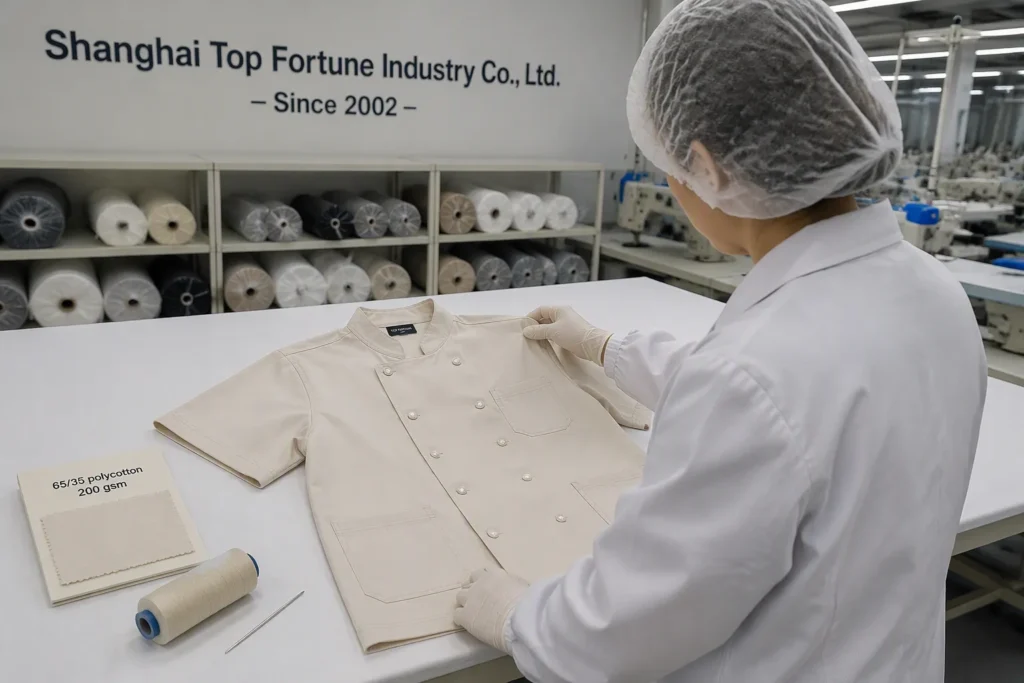
You need a partner who ships on time and follows your specs. The right factory makes your bakery production uniform OEM China project run smoothly from beginning to end. Use clear rules to tell strong manufacturers apart from weak ones.
Factory Capabilities and Certifications
Begin with factory size and how many years it has run. A facility of 1,000 m² or more with 50+ workers shows real production power. Shanghai Top Fortune Industry Co., Ltd. matches this profile. This company has operated since around 2002. Its 1,506 m² facility sits in Songjiang, Shanghai. Top Fortune works as an OEM/ODM manufacturer. It exports to Europe, the Middle East, Oceania, Southeast Asia, and the Americas. This long history and global reach give you confidence in their ability to handle your order.
Look at the specific capabilities that matter for bakery uniforms. Check these criteria:
Criterion | Description | Relevance to Bakery Uniforms |
|---|---|---|
Fabric composition & weight | 65/35 polycotton at 180–220 gsm | Balances breathability and durability for warm bakery environments |
Seam reinforcement | Double-needle topstitching, bar tacks at stress points | Prevents tearing when staff bend and lift |
Logo application method | Embroidery recommended for longevity (50+ washes) | Withstands frequent washing |
Pocket configuration | Two front patch pockets + internal phone slot; cargo pockets | Holds thermometers or order pads |
Wash durability rating | ISO 105-C06 Class 4+, tensile strength ≥250N | Ensures long life through repeated washing |
Flame-resistant fabric | Required near bakery ovens | Critical for preventing burns in oven areas |
Also check where raw materials come from. This confirms fabric quality and safety. Check the on-time delivery rate. A rate of 97–98% shows a reliable supply chain. Ask about customization options. Sample-based and drawing-based customization lets you get exact bakery uniform requirements. Review their quality control steps. Finished product inspection and traceability systems protect your order.
Communication and Sample Turnaround
Good communication saves you time and money. Test how well your manufacturer responds before you commit. Send a detailed inquiry with your specs. See how fast they reply. Check if they ask smart questions about your needs. A strong partner replies within one business day. They give clear answers about fabrics, trims, and timelines.
Sample turnaround matters for your schedule. Ask how long sampling takes. A reliable factory delivers samples in one to two weeks. They also handle revision rounds without delay. You should approve a sample before bulk production starts. This step locks in every detail. It prevents costly mistakes later.
For a related example of how this process works for cafe uniforms, see our guide on barista cafe uniform OEM China. The same principles apply to bakery workwear programs.
Ask for references from past clients. Contact those clients about their experience. A manufacturer with strong references shows they deliver on promises. You want a partner who treats your order with care. Clear communication and fast sampling build trust. These qualities lead to a successful bakery uniform program.
Generic vs. Custom Bakery Uniform Programs
When you buy bakery workwear, you have two paths to pick from. One path is generic stock uniforms. The other path is a custom OEM program. Each one meets different needs. Your bakery size, budget, and branding goals help you decide.
When Generic Stock Works
Generic uniforms fit small bakeries with one or two shops best. You order from a catalog of already-made items. You do not need any design work. No sample delays slow you down. Delivery takes days, not weeks.
This choice works well for emergencies. A sudden team growth or a lost shipment leaves you short. You grab stock pieces and keep your team working. Generic items also suit temp staff or trial hires. You skip a big upfront cost.
The downsides are clear. Branding stays very small. You get no logos or only basic generic labels. Fabric choices are few. You may not find the exact weight or pocket style your team needs. Fit options cover standard sizes only. Your brand presence stays weak across your team.
When Custom OEM Delivers Better Value
Custom OEM programs work best when you run many locations or franchise operations. Your brand image matters to every customer. Your team needs special features for safety and comfort. This is where bakery production uniform OEM China becomes a strong choice.
You control every detail. Pick the fabric blend and weight that fits your bakery setting. Choose pocket styles that match your workflow. Select logo placement and application method. Your uniforms match your brand colors exactly.
Custom programs also help with better hygiene. You choose food-grade fabrics with easy-clean finishes. You add safety features like snap closures instead of buttons. These details lower contamination risk. Your team wears uniforms made for real bakery work.
Upfront cost runs higher than stock. But per-unit cost drops with bigger orders. A custom program with 1,000 pieces per style often costs less per garment than buying 50 stock pieces from a catalog. Quality fabrics and reinforced stitching survive more wash cycles. Your uniforms last longer and look better.
For a similar approach in retail settings, see our guide on supermarket retail staff uniform OEM China.
Quality Control and Compliance
Quality control keeps your order free from flaws. Compliance keeps your business safe from legal trouble. You need both to run a safe bakery uniform program. Each one works in its own way.
In-House QC vs. Third-Party Inspection
In-house QC means the factory checks its own work. Inspectors look at fabric, stitching, measurements, and color at each stage. They remove bad pieces before packing. This method catches problems early and keeps your order on track. Most factories offer in-house QC as a standard service.
Third-party inspection brings in an outside company to review your goods. You hire this firm, not the factory. The inspector visits before shipment and checks the bulk order against your approved sample. They confirm branding, packaging, and labeling. You get a detailed report with photos. This step adds cost and time. It also gives you independent proof that your order meets your specs. Many buyers use third-party inspection for large or first-time orders. You can also combine both methods. Let the factory run in-house QC during production. Then bring in a third party for the final pre-shipment check.
Understanding Food-Safety Compliance Limits
Top Fortune supplies workwear to your specifications. The company is a manufacturer, not a food-safety certifier. Top Fortune does not certify that a garment meets any food-safety regulation. That distinction matters for your compliance planning.
You must verify compliance with your local food-safety rules on your own. Different markets set different requirements for bakery workwear. Some rules cover fabric type, pocket design, or closure style. Others address how you wash and handle uniforms. You should confirm these details with your local food-safety authority. Ask your fabric supplier for material safety data when your market requires it. Check whether your chosen trims and finishes meet local standards. This step protects your business and your team.
A clear QC plan and a clear compliance plan work together. You inspect what you can control. You verify what your market demands. This approach keeps your bakery uniform program safe and legal.
Pricing, MOQs, and RFQ
Typical Pricing Factors and MOQ
Four main things decide the price of your bakery uniform order. The fabric type makes the biggest difference in cost. A normal poly-cotton blend costs less than a special oil-resistant or sweat-wicking fabric. How complex your customization is also changes the price. Simple silkscreen logos cost less than full embroidery or woven patches. The amount you order affects the price for each piece. Bigger orders spread out fixed costs like pattern-making across more garments. This lowers your cost for each piece. Shipping terms add one more variable. FOB pricing covers goods delivered to the port. CIF adds freight and insurance. EXW means you arrange all transportation yourself.
Top Fortune sets a minimum order of about 1,000 pieces per style. You can mix sizes within that amount. Some manufacturers offer lower MOQs around 300 sets. These smaller runs often come with higher prices for each piece. Match the MOQ to your bakery’s size and growth plans. A chain with many locations benefits from the lower costs that 1,000 pieces per style provides.
RFQ Specification Table
A clear RFQ helps you get accurate pricing fast. Include every detail the manufacturer needs to quote your order. Use this table template for your request:
Item | Specification Details | Quantity | Target Price | Branding Method | Delivery Date |
|---|---|---|---|---|---|
Chef Coat (Plant) | 65/35 poly-cotton, 200 gsm, snap closures, chest pocket | 500 pcs | US$9.00/pc | Embroidery on left chest | 60 days ARO |
Apron (Counter) | Full bib apron, 100% polyester, adjustable neck strap | 300 pcs | US$5.50/pc | Silkscreen on bib | 60 days ARO |
Polo Shirt | 65/35 poly-cotton pique, 180 gsm, collar with buttons | 200 pcs | US$7.00/pc | Embroidery on left chest | 60 days ARO |
Send your completed RFQ to rill@topfortunemail.com. You can also reach the team on WhatsApp at +86 13524210501. Include your expected quantity, preferred fabrics, logo files, and target delivery date. The team reviews your request and responds with pricing, sample timelines, and production lead times within one business day.
Shipping and Logistics
Incoterms and Lead Times
You should understand the shipping terms before you order. Three Incoterms cover most bakery uniform shipments. FOB, or Free on Board, means you are responsible once goods leave the Shanghai port. CIF, or Cost Insurance and Freight, covers shipping and insurance to your destination port. EXW, or Ex Works, means you handle all shipping from the factory door. Each choice changes your total cost and risk.
Lead times depend on your order size and customization. After sample approval, bulk production takes several weeks. Sea freight from Shanghai to major ports adds more time. A normal trip from Shanghai to Rotterdam takes about 30 to 35 days. Plan your uniform program around these timelines. Order early enough to cover production, shipping, and any port delays.
Freight costs change by route and container type. Here is a breakdown for the Shanghai to Rotterdam route:
Route | Container Type | Freight Cost | Notes |
|---|---|---|---|
Shanghai to Rotterdam | 20 ft, 20,000 kg | 2,000 USD | Specific quote |
China to Netherlands | 20 ft FCL | 1,500–3,500 USD | General range |
Your freight forwarder can help you get a specific quote for your delivery address.
Packaging and Labeling
Your bakery uniforms need packaging that fits where they are going. Bulk packing works best for plant distribution. The factory packs 50 or 100 pieces per carton. Each carton holds one style and one size. This makes unpacking easy at your warehouse. Your team sorts uniforms by size and sends them to each location.
Individual polybag packing works better for retail stores. Each uniform goes into its own bag with a size label. You add a hang tag or barcode sticker to track inventory. This option costs a little more per piece. It saves time at each store.
Labeling keeps your uniforms organized across locations. Your manufacturer can print your brand name, size, and care instructions on each label. You choose the label material and where it goes. Standard labels resist washing and stay readable. Soft labels work best near the collar and waist in bakery settings. They do not bother skin during long shifts.
Buyer Checklist
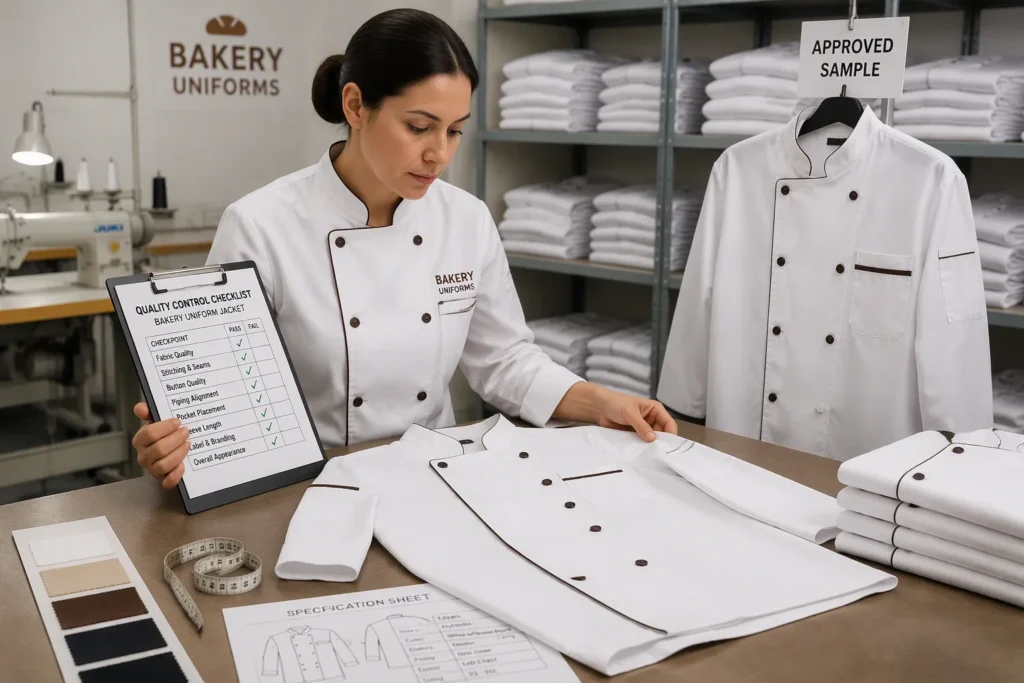
You make fewer mistakes when you use a clear checklist at two key times. Use this guide before production begins and again before goods ship. These steps help you get uniforms that match your order.
Pre-Production Checklist
Confirm all specifications in writing. Go over fabric type, weight, color codes, and garment measurements with your manufacturer. Make sure pocket styles, closure types, and trim details match your approved design. Send clear reference images if you need to. This step catches errors before cutting starts.
Approve the sample before bulk production starts. Get a sample garment that matches your specs. Have a team member who fits your typical employee size try it on. Check the fit at the shoulders, chest, and length. Make sure the logo placement and size are right. Test the fabric feel and stitch quality. Only approve the sample when everything meets your standards. Revisions take time but save money compared to fixing bulk mistakes.
Verify fabric and trim quality. Ask your manufacturer for fabric swatches or material data sheets. Make sure the fabric weight and composition match your order. Check that colors match your brand standards. Talk about how the fabric holds up through industrial washing. Fix any concerns before the factory orders materials.
Confirm the MOQ and pricing in writing. Top Fortune requires about 1,000 pieces per style. Make sure this quantity fits your budget and timeline. Agree on pricing for the confirmed order. Add any shipping or customization costs to your total.
Agree on production lead times. Ask for a clear timeline from fabric ordering to shipment. Confirm how long sample revision takes. Plan your uniform launch around these dates. A written schedule protects both sides.
Pre-Shipment Checklist
Inspect the bulk order before shipment. Compare random samples from the production run against your approved sample. Check measurements, stitching, and color consistency. Look for defects like loose threads, uneven seams, or fabric flaws. Reject pieces that do not match your quality standards.
Verify branding on every garment. Check logo placement, size, and application quality. Make sure embroidery threads match your brand colors. Test that silkscreen or sublimation prints line up correctly. Branding mistakes are hard to fix after goods leave the factory.
Check packaging and labeling. Make sure each carton has the correct style and size. Verify individual polybags have the right labels. Check that care instructions and size tags match your requirements. Good packaging protects uniforms during ocean freight.
Confirm all shipping documents are complete. Review the packing list, commercial invoice, and bill of lading. Check that your company name and delivery address are correct. Make sure the Incoterm matches your agreement. Complete documents prevent customs delays.
You now have a clear plan for buying bakery production uniform OEM China. Begin with detailed specs. Approve a sample before bulk production. Check quality at every stage. These steps protect your order and your brand.
Shanghai Top Fortune Industry Co., Ltd. brings more than twenty years of experience to your project. The company runs a 1,506 m² facility in Songjiang, Shanghai. Top Fortune serves buyers across Europe, the Middle East, Oceania, Southeast Asia, and the Americas. You gain a partner who knows global workwear needs.
Top Fortune is not a food-safety certifier. You must confirm compliance with your local food-safety rules on your own.
Ready to start? Email rill@topfortunemail.com or message WhatsApp +86 13524210501. Visit the Haier Zhigu office at Floor 3, Building 20, Haier Zhigu, No. 66 Guangfulin East Road, Songjiang, Shanghai 201600. Ask for a quote or sample today.
FAQ
What is the minimum order quantity for bakery uniforms?
Top Fortune needs about 1,000 pieces for each style. You can mix different sizes in that count. Some factories let you order as few as 300 sets. But smaller orders usually cost more per item. Pick an MOQ that fits your bakery’s size and plans.
How long does sampling take?
Sampling usually takes one to two weeks. The time depends on fabric supply and how complex the design is. Plan for at least one round of changes. Staying in touch with the factory helps you save time. You must approve the sample before they start making the full order.
Can I customize fabrics and trims for my bakery?
Yes. You choose the fabric weight, mix, and special features. You can pick oil-resistant coatings, breathable weaves, or colors that do not fade. You can add strong stitching, snap closures, or pockets made for your needs. Each detail helps with cleanliness, comfort, and your brand.
What logo methods work best for bakery workwear?
Silk screen printing is good for bold logos on polos and aprons. Embroidery looks high-end and does not fade easily. Sublimation works well on polyester fabrics with many colors. Woven logos are strong for small, detailed designs. Pick the method that fits the garment and your money.
What are typical lead times for bulk orders?
After you approve the sample, making the full order takes a few weeks. Shipping by sea from Shanghai to big ports adds more time. A usual trip from Shanghai to Rotterdam takes about 30 to 35 days. Plan your uniform project with these time frames in mind.
Does Top Fortune certify food-safety compliance?
No. Top Fortune makes workwear to your exact needs. The company is a manufacturer, not a food-safety certifier. You are the one who must check that the uniforms meet your local food-safety rules. Talk to your local authority about fabric type, pocket style, and closures.