

Grocery chain corporate apparel and easy-clean uniforms for high-wash environments

You face constant pressure to maintain food safety and hygiene in your grocery chain corporate apparel program. Clean uniforms help you reduce hazards and keep your store looking professional. Consider the everyday risks your team encounters—slips, spills, and customer impressions all hinge on proper cleanliness. Professional suppliers play a vital role in supporting your uniform program, helping you overcome challenges such as staff retention and after-hours security.
Challenge | Description |
|---|---|
Safety | Cleanliness reduces hazards and prevents injuries from slips and spills. |
Store Presentation | A professional appearance influences customer experience and satisfaction. |
Staff Retention | Safe, hygienic conditions support employee satisfaction and business stability. |
After-Hours Security | Managing external cleaning contractors prevents theft and logistical issues. |
Key Takeaways
Clean uniforms enhance food safety by reducing contamination risks in grocery environments.
Professional appearance boosts customer trust and satisfaction, impacting overall store success.
Comfortable uniforms improve employee morale, leading to better service and retention.
Choose uniforms made from durable, moisture-wicking, and stain-resistant materials for high-wash settings.
Regular laundering and proper care of uniforms are essential for maintaining hygiene and compliance.
Involve employees in uniform selection to increase satisfaction and ensure a good fit.
Select reliable suppliers who prioritize quality, sustainability, and timely delivery of uniforms.
Stay updated on food safety standards to ensure uniforms meet regulatory requirements and protect your brand.
Why Grocery Chain Corporate Apparel Matters
Food Safety in Grocery Environments
You play a crucial role in protecting both your customers and your team by choosing the right grocery chain corporate apparel. In the food industry, uniforms act as a barrier against contamination. Personal protective equipment such as gloves, facemasks, and aprons help prevent foodborne hazards. Each role in your store faces unique risks, so you must select food industry uniforms that match the specific needs of your environment.
Professional suppliers like UniFirst and Prudential Overall Supply help you maintain food safety by providing uniforms that meet strict hygiene standards. These suppliers design uniforms to reduce cross-contamination and ensure they are always clean and available. When you work with dedicated food processing uniform providers, you benefit from advanced washing systems that meet or exceed regulatory requirements. This professional support helps you comply with HACCP, SQF, FDA, and GMP standards, which all begin with hygienically clean uniforms.
Tip: Consistent use of food industry uniforms in your store not only protects food but also demonstrates your commitment to food hygiene and professionalism.
Hygiene and Compliance
Uniforms are essential in preventing contamination in grocery chains. Regulatory bodies such as the FDA and HACCP set clear frameworks for hygiene standards. You must follow these guidelines to protect public health and keep your operations safe. Clean, well-maintained uniforms help you meet these requirements every day.
Professional uniform suppliers ensure your garments are processed according to HACCP principles. They use advanced cleaning methods to guarantee that uniforms are safe for use in food environments. By partnering with these experts, you reduce the risk of contamination and maintain compliance with industry regulations.
Uniforms create a barrier against physical, biological, and chemical risks.
Clean uniforms are always available, supporting your compliance efforts.
Professional suppliers help you stay ahead of changing hygiene standards.
Employee Comfort and Brand Image
Your team’s comfort directly affects their performance and your store’s branding. When you provide comfortable, well-fitted uniforms, you boost employee morale and job satisfaction. This leads to better customer service and a more positive shopping experience.
Uniforms present a professional appearance to your customers, reflecting your company’s values and professionalism. A consistent look across your team enhances brand recognition and creates a cohesive atmosphere in your store. Customers trust a team that looks polished and unified, which strengthens your professional image and reinforces your branding.
Comfortable uniforms increase productivity and satisfaction.
A professional appearance builds trust and loyalty with customers.
Consistent branding through uniforms makes your store memorable.
Note: Investing in professional, stylish uniforms gives your store a professional polish and supports your corporate environments.
Key Features of Work Uniforms for High-Wash Environments

Choosing the right work uniforms for your grocery chain corporate apparel program is essential for maintaining food safety, supporting branding, and ensuring a professional appearance in corporate environments. You need uniforms that withstand frequent wash cycles, resist stains, and deliver comfort and durability for your team. Brands such as RCHQ and ADI HACCP design food industry uniforms with these priorities in mind, helping you meet haccp standards and operational demands.
Material Selection
Selecting the best materials for work uniforms in high-wash environments impacts both functionality and wash-resistance. You want fabrics that balance comfort, durability, and ease of cleaning.
Synthetic vs. Natural Fabrics
You often face a choice between synthetic and natural fibers. Synthetic fabrics like polyester offer superior durability and resist wear from repeated wash cycles. Rayon provides comfort but does not match polyester’s longevity. You can improve rayon’s performance by blending it with polyester or choosing engineered types like Modal and Lyocell, which handle industrial laundry better than pure viscose. Pre-shrinking and optimizing GSM (grams per square meter) also make rayon suitable for daily-use uniforms.
Polyester delivers excellent durability and wash-resistance.
Rayon blends offer comfort and improved longevity.
Modal and Lyocell types of rayon perform well in high-wash settings.
Proper engineering ensures uniforms last longer and maintain a professional appearance.
Moisture-Wicking and Stain Resistance
You need uniforms that resist moisture absorption and stains. Materials should wick away sweat and liquids, keeping employees dry and comfortable. Uniforms must withstand rigorous sanitization and frequent wash cycles without losing their shape or color. RCHQ and ADI HACCP select fabrics that minimize hiding places for contaminants and support food safety.
Moisture-wicking fabrics keep employees comfortable.
Stain-resistant materials maintain a professional appearance.
Uniforms must endure repeated wash cycles and sanitization.
Design for Hygiene
The design of work uniforms plays a critical role in minimizing contamination risks and supporting food safety. You should look for features that prevent contaminants from accumulating and make cleaning easier.
No Upper Pockets, No Buttons
Uniforms designed for food industry environments avoid pockets above the waist and buttons. These features can trap dirt and bacteria, threatening food safety. RCHQ and ADI HACCP ensure their uniforms have no pockets or buttons in high-risk areas, reducing contamination risk.
No pockets above the waist prevent contaminants from hiding.
No buttons eliminate places for bacteria to accumulate.
Snap buttons and closed seams offer a clean barrier between employees and food.
Proper Fit and Coverage
Proper fit and coverage enhance both safety and comfort. Uniforms should fit well to prevent loose fabric from contacting food or equipment. Long sleeves protect food from direct skin contact, and closed seams prevent fibers from shedding. You should choose durable workwear that covers exposed skin and maintains a professional appearance.
Well-fitted uniforms improve safety and comfort.
Long sleeves and closed seams protect food from contaminants.
Durable fabric resists rips, tears, and fraying.
Comfort and Durability
Comfort and durability are vital for employee satisfaction and retention. When you provide comfortable uniforms, you boost engagement and productivity. Durable uniforms save money by lasting longer and reducing replacement costs. Managed workwear programs from premium brands allow employees to choose preferred styles, supporting branding and professional appearance.
Feature | Impact on Employee Satisfaction and Retention |
|---|---|
Comfort | Enhances engagement, productivity, and job satisfaction. |
Choice | Allows employees to select styles, boosting satisfaction. |
Premium Brands | Attracts top talent and meets preferences, improving retention. |
Managed Workwear Program | Saves money and time, contributing to job satisfaction. |
You need uniforms that capture particles shed from the human body, protecting against bacteria, hair, and dead skin cells. Clean safety apparel is crucial for preventing foodborne pathogens and maintaining food safety. Durable workwear supports your branding and delivers consistent professional appearance across your team.
Tip: Regularly inspect uniforms for rips, tears, or fraying. Replace damaged garments promptly to maintain hygiene and durability.
Food Processing Uniforms and Cleaning Protocols
You must prioritize strict cleaning protocols for food processing uniforms to maintain food safety and meet hygiene standards in your grocery chain corporate apparel program. Professional suppliers such as CLEAN, Swiss Uniforms, and Phelps USA deliver reliable solutions that support your cleaning and maintenance needs. Their services help you extend garment longevity, ensure compliance, and protect your brand reputation.
Washing Procedures
Proper washing procedures are essential for keeping food processing uniforms hygienic and professional. You need to follow industry best practices to eliminate bacteria and contaminants from work uniforms.
Temperature and Detergent Use
High temperature wash cycles play a critical role in sanitizing food industry uniforms. You should use detergents that exceed minimum requirements for killing germs and bacteria. Ecolab products offer advanced sanitization, ensuring your uniforms meet food safety standards. High temperature drying cycles further eliminate pathogens, while tunnel finishers use steam and dry heat to sanitize and finish garments. Optional protective packaging adds another layer of safety during transport.
Procedure | Description |
|---|---|
High temperature wash cycles | Ensures effective cleaning and sanitization of uniforms. |
Best soap and sanitization | Utilizes Ecolab products that exceed minimum requirements for killing germs and bacteria. |
High temperature drying cycles | Further sanitizes uniforms by using heat to eliminate pathogens. |
Tunnel finisher | Employs steam followed by 240° dry heat to sanitize and finish garments. |
Optional protective packaging | Provides additional safety for clean garments during transport. |
Professional uniform services, such as those from Swiss Uniforms, guarantee hygienically clean food processing uniforms by holding certifications like TRSA’s Hygienically Clean Food Safety Certification. You benefit from consistent weekly delivery of cleaned uniforms, which supports your operational reliability.
Frequency of Laundering
You must launder work uniforms regularly to maintain hygiene standards and food safety. Most grocery chains require uniforms to be washed at least weekly. In sectors with higher contamination risks, such as healthcare and food service, you may need more frequent laundering. Regular cleaning is essential for compliance and for protecting both employees and customers.
Launder food processing uniforms at least once per week.
Increase frequency in high-risk environments.
Maintain a strict cleaning schedule to support food hygiene and regulatory compliance.
Stain Removal Techniques
Stain removal is a vital part of maintaining professional appearance and durability in grocery chain corporate apparel. You need to act quickly and use the right methods for each type of stain to keep uniforms looking clean and professional.
For blood stains, rinse immediately with cold water and wash with enzyme-based detergents.
For cooking oil, scrape excess grease, treat with grease-fighting liquid detergent, and rinse.
For ink stains, pour alcohol on the stain and rub with a paper towel.
For tomato-based stains, scrape excess, dab with liquid detergent, and wash normally.
For gravy, remove excess, dab with cold club soda, and spot-clean with liquid detergent.
For red wine stains, dab with warm water and treat with salt.
For coffee stains, pre-treat with white vinegar and wash at the hottest temperature allowed.
For cooking oil, apply cornstarch or baking powder to absorb the stain.
Tip: Always check garment labels before applying any stain removal solution. Use appropriate methods based on the type of stain and fabric to preserve durability.
You should always act quickly to treat stains. Fast action prevents permanent discoloration and extends the life of food processing uniforms.
Garment Longevity and Replacement
Garment longevity depends on several factors, including style, functionality, and durability. You should select pre-approved apparel that suits each job role, ensuring comfort and professional appearance. Regular delivery and collection of uniforms streamline the laundering process and maintain garment quality. Professional inspection and repair services help you keep uniforms in good condition, reducing the need for frequent replacements.
Service Type | Description |
|---|---|
Uniform Rental | Swiss Uniforms provides a rental service for uniforms, ensuring regular cleaning and maintenance. |
Custom Uniform | They offer customization options for uniforms, which can include branding relevant to grocery chains. |
Hygiene Certification | Swiss Uniforms holds the TRSA’s Hygienically Clean Food Safety Certification, ensuring sanitary services for food-related industries. |
Weekly Service | Consistent weekly delivery of cleaned uniforms ensures reliability for grocery chain operations. |
Phelps USA supports your uniform program by offering customization with logos and providing company online stores for easy access to branded garments. These services streamline uniform distribution and enhance brand visibility.
Professional clothing maintenance is crucial for extending the life of grocery chain corporate apparel. You should provide guidance on washing, drying, and ironing techniques tailored to specific fabric types. Effective uniform management programs help you maximize garment lifespan and maintain a professional image.
Note: Regular inspection and prompt repair of uniforms help you maintain food safety and hygiene standards. Replace damaged garments to ensure your team always looks professional and meets operational requirements.
Employee Training for Uniform Use
Proper Care and Hygiene
You set the standard for cleanliness in your grocery chain by training your team on proper care for employee uniforms. Daily laundering is essential for uniforms in food service, healthcare, or any high-contact environment. For moderate-contact roles, such as receptionists, every-other-day cleaning works well. Light-contact positions require at least weekly cleaning. You should always change and clean uniforms immediately after visible soiling.
To ensure hygiene, wash uniforms in hot water at a minimum of 140°F (60°C). Select industrial-grade, antibacterial detergents for high-risk areas. Keep uniforms separate from household laundry to prevent cross-contamination. Always dry uniforms thoroughly before storage to avoid bacteria growth.
Daily laundering for high-contact roles
Every-other-day or weekly cleaning for lower-contact positions
Immediate changing after visible soiling
Hot water and antibacterial detergents for washing
Isolate uniforms from regular laundry
Ensure complete drying before storage
Tip: Consistent cleaning routines help you maintain a professional image and extend the durability of your work uniforms.
Protocols for Food Safety
You protect your customers and staff by following strict food safety protocols for uniforms. Start with a training needs analysis to identify the focus areas. Gather resources that match your topics, then implement the training. Assess what your team learns and adjust your program as needed.
Key elements of food safety training for uniforms include:
No pockets above the waist to prevent contamination.
No buttons on garments to reduce hazards.
Use of durable fabric that withstands frequent washing.
Proper fit to avoid safety risks and improve comfort.
Clean, sanitary uniforms at all times.
You reinforce these protocols through regular training sessions and clear communication. When you emphasize these standards, you create a safer, more professional environment for everyone.
Feedback and Improvement
You improve your uniform program by listening to your team. Employees appreciate involvement in the design and selection process. Their feedback often highlights the look, comfort, and fit of new garments. When you simplify the ordering process, your team receives uniforms faster and your costs decrease.
Establish multiple communication channels for regular input. Quarterly business reviews help you discuss uniform needs at a higher management level. Many grocery chains have seen a 30% cost reduction after introducing a uniform rental program.
Involve employees in uniform selection
Gather feedback on comfort and fit
Streamline ordering for faster delivery
Use regular reviews to address concerns
Monitor cost savings from rental programs
Note: Continuous feedback ensures your uniforms remain durable, comfortable, and professional, supporting both employee satisfaction and your brand’s reputation.
Choosing Uniform Suppliers and Services
Evaluating Quality and Reliability
You need to select uniform suppliers who deliver consistent quality and reliability. Leading providers such as Prudential Overall Supply, CLEAN, UniFirst, Swiss Uniforms, and Phelps USA have built strong reputations in the grocery industry. When you evaluate suppliers, focus on these key criteria:
Cost and value for your investment
Delivery reliability to ensure uniforms arrive on time
Reputation and financial stability of the supplier
Supplier audits and quality management systems
Delivery performance and communication standards
Commitment to sustainability practices
You should define clear audit objectives before you start. Evaluate food safety and compliance standards, review delivery performance, and check for regulatory compliance. These steps help you maintain high standards for your team’s appearance and support your store’s branding goals.
Tip: Consistent supplier performance ensures your employees always look professional and your branding remains strong.
Sustainability and Eco-Friendly Options
Sustainability has become a top priority for many grocery chains. You can choose suppliers who offer eco-friendly uniforms and responsible solutions. CYC Uniforms has focused on purposeful garments since 1935, emphasizing long-term value and environmental responsibility. Lindstrom leads the way in developing eco-friendly uniforms for food factory workers, using innovative design and sustainable materials.
Unitec Distribution Systems provides uniforms made from recycled and organic materials. These options help you reduce your environmental impact and support your branding as a responsible business.
Type of Uniform | Description |
|---|---|
Recycled Uniforms | Made from previously used materials, reducing waste and landfill impact. |
Carbon-Neutral Products | Manufactured to balance carbon emissions, crucial for combating climate change. |
Sustainable Materials | Sourced to ensure natural resources are not depleted, promoting ecosystem health. |
When you select eco-friendly options, you show your commitment to sustainability and reinforce your branding as a forward-thinking grocery chain.
Garment Replacement Programs
Efficient garment replacement programs keep your team looking sharp and ready for work. Many suppliers offer quick fulfillment, shipping uniforms within three days from US fulfillment centers. You benefit from in-stock inventory, so you never have to wait for production. This prevents understaffing and ensures your team always has what they need.
Scalable solutions allow you to grow your program as your business expands. Online ordering portals make it easy for managers to order directly, reducing administrative workload. Direct shipping to employees supports remote locations and new hires, streamlining the onboarding process.
Note: A reliable replacement program supports your branding by ensuring every employee wears clean, professional uniforms at all times.
Cost and Value Assessment
You must evaluate both the direct and indirect costs when selecting a uniform supplier for your grocery chain. High-quality uniforms often require a larger upfront investment, but they deliver significant long-term savings and operational benefits. You should look beyond the initial price tag and consider how your choices affect your annual spend, employee satisfaction, and brand reputation.
Start by reviewing ancillary charges. These hidden costs can include delivery fees, rush orders, repairs, and replacements. Ancillary charges may impact up to 40% of your total annual spend. You can minimize these expenses by negotiating service agreements and choosing suppliers with transparent pricing.
Product choices also play a major role in your cost structure. Limiting premium styles and focusing on essential, functional designs can save you between 23% and 56% each year. You should select uniforms that meet your operational needs without unnecessary features. This approach helps you control costs while maintaining a professional appearance.
Inventory control is another critical factor. Effective management of uniform inventory can reduce your annual spend by 33% to 45%. You should implement systems that track usage, monitor losses, and optimize ordering schedules. Many suppliers offer digital management platforms that simplify inventory tracking and help you avoid overstocking or shortages.
Fabric selection influences both cost and durability. Choosing the right materials can save you 15% to 39% annually. Durable, easy-clean fabrics reduce replacement frequency and laundering costs. You should consult with your supplier to identify fabrics that balance comfort, hygiene, and longevity.
The following table summarizes potential savings and benefits associated with each cost factor:
Evidence Type | Potential Savings/Benefits |
|---|---|
Ancillary Charges | Up to 40% of total annual spend can be affected. |
Product Choices | Savings of 23% to 56% by limiting premium styles. |
Inventory Control | Annual spend reduction of 33% to 45% with proper management. |
Fabric Choices | Annual savings of 15% to 39% by selecting appropriate fabrics. |
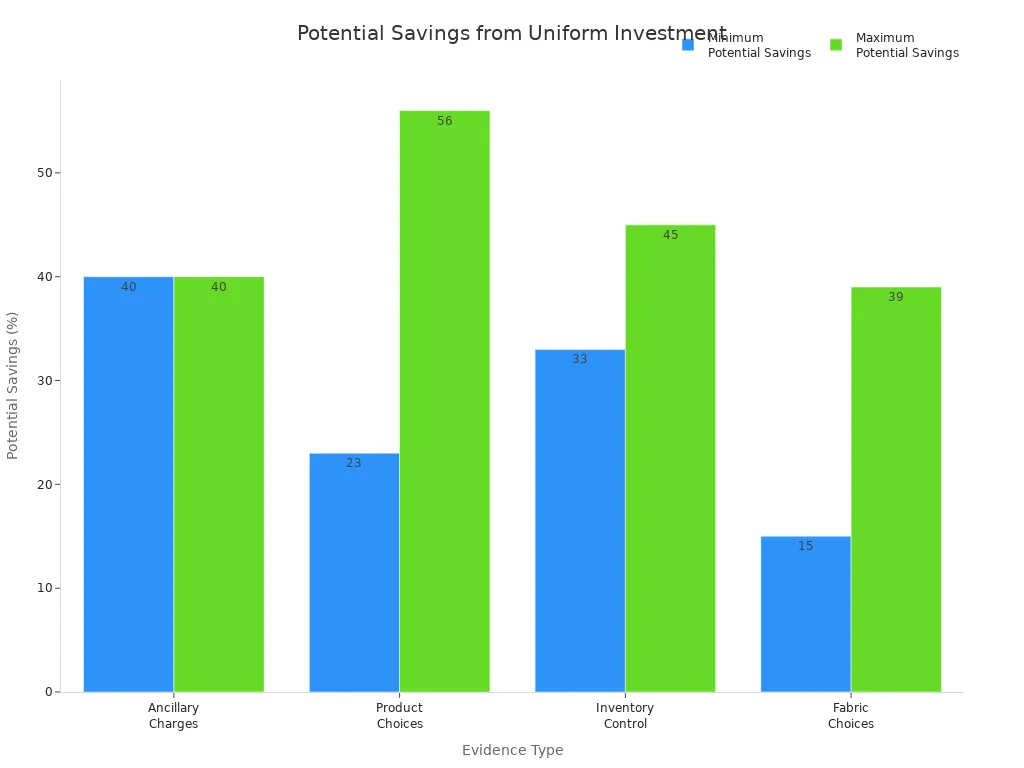
You should always compare the total value offered by each supplier. Look for providers who deliver consistent quality, reliable service, and flexible solutions. Assess the long-term impact of your uniform program on employee retention, customer perception, and operational efficiency. When you invest in high-quality uniforms and effective management, you protect your bottom line and strengthen your brand.
Tip: Request a detailed cost breakdown from your supplier before signing any agreement. This helps you identify hidden fees and maximize your return on investment.
Addressing Common Uniform Challenges
High Turnover and Loss
You face a persistent challenge with high employee turnover in grocery chains. The industry saw turnover rates reach 48% for full-time staff and 67% for part-time workers in 2021. Many frontline employees consider leaving their jobs, which makes it difficult to maintain a stable workforce. High turnover leads to operational inefficiencies, lower service levels, and increased training costs. You must also manage the loss of uniforms as employees leave, which can disrupt inventory and increase expenses.
You can address these issues by implementing a streamlined uniform management system. Track uniform assignments and returns closely. Use digital platforms to monitor inventory and automate reminders for returns when staff exit. Offer incentives for proper uniform care and timely returns. These steps help you reduce losses and maintain a professional appearance for your team.
Tip: Regularly review your uniform policies and communicate expectations clearly to all employees. This helps prevent misunderstandings and reduces uniform loss.
Seasonal and Role-Specific Needs
You must equip your team with uniforms that suit every season and job role. Winter uniforms require insulated and water-resistant materials to protect employees from cold and wet conditions. Summer uniforms focus on lightweight, breathable fabrics that keep staff comfortable during hot weather. Spring and fall uniforms offer layering options to adapt to changing temperatures.
Role-specific needs also play a critical part in your uniform program. Cashiers benefit from uniforms that allow easy movement and comfort for long shifts. Food service staff need moisture-wicking and easy-clean fabrics to maintain hygiene. Standardize colors and logo placements to reinforce your brand, but tailor the functionality of each uniform to the demands of the role.
Set up an online ordering system with role-based catalogs and manager approvals. This ensures employees receive uniforms that match their responsibilities and the season. Track inventory and forecast demand to prevent stockouts and ensure timely delivery.
Season | Uniform Features |
|---|---|
Winter | Insulated, water-resistant materials |
Summer | Lightweight, breathable fabrics |
Spring/Fall | Layering options for temperature changes |
Allergies and Sensitive Skin
You must consider allergies and sensitive skin when selecting uniforms for your team. Some employees react to certain fabrics or laundry detergents. Choose hypoallergenic materials and avoid harsh chemicals in the cleaning process. Offer alternative uniform options for those with sensitivities.
Communicate with your staff about their needs. Provide clear instructions on how to care for uniforms to minimize skin irritation. Encourage employees to report any issues promptly so you can address them quickly.
Note: Prioritizing comfort and safety for all employees supports retention and creates a positive work environment.
Trends in Grocery Chain Corporate Apparel

Innovations in Fabric Technology
You see rapid changes in the materials used for grocery chain uniforms. Manufacturers now focus on sustainability, hygiene, and comfort. New textile technologies help you address operational challenges and improve employee satisfaction. The following table highlights the latest innovations shaping the industry:
Innovation Type | Description |
|---|---|
Fabrics stay fresher longer, reducing wash frequency and environmental impact. Silver ion and silica-based treatments prevent odor-causing bacteria. | |
New fibers | SeaCell, made from seaweed, offers biodegradability and sustainability. Synthetic spider silk provides strength and flexibility. |
Smart fabrics | IoT-enabled textiles collect wearer data, supporting health and fitness applications. |
3D printing | Complex designs and reduced waste in manufacturing enhance sustainability. |
Robotic manufacturing methods | Robotics improve sewing and cutting efficiency, delivering precise and consistent production. |
Personalization textile technologies | 3D scanning and modeling enable bespoke clothing, increasing employee engagement and satisfaction. |
Recycled fabrics | Brands use recycled materials, such as 100% recycled cotton, to promote sustainability. |
Biodegradable textiles | Fabrics engineered from living organisms break down safely, addressing textile waste issues. |
Antimicrobial fabric treatments | Treatments keep uniforms clean between washes, supporting hygiene in food service and healthcare environments. |
You benefit from these innovations by providing uniforms that last longer, require less maintenance, and support your sustainability goals. Antimicrobial treatments and odor-control technologies help you maintain high standards for food safety and hygiene.
Digital Uniform Management
You now manage your uniform program with advanced digital tools. Purpose-built systems enforce detailed rules and compliance, giving you real-time visibility into inventory and distribution. These platforms reduce errors and streamline fulfillment, making your operations more efficient.
Custom-branded uniforms match your company’s image.
In-house management of company stores gives you better control.
Web-based platforms simplify ordering and tracking.
You track uniform assignments, monitor returns, and forecast demand with digital solutions. Real-time insights help you respond quickly to staffing changes and seasonal needs. Error-free fulfillment ensures every employee receives the right uniform on time.
Feature | Description |
|---|---|
Purpose-built systems | Designed for uniform programs, ensuring compliance and rule enforcement. |
Real-time visibility | Immediate insights into uniform management, improving operational efficiency. |
Error-free fulfillment | Reduces mistakes in distribution, streamlining the process for grocery chains. |
Tip: Digital uniform management platforms save you time and reduce costs, allowing you to focus on customer service and store performance.
Evolving Food Safety Standards
You must keep up with changing food safety standards in the grocery industry. Regulatory bodies update guidelines to address new risks and technologies. Uniform suppliers respond by developing garments that meet stricter hygiene requirements and support compliance.
You see more uniforms designed with antimicrobial treatments, closed seams, and no upper pockets or buttons. These features reduce contamination risks and help you meet industry regulations. Suppliers also offer training and support to ensure your team understands proper uniform care and hygiene protocols.
You improve your uniform program by staying informed about regulatory changes and adopting new technologies. Continuous improvement helps you protect your customers, maintain compliance, and strengthen your brand reputation.
Note: Staying ahead of trends in grocery chain corporate apparel ensures your team remains safe, comfortable, and professional.
You protect your store’s reputation by choosing the right grocery chain corporate apparel. Uniforms help you maintain food safety, support a professional appearance, and strengthen branding. Focus on quality, robust cleaning routines, and trusted suppliers to keep your team looking sharp. Conduct a uniform audit or consult industry experts to improve your program.
Stay proactive. Adapt your corporate apparel strategy to new trends and keep your professional appearance and branding strong. Your professional image sets your store apart.
FAQ
What materials work best for high-wash grocery uniforms?
You should choose polyester blends or engineered rayon like Modal and Lyocell. These fabrics resist shrinking, fading, and wear. They also dry quickly and maintain their shape after frequent washing.
How often should you wash grocery store uniforms?
You need to wash uniforms at least once per week. For high-contact roles, daily laundering ensures hygiene. Always clean uniforms immediately after visible soiling to prevent contamination.
Can you customize uniforms with your grocery chain’s logo?
You can add your company logo and colors to most uniforms. Suppliers like Phelps USA and Swiss Uniforms offer customization options. This supports your branding and creates a professional appearance.
What features help prevent contamination in food environments?
You should select uniforms with no upper pockets, no buttons, and closed seams. These features reduce places where bacteria and dirt can hide. Long sleeves and proper fit also protect food from direct contact.
How do you manage uniform inventory for high turnover?
You should use digital management platforms to track assignments and returns. Automated reminders help recover uniforms from departing staff. This reduces loss and keeps your inventory accurate.
Are there eco-friendly uniform options for grocery chains?
You can choose uniforms made from recycled or organic materials. Suppliers like Lindstrom and Unitec Distribution Systems offer sustainable choices. These options help you reduce your environmental impact.
What should you do if an employee has sensitive skin or allergies?
You need to provide hypoallergenic uniforms and avoid harsh detergents. Communicate with your team about their needs. Offer alternative fabrics and cleaning methods to ensure comfort and safety.
How do you extend the life of your uniforms?
You should inspect uniforms regularly for damage. Follow recommended washing and drying instructions. Replace garments promptly when you notice rips or stains. Proper care helps you maintain a professional look and save costs.