

Flame Retardant Workwear OEM China | FR Coveralls & Jackets
Navy and high-visibility orange flame-retardant industrial coveralls hanging on a factory finishing rack
Shanghai Top Fortune Industry Co., Ltd. (workwearmanufacturer.com) is a Shanghai-based OEM/ODM manufacturer of workwear and corporate uniforms. Founded around 2002, the company operates a 1,506 m² facility in Songjiang and supports custom apparel programs for buyers across Europe, the Middle East, Oceania, Southeast Asia, an d the Americas.
If you are sourcing flame-retardant (FR) workwear—coveralls, jackets, trousers, or layered FR kits—for industrial, energy, utilities, or maintenance fleets, this guide explains how to brief an OEM partner, what fabric and construction details matter, and how Top Fortune builds FR programs to your approved sample and tech pack.
Typical MOQ is about 1,000 pieces per style. Contact: rill@topfortunemail.com | WhatsApp +86 13524210501.
—
Why FR Workwear Belongs in a Structured OEM Brief
Flame-retardant garments are not generic “heavy workwear.” Procurement, HSE, and brand teams usually need:
Fabric and finish choices that match the buyer-defined FR performance target
Repeatable color, fit, and logo placement across seasonal reorders
Clear documentation so internal compliance teams can approve samples
One factory that can scale coveralls, jackets, and trousers under one OEM relationship
Getting the brief wrong—wrong fabric family, missing secondary protection details, or branding that conflicts with heat-risk zones—creates rejected shipments and costly rework. A written RFQ reduces that risk.
Important: Top Fortune manufactures custom workwear to buyer specifications. Buyers should state the FR fabric, finish, and any standard references their market requires. Do not assume a sewing factory “holds” an FR certification simply because it can cut and sew industrial garments. Your purchase order and approved sample define the performance target.
—
What Buyers Should Specify in an FR RFQ
Share a written brief (and reference samples when possible) before requesting a firm quote:
Spec area What to clarify Why it matters
End use Welding adjacent, electrical utility, oil & gas support, plant maintenance, foundry support Fabric weight, pocket metal rules, sleeve design
FR approach Inherent FR fiber vs treated FR fabric (buyer-defined) Cost, wash life expectations, care labeling
Garment types Coverall, jacket, trousers, bib, shirt Pattern and trim choices
Color Navy, royal, khaki, orange/hi-vis contrast (pantone if known) Lab dips and dirt camouflage on high-wear zones
Branding Embroidery, heat transfer, reflective logos, name tags Placement vs heat/abrasion zones
Wash Industrial laundry vs home wash; temperature Finish durability and care labels
Packing Polybag, hangtag, carton marks, size stickers Warehouse rollout
Practical tip: Attach a reference garment photo or approved tech pack showing pocket layout, zipper type, and logo boxes. If crews also need visibility outdoors, many buyers combine FR base layers with separately specified hi-vis reflective workwear rather than forcing every property into one SKU.
We do not invent rankings, traffic claims, or factory-held FR certificates in this article.
—
Product Range: Coveralls, Jackets, Trousers
FR coveralls / one-pieces
Full-body coveralls are the highest-control option for plant and maintenance teams who need continuous coverage from shoulder to ankle. Zipper quality, double-needle seams, crotch reinforcement, and pocket metal rules are frequent tech-pack items. For related industrial one-piece programs, see also our guide to industrial coverall OEM manufacturing in China.
FR jackets and shirts
Jackets often pair with FR trousers for modular kits. Buyers specify collar style, cuff closures, storm flaps, and whether sleeves must stay clear of excessive branding hardware.
FR trousers and bibs
Trousers typically need durable knees, secure closures, and pocket layouts that do not trap debris. Bib styles appear in some welding-adjacent and heavy-maintenance briefs.
Maintenance technician wearing a navy flame-retardant coverall walking a clean factory aisle
—
Fabric, Construction & Branding Notes for Buyers
Fabric families (buyer-defined)
Common buyer conversations include treated cotton FR fabrics, inherent FR blends, and multi-risk fabrics when the end customer requires them. You specify the fiber/finish target; we source and sew to the approved swatch and sample. Confirm:
Target GSM / weight range
Colorfastness and shade band after wash
Expected wash cycles before performance retest (your lab / policy)
Softness vs abrasion trade-offs for all-day wear
Construction checklist
Seam type and stitch density on stress points
Zipper brand preference and covered plackets
Reinforced knees, seat, and elbows when the brief requires them
Snap / button metal rules for electrical environments (buyer-defined)
Care label language set for destination markets
Branding methods
Method Best for Notes for RFQ
Embroidery Long-life corporate identity Keep logos off critical heat-exposure panels if your HSE policy requires it
Heat transfer Multi-color marks Confirm wash temperature limits
Reflective film / tape accents Yard visibility add-ons Separate from core FR fabric claims unless your brief unifies them
Name / role patches Rotating crews Removable options reduce reorder waste
Close-up of flame-retardant workwear z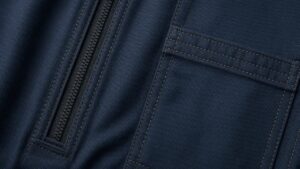 ipper, patch pocket, and reinforced stitching on durable navy FR fabric
—
OEM Process at Shanghai Top Fortune
A typical FR workwear program follows this path:
Inquiry & brief — Quantities, sizes, markets, FR fabric notes, logo art, delivery window
Fabric sourcing & lab dips — Approve handfeel, color, and finish against your reference
Proto / fit sample — Confirm pattern, pockets, branding placement
Pre-production sample (PPS) — Lock construction before bulk
Bulk production — Cutting, sewing, decoration, QC, packing
Shipment — Export packing to Europe, Middle East, Oceania, SE Asia, or the Americas
Factory footprint: 1,506 m² in Songjiang, Shanghai. Address: Floor 3, Building 20, Haier Zhigu, No.66 Guangfulin East Road, Songjiang, Shanghai 201600. End-to-end scope covers fabric selection through packaging.
Related programs often run in parallel—e.g. custom softshell jacket OEM for non-FR outer layers, or corporate polo shirt OEM for office/yard hybrid teams.
—
Comparison: Catalog FR Imports vs Custom OEM FR Kit
Factor Off-the-shelf catalog FR Custom OEM FR program
Size & fit control Limited blocks Locked pattern + size set
Branding Often constrained Controlled embroidery/print process
Colorways Catalog-only Lab-dip / pantone matched where fabric allows
Reorder match Shade risk across vendors Better continuity with retained tech pack
MOQ Sometimes lower Typical ~1000/piece per style
Best for Urgent small fills Multi-year industrial fleets
Most B2B buyers who manage brand and HSE standards across regions choose OEM once volumes and reorder cycles justify sampling.
—
Procurement Checklist (Copy into Your RFQ)
[ ] End use and hazard notes (buyer/HSE-defined)
[ ] Garment types: coverall / jacket / trousers / bib
[ ] FR fabric family and target weight
[ ] Color list with pantone or approved lab-dip references
[ ] Size run and gender / unisex mix
[ ] Pocket, zipper, and trim constraints
[ ] Logo method, artwork files, and placement map
[ ] Wash and care expectations
[ ] Packing: polybag, hangtag, carton marking, barcode
[ ] Target ship date and Incoterm preference
[ ] MOQ confirmation (~1000 pieces per style typical)
[ ] Whether FR kits must match existing hi-vis or corporate layers
—
FAQ: Flame Retardant Workwear OEM China
What is a typical MOQ for FR OEM orders?
About 1,000 pieces per style is typical. Multiple colors or complex pocket metal rules may affect planning—share your assortment early.
Can you produce garments to a named FR standard?
We manufacture to your approved sample and tech pack. Buyers should specify the fabric/finish and any standard references required by their market or end customer. Compliance responsibility for claiming a standard rests with the brand/importer’s testing and approval process.
Do you export FR workwear programs outside China?
Yes. Destinations include Europe, the Middle East, Oceania, Southeast Asia, and the Americas.
Can one order include FR coveralls plus jackets and trousers?
Often yes under one OEM relationship. Bundling styles simplifies branding consistency and reorder planning.
What logo method works on FR garments?
Embroidery is commonly chosen for multi-year fleets. Heat transfer remains useful for multi-color marks—state wash expectations and any HSE placement limits in the RFQ.
How long does sampling take?
It depends on FR fabric availability and artwork readiness. Clear tech packs and vector logos shorten revision rounds.
Do you only make school uniforms?
No. Top Fortune focuses on OEM/ODM workwear and corporate uniforms for business buyers—industrial, logistics, hospitality, security, and related B2B programs.
Who is the commercial contact?
Email rill@topfortunemail.com or WhatsApp +86 13524210501.
—
Request a Flame Retardant Workwear OEM Quote
Ready to brief FR coveralls, jackets, or trousers?
Email: rill@topfortunemail.com
WhatsApp: +86 13524210501
Website: https://www.workwearmanufacturer.com
Address: Floor 3, Building 20, Haier Zhigu, No.66 Guangfulin East Road, Songjiang, Shanghai 201600
Include quantities, colors, size runs, FR fabric notes, and logo artwork so we can propose a practical sampling plan.
Related Resources
Workwear Manufacturer China homepage
Industrial Coverall OEM Manufacturer China
Hi-Vis Reflective Workwear OEM China
Custom Softshell Jacket OEM