

Convenience Store Uniform OEM vs. Local Tailors: Cost Comparison for 100 Chain Stores
Table of Contents
Display
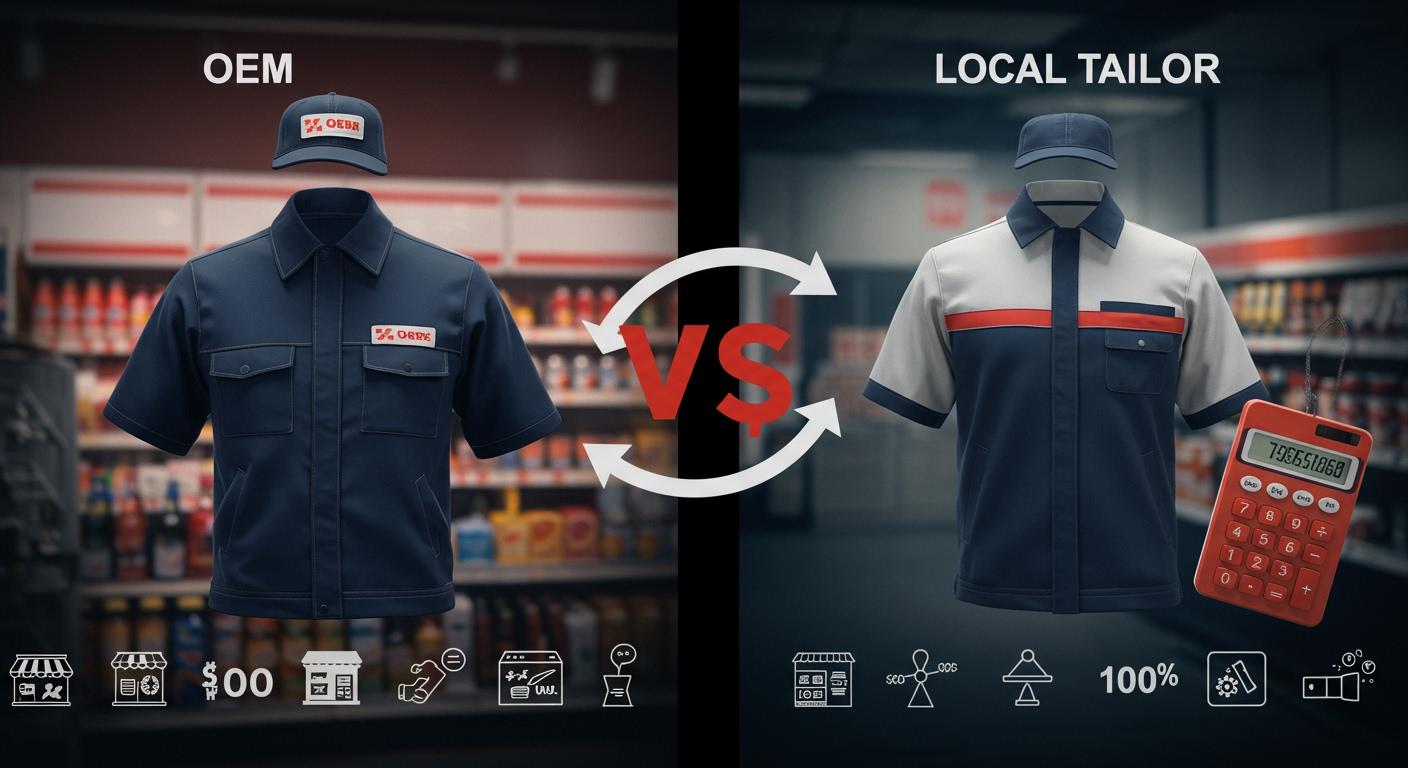
When I look at outfitting 100 convenience store chains, I notice that OEM suppliers usually give me lower costs because they handle large orders efficiently. Their bulk pricing and economies of scale make a big difference. Local tailors, on the other hand, offer more customization, but I find their prices higher. For any business owner, I believe the right choice depends on how I balance cost, quality, and branding. Cost Comparison remains a key factor in making this decision.
Key Takeaways
OEM suppliers offer lower costs for large orders due to bulk pricing and economies of scale.
Volume discounts can significantly reduce the price per uniform when ordering in bulk from OEM suppliers.
Logistics fees are typically lower with OEM suppliers, making it easier to manage costs across multiple locations.
Customization options from OEM suppliers allow for branding without significantly increasing costs.
Local tailors provide a personal touch and unique designs, but their prices are generally higher due to labor and material costs.
Local tailors excel in personalized fittings, ensuring uniforms fit well for each employee.
Consider hidden costs like time management and potential delays when choosing between OEM suppliers and local tailors.
Evaluate the reliability and turnaround time of suppliers to ensure timely delivery and consistent quality.
OEM Uniform Costs

When I order uniforms for 100 convenience stores, I always look at the price first. OEM suppliers make it easy for me to get a lower price per uniform because they handle large orders. I see that bulk pricing plays a big role in the total cost. The cost comparison between OEM suppliers and local tailors often shows that OEMs win on price for big orders.
Bulk Pricing
I notice that OEM suppliers structure their price based on how many uniforms I order. If I order 1000 baseball jerseys from SHH Factory, I pay $5.25 for each uniform. Hengshui Jiahe Textile offers chef uniforms at $3.67 per piece when I buy in bulk. When I order 500 uniforms, I can save 15-30% because of volume discounts. This price advantage helps me keep my cost low across all stores.
Volume Discounts
I always ask about volume discounts before placing a large order. The more uniforms I buy, the lower the price per uniform. For example, if I need uniforms for 100 stores, I can negotiate a better price. Suppliers often give me a discount when I reach certain order sizes, which makes the cost much more manageable.
Logistics Fees
I also consider logistics fees when I calculate the total cost. OEM suppliers usually have established shipping systems. They can deliver uniforms to multiple locations at a lower price than local tailors. I find that logistics fees are lower when I order in bulk, which helps me control my overall cost.
Customization Options
Customization matters to me because I want my brand to stand out. OEM suppliers offer many customization choices for uniforms. I can pick the fabric, add my logo, and choose colors that match my store’s theme. This flexibility lets me create a unique look for each uniform without raising the price too much.
Branding Features
Description | |
|---|---|
Wide Fabrics and Customization Options | In-house fabric factories provide a variety of fabric options and trims. |
Flexible MOQ | Accepts small to large orders, offering flexibility for growing brands. |
Full-Service Production Chain | Comprehensive service from yarn production to mass production. |
I use these branding features to make sure every uniform fits my store’s image. I can select from many fabrics and trims, which helps me create a professional look at a reasonable price.
Design Choices
Custom Employee Allocation: I can tailor uniform distribution based on position, department, and location.
Full Service Uniform Customization: OEM suppliers help me customize every detail of the uniform, from style to color.
I value the ability to adjust design choices for each store. This level of customization gives me control over the final product. I do not have to sacrifice price or quality when I work with OEM suppliers. I find that the cost stays predictable, even when I add special features to my uniforms.
Local Tailor Uniform Costs
When I consider local tailors for my convenience store uniform needs, I notice a different approach compared to OEM suppliers. Local tailors often work with smaller teams and handle each uniform order by hand. This method gives me more control over the final product, but it also affects the price and the overall cost comparison.
Pricing Structure
Labor and Material Costs
I see that local tailors spend more time on each uniform. They cut, sew, and finish every piece with care. This attention to detail increases labor costs. Materials also play a big role. Local tailors may use higher-quality fabrics, which can raise the price per uniform. When I ask for special trims or embroidery, the price goes up even more. I pay for the skill and time that local tailors put into each uniform.
Order Size Impact
When I place a large order, I notice that local tailors cannot match the scale of big factories. They do not have the same equipment or staff. As a result, the price per uniform does not drop much, even if I order for 100 stores. I do not get the same bulk discounts that I see with OEM suppliers. The cost comparison shows that local tailors become less competitive for large uniform orders.
Customization and Service
Fabric Selection
One thing I love about local tailors is the wide range of customization options. I can choose from many fabrics, colors, and textures. If I want a unique look for my uniform, local tailors help me find the perfect material. They often source special fabrics that match my brand’s image. This level of customization makes my uniform stand out.
Personalized Fittings
Local tailors also offer personalized fittings. They measure each employee to make sure the uniform fits well. This service improves comfort and appearance. I can request adjustments for different body types or job roles. The customization process feels personal and detailed. I work directly with the tailor to discuss every aspect of the uniform, from buttons to stitching.
Tip: If I value a perfect fit and unique design, local tailors give me the best customization experience.
Cost Comparison for Convenience Chains
When I compare the options for outfitting 100 convenience chains, I always start with a detailed cost comparison. I want to see how the total cost, price per uniform, and hidden expenses stack up between OEM suppliers and local tailors. This helps me make the best decision for my business.
Total Cost Analysis
Sample Calculations
I like to break down the numbers before I make a big purchase. For 100 convenience chains, I usually need about 10 uniforms per store. That means I order 1,000 uniforms in total. If I choose an OEM supplier, the price per uniform can be as low as $5.25. My total cost for all stores would be:
1,000 uniforms x $5.25 = $5,250
If I go with a local tailor, the price per uniform often rises to $12 or more. My total cost jumps to:
1,000 uniforms x $12 = $12,000
This cost comparison shows a clear difference. OEM suppliers help me save a lot of money when I need uniforms for many convenience chains.
Per-Store Breakdown
I also look at the cost for each store. With OEM suppliers, the cost per store for uniforms is:
10 uniforms x $5.25 = $52.50 per store
For local tailors, the cost per store is:
10 uniforms x $12 = $120 per store
This per-store breakdown makes it easy for me to see how much I spend on each location. When I manage many convenience chains, these numbers add up quickly. The price difference becomes even more important as my business grows.
Hidden Costs
I know that the price tag is not the only thing that matters. I always consider hidden costs when I make a decision for my convenience chains. These costs can affect my budget and my peace of mind.
Time and Management
Managing uniform orders for 100 convenience chains takes a lot of time. With OEM suppliers, I place one large order and let them handle the logistics. This saves me hours of work. Local tailors often need more attention. I have to coordinate fittings, check on progress, and solve problems as they come up. The extra time I spend on management can increase my overall cost, even if the price per uniform looks good at first.
Note: I always factor in my own time when I calculate the true cost for my convenience chains. Time spent on uniform management is time I cannot spend on other parts of my business.
Risk Factors
I have learned to watch out for risks that can affect my convenience chains. Delays and quality issues can cause big problems. I use the table below to keep track of the main risk factors:
Risk Factor | Description | Consequences |
|---|---|---|
Quality Issues | Defective materials, poor workmanship, non-compliance, inconsistent sizing | Rejections, returns, reputational damage, legal liabilities |
Delivery Delays | Production bottlenecks, logistics issues, material sourcing problems | Lost sales, penalties, damage to relationships, reputation damage |
If I choose an OEM supplier, I usually get more consistent quality and faster delivery. Local tailors sometimes struggle with large orders, which can lead to delays or mistakes. These risks can increase my cost if I have to reorder uniforms or deal with unhappy staff at my convenience chains.
I always include these hidden costs in my cost comparison. I want to make sure I get the best value for my convenience chains, not just the lowest price. Uniform quality, reliable delivery, and smooth management all play a big role in my final decision.
Quality and Value Factors
Uniform Consistency
OEM vs. Local Tailor
When I choose uniforms for my convenience chains, I focus on consistency. Uniform consistency helps me maintain strong branding and a professional image. OEM suppliers give me a reliable look across all stores. Local tailors sometimes struggle to match every detail, especially with large orders. I use the table below to track the main factors that affect uniform consistency:
Factor | Description |
|---|---|
Ensures a seamless customer experience and builds trust across multiple locations. | |
Standardized Facility Design | Establishes a uniform look and layout, enhancing customer recognition and loyalty. |
Consistent Fixture and Merchandising Practices | Maintains a cohesive shopping experience that customers can rely on. |
Unified Maintenance Practices | Regular assessments and proactive repairs are essential to uphold the brand’s standards. |
Uniform consistency supports my branding efforts. I want every employee to wear high-quality uniforms that reflect my chain’s values. OEM suppliers help me achieve this goal with standardized workwear and reliable production processes.
Turnaround Time
Delivery Speed
Speed matters when I order uniforms for 100 stores. OEM suppliers usually deliver large orders in 3-4 weeks. Local tailors often need 6-10 weeks to finish the same amount. I compare delivery times using the table below:
Supplier Type | Average Turnaround Time |
|---|---|
OEM Suppliers | 3-4 weeks |
Local Tailors | 6-10 weeks |
Team Triton ships bulk team orders within 3-4 weeks. Kute Tailor takes 6-10 weeks for corporate orders. Fast delivery helps me keep my stores running smoothly and ensures my staff always has proper workwear.
Reliability
Reliability is important for my business. OEM suppliers offer better control over timing, quality, and cost. I get predictable procurement cycles and consistent branding. Local tailors provide faster and more controllable turnarounds for small orders. They also support the national manufacturing industry. However, local tailors have limited product choices and higher production fees. I use the table below to compare reliability:
Supplier Type | Pros | Cons |
|---|---|---|
OEM Suppliers | Better control over timing, quality, and cost; predictable procurement cycles; consistent branding | May have longer lead times |
Local Tailors | Faster and more controllable turnarounds; easier quality control | Limited choice of products and fabrics; higher production fees |
Tip: I always check supplier reliability before placing a large uniform order. Reliable suppliers help me avoid delays and maintain high-quality uniforms for my staff.
After-Sales Support
Reorders
Reordering uniforms is a regular part of managing chain stores. Local tailors often use inventory integration plans to keep stock updated and automate reordering. This helps me maintain supply consistency. I value suppliers who offer easy reordering and keep my workwear inventory full.
Defect Handling
Defect management is another key factor. Local tailors run pilot programs to monitor orders, delivery times, and defect rates. They aim for a defect rate of less than 1-2%. I appreciate suppliers who review quality, lead times, and costs every quarter. They also set up contingency plans for supplier disruptions. This approach helps me keep high-quality uniforms in every store.
Note: I look for value-added features when selecting a uniform supplier. Experience, inventory, quality, reputation, price, customer service, convenience, and e-commerce support all matter. High-quality uniforms and reliable workwear improve staff comfort and durability. Good suppliers make my job easier and support my branding goals.
I see that OEM suppliers usually help me save money when I outfit 100 convenience stores. Local tailors give me more unique designs and personal service. My decision depends on what matters most—cost, quality, branding, or a personal touch. I always consider both direct and hidden costs. I also look at new trends in the industry:
Many companies want eco-friendly and durable uniforms.
Smart fabrics and fashion-forward designs are gaining popularity.
Supporting local suppliers can boost my community and reduce pollution.
I weigh these factors before I choose the best uniform supplier for my stores.
FAQ
What makes uniform manufacturers usa a better choice for chains?
I choose uniform manufacturers usa for chains because they offer bulk pricing, fast delivery, and consistent quality. Their experience in retail helps me boost profits and maintain a strong brand image across all chain-run convenience stores.
How does in-house customization benefit my retail chains?
In-house customization lets me create uniforms that match my retail chains’ branding. I work directly with manufacturers to select fabrics, colors, and logos. This process improves safety, supports custom branding, and helps me stand out in a competitive market.
Can local workwear manufacturers provide complete uniform solutions for chains?
Local workwear manufacturers in the usa offer complete uniform solutions for chains. I get personalized service, custom fittings, and flexible design choices. They help me manage inventory and support my retail profits by keeping my staff comfortable and safe.
How do uniform manufacturers usa help with cost-control consultation?
Uniform manufacturers usa give me cost-control consultation by analyzing my chains’ needs. They recommend bulk orders, suggest fabric options, and optimize delivery schedules. This advice helps me reduce expenses and increase profits in a competitive retail market.
What is the advantage of a full-service uniform program for chains?
A full-service uniform program covers everything from design to delivery. I rely on manufacturers to handle production, logistics, and reorders. This service saves me time, ensures safety, and keeps my chains running smoothly in the retail market.
How does delivery speed impact retail profits for chains?
Fast delivery from uniform manufacturers usa keeps my chains stocked with uniforms. Quick turnaround reduces downtime, improves staff appearance, and supports retail profits. Reliable delivery helps me stay ahead of the competition and maintain high safety standards.
Why should chains focus on safety when choosing uniform manufacturers usa?
Safety matters in retail. I select uniform manufacturers usa who use durable fabrics and proper designs. Safe uniforms protect my staff, reduce accidents, and improve profits. Manufacturers with safety expertise help my chains meet regulations and build trust with customers.
How does competition affect my choice of uniform manufacturers usa for chains?
Competition in the retail market pushes me to choose manufacturers who offer quality, fast delivery, and custom branding. I compare service, pricing, and reliability. The right manufacturer helps my chains increase sales, improve safety, and maximize profits.