

Conference Center Staff Uniform OEM China | Branded Meeting & Event Workwear
Yes, you can really find good, low-cost conference center staff uniform OEM China choices. Low prices, deep customization, and skilled manufacturing make Chinese makers a great choice for your venue. You have many good choices.
You may worry about quality control, communication problems, or shipping. These worries are real. This guide gives you a clear plan for sourcing from China. You will find clear answers here. Your project can really succeed.
As a procurement professional or event manager, you need practical steps. You deserve a smooth process. A trusted and reliable partner makes a big difference for your team.
Key Takeaways
Figure out what you need from your uniforms before you talk to suppliers. This step saves time and money.
Check suppliers carefully. Look for certifications and red flags to avoid trouble.
Always ask for a real sample. Check the fit and color before making a large order.
Discuss terms like MOQ, price, and payment methods. Use Trade Assurance to protect your deal.
Plan for quality control and logistics. Outside inspectors and customs agents help make sure things go well.
Define Your Uniform Customization Needs
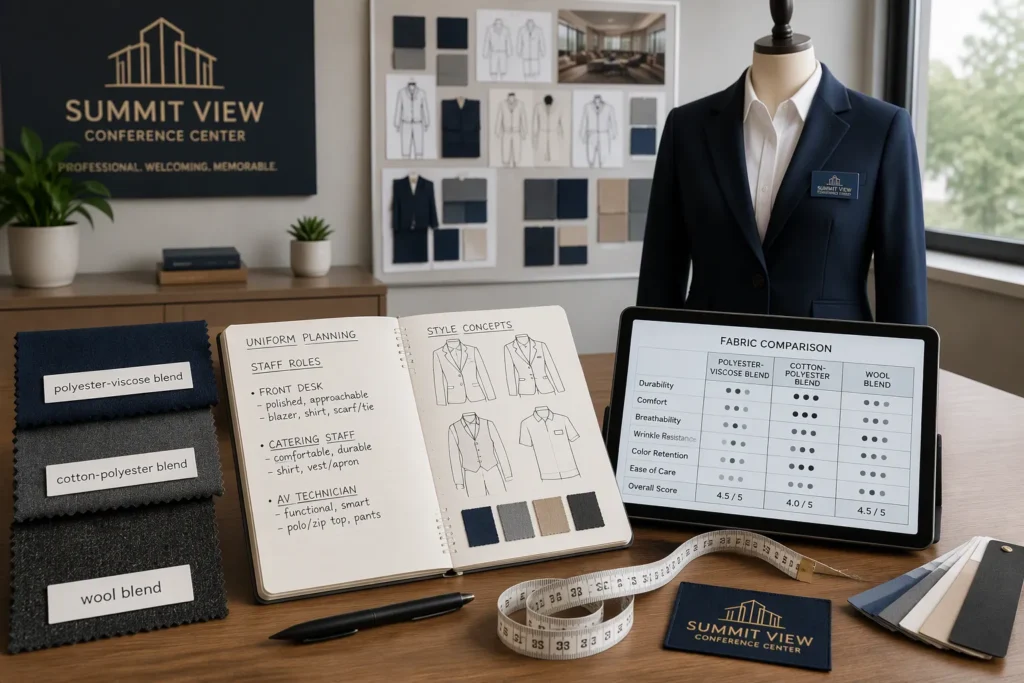
Before you reach out to any supplier, make a detailed uniform plan. This document is your complete guide. It lists all needs for style, fabric, sizing, and branding. A good plan stops confusion and keeps your conference center staff uniform OEM China project on track. Spend time here to avoid expensive changes later.
Style, Fabric, and Functionality
Every job in your conference center needs a different style. Front desk workers need neat, formal clothes that show professionalism. Catering staff need practical clothes for easy movement and spill protection. AV technicians need strong workwear with pockets for tools. Clearly list these needs in your product specification.
Fabric choice changes how uniforms work and look. For front-of-house staff who must look neat all day, one blend is best:
For front-of-house workers in hospitality and retail who must look neat all day, polyester-viscose blends in 65/35 or 70/30 ratios are common for hotel and restaurant uniforms. These blends fight wrinkles, hang well, and wash easily in large amounts. TR (polyester-viscose) blends are chosen when a nice drape and formal look are important.
For other jobs, different fabrics work better. Polyester-cotton blends are the top pick for uniforms overall. Polyester makes them last longer and resist wrinkles, while cotton adds softness and breathability. Twill fabric has a strong diagonal weave for thickness and strength. It keeps a tailored shape during long work hours.
The table below compares common blends for your uniform project:
Fabric Blend | Durability | Professional Appearance | Best For |
|---|---|---|---|
Cotton-polyester blend | Higher polyester content makes it stronger; resists wrinkles | Balanced, holds shape; keeps structure through long shifts | Work shirts, service uniforms, office wear, front desk teams |
Wool and wool blends | Wool blends last longer than pure wool | Nice drape, high-quality look, natural temperature control | Suits, blazers, formal items; top customer-facing jobs |
Pick fabric based on each department’s needs. This choice affects comfort, look, and how long uniforms last.
Sizing and Branding Specifications
A detailed size chart is key for your OEM order. Chinese makers need correct measurements for uniforms that fit well. Give chest, waist, hip, inseam, and sleeve length. Include a size range for all staff. This care in product specification cuts returns and gives a professional look.
Branding changes plain clothes into your conference center’s look. Two common methods work well. Logo embroidery gives a high-quality, long-lasting finish. HD printing makes detailed designs at a lower cost. Suppliers like Haiyuan Workclothes offer both with steady quality. Clearly say where to put the logo, thread colors, and print colors.
Your OEM customization solutions should cover every detail. Include zipper types, button styles, pocket placement, and seam finishes. Private labeling puts your brand on labels and tags inside each garment. The more detail you give, the closer the final product matches your idea.
This early work makes sourcing smooth. Your supplier knows exactly what you need. Your staff gets uniforms that fit well and show your brand correctly.
Sourcing and Vetting China Suppliers
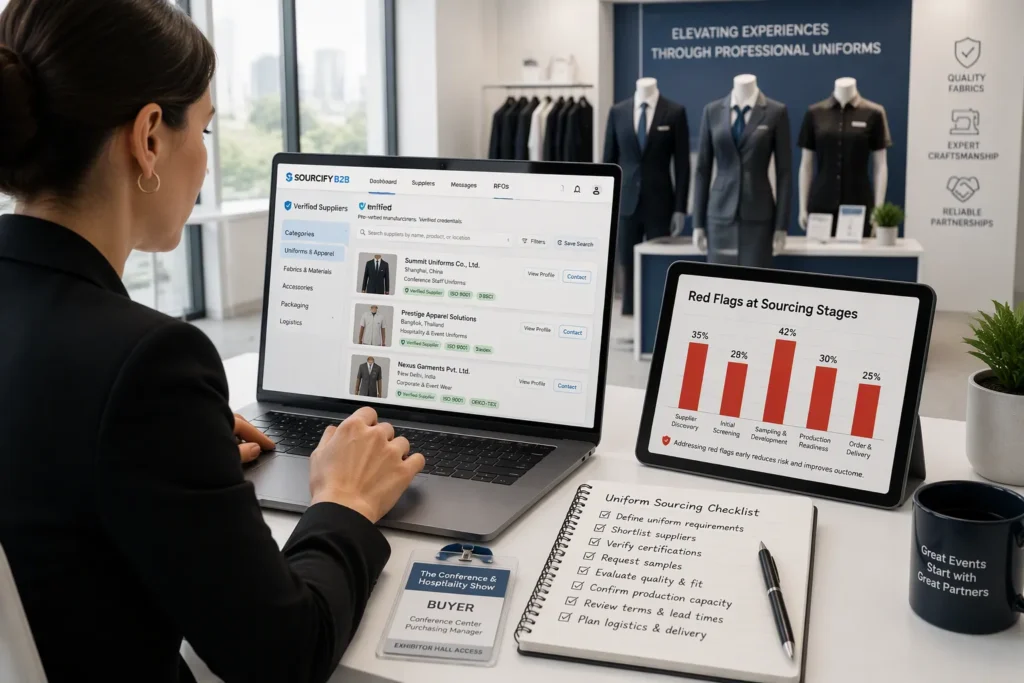
Finding the right partner for your conference center staff uniform oem china project takes careful research. You can find good Chinese manufacturers on online platforms and at events. You must check their credentials. This section walks you through your sourcing process.
B2B Platforms and Trade Shows
Start your search on B2B platforms. Alibaba.com, Made-in-China.com, and Global Sources list many uniform suppliers. Use their search and filter tools. Narrow results by product type, certification, and location. Look for suppliers with verified badges and a long history.
You can also meet factories face to face. Trade shows like CBME China let you see products and talk to factory reps. You check quality in person. This speeds up your sourcing from china.
The chart below shows common red flags at each stage when vetting partners.
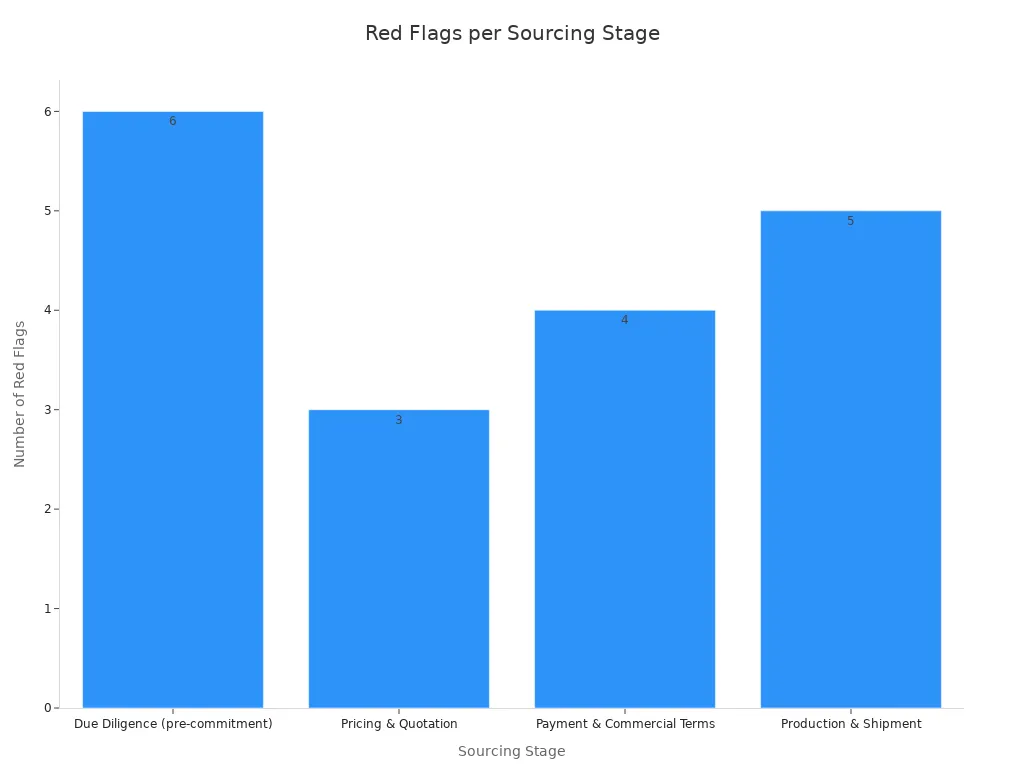
The table below shows red flags by category. Use it to screen potential suppliers.
Vetting Category | Red Flag Criteria |
|---|---|
Verification | Business license not verifiable; scope lacks manufacturing; name mismatch with bank account |
Communication | Slow responses; vague answers; refuses video calls; changes contact person |
Pricing | Price too low; flat pricing with no volume discount; refuses cost breakdown |
Contract & Payment | Rejects 30/70 terms; bank account mismatches license; refuses negotiation |
Any single fail needs extra scrutiny. Multiple fails mean you should move on.
Watch for these payment red flags. Chinese oems with OEM and ODM capabilities follow standard practices.
Demanding 100 percent prepayment — No real manufacturer asks for full payment upfront. Standard 30/70 or 30/50/20 structures protect both sides.
Requesting payment to a personal account — Real transactions use corporate accounts. Personal payments are hard to recover.
Insisting on a non-negotiable contract — A take-it-or-leave-it contract blocks changes to quality terms.
Unusual payment methods — Western Union or cryptocurrency remove buyer protection. Use bank transfers.
Certifications and Factory Audits
Certifications prove a supplier’s manufacturing quality. Check them before you place an order. Here are key certifications to look for:
Certification | What It Covers | Best For |
|---|---|---|
ISO 9001 | Quality management system with documented processes | Consistency and traceability |
OEKO-TEX Standard 100 | Tests for harmful substances in textiles | Skin-contact apparel, chemical safety |
SEDEX / SMETA | Social audit on labor, health, safety, environment | Brands with sustainability goals |
amfori BSCI | Social compliance code with rating band A to E | Comparing multiple factories |
Request copies of the supplier’s certificates directly.
Look for ISO, BSCI, or OEKO-TEX certifications.
Verify the certificate numbers online to confirm authenticity.
BSCI is a social audit framework from amfori. It covers no forced labor, no child labor, fair pay, health and safety, and environmental rules. Auditors assign a rating from A to E. You compare suppliers quickly. One audit works for many buyers.
After your first order, watch for these red flags:
Quality drops after initial orders. Defects increase and materials change. Use pre-shipment inspections.
Communication gets slower. This signals shifting priorities. Address it directly.
New costs appear mid-order. Do not pay charges not in the signed PO.
Due diligence protects your project. Reliable manufacturers welcome verification. The more you check factory capabilities early, the fewer problems you face. A genuine partner values transparency. This builds a strong foundation for your apparel project.
Request and Evaluate OEM Samples
Before you say yes to any production for your conference center staff uniform oem china project, you must ask for a real sample. This step is a must. A sample shows the product quality, the workmanship, and the materials before you place a big order. You can see the stitching, feel the fabric, and check the construction details that photos never show.
Suppliers charge a sample fee for this service. This fee pays for fabric, labor, and shipping. Most factories give this money back on your bulk order after you place it. Ask about this policy early when you source. A sample saves you from costly mistakes later. Your customization needs become real when you hold the garment.
The Importance of a Physical Sample
A real sample shows what digital files hide. You feel the fabric weight. You check the seam strength. You see how the collar keeps its shape. For your apparel project, these details matter. A sample also tests if your supplier is reliable. Do they deliver on time? Does the garment match your specification? You learn through this process.
The sample process has clear steps. First, the factory sends a lab dip for color approval. They dye a small fabric swatch to your Pantone code. You check this swatch under D65 daylight-equivalent lighting, not office fluorescents. Approval takes two to three days for your review and three to five days for adjustment. After lab dip approval, the factory makes a pre-production sample with all parts. This sample includes lining, zippers, elastic, and labels. Pre-production samples ship after lab dip approval.
Conducting a Fit and Color Test
Have your staff try on the sample. Different body shapes show fit issues. Check comfort across all sizes. Does the jacket restrict movement? Do pants fit right at the waist? A fit test catches problems before bulk production starts.
Color matching needs a systematic approach. Use a Pantone book for your reference, not loose chips. Quality suppliers use lab dip reports to match your specified code. Color difference between the approved dip and finished fabric is measured, and a low score ensures consistency. Request per-batch reports to track consistency.
Color consistency matters at scale. Without lab dip reports and Pantone matching, the same fabric varies across batches. Small shade shifts cause visible inconsistency across teams. Replacements do not match existing uniforms. Lab dip reports let you test colors before bulk production starts. Pantone matching creates a fixed reference point for future orders. Every uniform looks the same whether it is the first batch or the fifth.
Related OEM uniform programs
Different materials absorb dye differently. Polyester shell uses disperse dyes. Nylon zippers need acid dyes at lower temperatures. The same Pantone formula gives different hues on different materials. Approve separate lab dips for each fiber type. Mesh lining often reads lighter with the same dye formula. Your factory adjusts dye concentration to make up for this. Verify these matches on your pre-production sample under daylight.
Negotiate OEM Terms and Pricing
MOQ, Pricing, and Payment
MOQ means minimum order quantity. This is the smallest order a factory will take. For your first oem order, you can often ask for a lower MOQ. Ask the supplier how flexible they are. Many factories lower the MOQ if you promise to order again in the future.
Pricing structures are different from one supplier to another. FOB means the seller brings goods to the port. EXW means you pick up the goods at the factory. FOB is usually better for new buyers. You should always use Trade Assurance on sites like Alibaba. This service protects your payment if the supplier does not follow the contract terms.
Lead Times and Production Schedules
Sample lead time is not the same as bulk production lead time. A sample may take time to make and ship. Bulk manufacturing takes longer. You must plan for both timelines in your sourcing schedule.
Build a buffer into your production schedule. Add extra weeks for possible delays. Chinese manufacturers have peak seasons and holiday shutdowns. Factories slow down during Chinese New Year. Your suppliers need advance notice for large orders. A realistic timeline stops rushed shipping and poor quality. Always confirm the production schedule in writing before you pay a deposit.
Manage Production and Quality Control
Once your order starts production, you need someone watching the factory floor. You cannot fly to China for every order. Third-party inspections and clear defect rules let you stay in control from far away. These steps protect your product quality and your brand.
The Role of Third-Party Inspections
A third-party inspection is an independent check of your goods. You hire a company that has no stake in how the factory does. This company sends an inspector to the factory. The inspector looks at your uniforms at key points. During-production inspections catch problems while the line still runs. Pre-shipment inspections happen after production ends and before goods ship. This final check is the most common.
Companies like SGS and Bureau Veritas offer these services. An inspector counts units, checks measurements, pulls on seams, and reviews labels. You get a detailed report with photos. For a uniform order from China, a pre-shipment inspection is an important step.
You should also check manufacturing reliability before production starts. Ask your manufacturer for in-line inspections and fabric testing before cutting. A factory with extensive experience and a global client base usually has these steps in place. Their track record supports stable mass production across repeat orders.
Setting Defect Thresholds
You must define what counts as a defect in your contract. The Acceptable Quality Limit (AQL) is the standard tool for this. AQL sets the most defective units you will accept in a batch. For professional uniform orders, a strict AQL is the minimum acceptable standard. A more lenient AQL suits internal-use garments or budget projects where minor cosmetic issues are okay. Every production run should be inspected at a strict AQL as standard.
Your contract should reference a recognized inspection standard. It should also name ISO 9001 or an equivalent for the manufacturer’s management system. Include a golden sample approval step, the right to inspect before shipment, and a clear rejection and cure procedure that states who pays for rework.
Defect Type | Typical AQL | Definition |
|---|---|---|
Critical | Zero tolerance | A safety hazard, a violation of mandatory regulations, or a defect that could cause injury. One critical defect fails the entire batch. |
Major | Low limit | A defect that reduces usability or commercial value. A customer would likely return or reject the item. |
Minor | Moderate limit | A cosmetic deviation that does not affect safety or function. Most customers would still buy and use the item. |
These rules give your suppliers clear targets. They also give you a fair basis to reject a bad batch. Consistent quality standards come from clear contracts, not from hope. When you enforce AQL terms, your apparel sourcing becomes predictable. Each order meets the same bar. That reliability builds trust between you and your manufacturing partner.
Handle Logistics and Import from China
Incoterms and Shipping Methods
Incoterms explain who is in charge of the goods and who pays at each step. EXW means you pick up the order right at the factory. FOB means your supplier brings it to the port and loads the container. DDP means the seller takes care of everything, like duties, and brings it to your venue. New buyers often pick FOB because it gives them balance and control.
Shipping methods trade speed for cost. Sea freight moves full containers at the lowest price per unit. Transit times vary depending on the route and carrier.
Route (China → US West Coast) | Estimated Transit Time |
|---|---|
Shanghai → Los Angeles | Several weeks |
Shenzhen → Long Beach | Several weeks |
Ningbo → Oakland | Several weeks |
Air freight costs much more and works for urgent, smaller batches. Express couriers are best for samples and replacement pieces.
Customs Clearance and Duties
A customs broker gets your uniforms through US customs. This licensed expert files entries, pays duties for you, and fixes any holds. Hire one before your first shipment leaves China.
You need three main documents. The commercial invoice shows the value and terms. The packing list gives carton counts and weights. The bill of lading proves the carrier got the goods. Your broker uses these to sort your garments and figure out tariffs.
Landed cost equals the unit price plus freight, duty, broker fees, and inland delivery. Tariff rates for apparel change by fiber and classification, so check the current rate with your broker instead of guessing. Add this total into your budget before you commit to any oem purchase. Careful sourcing across reliable suppliers and checked factories keeps manufacturing costs steady, and correct landed-cost math protects your margin from port to wardrobe.
You now have a clear plan for your conference center staff uniform OEM China project. First, define your needs. Then, vet suppliers with care. Test samples. Negotiate fair terms. Manage quality and logistics at every step. Each stage builds on the one before.
Sourcing from China works best as a partnership. Your manufacturer becomes part of your team. Take time early on. Clear needs and careful checks stop problems later. This effort pays off with uniforms your staff wear with pride.
Chinese makers value buyers they can count on. Build trust with clear talk and regular orders. Long-term OEM partners help each other grow. Your venue gets a reliable supply chain. That bond protects your brand for years.
OEM Conference Center Uniforms vs Off-the-Shelf Hospitality Wear
Stock hospitality catalogs ship faster but lock silhouette, fabric weight, and logo placement. Full OEM/ODM lets conference venues, convention centers, and hotel meeting wings align greeter, AV/tech, banquet, and supervisor looks under one brand book, with locked tech packs for multi-venue reorders.
| Factor | OEM / ODM conference program | Off-the-shelf hospitality |
|---|---|---|
| Brand book match | Color / fabric / trim locked | Nearest SKU compromise |
| Role kits | Greeter + AV + banquet + supervisor mapped | Generic front-of-house tees |
| Multi-venue reorder | Tech-pack controlled | SKU drift risk |
| MOQ | ~1,000 / style | Often lower, less flexible |
Shanghai Top Fortune Industry Co., Ltd. (Top Fortune), established around 2002, operates a 1,506 m² Songjiang OEM/ODM factory exporting adult conference and hospitality workwear. Typical MOQ is about 1,000 pieces per style — adult staff apparel only.
Buyer Checklist Before Approving Bulk Conference Center Uniforms
- Map garments to roles (greeters, registration, AV/tech, banquet runners, supervisors, security liaison).
- Approve fabric hand-feel under house lighting, embroidery/print proofs, wash tests, and fit samples.
- Confirm adult size curves across venues and packing/carton marks for multi-site drops.
- Lock AQL inspection, lead time, payment terms, and export documents in the RFQ.
Request a Conference Center Staff Uniform Quote
Email rill@topfortunemail.com or WhatsApp +86 13524210501 with venue count, quantities, destination country, fabric preference, and logo files. Factory address: Floor 3, Building 20, Haier Zhigu, No.66 Guangfulin East Road, Songjiang, Shanghai 201600. MOQ about 1,000 pieces per style.
FAQ
How long does the OEM process take from start to delivery?
The full process varies depending on complexity. Sample creation and approval take some time. Bulk production takes several weeks. Sea freight adds additional time. Build extra time for holidays.
What if the uniforms do not fit my staff correctly?
Give your suppliers a detailed size chart with chest, waist, and hip measurements. Order a pre-production sample first. Have your team try it on. Adjust sizes before bulk production starts.
Can I order small quantities for a trial order?
Many Chinese suppliers lower the MOQ for first-time buyers. Ask about trial orders during your sourcing process. A small batch lets you test quality before scaling up.
How do I protect my payment when sourcing uniforms from China?
Use Trade Assurance on platforms like Alibaba. This sourcing tool holds your payment until you confirm the order meets specifications. Avoid full upfront payment or personal accounts.