

Beauty Salon Staff Uniform OEM | Salon & Beauty Chain Crews
An OEM salon staff uniform is apparel that a manufacturing partner builds to your salon’s own specifications and branding. You control the design, fabric, fit, and logo placement. The factory produces it under your label.
This approach pays off for single salons and multi-site chains alike. Every stylist and front-desk host wears one consistent brand look. You choose fabrics and fits that hold up on chemical- and color-service floors. You also scale the same program across new locations without redesigning from scratch.
You likely have practical questions about how OEM differs from stock, what to check on fabric and fit, how compliance and cost work, and how to pick a supplier. This guide answers them.
Key Takeaways
OEM means a factory builds your salon uniforms to your exact design and branding.
Always approve a sample before bulk production to ensure quality and fit.
Choose fabrics that resist stains and fading for long-lasting uniforms.
Check labeling and chemical resistance rules for your market.
Compare total cost, not just unit price, and vet suppliers with samples.
What a salon staff uniform OEM order involves
Quick takeaways:
OEM means a factory builds your salon staff uniform to your own design, fabric, and branding specs.
You approve a pre-production sample before bulk production starts.
You lock in fabric, fit, and logo placement in writing before cutting begins.
A clear spec sheet shortens sampling and reduces rework.
Shanghai Top Fortune Industry Co., Ltd. is one manufacturing partner for this work. The company was founded around 2002 and runs a 1,506 m² factory in Songjiang, Shanghai. It handles OEM/ODM workwear and exports to Europe, the Middle East, Oceania, Southeast Asia, and the Americas. You can review its capabilities at https://www.workwearmanufacturer.com/ and its background at https://www.workwearmanufacturer.com/about-us/.
This section speaks to overseas beauty salon, hair salon, and beauty-chain buyers. If you run a single shop or a multi-site brand, you brief the factory on your salon staff uniform program. The minimum order is about 2,000 pieces per style. Reach the team at rill@topfortunemail.com or WhatsApp +86 13524210501.
This guide is for beauty salon and hair salon owners, beauty-chain operators, multi-site salon brand managers, and beauty retail ops. It does not cover nursing, medical scrubs, dental clinics, spa-therapist-only programs, yoga studios, or pilates studios.
Table of contents:
Defining OEM uniforms in plain terms
OEM vs. off-the-shelf vs. custom
Defining OEM uniforms in plain terms
An OEM order follows a set path. The whfronter.com process outline describes the steps clearly.
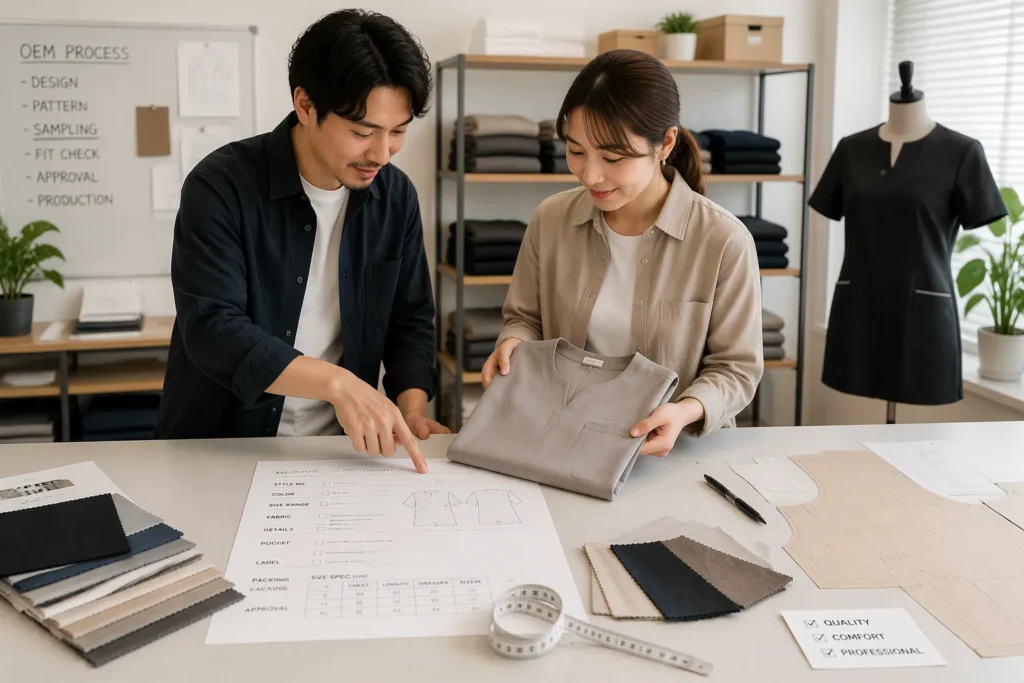
Confirm requirements: product type, quantity and size breakdown, destination country, fabric, color, logo and label needs, packaging, delivery date, and sample needs.
Select fabric and materials. Confirm the fabric before bulk production.
Develop the pattern and make a sample. Sample lead time is typically 2 to 4 weeks, and the factory can credit sample costs against the bulk order once production is confirmed.
Approve the sample and lock pre-production details in writing: fabric, size chart, logo artwork, color reference, size breakdown, packaging, timeline, and payment and delivery terms.
Run bulk production: fabric inspection, cutting, sewing, logo and label work, inline checks, finishing, final inspection, and packing.
Inspect before shipment. Final inspection follows AQL 2.5 sampling standards, and you can arrange third-party inspection by SGS, TÜV, or a buyer-nominated agency.
Pack and export. Options include individual polybags, size and color labels, inner carton sorting, master carton marks, and barcode labels.
The sample stage matters most. A pre-production sample lets you verify design and silhouette, size and fit, fabric hand feel and weight, color accuracy, pocket placement, closure quality, logo position, and sewing quality.
OEM vs. off-the-shelf vs. custom
Off-the-shelf stock gives you a fast start with no design work. Custom builds a new design from zero. OEM sits between them: you set the specs and branding, and the factory handles production. For a salon staff uniform rollout across sites, OEM keeps the look consistent while you control fabric and fit. Stock suits a small shop that needs uniforms quickly. Custom suits a brand with a design team and a clear vision. OEM suits a chain that wants its own label without building a factory relationship from scratch. Each option has a place in a salon’s growth plan.
Performance and fit for salon floors
Your salon staff uniform has to survive color services, wet hands, and long standing shifts. Build the spec around three things: wash durability, stain awareness, and colorfastness. Then add breathability and stretch so stylists and front-desk hosts can move freely.
Fabric durability, stain resistance, and colorfastness
Fabric choice drives everything else. A comparison published by Alibaba’s apparel guide rates bi-stretch technical blends for superior mobility and excellent recovery, which suits waxing and facial work. It notes a higher static cling risk that needs anti-static laundry additives. Luxury crepe earns praise for wrinkle resistance and a strong brand signal, though breathability drops in humid climates. Structured cotton-blend tunics offer consistent drape, breathable wear, and wide size availability, with less stretch than synthetics.
Colorfastness is where cheap fabric fails. Ask for AATCC Test Method 61 results, the same guide advises, and expect reports showing grade 4 or better after 50 wash cycles. For bleach-based disinfectants, the pink salon uniform guide from Alibaba points to ISO 105-C06 wash fastness at Level 4 or higher. Solution-dyed fibers hold color well because the pigment enters the fiber before spinning, as Rmcoco explains for solution-dyed acrylic. That construction resists fading through sun, wear, and bleach exposure.
Breathability, comfort, and freedom of movement
Stylists raise their arms all day. Shoulder movement is rated essential for salon uniforms in Alibaba’s comparison guide, which names chemical resistance, freedom of movement, and durability as the core needs for haircutting, color, and styling work. Stretch fabrics and color-fast materials solve the common problems of fading, staining, and restricted motion.
Comfort follows the same logic. Urban Base Uniforms lists lightweight, breathable construction, stretch fabrics, moisture-wicking technology, and wrinkle resistance as the features that reduce fatigue across long shifts. A Vocal Media salon guide adds cotton and linen as breathable options and calls for crinkle-proof, tear-resistant fabric with practical cuts that support fast movement. Roux Professional describes side vents and a light spandex blend as ways to keep a tunic airy and free through active service.
Lock these choices into a written spec before you request quotes:
Style | Fabric | Colorfastness target | Pockets | Logo placement | Sizes | Packaging |
|---|---|---|---|---|---|---|
Stylist tunic top | Bi-stretch blend or cotton-blend | AATCC TM 61 grade 4+ after 50 washes; ISO 105-C06 Level 4+ for bleach use | Two front patch pockets | Left chest, embroidered | Full size run | Individual polybag |
Front-desk polo | Lightweight knit | ISO 105-C06 Level 4+ | One chest pocket | Left chest, embroidered | Full size run | Individual polybag |
Layering apron | Stain-aware woven | ISO 105-C06 Level 4+ | Center pocket | Waistband, woven label | Adjustable | Bulk carton |
Then run the gates. Approve a sample first. Sign off a pre-production sample (PPS) that matches the approved fabric, color, and logo. Only then release bulk cutting. Each gate catches a mismatch before it multiplies across thousands of pieces.
Compliance and cost considerations
Safety, labeling, and chemical resistance
Chemical exposure shapes your fabric brief. Salonwear.com lists the properties a color-service garment needs: resistance to strong chemicals and water, dye seepage prevention, and no degradation after repeated exposure. Hair Barnyc puts the standard plainly: “Always utilize high-quality salon capes to ensure no residue reaches the client’s skin or the stylist’s clothing.” Apply the same logic to your salon staff uniform tops and layering pieces.
Labeling is a separate compliance track. Bennycotts explains that care, fiber content, and country of origin labels must be in English, with fiber and origin lettering at least 1.5 mm high. Care labels must survive the treatment they describe. Confirm these details with your factory before production, and check the rules for your destination market.
Unit price, minimums, and total cost of ownership
Do not compare quotes on unit price alone. Model total cost of ownership: unit price, sampling and freight, replacement rate from fading or staining, and the labor hours lost to reordering. A cheaper fabric that fades after a few washes costs more across a year.
Factor | Catalog stock | Private-label beauty-salon OEM |
|---|---|---|
Design control | Fixed styles | Your specs and branding |
Branding | Generic or limited | Your label and logo |
Fabric choice | Limited menu | Selected to your brief |
Fit range | Standard | Your size chart |
Reorder consistency | Depends on stock | Locked to approved spec |
Copy this checklist into your next supplier brief:
Style list with sketches or reference photos
Fabric, weight, and colorfastness targets
Size chart and size breakdown
Logo artwork, placement, and label text
Care, fiber, and origin label wording
Packaging and carton marks
Sample and delivery dates
Choosing an OEM supplier and comparing options
Vetting capabilities, quality control, and sampling
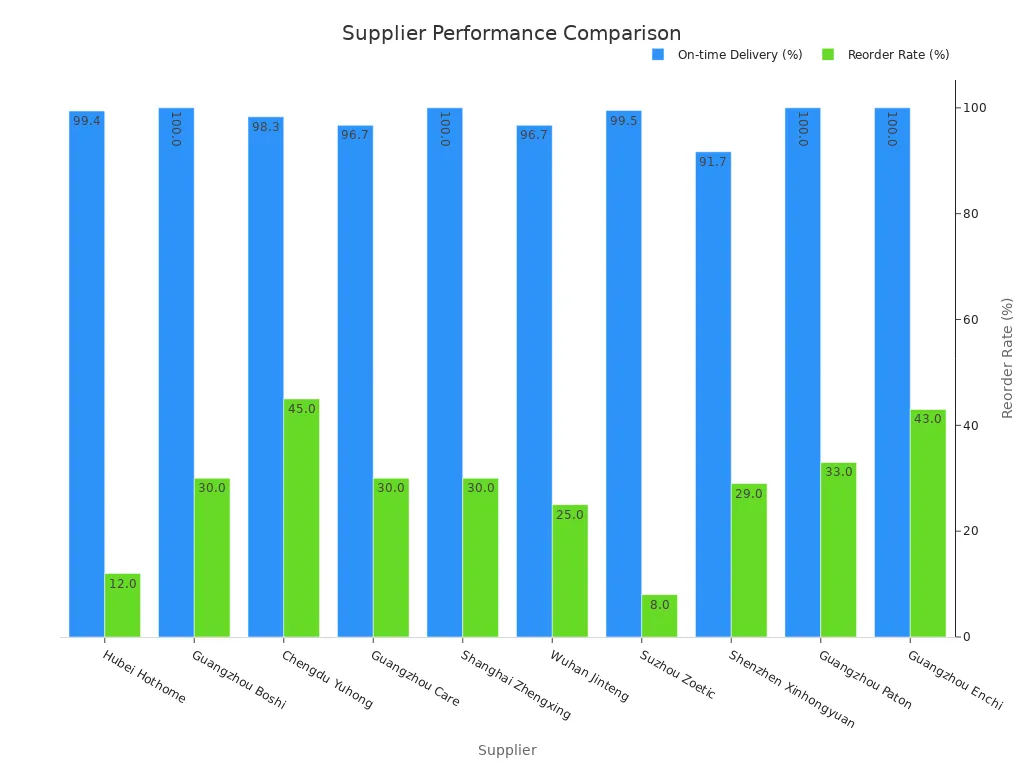
Start with performance data. Accio’s supplier comparison shows on-time delivery rates ranging from 91.7% to 100% and reorder rates from 8% to 45% across ten uniform suppliers. Reorder rate tells you how often buyers come back. On-time delivery tells you how reliably goods ship.
Then verify quality in stages. Accio recommends pre-production sample approval, in-line inspections during manufacturing, and a final pre-shipment inspection. You or a third-party service can run each check. Request fabric swatches for tactile review of stitch durability, shrink resistance, and colorfastness. Confirm the factory’s years in operation, audit reports, and communication speed.
That quote shows how one factory presents its OEM line. Read each supplier’s own materials the same way, and match the claims to your salon brief.
OEM vs. off-the-shelf vs. custom, side by side
Each route fits a different stage. Off-the-shelf stock suits a new shop that needs uniforms this month. Custom suits a brand with a design team and a fixed vision. OEM suits a chain that wants its own label with factory-built specs. Review the polo and jacket programs at https://www.workwearmanufacturer.com/custom-polo-shirt-manufacturer/ and https://www.workwearmanufacturer.com/custom-jacket-manufacturer/ to see how OEM lines take shape.
Ready to brief a factory on your salon staff uniform program? Email rill@topfortunemail.com or message WhatsApp +86 13524210501. Share your style list, size breakdown, and logo files, and request a sample quote.
You now have a clear path for your salon staff uniform program. Define your needs first. Then check fabric and fit against real salon floor conditions. Confirm labeling and chemical-resistance requirements for your market. Model total cost of ownership, not just unit price. Finally, vet each supplier through samples and staged quality checks.
Your next steps are practical. Draft a spec sheet with styles, fabrics, sizes, and logo placement. Request samples and wash them before you commit. Compare quotes across OEM, off-the-shelf, and custom options so you choose the route that fits your brand and timeline. With those steps in hand, you can move forward with confidence.
FAQ
What is the minimum order for a salon staff uniform OEM run?
The minimum order is about 2,000 pieces per style. You can split that quantity across sizes and colorways within the same style. Plan your size breakdown before you request a quote, so the factory can price the run accurately.
How do I get a quote for my salon crew?
Email rill@topfortunemail.com or message WhatsApp +86 13524210501. Send your style list, fabric targets, size breakdown, logo files, and target delivery date. The team reviews your brief and returns a quote with sample timing.
How does this differ from a spa therapist or spa salon uniform program?
This guide covers shop-floor salon and hair salon crews: stylists and front-desk hosts. Spa therapist programs focus on treatment-room garments. Spa salon programs blend both settings. Your salon brief centers on color-service durability and brand visibility at the styling chair and reception desk.
Is this the same as a dental or medical scrub program?
No. Dental clinic and medical scrub programs follow clinical requirements and clinical fit. Your salon staff uniform prioritizes stain-aware fabric, freedom of movement for cutting and color work, and a clean brand look. Keep clinical scrub specs out of your salon brief.
Where do yoga and pilates studio staff kits fit?
Yoga studio and pilates studio staff kits serve movement-led studio floors. They are separate programs with their own fit and fabric goals. If you also run a studio, brief it as its own project rather than folding it into your salon order.
Do you supply nursing uniforms?
No. This program does not cover nursing uniforms or clinical apparel. The focus stays on beauty salon, hair salon, and beauty-chain crew apparel.