

Office Reception Staff Uniform OEM | Corporate Front Desk Apparel
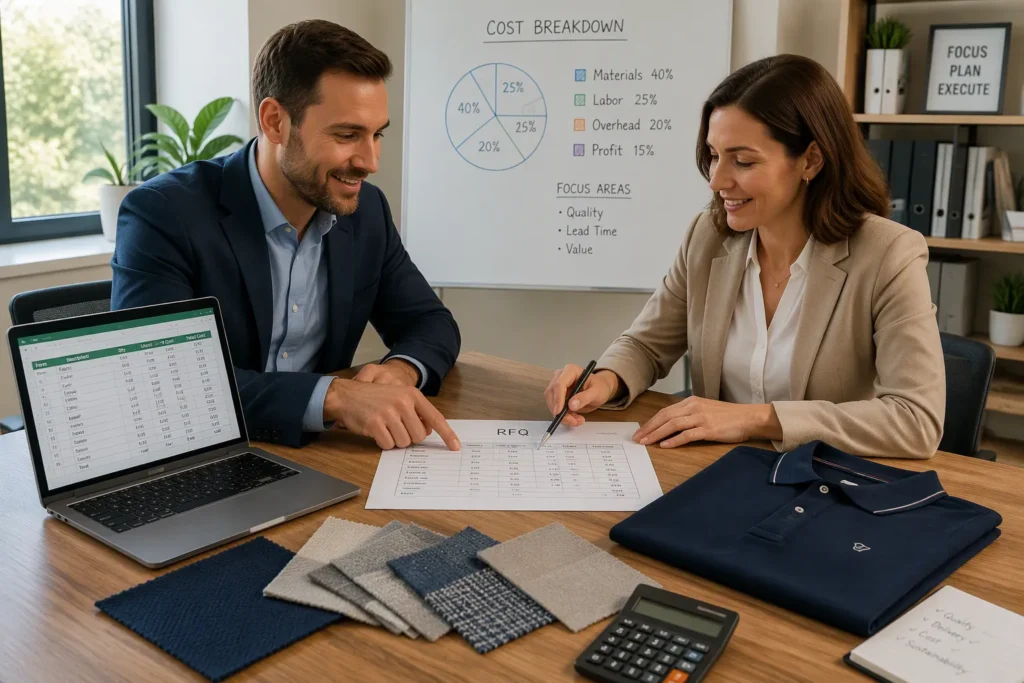
Proven experience producing corporate reception and front desk apparel is the single most important factor to weigh in an OEM. An experienced partner already understands how a reception staff uniform must sit, drape, and hold its shape through daily wear at a busy lobby desk. The stakes are high. Reception staff are the face of the business. A weak OEM choice quietly surfaces later as inconsistent fit across sites, faded branding after a few washes, and reorders that never match the original run. This guide gives buyers a practical evaluation framework for vetting candidates. It covers capabilities, quality, customization, compliance, cost, communication, and sampling.
Key Takeaways
Choose an OEM with proven experience in making reception uniforms. Experience ensures proper fit and durability.
Consistency is critical. The OEM must maintain the same specifications across all locations.
Follow a sampling process: development sample, fit sample, pre-production sample, and size-range check.
Decide between catalog and private-label options based on your need for customization and speed.
Use a procurement checklist to evaluate OEMs fairly. Compare samples side by side before deciding.
Buyer Intent and Who This Guide Serves
Corporate HQ and Multi-Site Reception Buyers
Overseas corporate headquarters and multi-site office programs brief an OEM for one reason. They need lobby hosts and reception crews across HQ and satellite offices to wear a consistent corporate front-desk look. Facilities, office operations, and brand or HR teams drive this work. They specify the garments, approve the branding, and hold every site to the same standard. Shanghai Top Fortune Industry Co., Ltd. serves this demand directly. The company was founded around 2002 and runs a 1,506 m² factory in Songjiang. It handles OEM and ODM workwear and exports to Europe, the Middle East, Oceania, Southeast Asia, and the Americas. Buyers can reach the team at rill@topfortunemail.com, by WhatsApp at +86 13524210501, or at Floor 3 Building 20 Haier Zhigu No.66 Guangfulin East Road Songjiang Shanghai 201600. Programs typically start at about 2,000 pieces per style.
This guide does not cover bank teller or bank-corporate programs, hotel front desk apparel, sports-club front desk apparel, PPE or hi-vis-first lines, construction workwear, or nursing uniforms. Each of those has its own construction logic and buying cycle.
What a Reception Staff Uniform OEM Must Deliver
A reception staff uniform program lives or dies on consistency. Pham Fashion notes that locally sourced apparel produces visible variation in color, fabric, and fit that site managers cannot correct. The OEM must therefore hold one specification across every location. A sealed approved sample, a numbered color standard, and a documented fabric construction give the factory and the buyer a shared physical reference.
Role-based planning matters too. Quality Imprint advises defining apparel by job function while keeping shared branding standards. Reception teams need polished, visitor-facing pieces. Managers may need a refined layer above that. The OEM should also accept a mixed size breakdown inside one order and pack by site or department. That single capability removes most of the friction from a multi-office rollout.
Spec Stack and RFQ for Reception Staff Uniforms
Polo, Light Layer, and Soft Jacket Options
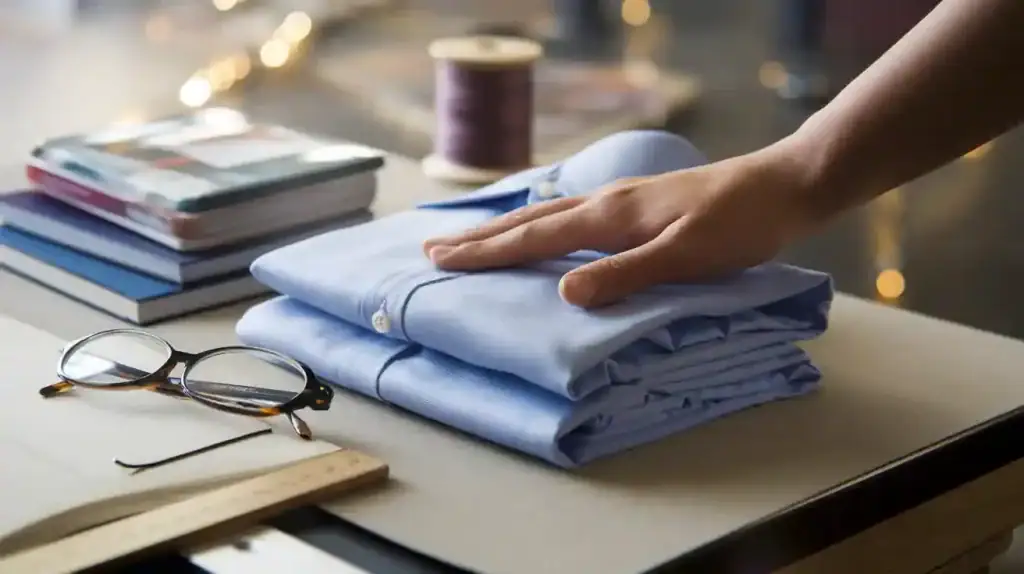
A strong reception staff uniform program builds from a small, coordinated stack. The core is a structured polo or a button-up blouse in a neutral tone. Arklavo notes that blouses suit formal offices, law firms, and executive environments, while polos work better in modern offices where staff need ease of movement and simpler care. Buyers can pair either top with straight-leg trousers or a pencil skirt to balance authority with comfort for long desk hours.
The second layer is a fine-gauge knit or a light soft jacket. Arklavo advises ordering a blazer only if staff will wear it for a full shift. A soft shell jacket from the custom jacket range serves better as an all-day layer. Coordinated pieces create a unified look without feeling overly constrained. Each garment should carry embroidery-ready brand visibility, so the logo reads clearly on the polo chest, the knit sleeve, or the jacket back.
RFQ Specs and Brand Visibility
The request for quote should carry every specification before the factory prices the job. Retailers Egypt notes that logo placement, color direction, and embroidery requirements can be reviewed before quotation. A complete RFQ package includes sector, roles, quantity range, preferred colors, logo files, and reference photos where available.
Style | Fabric | Color | Logo Placement | Sizing Range | Qty per Site | Target Lead Time | Packaging |
|---|---|---|---|---|---|---|---|
Structured polo | Buyer-specified knit | Neutral core palette | Left chest embroidery | Full adult range | Per site schedule | Confirmed at quote | Folded, site-labeled |
Button-up blouse | Buyer-specified woven | Neutral or classic print | Left chest or cuff | Full adult range | Per site schedule | Confirmed at quote | Folded, site-labeled |
Fine-gauge knit | Buyer-specified yarn | Matches core palette | Left chest embroidery | Full adult range | Per site schedule | Confirmed at quote | Folded, site-labeled |
Soft jacket | Buyer-specified shell | Matches core palette | Chest or back | Full adult range | Per site schedule | Confirmed at quote | Bagged, site-labeled |
Embroidery is the standard branding method for shirts and polos. Textileways reports that it delivers consistency across a program, and the buyer should approve placement before bulk. Textileways also states: “Logo position, stitch count and thread colour are approved on a sample, then repeated exactly on every order.” That approval step protects brand visibility across every satellite office.
The OEM should also differentiate front-office reception attire from back-office attire. Visitors identify reception personnel by a distinct top, a branded layer, or a defined color accent. A clear visual split between front-of-house and back-office staff removes confusion at the lobby desk and reinforces the corporate front-desk look.
Sampling Gates and Catalog vs Private-Label
Sample to PPS to Bulk Gates
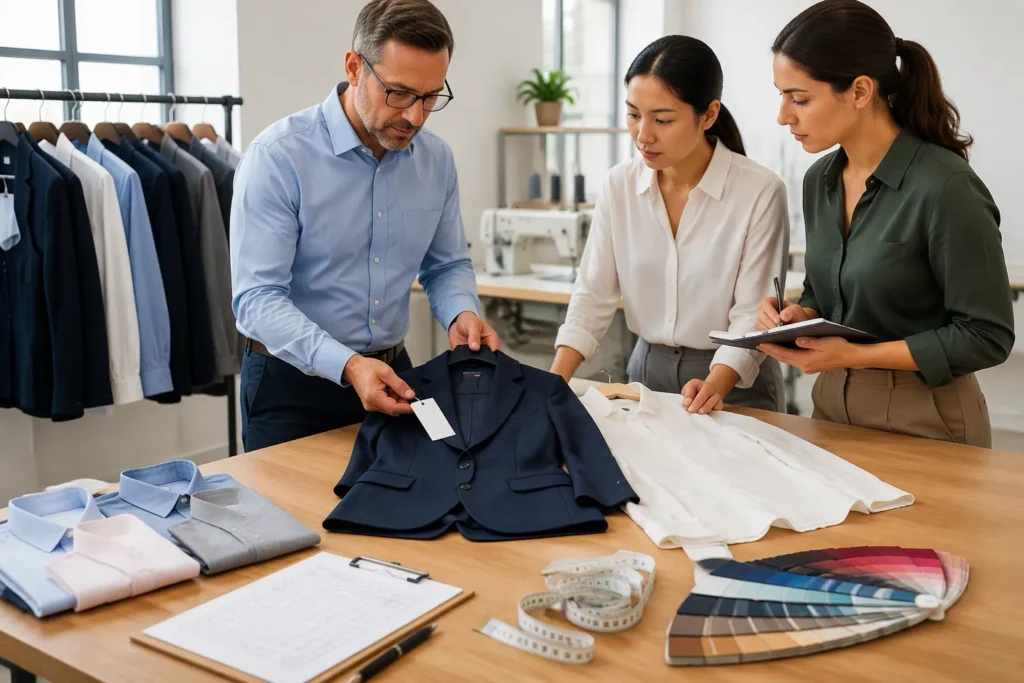
A disciplined sampling process protects the whole reception staff uniform rollout. TL Apparel describes four gates that build on each other. Each gate answers a different question, and the buyer should not skip ahead.
- Development sample. The early prototype confirms that the pattern structure and construction method can deliver the intended silhouette. The factory checks panel geometry, seam strategy, and feasibility at scale.
- Fit sample. This round confirms comfort, proportion, and movement on the intended fit model. The team measures the garment against the size chart with defined tolerances, then translates the findings into pattern actions. Leeline Apparel advises budgeting for at least two rounds here, because drape on a live model rarely passes on the first attempt.
- Pre-production sample (PPS). The PPS is the golden sample. The factory makes it with final bulk fabric and trims, so it confirms color standards, shrinkage behavior, and exact embroidery placement. Leeline Apparel notes that the PPS verifies repeatability with the exact production materials.
- Size-range and early production check. A size set proves the grading logic, so the XL is not simply a stretched M. An early output reference from the first run then confirms the line matches the sealed standard.
At each gate, the buyer checks four things: fit against the approved chart, fabric hand-feel, embroidery placement, and color consistency against the standard. Leeline Apparel gives one firm rule: do not release the next deposit until the current stage passes, and never authorize bulk production based on a single prototype.
Catalog vs Private-Label Comparison
Both routes serve real programs. The right choice depends on how much visual control the brand needs and how many sites must match.
Factor | Catalog | Private-label |
|---|---|---|
Customization level | Select from existing styles and colorways | Full control over pattern, fabric, and trim |
Branding options | Standard embroidery placements | Any placement, plus custom labels and trims |
MOQ implications | Lower entry point per style | Higher commitment per style |
Lead time | Shorter, since styles already exist | Longer, because sampling gates come first |
Best-fit use case | Fast rollouts and smaller satellite offices | HQ-led programs with a defined corporate look |
A catalog route suits a facilities team that needs a consistent look quickly across a few sites. Private-label fits a brand or HR team that owns a specific front-desk identity and wants every lobby host to match it exactly. Neither option is weaker. Each one matches a different stage of program maturity.
Procurement Checklist, FAQ, and Next Steps
Copy-Paste Procurement Checklist
A structured checklist keeps the evaluation fair across every candidate. Buyers can copy the list below into a briefing document and score each OEM against it.
Experience questions: years producing office reception apparel, multi-site program references, and familiarity with embroidery-ready branding.
Sample checks: fit against the approved chart, fabric hand-feel, embroidery placement, and color consistency.
Spec confirmation: item code, product description, material, color and finish, logo requirement, and approved sample reference.
Sizing: full adult range, grading logic, and a mixed size breakdown per site.
Reorder process: sealed standard retention, color standard storage, and replenishment lead time.
Communication cadence: named contact, update frequency, and escalation path.
The garment list itself should cover formal shirts or blouses, professional trousers or skirts, optional blazers or vests, name badges, and neutral, calming colors such as navy, beige, grey, and pastel tones, per UniformCraft. OkBuildPro adds practical fields: number of employees, department and job role, uniform sets issued per employee, laundry turnaround, seasonal staff requirements, replacement allowance, packaging and labeling, delivery destination and required date, and spare or replenishment quantity.
FAQ and Contact CTA
What is the minimum order? Programs typically start at about 2,000 pieces per style.
How does a buyer request a quote? Benjima describes a clear path: share the brief with brand guidelines, roles, quantities, and launch date; choose styles and accessories; approve a prototype; then confirm production and checks. A short brief covering garment, quantity, and date is enough for a costing.
How does this differ from bank-corporate programs? Bank programs follow teller-specific rules and security-driven styling. This guide addresses lobby and front-desk teams in general corporate offices.
How does it differ from a corporate-uniform procurement checklist? That resource covers company-wide rollouts. This one narrows to visitor-facing reception roles.
How does it differ from a corporate-polo buyer guide? The polo guide focuses on one garment. This program coordinates polos, blouses, knits, and soft jackets.
How does it differ from sports-club front desk apparel? Club desks lean sporty and casual. Corporate lobbies need a polished, restrained look.
How does it differ from hotel front desk uniforms? Arklavo notes that hospitality uniforms become part of the guest experience and carry a deliberate visual identity. Corporate reception apparel instead signals professional order and brand consistency.
Ready to move forward? Request samples from two or three shortlisted OEMs and compare them side by side. Email rill@topfortunemail.com or message WhatsApp +86 13524210501 for a quote. Explore the factory at https://www.workwearmanufacturer.com/, the company profile at https://www.workwearmanufacturer.com/about-us/, the jacket line at https://www.workwearmanufacturer.com/custom-jacket-manufacturer/, polo production at https://www.workwearmanufacturer.com/custom-polo-shirt-manufacturer/, corporate polo OEM details at https://www.workwearmanufacturer.com/corporate-polo-shirts-oem-china-manufacturer/, the procurement checklist at https://www.workwearmanufacturer.com/corporate-uniform-program-oem-procurement-checklist/, the polo buyer guide at https://www.workwearmanufacturer.com/corporate-polo-oem-buyer-guide-china/, bank program context at https://www.workwearmanufacturer.com/bank-corporate-uniform-oem-china/, and the blog at https://www.workwearmanufacturer.com/blog/.
Experience, quality, and communication decide the outcome of any reception staff uniform OEM search. A proven factory holds one specification across every site. Strong quality control keeps fit, color, and embroidery stable. Clear communication keeps reorders matched to the sealed standard.
Fuway Golf recommends a short vetting checklist. Ask whether the fabric keeps its appearance after repeated washing. Confirm the collar, seams, and decoration stay stable. Check that the supplier covers the real employee size range. Verify approved colors and styles can be reordered. Compare cost per wear, not unit price alone. Fuway Golf adds one closing rule: the best supplier matches the program’s commercial and operational needs, not the cheapest option.
Request samples from two or three shortlisted OEMs and compare them side by side. Then email rill@topfortunemail.com for a quote.
FAQ
How does a buyer request a quote?
A buyer shares a short brief with garment types, roles, quantities, target launch date, and logo files. The OEM reviews the brief and returns a costing. A complete brief speeds up the quote and reduces back-and-forth.
How does this program differ from bank-corporate uniform work?
Bank programs follow teller-specific rules and security-driven styling. This guide addresses lobby hosts and front-desk crews in general corporate offices. The construction logic and buying cycle differ between the two.
How does this differ from a corporate-uniform procurement checklist?
A company-wide checklist covers every department and role. This guide narrows the focus to visitor-facing reception teams. The evaluation criteria stay similar, but the scope is tighter.
How does this differ from a corporate-polo buyer guide?
A polo guide focuses on one garment. This program coordinates polos, blouses-compatible tops, knits, and soft jackets into one unified front-desk look across sites.
How does this differ from sports-club or hotel front desk apparel?
Sports-club desks lean sporty and casual. Hotel uniforms carry a deliberate hospitality identity tied to the guest experience. Corporate reception apparel instead signals professional order and brand consistency.