

Corporate Office Staff Work Shirt OEM | Twill & Oxford Office Shirts
Table of Contents
Display
A woven office shirt is the garment people stop noticing when it is right. Nobody comments on a twill shirt that comes out of the wash smooth, keeps its collar under a tie, and still fits the same team member at the next reorder. They notice when the cuffs fray in month three, when one office gets a slightly greener blue, or when half the floor stops tucking in because the tail is too short.
This guide is for purchasing, HR, and workplace teams who buy woven corporate office staff work shirts in twill or oxford cloth for adult employees: account managers, shared-services staff, advisors, and anyone whose dress standard is a collared woven shirt rather than a knit. If your program is built around a knit top, the corporate office staff polo shirt OEM guide covers that brief. If you need an outer layer worn over the shirt, see the corporate office staff jacket OEM page. Everything below is about the woven shirt itself.
Twill or oxford: choose the cloth by the week, not by the swatch
Swatch boards make every cloth look good. The useful question is what the shirt goes through between Monday and Friday, and how it is cared for afterwards.
Twill has a diagonal weave that drapes smoothly, takes a press well, and hides small creases. It reads slightly dressier and works well under a tie or a jacket. A fine two-ply twill feels premium; a single-ply twill is lighter and cooler but shows wrinkles sooner.
Oxford has a basket weave with a visible texture. It is sturdier at the collar points and cuffs, forgives a missed iron, and looks right with or without a tie. A pinpoint oxford sits between the two: smoother than a standard oxford and more robust than a fine twill.
A practical way to decide:
If most staff wear a tie or a jacket most days, start with twill.
If the standard is open-collar business casual, start with oxford or pinpoint oxford.
If staff wash shirts at home and rarely iron, choose the cloth after you decide the finish (see the pressing section below), because the finish matters more than the weave.
If the same shirt must work in a warm regional office and a cool headquarters, pick one weave and change the yarn weight, not the cloth family.
Cotton-rich cloth breathes and feels natural against the skin. A cotton-polyester blend holds shape and color longer through home washing and dries faster. Many programs settle on a blend for daily issue and keep a 100% cotton version only for senior or client-facing roles, but that is a second style with its own sampling, not a free variation.
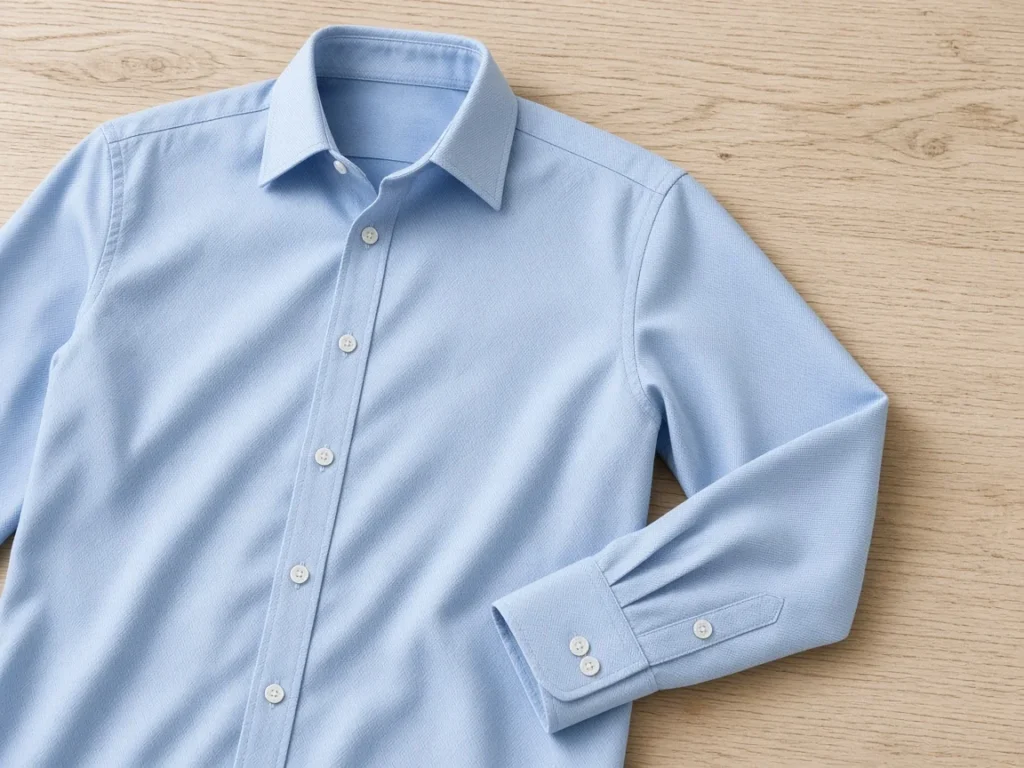
A fabric comparison you can circulate internally
Use this table when HR, purchasing, and the workplace team need to agree before anyone requests samples.
Cloth | Look | Wrinkle behaviour | Durability at collar and cuff | Best fit for |
|---|---|---|---|---|
Fine twill | Smooth, slight sheen, dressier | Hides light creases; needs a press for a sharp look | Good; points can soften over time | Tie or jacket days, client meetings |
Standard oxford | Textured, matte, relaxed | Forgiving; looks fine with minimal ironing | Very good; holds up to frequent wear | Open-collar business casual |
Pinpoint oxford | Fine texture, semi-dressy | Moderate | Good | Mixed teams that switch between tie and open collar |
Yarn-dyed stripe or check (twill or oxford) | Patterned, adds role cues | Pattern hides creases | Depends on base weave | Distinguishing teams without a new silhouette |
Ask for each candidate cloth to be wash-tested at your actual care route before shortlisting. Shrinkage, shade change, and how the cloth looks after drying matter more than the hand-feel on day one. We can provide fabric test reports for the shortlisted cloth so your team can review results such as shrinkage and colorfastness against the test methods you specify.
Collar style is a policy decision
The collar tells people what kind of workplace this is. Decide it once, then write it into the spec so every reorder matches.
Button-down collar: relaxed and practical; keeps the points in place without a tie. Common in oxford programs.
Semi-spread collar: the most versatile option; works with and without a tie and suits most face shapes.
Spread or cutaway collar: dressier, made for a tie knot; can look loose when worn open.
Band or mandarin collar: modern and tie-free; suits a creative or front-office team but is less versatile.
Specify the collar point length, the collar band height, and the interlining type (fused or non-fused, soft or firm). A firm fused interlining keeps a crisp edge through repeated washes. A softer interlining is more comfortable for a long day but can roll at the points. Collar stays, removable or sewn-in, are worth naming if the shirt will be worn without a tie.
Lock the button too: material, size, color, and the number of buttons on the placket. A cheap button that cracks in the first commercial wash makes a good shirt look neglected.
The pressing question: non-iron, easy-care, or pressed
Most office staff will not iron a shirt every morning. The finish you choose determines how the shirt looks at 9 a.m. more than the weave does.
Non-iron (wrinkle-free) finish: a resin treatment applied to the cloth or the finished garment. Shirts come out of the dryer close to smooth. Ask how the finish performs after the number of washes your staff will realistically run, and check hand-feel, because a heavy finish can feel stiff.
Easy-care finish: a lighter treatment that reduces creasing but still benefits from a quick touch-up. Softer than non-iron, and often a good balance for blends.
No finish, pressed by staff or a laundry service: best natural hand-feel and breathability, but only realistic if a laundry route exists or staff accept ironing.
Also look at the seams. Puckered seams after washing are the most common reason a non-iron shirt still looks tired. Seam taping or adjusted stitch tension on the side seams, armholes, and placket helps them stay flat. Ask the factory to show a washed sample next to an unwashed one, side by side, before you approve.
Long sleeve, short sleeve, and the cuff
Decide the sleeve policy before you size the program, because it changes quantities and patterns.
Long sleeve with barrel cuffs is the standard. Two-button adjustable cuffs fit a wider range of wrists.
Long sleeve with convertible or French cuffs suits client-facing roles, but adds cost and complexity to issuing and sizing.
Short sleeve is common in warm regional offices. Treat it as its own style with its own pattern, not a long-sleeve shirt with the sleeve cut off. The sleeve opening and length need their own fit check.
Cuffs and collar points take the most wear. Specify a durable stitch at the cuff edge, and check the inside of the cuff after a wash trial for fraying. A sleeve placket with a gauntlet button keeps the cuff from gaping when staff roll sleeves up.
Tuck-in length and the shirt tail
A shirt that will not stay tucked creates more dress-code friction than almost anything else.
If the dress standard is tucked, the back length should sit well below the belt line when the wearer reaches forward or lifts an arm. A curved tail with side gussets holds better than a straight hem. If the standard allows untucked shirts, a shorter, straighter hem looks intentional rather than sloppy. A shirt that tries to do both usually fails at both, so choose one and write it down.
Check back length on actual staff, not just a fit model. Staff who are tall for their size band are where a short tail shows up first.
Sizing a woven shirt by neck and sleeve
Woven shirts have less give than knits, so the size run needs more care.
Collar-and-sleeve sizing (for example neck 38–46 cm with two sleeve lengths) fits more precisely and is common for tie-wearing programs. Alpha sizing (S to 3XL) is simpler to issue and usually fine for open-collar programs. Offer men’s and women’s blocks: a women’s woven shirt needs a different bust, waist shape, and shoulder, not just a smaller men’s pattern.
Choose a body fit for each block, such as classic, regular, or slim, and keep it consistent across reorders. Collect a size survey from the roster before quoting and plan the size curve from those numbers. Keep a few extra pieces in the most common sizes for new hires so that a new team member does not wait for the next bulk order.
Branding a woven shirt without breaking its look
Office shirts usually carry a smaller and quieter mark than knits or jackets.
A small left-chest embroidery or a tonal mark on the pocket is the most common option.
A discreet embroidery on the cuff or below the back yoke suits programs that want a cleaner front.
Large prints usually look out of place on a dress shirt and can crack after washing.
Embroidery on a fine twill needs the right backing and stitch density, or it will pucker. Ask for the sew-out on the production cloth, then wash it at your care route and check again. Use matching or tonal thread if the brand standard allows it; it looks more refined at close range.
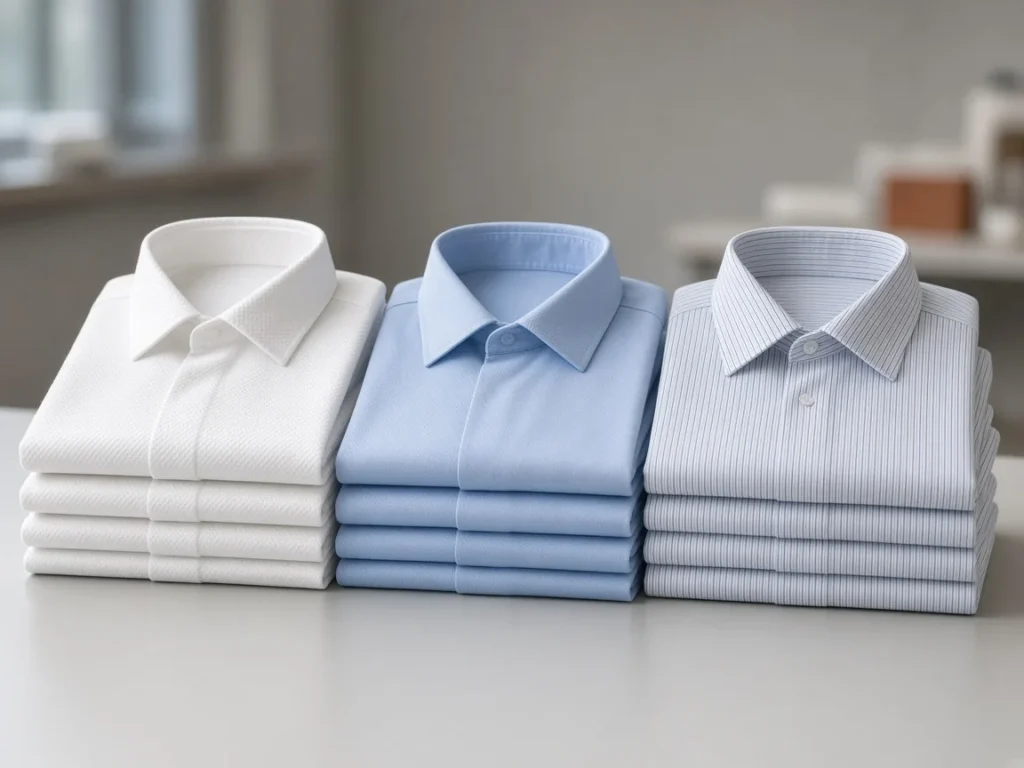
From lab dip to bulk: a sampling sequence
A clear sequence avoids late surprises and keeps every office on the same blue.
Brief: share cloth preference, finish, collar, sleeve policy, fit blocks, decoration, care route, and target delivery date.
Lab dip or yarn-dye strike-off: approve the shade against a physical standard, under your office lighting as well as daylight.
Fit sample: check collar, shoulder, sleeve length, and tail on real staff in several sizes.
Wash trial: run the sample through the actual care route and check shrinkage, seam appearance, button hold, and decoration.
Pre-production sample: bulk cloth, bulk buttons, production label, and production decoration. Approve it in writing and keep a sealed copy on both sides.
Bulk and packing: pack by office, department, or person as agreed, with clear size labels for fast issue.
For volume planning, each combination of cloth, color, and collar style counts as one style. A typical starting order is about 2,000 pieces per style, combined across sites and sizes that share the same cloth. If you need a second color or a short-sleeve version, plan it as its own style rather than splitting one order.
Questions buyers ask about office work shirts
Can twill and oxford shirts sit in the same program?
Yes, if the roles are clearly divided, for example twill for client-facing staff and oxford for internal teams. Keep the color family, collar style, and mark consistent so the program still reads as one standard.
Do non-iron shirts feel stiff?
Some do, especially with a heavy finish on a lightweight cloth. Ask for a washed sample and compare hand-feel after several washes, not just on day one.
Can you match a shirt we already issue?
Usually, yes. Send a physical sample of the current shirt, plus any spec sheet you have. We can check the weave, weight, shade, and pattern and propose the closest match or an improvement.
How do we confirm shrinkage before bulk?
Agree on the care route and test method first, then review the wash trial results on the sample and the fabric test report for the bulk cloth before approving the pre-production sample.
Working with Top Fortune on an office shirt program
Shanghai Top Fortune Industry Co., Ltd. has made OEM and ODM staff apparel since about 2002. Cutting, sewing, decoration, and pressing are done at our Songjiang facility, which helps woven shirts stay consistent in shade and fit from the first order to later reorders. You can read more on the About Us page.
Request a corporate office work shirt quote: rill@topfortunemail.com | WhatsApp +86 13524210501
Send your preferred cloth and finish, collar and sleeve policy, logo files, a size survey, the care route, and your in-hands date. We will come back with suggested cloths, a sample plan, and a timeline.