

Convenience Store Staff Jacket OEM | Counter & Overnight Crews
Table of Contents
Display
A convenience store never really closes, and neither does its front door. Every time a customer walks in, a draft crosses the counter. Overnight, the heating is turned down and one or two staff run the whole store. In the afternoon, the same jacket has to come off quickly when the store warms up, and go somewhere sensible in a back room that is mostly shelving.
This guide is for operations, purchasing, and franchise-support teams who buy convenience store staff jackets for counter and overnight crews across a chain or franchise network. It assumes you already have a shirt standard; if not, start with the convenience store staff work shirt OEM guide and treat the jacket as the layer that goes over it. Larger-format grocery teams have different aisle and backroom needs, covered on the supermarket staff jacket OEM page. This page stays inside the small-format store.
One jacket across three shifts
Before choosing fabric, walk through a full day in one store and note what the jacket actually has to do.
Opening shift. The store is still cold, deliveries arrive, and staff move between the counter, the shelves, and the stockroom. The jacket is on, zipped, and moving a lot. It needs shoulder and arm room for lifting trays and reaching high shelves.
Daytime shift. Customer traffic peaks and the counter is busy. The store warms up, so the jacket is often worn open or taken off and put back on several times. It needs to look tidy when open and to be easy to remove without fighting a tight cuff.
Overnight shift. One or two people run the store with lower heating. They spend long stretches behind the counter, then restock the chilled cabinets and the front shelves. The jacket is worn for hours and needs to stay comfortable when the wearer sits briefly or leans on the counter.
Many chains try to solve this with two jackets, a light one and a heavier one. In small stores with little storage, one well-chosen mid-weight jacket, worn open or closed, usually works better. If your network spans very different climates, keep the same pattern and change the fill or fabric weight by region, not the design.
Warmth that does not get in the way at the counter
Counter work is close work: scanning, bagging, handing over change, using a touchscreen. Bulk is the enemy.
Good starting points for a convenience store jacket:
Softshell with a light brushed back. Blocks door drafts, stretches with the wearer, and looks neat. A common all-round choice.
Brushed-back knit or bonded fleece jacket. Warm and soft, quiet when moving, comfortable for long overnight shifts. Less wind-resistant at an open door.
Light padded jacket with a thin fill. Warmest option for cold regions or stores with frequent door openings in winter. Choose a slim baffle layout so it does not bulk up at the counter.
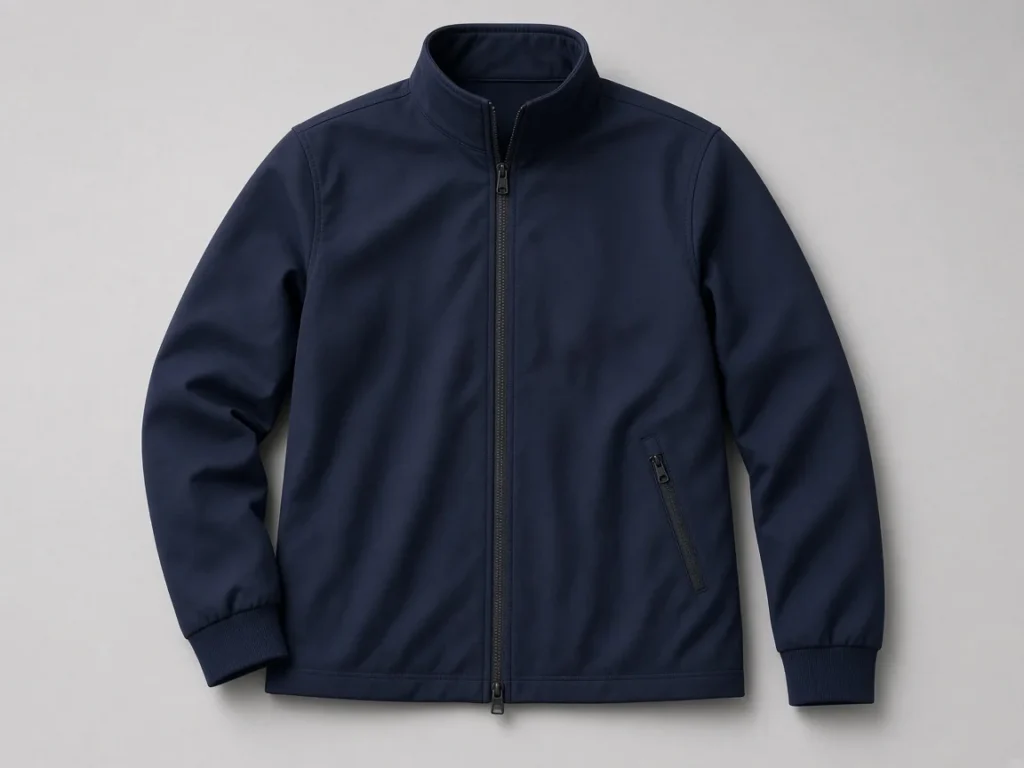
Whatever the shell, check three things on the sample: the jacket must not rustle loudly when the wearer reaches for an item, it must not restrict the arm when reaching across the counter, and the front must not swing into the till or bag area when open.
Breathability matters more than many buyers expect. Staff move from a cold doorway to a warm stockroom to a chilled cabinet in minutes. A jacket that traps heat leaves people sweating under the shirt, and then cold again when they return to the counter.
Sleeves that clear the scanner and the till
Sleeves cause more day-to-day complaints than any other part of a store jacket.
Sleeve length should end at the wrist bone when the arm is extended forward, not over the hand. A long sleeve drags across the scanner glass and the counter top.
Cuffs should be snug enough to stay out of the way but easy to push up. A soft knit cuff or a partial elastic cuff works better than a hard hook-and-loop tab that catches on bags.
The underarm needs enough room for a reach to a top shelf without lifting the whole jacket hem.
Ask staff to try the sample at an actual counter: scanning, bagging, handing over a receipt, and wiping the counter. If a sleeve is pushed up within five minutes, it is too long or too loose.
Closure: full zip, quarter-zip, or snap front
The closure decides how quickly the jacket can be opened and closed during a busy shift, and how it looks when worn open.
Closure | Strengths | Watch out for | Works best for |
|---|---|---|---|
Full zip | Fast on and off; looks neat open or closed | Zip pull can tap the counter; choose a low-profile pull | Most counter and overnight crews |
Quarter-zip pullover | Clean front, fewer parts | Slow to remove; awkward over a collared shirt | Very cold regions with stable store temperatures |
Snap or button front | Quick to open; softer look | Gaps between snaps let in drafts | Mild climates, lighter jackets |
Full zip with storm flap | Better draft protection at the door | Slightly bulkier front | Stores with frequent winter door openings |
Most chains settle on a full zip with a quiet, non-metallic pull and a chin guard so the zip does not rub the neck during a long overnight shift.
Pockets for a small-store routine
Store staff carry fewer things than delivery or warehouse teams, but they need them quickly: a phone, a box cutter or pen, a small notebook for counts, and sometimes keys.
A practical pocket plan:
Two zipped hand pockets, positioned so items do not fall out when the wearer bends to restock low shelves.
One inside chest pocket for a phone.
Optional sleeve pocket for a pen.
Skip large cargo pockets. They catch on shelf edges in narrow aisles and make the jacket look bulky behind the counter.
Name badge and logo on a jacket worn open and closed
Customers often look for a name badge or a store mark to identify who works there. Because the jacket is worn both open and closed, placement needs planning.
Put the primary logo on the left chest so it shows when the jacket is closed and stays visible on the panel when open.
Add a small sleeve mark or a back-yoke mark if store staff often have their back to the customer while restocking.
If staff wear name badges, add a reinforced badge tab or a discreet loop above the logo so the badge does not pull the fabric or hang at an angle.
Embroidery works well on softshell and fleece with the right backing. A flat transfer suits lighter shells but needs a wash trial. Approve every decoration on the production fabric, not on a swatch from a different jacket.
Storage and issue in stores with no spare room
A small store has a few lockers or hooks, not a uniform room. That changes how jackets should be sized, packed, and issued.
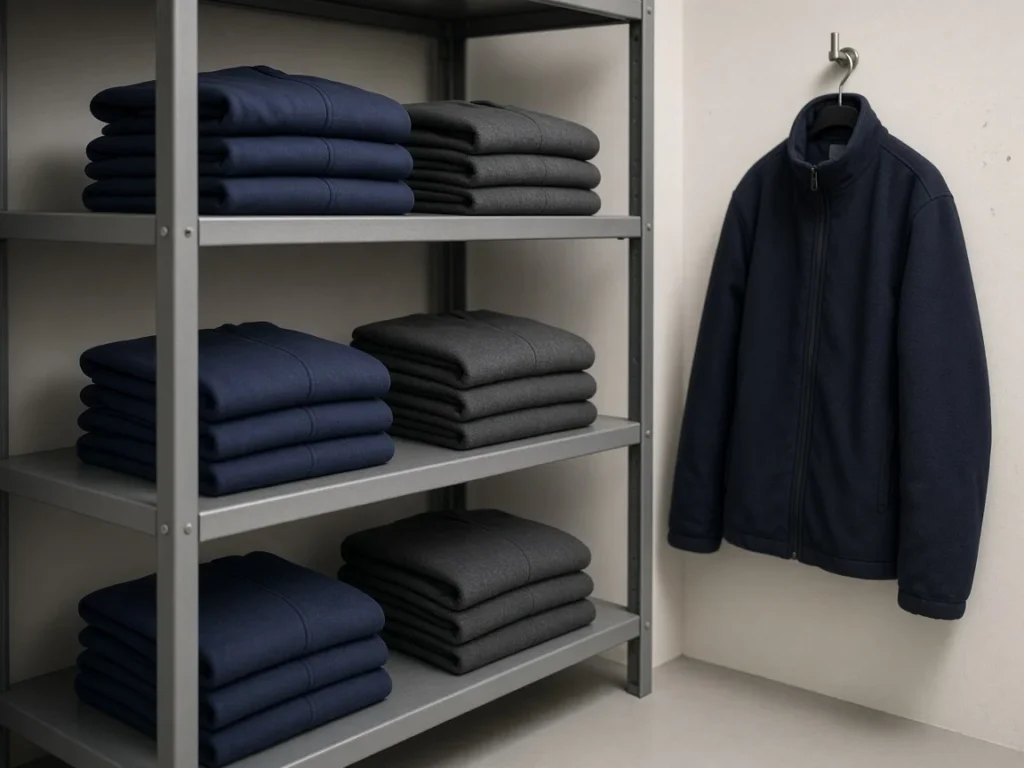
Size curve per store, not per chain. A store with six staff needs a different pack from a store with fifteen. Build store packs from the roster.
Pack flat and labelled. Each jacket should be folded and bagged with a clear size label so a new hire can find their size without unpacking the whole carton.
Keep a small reserve centrally. Franchise support or a regional office should hold a few pieces in the most common sizes for new starters and replacements.
Hanger loop and drying. A strong inside hanger loop lets staff hang the jacket on a hook in the back room. Jackets are often washed at home; specify a care route that dries quickly overnight.
Keeping a franchise network on one shade
Convenience chains grow store by store, and reorders come in small, frequent batches. That is where shade drift appears: one region’s navy turns slightly purple, or a new batch of zip pulls is a different grey.
Lock the following before the first order:
A physical color standard for the shell, approved under store lighting as well as daylight.
The zip type, zip pull color, and any trim colors.
The logo size, thread or transfer colors, and placement in millimetres.
A sealed pre-production sample kept by both sides.
Ask how the fabric shade will be repeated on later orders. We can provide fabric test reports for the bulk cloth, including colorfastness results against the test methods your team specifies, so franchise support can compare new batches to the approved standard.
For planning, one shell fabric in one color with one design is one style. Orders are built around about 2,000 pieces per style, combining store packs across the network. A regional weight change (for example a padded version for colder stores) counts as a separate style.
A one-week store trial before bulk
A jacket that looks good on a hanger can still fail at the counter. Run a short trial in real stores before approving.
Pick two or three stores with different traffic levels and at least one overnight shift.
Issue samples in the main sizes to staff on all three shifts.
After one week, collect feedback on warmth at the door, sleeve comfort at the counter, ease of taking the jacket off and on, and pocket use.
Wash each sample on the care route staff actually use and check shade, pilling, and decoration.
Adjust the pattern or trims, then approve the pre-production sample in writing.
Questions convenience store buyers ask
Should the jacket match the work shirt color?
It does not need to be identical. Many chains use a darker jacket over a lighter shirt so the logo stands out. What matters is that the jacket color is locked and consistent across all stores.
Can staff wear the jacket behind a food-to-go counter?
Many stores ask staff to remove jackets at food-preparation points for hygiene and comfort. Treat the jacket as a counter and shop-floor layer, and set the rule in your store guidelines.
What if some stores are in much warmer climates?
Keep the same design and color, and offer a lighter shell or a vest option for warm regions. Plan it as a separate style rather than mixing fabrics within one order.
How should staff wash the jacket?
Most chains rely on home washing. Choose a fabric that dries overnight and keeps its shade, and print the care instructions on the label so every store gets the same guidance.
Working with Top Fortune on a store jacket
Shanghai Top Fortune Industry Co., Ltd. has produced OEM and ODM staff apparel since about 2002 at our facility in Songjiang. Pattern making, sewing, and decoration under one roof make it easier to keep a growing store network on one jacket, one shade, and one logo standard. More background is on the About Us page.
Request a convenience store staff jacket quote: rill@topfortunemail.com | WhatsApp +86 13524210501
Send your store count, the shirt the jacket will be worn over, climate notes by region, logo files, a size survey, and the date jackets need to reach the stores. We will suggest fabric options, a trial plan, and a timeline.