

Corporate Office Staff Jacket OEM | Workplace Jackets
Table of Contents
Display
Office staff spend most of the day sitting, standing up for a meeting, hanging a jacket on a chair back, and putting it on again when a room runs cold. The garment has to look composed in a workplace photo, stay quiet in a meeting, and still feel right after a short walk between buildings. That is a workplace jacket problem, not a lobby-uniform problem.
This page is for purchasing, facilities, workplace operations, brand, and HR teams who buy adult office staff jackets for desks, shared services, and campus teams. It is not a rewrite of front-desk apparel. If your brief is for visitor-facing hosts at a reception desk, use the office reception staff uniform guide and keep this jacket off that kit.
This is a workplace jacket, not a lobby uniform
A reception program is built to be read from a lobby: a more formal silhouette, a host-ready layer, and a sign-off that usually sits with facilities plus brand or HR for the front door. A corporate office staff jacket is issued more widely. Project teams, operations, finance, and campus staff wear it over a shirt or knit for a full workday. Visitors should not mistake those people for the hosts at the desk.
Northfield Partners can keep a separate reception kit and still issue one soft office jacket across three sites. Cedarline Offices can share a distant color story between the lobby and the floors, but the jacket on this page should have its own pattern, length, and hardware brief. Pasting a desk-blazer spec into an all-staff jacket order usually produces a garment that is too formal for everyday desk work and too stiff after a day on a chair.
The jacket also is not a corporate polo. A polo is a knit top. The jacket is an outer layer worn over workplace clothing. They can share a color system and a logo size — see corporate polo shirts OEM when you already have a knit standard — but they should be sampled and quoted as separate styles.
Seated fit, chair-back wrinkling, and quiet hardware
Most office jackets fail in the chair, not on the hanger. Ask for a seated fit check as a named requirement, not as an afterthought.
Body length should still cover the shirt hem when the wearer sits and reaches a keyboard.
Sleeves should not ride up the forearm in a typing position, and they should not flood the hand when the wearer stands.
The back should not bag permanently after a day hung on a chair.
Shoulder ease should allow a reach to a high shelf or a coat hook without pulling the logo off-center.
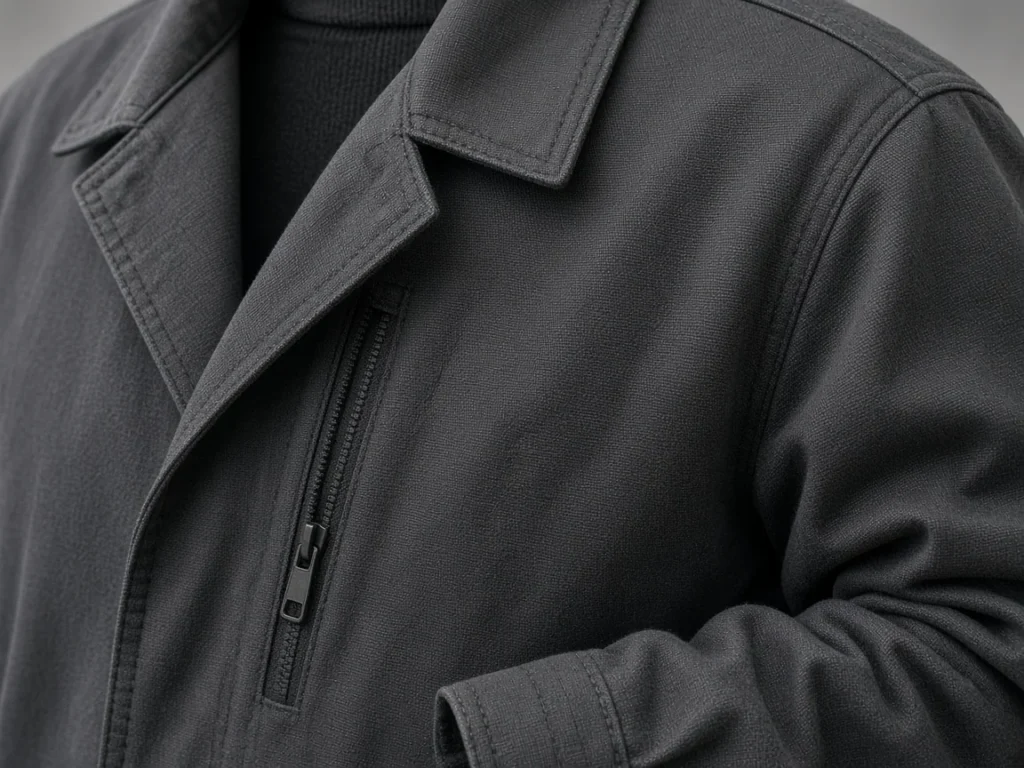
Fabric hand-feel is part of that test. A mid-weight woven shell or a light softshell that looks smooth in indoor light is the usual starting point. A stiff outdoor shell rustles in a meeting and reads as field gear in a workplace photograph. A fashion jacket often wrinkles at the mid-back and uses a loud zip. Specify a quiet closure, a low-shine pull, and a chin-guard that is comfortable when the jacket is zipped in a cold meeting room.
Care is usually a gentle home wash, not an industrial route. Set that in the brief. Check pilling where bags and chair backs rub, and check shade after the care cycle you actually use. A jacket that looks sharp on day one and fuzzy at the cuffs in month two undercuts the workplace standard you paid to set.
Indoor all-day shells vs a short walk between buildings
One pattern can cover two conditions if you change weight, not identity.
The core workplace jacket is a slightly lighter, smoother shell for all-day indoor use at Northfield Partners. A campus layer can use the same pattern, length, and logo size with a slightly denser face, or a light wind-resistant finish, for staff who walk between buildings at Cedarline Offices. Keep the color standard identical so the two versions still photograph as one program.
Do not invent a third, louder jacket for “brand presence.” If a function or a site needs a cue, use a small sleeve mark or an inner-placket contrast, not a new silhouette. And do not fold reception hosts into this matrix. They have a different formality and a different sign-off.
View swatches under office lighting. A shade that looks correct in a factory booth can go cold or flat under typical workplace LEDs. If the jacket must sit next to an existing polo, dip the jacket fabric against the same physical standard. Knit and shell takes on dye differently; “same charcoal” is not a match until you see the two together.
Badge, phone, and logo placement that survive an open zip
Office staff carry an access card, a phone, and sometimes a slim notebook. Pockets should hold those items without bulging at a conference table.
A practical map is two hand pockets with a secure closure, plus one interior pocket for a badge or phone. A chest pocket is optional and should not crowd the logo. Avoid large cargo pockets. They read as utility wear and they sit badly when the wearer leans on a desk.
The jacket is often worn open. Place the primary mark on the left chest so it still reads when the front is unzipped. Confirm that the decoration stays flat when the placket folds back. Embroidery on a light softshell needs a sew-out on the real shell; a dense stitch will pucker. A flat mark must stay flexible near a zip. Send vector artwork, finished size, and thread or film colors, and approve the decoration on the production fabric.
Cuffs should sit cleanly over a shirt cuff. Elastic or a simple adjustment is enough. Hardware at the cuff should not catch on a keyboard edge or click on a table.
Multi-site issue: one shade, site-level size packs
The workplace standard breaks when Site A reorders a slightly different charcoal and Site B invents a new length. Lock one palette, one logo size, and one thread or film color before the second office orders. Give each site its own size pack, not its own colorway.
Facilities and HR should own a size survey that includes seated measurements, not only chest and length on a standing form. Offer men’s and women’s blocks, or a unisex block plus a shaped option. Pack by office or building so a Cedarline opening kit is not picked from a carton meant for another city.
Ask the factory how long it will hold the shell shade and the pattern. A workplace jacket is a reorder product. If the shade cannot be repeated, the program is already in trouble.
A catalog jacket with your logo can dress a first office or a tight move-in. A private-label jacket is the better path when several sites must match in every workplace photo for years. A common middle path is a proven block from a custom jacket manufacturer range, then your color, your pocket map, and a locked mark size. Write the path into the brief, and do not import a reception style into the office program.
What facilities and purchasing should put in the first brief
Field | What to lock |
|---|---|
Who wears it | Office, shared-services, and campus teams — not lobby hosts |
Worn over | Shirt, knit, or polo, with a fabric-weight note |
Shell | Mid-weight woven or light softshell; lining if any |
Indoor vs campus | Same pattern; weight change only if needed |
Color | Physical standard; dip beside any existing polo |
Closure and hardware | Quiet zip or zip-plus-placket; low-shine pulls |
Pockets | Hand pockets plus interior badge/phone pocket |
Logo | Size, method, left-chest placement when worn open |
Fit | Men’s and women’s or shaped; seated-fit and chair-back notes |
Care | Typical home-wash or agreed method |
Issue plan | Headcount by site; size packs; in-hands date |
This table is the quote document. A headcount without a seated-fit note, or a color name without a physical standard, will produce a jacket that looks right on a hanger and wrong at a desk.
Plan volume by style, not by the whole company. Indoor and campus versions count as one style only when the fabric stays the same. When the shell changes, plan each style around about 2,000 pieces per style, combining site size runs that share the same cloth.
Approve on a real desk day, not only on a hanger
Put samples on people who will actually wear them: a desk day, a meeting, a short walk between buildings if you have a campus layer. Hang the jacket on a chair back for several hours and inspect the mid-back and collar. Wash it on the agreed care cycle before you sign. Check logo sit when the jacket is open, zipper comfort at the neck, and whether a badge in the interior pocket prints through the shell.
The pre-production sample must use the bulk shell, bulk lining, production hardware, and the production mark. Approve it in writing and seal a copy at your office and at the factory. Do not release cutting from an unlined proto or from a photo of a catalog jacket in a similar color.
Questions workplace buyers ask
How is this different from office reception uniforms?
Reception programs dress visitor-facing lobby hosts. This page specifies a daily workplace jacket for office, campus, and shared-services teams. The two programs should not share this spec.
How is this different from a corporate polo program?
A corporate polo is a knit top. This is a staff jacket worn over workplace clothing. Share a color system if you want; sample and quote them separately.
Do we need two jackets if some staff walk between buildings?
Not two identities. You may need a slightly denser campus layer on the same pattern and logo. Treat a different fabric as its own style for volume planning.
What should the first sample prove?
Seated fit, chair-back wrinkling, quiet hardware, an open-zip logo that still sits flat, and a shade match to any existing polo under office lighting.
About Top Fortune and an office-jacket quote
Shanghai Top Fortune Industry Co., Ltd. has built OEM and ODM staff-apparel programs since about 2002 from a 1,506 m² facility in Songjiang. Sampling, sewing, and decoration sit under one roof, which helps a multi-site jacket stay on one sealed shade and one mark size. More about the company is on the About Us page.
Request a corporate office staff jacket quote: rill@topfortunemail.com | WhatsApp +86 13524210501
Send the brief table, the garment worn under the jacket, logo files, a size survey by site, care expectations, and the date jackets must arrive. The sample that matters is the one worn at a desk, hung on a chair, and walked between buildings — not only the one that looks clean on a hanger.