

Property Cleaning Staff Pants OEM | Facility Trousers
Table of Contents
Display
Cleaning work on a property site is mostly done from the waist down: walking corridors, kneeling at a baseboard, pushing a trolley, climbing a short step, and standing in a lobby that tenants still use. Shirts get the logo. Pants take the wear. If the seat thins, the knee bags, or a pocket dumps a spray bottle in a lift, the program is already costing you replacements and complaints.
This page is a pants-only brief for property and facility cleaning crews. It is not a full commercial cleaning uniform catalog, and it is not a residential concierge or lobby-host kit. Overseas property operators, facility contractors, and the purchasing teams who supply them use it to specify trousers that survive the job and still look acceptable on a tenant-facing floor.
Where cleaning trousers actually fail
Parkside Property Services can run a day crew through an office lobby in the morning and an after-hours crew through the same building at night. Both crews kneel, both carry tools, and both go through frequent laundry. The failures we see in trousers are consistent, and they should drive the spec:
Seat and rise wear from sitting on heels, climbing stairs, and sliding in and out of a van or a plant-room stool.
Knees that bag or thin because the block has no room to kneel, or because the cloth was chosen for a desk trouser, not a cleaning shift.
Pocket mouths that tear, or open cargo pockets that catch a trolley handle and spill a bottle in a public corridor.
Color that goes patchy after frequent washing, so a day-two pair no longer matches the pair issued last month.
A hem that is too long on wet floors or too tight at the calf when the wearer climbs a step.
Elm Court Facilities needs a cleaning-staff trouser with a named rise, a pocket map, a laundry route, and a color that still looks composed when a tenant walks past — not a fashion chino and not a generic work pant with decorative pockets.
For a full janitorial kit, see commercial cleaning uniform OEM. For lobby-host apparel, see residential property concierge uniforms. Stay here when the open item is the pants.
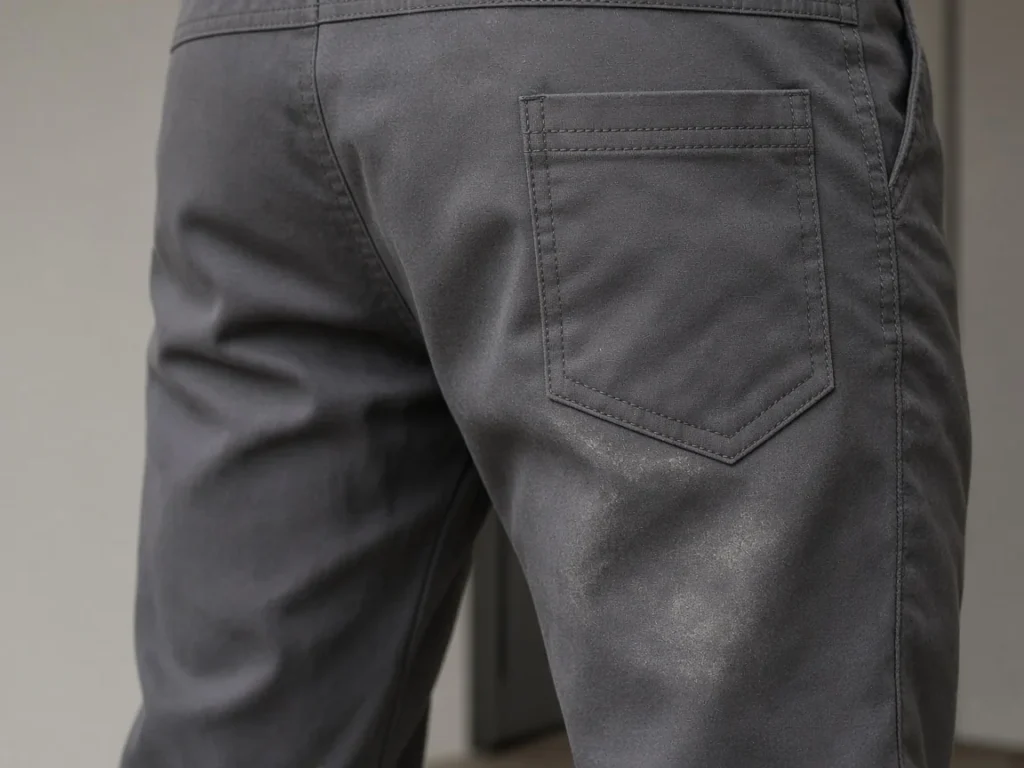
Rise, stride, and kneeling: get the block right first
The block is the program. Fabric cannot save a rise that binds when the wearer kneels.
Specify a rise that stays comfortable in a kneel and in a walk — usually a mid or slightly higher rise rather than a low fashion rise. Check stride and crotch depth on people who actually clean, not only on a standing fit model. Ask the wearer to kneel, stand, walk a long corridor, and sit on a low stool. If the waistband pulls down or the thigh locks, fix the pattern before you talk about color.
Knee behavior is part of the block, not an optional “reinforcement” slogan. Some programs add a double layer or a slightly cleaner articulated knee on the after-hours pair, where kneeling is constant. On a day crew that works in a tenant lobby, a quieter, flatter knee often looks better and still needs enough ease to bend. Decide that by site, and write it on the style card. Do not assume a heavy utility knee belongs on every pair just because the wearer cleans.
Hem and fit at the ankle should clear a shoe that is worn all shift and should not drag on wet floor areas. A slight taper can look tidier in a lobby, but a tight calf will fight a step-up onto a platform or a van running board. Test it.
Offer men’s and women’s blocks, or a unisex block plus a shaped option, from a wearer survey. Cleaning crews are mixed, and a single “unisex” grade that is simply a men’s block will fail on a large part of the roster.
Pocket maps for bottles, cloths, and keys
List what the crew is allowed to carry, then build the pockets. Do not start from a catalog cargo pant and hope the layout fits a property site.
Day crews on tenant floors usually need a quieter map: a secure phone or radio pocket that does not bounce, a key clip or a small welt that does not rattle in a lift, and one utility pocket that closes, so a cloth or a pair of gloves does not fall onto a lobby floor. After-hours crews may need a slightly deeper utility pocket for a bottle or a roll of cloths, still with a flap or a secure entry so nothing dumps when the wearer bends.
If a pocket would look bulky in a daytime lobby photograph, it probably does not belong on the day-crew pant. Put extra volume on the after-hours style, or keep bulky items on a trolley. Open thigh cargos that catch on trolley handles are a common reason pairs come back damaged.
Crew | Typical carry | Pocket map | Appearance note |
|---|---|---|---|
Day / tenant-facing | Phone, keys, a cloth, gloves | Quiet welts or a closing utility pocket; no loud thigh cargos | Flat front; hardware that does not rattle in a lift |
After-hours / back areas | Bottle, cloth roll, keys, gloves | Deeper closing utility pocket; still no open dump pockets | Can be a slightly tougher cloth in the same color family |
Site lead / walk-throughs | Phone, keys, a slimmer front | Cleaner pocket map in the same color and logo rule | Should still match the crew from a distance |
Logo or name marks on trousers are usually small — a hip or back-pocket mark, if you use one at all — and should stay clear of the seat wear zone. Many property programs keep decoration on the shirt and leave the pant clean. If you do mark the pant, approve it on the production cloth, because a stitch line on a stretch woven can pucker at the hip.
Soil-release, color, and the laundry route you actually use
Pants for cleaning crews go through more wash cycles than most office trousers. Name the route in the brief: home wash, contractor laundry, or a mixed route; typical temperature; and whether any stronger detergent is used. Then pick a mid-weight woven — often a poly-cotton or stretch woven — that can release light soil and hold shade on that route. A stain-release face is worth asking for if you can wash-test it on the real cloth. Do not treat a finish name as a guarantee.
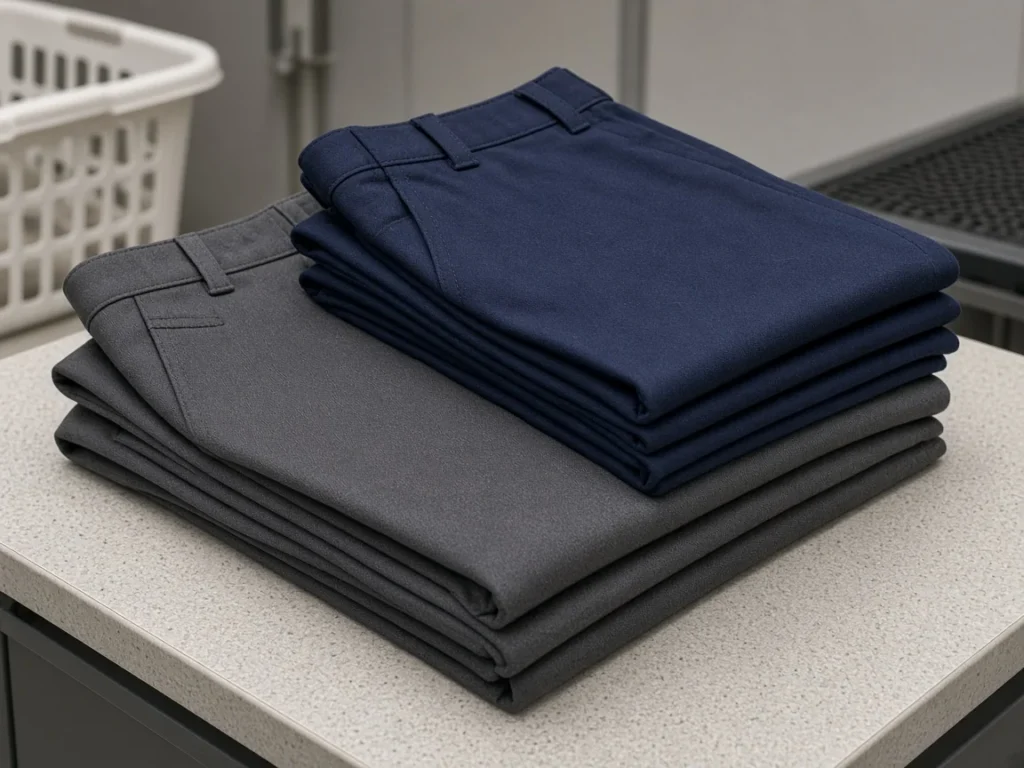
Color should hide light marks without looking like a different uniform family from the shirt. Charcoal, navy, and black are the usual bases. A day crew in a bright lobby may need a shade that still looks clean under daylight at a reception. An after-hours crew can use a slightly darker tone of the same color if you lock both dips against one standard. Avoid fashion mid-greys that go blotchy after repeated washing.
Ask for a wash trial on the sample: shrinkage at the waist, seat, and hem; color change; and whether the pocket bags twist. A pair that shortens at the hem after three washes will trip a wearer or look unfinished in a lobby.
This is ordinary staff workwear. Any separate, named site requirement belongs in its own brief and garment, not in a standard pair of property pants.
Day property work vs after-hours back areas
The difference is appearance and pocket depth, not a second brand.
Day work at Parkside often happens while tenants and visitors are in the building. The trouser should look composed in a corridor and in a lift. After-hours work at Elm Court may involve more kneeling and more time in plant rooms and back corridors. That pair can share the same color family and the same waistband and rise, with a slightly tougher cloth or a deeper closing pocket if the wash trial supports it.
Do not copy a concierge trouser into this program. A lobby-host pant is cut and finished for a desk and an arrival court, not for a cleaning kneel. Keep the two issue lists separate even if the building wants a related color story.
See also pants for other adult bottoms, without turning this brief into a full catalog.
A pants-only RFQ sheet and a replacement cycle
Quote trousers as trousers. A “set price” that hides the pant behind a shirt will not tell you what this style costs to replace.
Field | What to lock |
|---|---|
Crews | Day tenant-facing, after-hours, site lead — adult cleaning staff only |
Block | Rise, stride, knee ease, hem; men’s and women’s or shaped |
Cloth | Composition, weight, stretch if any; stain-release if required |
Color | Physical standard; day and after-hours tones if split |
Pockets | Item list, closure type, no-open-dump rule for tenant floors |
Marks | Whether the pant carries a logo at all, and where |
Laundry | Route, temperature, and wash-trial method |
Sizes | Wearer survey; quantities by site and crew |
Packing | By site or contract; size marks that survive washing |
Date | Contract start or seasonal hiring wave |
A factory-ready trouser with your color and a quiet pocket change can start a single-site contract quickly. A private-label block is better when several buildings must match for the life of a contract. Either way, seal a pre-production sample in the bulk cloth, with production pockets and any mark, before cutting.
Replacements are the real volume story. Track how many pairs a full-time cleaner goes through in a season, add hiring buffer, and plan the style as a repeating order. Combined site runs of about 2,000 pieces per style keep a shared block efficient. A different cloth or a different pocket map is a second style.
Fit samples should be worn on a real corridor walk and a real kneel, then washed, then measured again. Approve the PPS in writing. Pack by site so an Elm Court opening is not mixed with a Parkside top-up.
Questions property and facility buyers ask
How is this different from a commercial cleaning uniform page?
That page covers a full apparel program for janitorial and facility crews. This page specifies only the pants: block, pockets, laundry, and site appearance.
How is this different from a residential concierge uniform?
A concierge kit is for lobby and package-desk hosts. These trousers are for property and facility cleaning staff. They should not share a pattern just because they work in the same building.
Can day and after-hours crews share one pant?
They should share rise, color family, and waistband logic. They can differ on pocket depth or cloth weight. Keep both dips on one color standard.
What should the first sample prove?
A kneel and a long walk, a pocket that stays closed, a hem that clears the shoe after washing, and a shade that still looks acceptable in a tenant lobby.
About Top Fortune and a cleaning-pants quote
Shanghai Top Fortune Industry Co., Ltd. has built OEM and ODM staff-apparel programs since about 2002 from a 1,506 m² facility in Songjiang. Pattern, sampling, and sewing sit under one roof, which helps a pants-only program hold one rise and one shade across several property sites. More background is on the About Us page.
Request a property cleaning staff pants quote: rill@topfortunemail.com | WhatsApp +86 13524210501
Send the RFQ sheet, a pocket and carry list, a laundry note, a size survey, site counts, and the date trousers must arrive. The sample that matters is the pair that has been knelt in, walked in, and washed — not only the pair that looks clean on a hanger.