

How Workwear Distributors Choose an OEM Factory in China
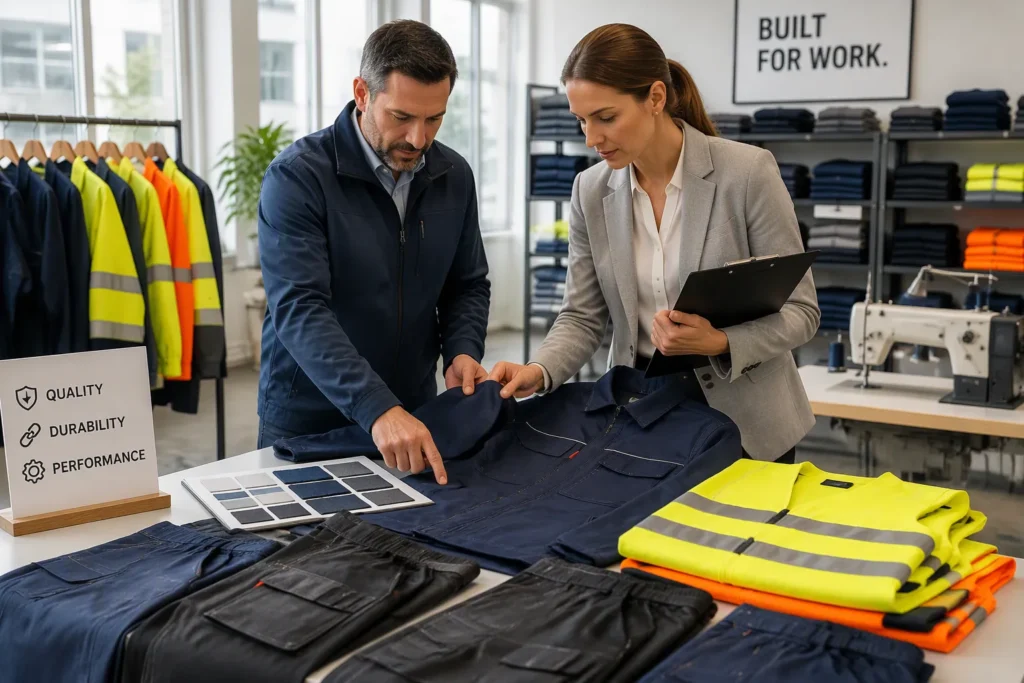
Choosing a workwear OEM factory China buyers can rely on takes a structured evaluation. Technical capability, quality systems, compliance, cost, communication, and supply chain reliability all carry weight. This guide speaks to overseas distributors, wholesalers, importers, and private-label brands. It does not address domestic China retail. Expect a practical, checklist-driven approach. The sections ahead cover what distributors actually buy, evaluation criteria, questions to ask, sample checkpoints, and when a trading company or a factory fits best. Shanghai Top Fortune Industry Co., Ltd. offers a useful benchmark. This OEM/ODM export uniform manufacturer began around 2002 and runs a 1,506 m² factory in Songjiang, Shanghai.
Key Takeaways
Evaluate factory skills and quality control before you place an order.
Confirm compliance and certifications with current test reports.
Define sampling and bulk production checkpoints clearly.
Use a weighted scorecard to compare factories fairly.
Start with a trial order to reduce risk.
What Distributors Actually Buy
Core Workwear Categories
Distributors build their catalogs around four workwear families: polos, jackets, trousers, and corporate sets. Each family carries its own construction logic. A polo needs a stable knit, a clean placket, and colorfast yarn. A softshell jacket depends on bonded layers, sealed seams, and reliable zippers. Trousers demand consistent pattern grading and reinforced stress points. Corporate sets combine a shirt or polo with a coordinated bottom, so the factory must match dye lots across garments. Buyers can review category examples on the custom polo shirt OEM page and the softshell jacket OEM page.
Sizing is a purchasing decision, not a detail. Distributors in Western markets order to a size curve, and that curve shifts by segment. The table below shows typical ratios a factory should be able to produce against.
Size | North American construction (all-male) | UK/European general industrial |
|---|---|---|
S | 5% | 8% |
M | 18% | 22% |
L | 25% | 28% |
XL | 25% | 24% |
2XL | 16% | 12% |
3XL | 8% | 5% |
4XL | 3% | 1% |
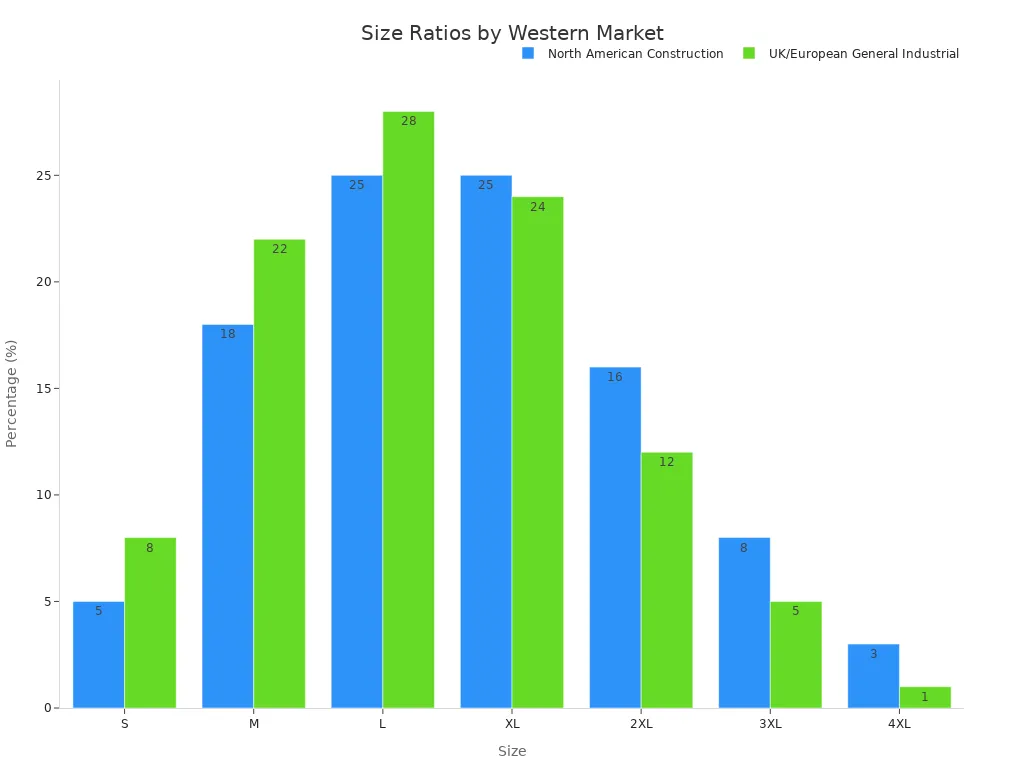
For a first order into a new market or style, distributors commonly add 10–15% extra units in the most popular sizes, typically L and XL. The size curve and the buffer both need to fit inside the order volume the factory can produce.
Private Label and Packing Needs
The garment is only half the deliverable. Distributors buy a branded product, and the branding lives in the details: woven labels, embroidery placement, screen printing or heat transfer, hang tags, poly bags, and export cartons. A factory that treats labeling as an afterthought creates rework at the packing line.
Private label manufacturing means a factory produces garments to your specification and applies your branding — your logo, labels, packaging and product naming — rather than selling you a pre-existing branded product to resell. True private label work builds branding into the manufacturing process itself — woven labels sewn in during construction, embroidery placement planned alongside the pattern, packaging designed around your product line.
Packing for wholesale adds another layer. Carton configuration, size assortment per carton, and carton marking all affect how quickly a distributor can receive and redistribute stock. Ask the factory to confirm these points in the quotation, not after the PO.
Vetting a Workwear OEM Factory China Buyers Can Trust
Capability, QC, and Lead Time
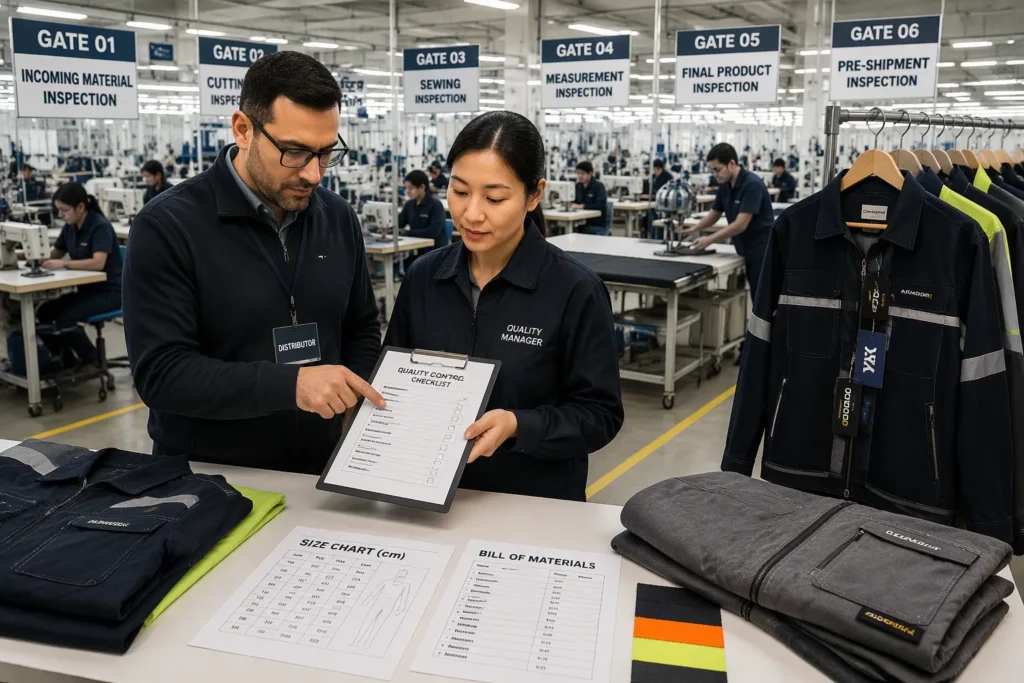
A capable workwear OEM factory China buyers can trust shows its process, not just its catalog. Start with the quality control chain. A disciplined factory runs five inspection gates: incoming material inspection against approved specs, cutting and sewing inspection for stitch and seam quality, measurement checks against the approved size chart, final product inspection for workmanship and labeling, and pre-shipment verification of quantities and documents. Ask each candidate to walk through these gates in order. A factory that skips the incoming material check will discover fabric faults at packing, not before cutting.
Component choice signals quality. Branded zippers such as YKK, branded shell fabrics such as Cordura, and branded insulation such as Primaloft give distributors a verifiable reference point. Confirm the factory can source these components and document them on the bill of materials.
Lead time deserves the same scrutiny. One named Chinese workwear OEM, Jinhua Mando Safety Co., Ltd., reports a typical lead time of approximately one month, even in peak season. Treat that as a benchmark, not a promise. Factories now use ERP scheduling, automated cutting, and digital printing to compress turnaround. Capacity planning still decides the outcome.
During peak season, some factories accept orders without realistic capacity planning, resulting in over-promised lead times and late shipments. Buyers should verify capacity commitments before relying on quoted lead times.
The table below summarizes the evaluation areas that separate strong candidates from weak ones.
Evaluation Area | What to Look For |
|---|---|
Capability | OEM/ODM skills: logo printing, embroidery, heat transfer, custom fabric and color, private label, size chart adjustment |
Quality control | Documented inspection gates from incoming material to pre-shipment verification |
Lead time transparency | Realistic capacity commitments, peak-season planning, scheduling systems |
Labeling | Woven labels, care labels, and logo placement confirmed before production |
Packing | Carton specs, units per carton, carton weight limits, pallet configuration |
English RFQ handling | Clear technical questions, written assumptions, fast quotation turnaround |
Trading companies and factories each fit different buyers. A trading company aggregates several factories and handles documentation, which suits small or highly varied orders. A direct factory offers tighter process control and usually better pricing at volume. Neither model wins outright. Match the partner to order size, product complexity, and how much sourcing work the distributor wants to keep in-house. Background on one OEM option appears on the about page.
Labeling, Packing, and RFQ Handling
Labeling and packing failures cause more receiving disputes than stitching defects. Distributors should define the full packaging system in writing: protective bag, inner box, master carton, pallet, corner protection, strapping, and shipping marks. Specify units per carton, carton dimensions, net and gross weight, maximum carton weight, pallet size, and cartons per pallet. Manually handled master cartons typically run about 15–20 kg gross, and loaded pallets commonly reach 1.2–1.8 m in height. Note that ISPM 15 applies to regulated raw-wood packaging such as pallets and crates.
RFQ handling reveals how a factory thinks. Strong suppliers ask technical questions early, name test methods, and document assumptions. Chinese manufacturers typically provide only the information explicitly requested, so the buyer must specify everything needed. Provide CAD files, size tables, print files, material specs, and applicable standards in writing. A factory that responds with precise questions and written assumptions will usually quote more accurately and ship with fewer surprises.
Questions and Checkpoints Before the First PO
Questions to Ask Upfront
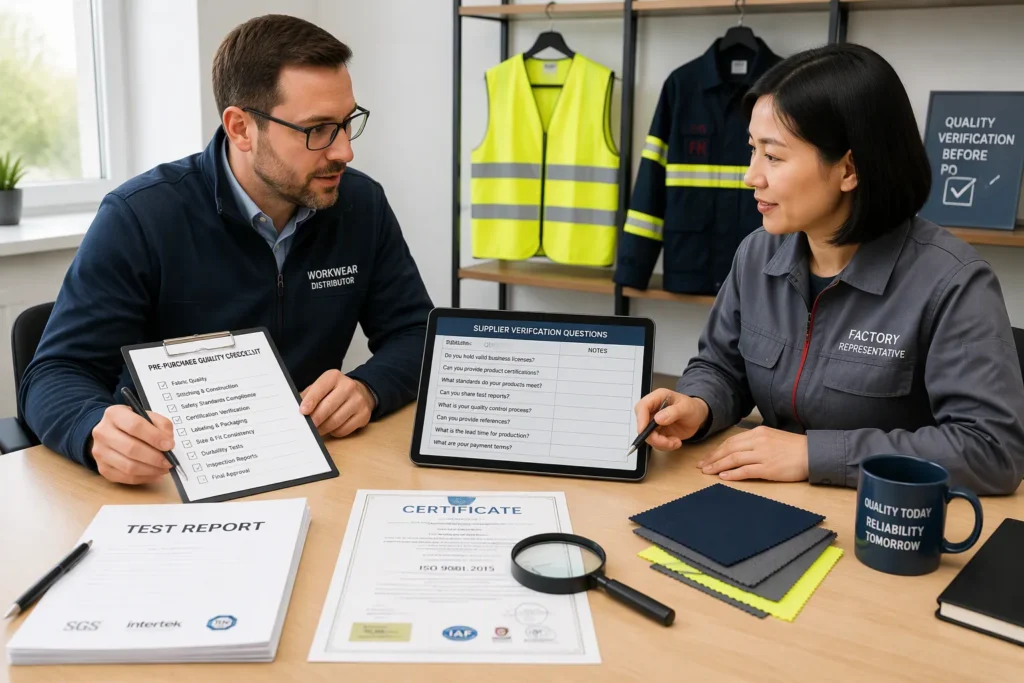
A distributor’s first purchase order carries the most risk. A structured question set lowers that risk before money moves. The table below groups the practical questions by area and explains why each one matters.
Question Area | Essential Questions to Ask | Why It Matters |
|---|---|---|
Quality controls | Will the factory review our tech pack? Can it confirm fabric specs with mill certificates and lab reports? Does it set AQL checkpoints at 2.5 or 4.0? Who owns the AQL gate? Is there a written sample-approval workflow for pre-production and top-of-production? Are reorder terms defined in writing? | Factories often skip AQL checks unless buyers demand them, so ownership of this gate must be explicit. |
Certifications | Can the factory provide third-party test reports rather than catalog claims? For hi-vis, does it hold ANSI/ISEA 107 (US) or EN ISO 20471 (EU)? For flame-resistant work, NFPA 2112 or NFPA 70E? For waterproof claims, EN 343 or equivalent lab proof? Can it produce current batch-level documentation? | A vendor unable to produce current batch-level documentation is a weak candidate. |
MOQ, samples, lead time, and landed cost | What are the dye-lot minimums and trim setup costs? What is the sample timeline in writing, including revision rounds? What is the bulk lead time after sample approval? Who bears HS-code and tariff responsibility? Is there an audit trail for every batch? | Buyers have lost margin by ignoring landed cost; settle tariff responsibility before committing. |
Documentation verification | Are third-party test reports tied to our purchase order number? Can the factory supply batch records and a certificate of analysis, not just a certificate on the wall? Which accredited lab issued each report? Which standard edition is cited? Was the finished garment tested, or only the fabric bolt? | This ensures traceability and confirms that testing applies to the actual finished product. |
Factory and design verification | What is the certification scope, and are test reports current? Are mill COAs and batch records available for traceability? Which plant will run our order? Will the factory modify a certified design or build a new OEM product? | Confirms the actual production site and whether certification remains valid for modifications. |
Capacity deserves a direct question. Ask how many lines the factory can dedicate to the order and what share of peak-season capacity the distributor will receive. Ask which processes run in-house and which are outsourced. Cutting, sewing, embroidery, and printing may sit under one roof or spread across subcontractors. Outsourced steps add coordination risk, so the distributor should know where each step happens.
Change-order handling belongs in the same conversation. A clear factory states how it prices a mid-production change, how long the change adds to the schedule, and who approves it. Export documentation is the final upfront item. Confirm that the factory can issue the commercial invoice, packing list, bill of lading support, and certificate of origin the destination customs authority requires.
Distributors new to China sourcing sometimes hire a Western sourcing agent. The agent adds cost but reduces risk, especially on a first order with unfamiliar specifications. This option suits buyers without in-house sourcing staff. It is one path among several, and many distributors work directly with a workwear OEM factory China buyers already trust.
Sample, PPS, and Bulk Checkpoints
Sampling follows a sequence, and each stage answers a different question. A prototype tests whether the design translates into a garment. A fit sample tests measurements and movement against the controlling size chart. A decorated sample tests whether the proposed branding works, with artwork, material, and placement references kept visible. A pre-production reference sample controls production release, with accepted files and any remaining conditions recorded.
Each stage needs a recorded decision. The buyer marks the sample Approved, Revise, or Pending with a date in a comment register. Production release requires naming the accepted sample plus the specification revision. Any remaining conditions stay visible and carry an assigned owner.
Bulk production then runs through four checkpoints, each with clear pass/fail logic.
Fabric and material inspection. Verify color consistency, fabric weight, waterproof rating, stretch recovery, shrinkage, and shading. Pass means materials match the approved references. Fail means any inconsistency. Fabric and material defects are a major source of garment defects, so issues must be caught before cutting.
Pre-production alignment. Review approved sample specs, measurement tolerances, stitching standards, cutting plans, and packaging instructions. Pass means every team aligns on the technical spec and standard operating procedure. Miscommunication is a leading cause of defects.
Inline production inspection. Run first-piece inspection, mid-production inspection, and random sewing-line checks. This catches stitching defects, machine issues, and pattern misalignment early. Inline checks can cut defect rates compared with final inspection alone.
Final inspection and shipment validation. Apply AQL standards on random samples. Check measurement accuracy, logo placement, zipper function, seam strength, and packaging. Categorize each unit as pass, rework, or reject. AQL inspection can reduce return rates.
These checkpoints apply across product types. A logistics or courier uniform program depends on durable fabric and consistent sizing across a large fleet, as the logistics courier uniform OEM page shows. A hotel or hospitality program leans on color matching and neat branding across front-of-house and back-of-house roles, which the hotel hospitality uniform OEM page illustrates. Both benefit from the same sample discipline and the same four bulk gates.
Audits, References, and the Final Scorecard
Factory Audits and Reference Checks
A video walkthrough or an on-site visit answers questions a catalog cannot. The auditor should watch floor organization, equipment condition, QC stations, and warehouse storage. A clean aisle and a labeled quarantine area tell more than a polished brochure. Ask to see calibration stickers on sewing machines and lighting set up for dye-lot inspection. Trace one random batch backward to its raw material and forward to shipment release. Request the documents behind each stage: material safety data sheets, third-party lab reports per textile lot, care and compliance label photos, and export certificates.
References close the loop. Ask for two or three distributor references in comparable markets and order sizes. A short call about reorder accuracy and how the factory handled a defect claim reveals more than any scorecard row.
Weighted Scorecard and Partner Checklist
A weighted scorecard turns scattered impressions into a comparable number. Score each candidate from one to five across technical fit, quality systems, compliance, cost, communication, and supply chain reliability, then apply weights that match the distributor’s priorities. Technical fit covers fabric and weather-performance mapping, reinforcement engineering, and pattern-stage construction detail. Compliance covers audit scores, testing coordination, and support for EU and North American chemical requirements.
For actual sourcing, an OEM/ODM partner should support BSCI, Oeko-Tex, GRS-oriented sourcing, testing coordination, and audited production — the difference between admiring premium workwear and owning a premium workwear brand.
A copy-paste partner checklist keeps the evaluation consistent: verified business license and export rights, live ISO 9001 scope check, machine count and maintenance logs, documented inspection gates, labeling and packing specs in writing, English RFQ response quality, named references, and a signed CAPA commitment before PO release. Score every workwear OEM factory China shortlist candidate against the same list.
Shanghai Top Fortune Industry Co., Ltd. welcomes that scrutiny as one credible option among several. Reach the team at rill@topfortunemail.com, WhatsApp +86 13524210501, or Floor 3 Building 20 Haier Zhigu No.66 Guangfulin East Road Songjiang Shanghai 201600. The company profile sits at workwearmanufacturer.com.
Distributors who follow a fixed sequence make better partner decisions. They define product requirements, review manufacturer capability and quality control, compare costs and terms, check communication, and visit the factories. Sample, PPS, and bulk checkpoints follow before the first purchase order. A weighted scorecard turns scattered impressions into a comparable number.
This documented approach converts a complex sourcing decision into a repeatable process and lowers first-order risk. A trial order and a refined scorecard reduce risk further. Shanghai Top Fortune Industry Co., Ltd. remains one credible workwear OEM factory China buyers can benchmark. Contact rill@topfortunemail.com, WhatsApp +86 13524210501, Floor 3 Building 20 Haier Zhigu No.66 Guangfulin East Road Songjiang Shanghai 201600.
FAQ
Does the factory sell to buyers inside China?
No. Shanghai Top Fortune Industry Co., Ltd. runs an export-only OEM/ODM operation. The company serves overseas distributors, wholesalers, importers, and private-label brands. Domestic China retail falls outside its scope. Buyers outside China can therefore treat the factory as a dedicated export partner rather than a domestic competitor.
How does a distributor start an RFQ?
The distributor sends a tech pack, size chart, logo files, target quantity, and destination market. The factory then reviews the brief and returns written questions. A quotation follows with assumptions stated in writing. Buyers reach the team at rill@topfortunemail.com or WhatsApp +86 13524210501 to open the conversation.
What order volume fits the program minimum?
The program minimum is about 2,000 pieces per style. Distributors usually place that volume once for a style, then reorder in replenishment packs. A written quote should use that program volume, not a small trial, as the cost model.
Should a distributor choose a trading company or a direct factory?
Each model fits a different buyer. A trading company aggregates several factories and suits small or highly varied orders. A direct factory offers tighter process control and usually better pricing at volume. Distributors should match the partner to order size, product complexity, and in-house sourcing capacity.
How long does sampling take before bulk production?
Timelines vary by style and material sourcing. The factory should confirm the sample schedule in writing, including revision rounds. Bulk lead time starts after sample approval. Distributors should verify capacity commitments before relying on quoted dates, especially during peak season.
Can the factory handle private label and wholesale packing?
Yes. Private label work covers woven labels, care labels, embroidery, screen printing, hang tags, poly bags, and export cartons. The distributor should define carton specs, units per carton, and pallet configuration in the quotation. Written packing specs prevent receiving disputes later.