

Hotel Brand Uniform OEM Procurement Checklist | Front Desk & Housekeeping
Table of Contents
Display
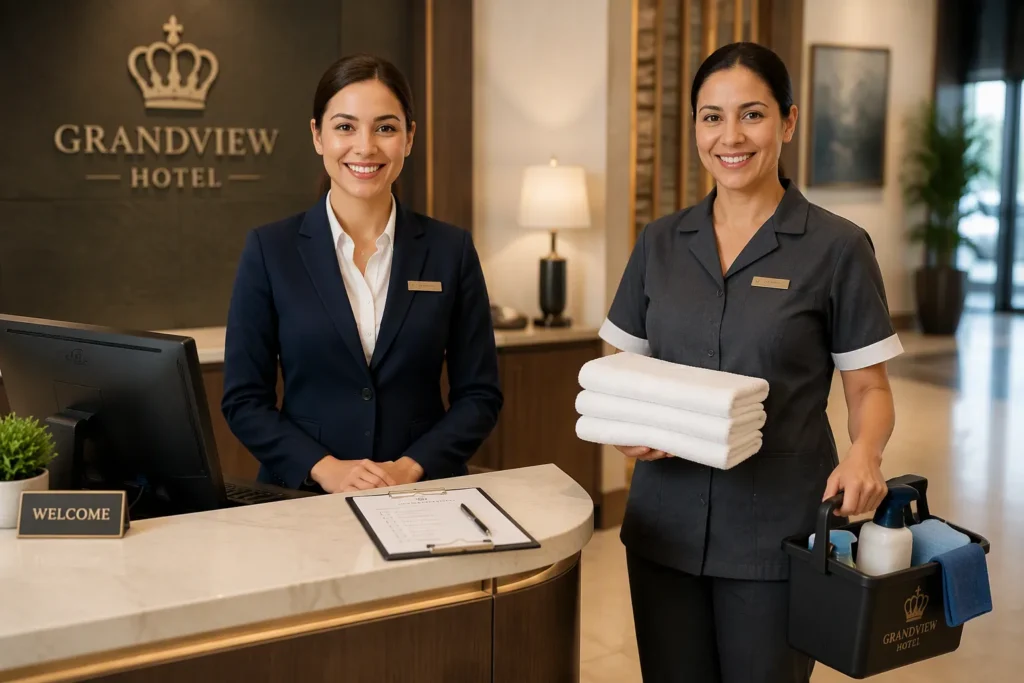
Front desk and housekeeping uniforms do two jobs at once. Guests see them as part of your brand, and staff wear them through long, physical shifts. Procurement mistakes show up fast: fading collars in the lobby, worn seams on housekeeping carts, and replacement orders that go over budget.
This checklist gives multi-property hotel brands a practical way to brief both departments together under one hotel brand uniform OEM program. You get department-specific guidance, comparison tables, sample-to-bulk gates, and a copy-paste checklist to drop straight into your next RFQ.
Key Takeaways
Make separate uniform specs for the front desk team and the housekeeping team.
Check how well the fabric holds up through industrial wash cycles before you approve the bulk order.
Use three approval steps: development sample, pre-production sample, and bulk inspection.
Use one OEM for all your orders to keep brand colors and logos the same.
Put detailed fabric, sizing, and branding info in your RFQ to save time.
Do fit trials and wash tests with staff to find problems early.
Keep signed samples and spec files so reorders are easy and stay consistent.
Begin buying supplies at least five months before you open. This helps you avoid delays.
Quick Takeaways
Five Points to Remember
Spec by Department
Front desk and housekeeping teams face different needs every shift. Front desk staff need neat, presentable garments with clean lines and tidy logo placement. Housekeeping staff need clothes that allow movement and hold up to washing and stains. Write separate spec sheets for each department, then brief both under one program.
Cost control: approved products per department support steady replenishment instead of random buying.
Inventory consistency: shared styles, colors, fabrics, and sizes help managers hand out uniforms efficiently.
Operational efficiency: set approved styles and size ranges cut the time spent searching for substitutes.
Test Fabric First
Never approve a fabric from a swatch alone. Ask for industrial wash data under EN ISO 15797 at the wash temperature your program really uses. A fabric tested at 60°C may not hold up the same at 75°C or 95°C. Request chlorine bleach resistance data if your laundry uses bleach for hygiene.
Confirm colorfastness ratings after repeated washing. Check shrinkage in both warp and weft directions. A sample that has survived at least 20 industrial wash cycles gives you a much safer basis for bulk approval than a fresh swatch.
Gate Every Order
Treat each order as three gates: development sample, pre-production sample (PPS), and bulk. At the development sample, judge fit, fabric hand, and color. At the PPS, sign off every detail against the written spec. During bulk, run inline and final inspection.
No gate should open on verbal approval. Keep the signed PPS as your reference standard for every future reorder.
Why They Matter
Fewer Replacements, Fewer Complaints
Uniform problems show up in public. A faded collar or a split seam appears in the lobby, not in a stockroom. Department-specific specs and tested fabrics catch these failures before bulk production starts.
Gated approvals protect your replacement budget. You catch shrinkage, color shift, and fit issues at sample stage, when fixes cost little. You also protect the guest impression. Staff in matching, well-fitting uniforms are easier for guests to spot and approach, and small style or color differences by department help guests find the right person for a specific question.
About the Manufacturer and Buyer Intent
Who We Are
Shanghai Top Fortune Industry Co., Ltd.
Shanghai Top Fortune Industry Co., Ltd. is a maker of workwear and hotel uniforms. It was started around 2002. The company creates OEM and ODM programs for hotel groups, corporate buyers, and uniform distributors. You can read the full company profile on the workwear manufacturer homepage and the about-us page.
That setup helps when you roll out to many properties. You talk to one technical contact and keep one spec file for each property. Custom logos, woven labels, and retail-ready packaging are part of the normal scope. So front desk and housekeeping programs share one approval trail from sample to shipment.
Factory and Export Markets
Production takes place in a 1,506 m² factory in Songjiang, Shanghai. Sampling, bulk sewing, and inspection all happen in one place. This keeps spec changes easy to see at every stage.
Export programs ship to Europe, the Middle East, Oceania, Southeast Asia, and the Americas. Buyers in many countries often need sizes adjusted for their region and labels made for their market. Bring up both points early, because they affect pattern work and packing lists.
What Buyers Ask
OEM/ODM Hospitality Scope
Multi-property hotel brands, property groups, and procurement teams brief front desk and housekeeping together. Adult staff only — this program does not cover school uniforms. A hotel brand uniform OEM program at this scale usually starts at about 2,000 pieces per style.
Buyers usually ask three questions: can one factory handle two department specs, can it repeat them on reorder, and how fast can it sample. Custom designs usually sample in about 7 days; existing styles in 1–3 days. Bulk production runs 15–30 days depending on quantity and complexity. In-house lab checks cover colorfastness, strength, and related fabric performance before bulk release.
How to Reach the Team
Send your front desk and housekeeping spec sheets straight to the team. Email rill@topfortunemail.com or message WhatsApp +86 13524210501. Include size ranges, fabric weights, logo placement files, and target delivery dates.
The office address is Floor 3 Building 20 Haier Zhigu No.66 Guangfulin East Road Songjiang Shanghai 201600. Quote requests with complete specs move faster than open inquiries, because the team can price fabric and construction without a second round of questions.
Table of Contents
How to Use This Checklist
This page works as a working document, not a one-time read. Skim the quick takeaways first. Then move to the section that matches your current stage in the buying cycle. A brand HQ team preparing an RFQ needs different pages than a franchise owner placing a reorder.
Each section stands on its own. You can print one page, send it to a colleague, or paste a table into your own template. The checklist near the end pulls every stage into one list you can reuse for each new property.
Jump to the Section You Need
Quick Takeaways — the five points that decide most uniform programs.
About the Manufacturer and Buyer Intent — who makes the program and what buyers usually ask.
Who This Checklist Is For — how brand HQ, regional operations, and franchise owners split the work.
Front Desk vs Housekeeping Specs — fabric, colorfastness, stain resistance, pockets, and badges by department.
RFQ and Specs Table — what to put in the request and which columns to require.
Sample to PPS to Bulk Gates — the three approval gates and what to sign at each one.
Catalog vs OEM Comparison — where each sourcing route fits best.
Copy-Paste Procurement Checklist — pre-RFQ, supplier and sample, and pre-order items in one list.
FAQ — scope, minimum order, quoting, and timeline questions.
Call to Action — how to send your specs for review.
Who This Checklist Is For
Brand HQ Teams
Standards and Approvals
Brand headquarters sets the standard. Your team writes the spec, approves the fabric, and signs off the logo file. You also decide how much local variation a property may accept. Hotel clusters show how this works in real life. Groups that share owners or a brand centralize office tasks, standardize staff training, and coordinate buying across properties in a region. One cluster model links several brands through shared service centers for finance and HR. It uses unified digital platforms and regular meetings to keep brand guidelines in line.
Approvals need a paper trail. Publish requirements through manuals or a digital portal. Use regional operations leaders to explain brand requirements, train department heads, and check consistency. Verify compliance through scheduled brand QA inspections, mystery shopper visits, and pre-opening reviews. Keep date-stamped photos, size measurements, deficiency logs, and completion sign-offs. This paperwork protects you at the next audit and at every reorder.
Regional Operations
Rollout Consistency
Regional operations turns the HQ standard into daily practice. Start with a clear picture of your staff. Map local hire share, average tenure, and main service zones. Then define the must-have specs for each department. Standardize fabric across properties, because a fragmented order book weakens rollout consistency.
Document every detail so repeated production runs do not drift. Record fabric composition, color, trims, embroidery, logo positioning, stitching, measurements, and size specs. Pilot one uniform line before you roll out across all regions. Run a wear trial in the real work environment and track wrinkle retention, seam integrity, and stain release after standard laundering. Treat launch as ongoing. Measure comfort, appearance retention, and size availability for new joiners months later.
Franchise Owners and One OEM
Centralized Ordering and Reorders
Franchise owners protect brand identity when they order against the same brand spec. One OEM keeps specs, colors, and logo placement consistent on every reorder. A central SKU catalog with reorder rules standardizes brand-critical elements and blocks unapproved substitutions. A franchise ordering portal limits orders to centrally authorized SKUs. It shows availability, recommended quantities, and authorized replacements in one place.
Centralized volume forecasting across the network improves pricing and production scheduling. Centrally managed order visibility lets head office combine shipments and respond faster to supplier issues. Franchisees keep local flexibility on fit feedback and delivery timing without touching the brand-critical details. That balance gives you one approval trail and fewer surprises at the next property opening.
Front Desk vs Housekeeping Specs
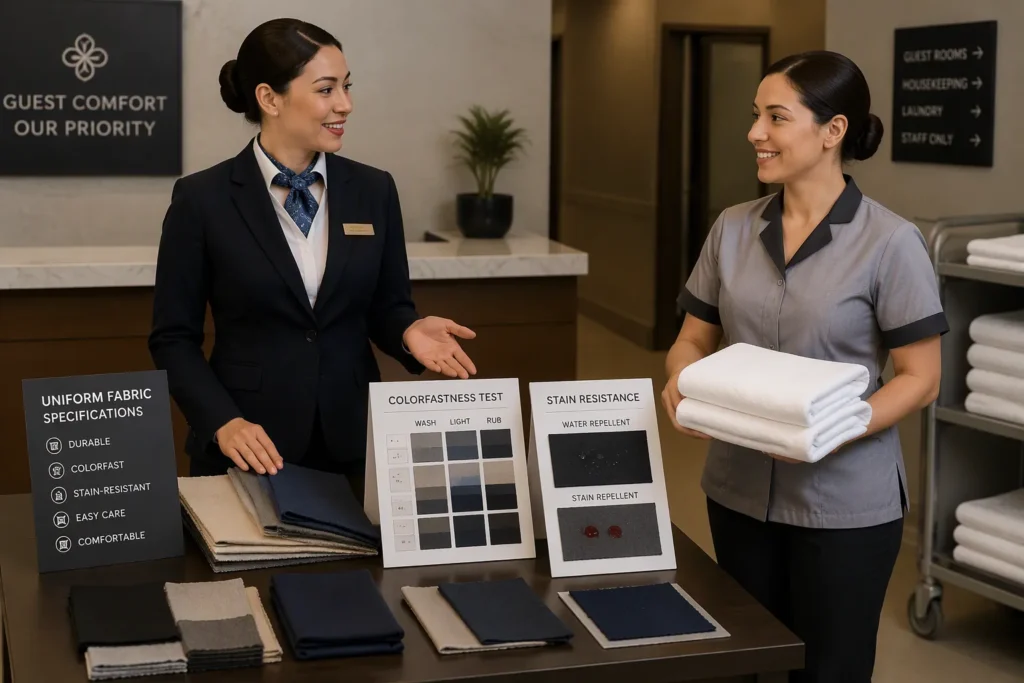
Fabric and Colorfastness
Front Desk: Stretch Twill and Moisture-Wicking
Front desk staff stand for hours and walk between the lobby and back office. They stay in guest view the whole shift. Build their spec around stretch twill so they can move easily. Add moisture-wicking options for warm climates and busy check-in times. Looks matter most here, so colorfastness counts as much as how the fabric feels.
A polyester-cotton blend at a 65/35 ratio gives the best mix of wrinkle resistance, breathability, and cost. For poly-cotton suiting, set a fabric weight of 200–240 GSM. Test colorfastness to washing under AATCC Test Method 61. A rating of 4 or higher means little fading after 50 wash cycles. Add ISO 105-C06 for washing and ISO 105-E04 for sweat. On the grey scale, 4/5 reads as good, 4–5/5 as excellent, and 3–4/5 as fair to good.
Standard Category | Front Desk Recommendation |
|---|---|
Fabric composition | Poly-cotton 65/35 or quality polyester suiting |
Fabric weight | 200–240 GSM for poly-cotton suiting |
Colorfastness to washing | AATCC 61 (rating ≥4 after 50 washes); ISO 105-C06 |
Colorfastness to perspiration | ISO 105-E04 |
Grey scale rating | Good 4/5; excellent 4–5/5; fair to good 3–4/5 |
Housekeeping: Abrasion Resistance
Housekeeping uniforms face a harder test every day. Staff bend, lift, scrub, and push carts through many wash cycles. Specify fabrics that are durable and resist abrasion well. A polyester-cotton blend works well here too, because it combines stain resistance, water repellency, and easy care with comfort and long wear.
Breathability still counts. Housekeeping work is physical, and fabric that traps heat wears staff down by mid-shift. Balance durability against comfort, then confirm both hold up under your real laundry conditions.
Stain Resistance and Pockets
Stain-resistant fabric keeps uniforms looking neat despite dirt, dust, and cleaning chemicals. A soil-release finish helps garments shed stains during normal use. A wrinkle-resistant finish keeps the uniform crisp through the shift. Reinforced stress points add durability where movement pulls hardest.
Pockets carry the working load. Housekeeping staff often need several pockets for cleaning supplies and tools they grab fast. Deep pockets of 8 inches, at 6.5 inches wide, hold pens and supplies securely. Offer different pocket setups to suit staff needs across properties.
Pocket Layout by Task
Match the layout to the job. Front desk needs a slim, tailored pocket line that holds a pen and a card without breaking the silhouette. Housekeeping needs deeper, reinforced pockets placed where a reaching hand finds them without stopping work. Test both layouts in a wear trial before bulk approval.
Name Badges and Logo Placement
Badge and Logo Standards
Logo placement follows department logic. Front desk and management take discreet logo embroidery on the left chest. Housekeeping takes an embroidered logo on a piqué polo, with differentiation by garment color rather than extra embroidery. Restaurant and F&B place embroidery on the apron or shirt, visible but not excessive. Spa and wellness use a discreet woven label or small chest embroidery. Maintenance puts durability ahead of looks.
Department | Logo Placement | Name Badge Placement |
|---|---|---|
Front desk and management | Discreet embroidery, left chest | Badge or embroidery, right chest |
Housekeeping and cleaning | Embroidered logo on piqué polo | Secure badge, color differentiation |
Restaurant and F&B | Apron or shirt embroidery | Per hotel policy |
Spa and wellness | Woven label or small chest embroidery | Per hotel policy |
Maintenance | Embroidery or screen print | Per hotel policy |
Standard spots include the left chest for the hotel logo and the collar or lapel for the employee name or initials. The sleeve can hold the department or role, and the back can hold large logos on outerwear or aprons. Badge side depends on context. Networking guides favor the right side to line up with a handshake. Hospitality settings favor the left side for oncoming foot traffic. The side matters less than position: keep the badge above the breastbone and readable from about 10 feet away.
RFQ and Specs Table for Hotel Brand Uniform OEM
A clear RFQ saves weeks. Vague requests make the factory guess, and guesses lead to sample rounds, delays, and rework. Write your request so a pattern maker and a fabric buyer can both act on it without a call.
What to Put in the RFQ
Style, Fabric, Sizing, Branding
Your RFQ needs five blocks of information. Start with style: garment type, silhouette, collar shape, sleeve length, and closure type for each department. Name the reference garment if you have one, and say whether the factory may suggest other construction options.
Fabric comes next. Give composition, weight, and finish requirements for front desk and housekeeping separately. If you already approved a fabric in a wear trial, attach the swatch reference and the wash test results. For European markets, include EU sizing in your size range so the factory builds patterns to the right grade rules from the start.
Branding closes the request. Supply logo files in vector format, state placement coordinates, and specify embroidery or print method. Add name badge dimensions and attachment type. A complete RFQ lets the factory quote fabric, construction, and decoration in one pass.
For department-specific guidance, see the hotel front desk uniform OEM program page and the hotel housekeeping uniform OEM program page. Both pages show how a hotel brand uniform OEM brief turns into production specs.
Specs Table Structure
Required Columns and Tolerances
Build one specs table per department. Each row covers a single style, and each column captures one requirement the factory must meet. Give every key measurement point its own tolerance column. Chest, length, and sleeve each need a separate acceptable margin, because one blanket tolerance hides fit problems at the points that matter most.
State the tolerance as a plus or minus margin per measurement. A common working example is +/- 1cm, but set the figure against your own fit trials and your brand’s standards. Tighter tolerances cost more to hold, so apply them where guests notice the difference.
Spec Table Column | What to Record |
|---|---|
Department | Front desk, housekeeping, or shared |
Style | Garment type, silhouette, closure |
Fabric and weight | Composition, weight, finish |
Colorfastness | Test method and minimum rating |
Shrinkage | Allowable change after laundering |
Pocket layout | Position, depth, reinforcement |
Logo placement | Coordinates, method, thread color |
Size range | Full run, including EU sizing where needed |
Packaging | Fold, bag, label, carton marks |
Add a bill of materials for trimmings. List every small component — thread type, zipper brand, interlining, button code — with the supplier or brand name and the exact Pantone color code. Then write construction call-outs. Specify seam finish explicitly, such as flatlock, overlock, or twin-needle, instead of assuming factory defaults. These details decide how the garment wears and how it looks after twenty washes.
Common RFQ Gaps
Missing Test Standards
The most common gap is a missing test standard. Buyers name a fabric but skip the test method and the pass limit. The factory then tests to its own default, and the result may not match your laundry conditions or your market’s expectations.
Name the standard and the minimum rating for each performance claim. State the wash temperature your program uses, and confirm the fabric was tested at that temperature. Add shrinkage limits in both directions. If your laundry uses chlorine bleach, say so and request bleach resistance data.
Two more gaps appear often. The first is a missing size range for new joiners, which leaves properties short of common sizes at opening. The second is missing packaging instructions, which causes labels and carton marks to differ across properties. Close both in the RFQ, and your first bulk order arrives ready to distribute.
Sample to PPS to Bulk Gates
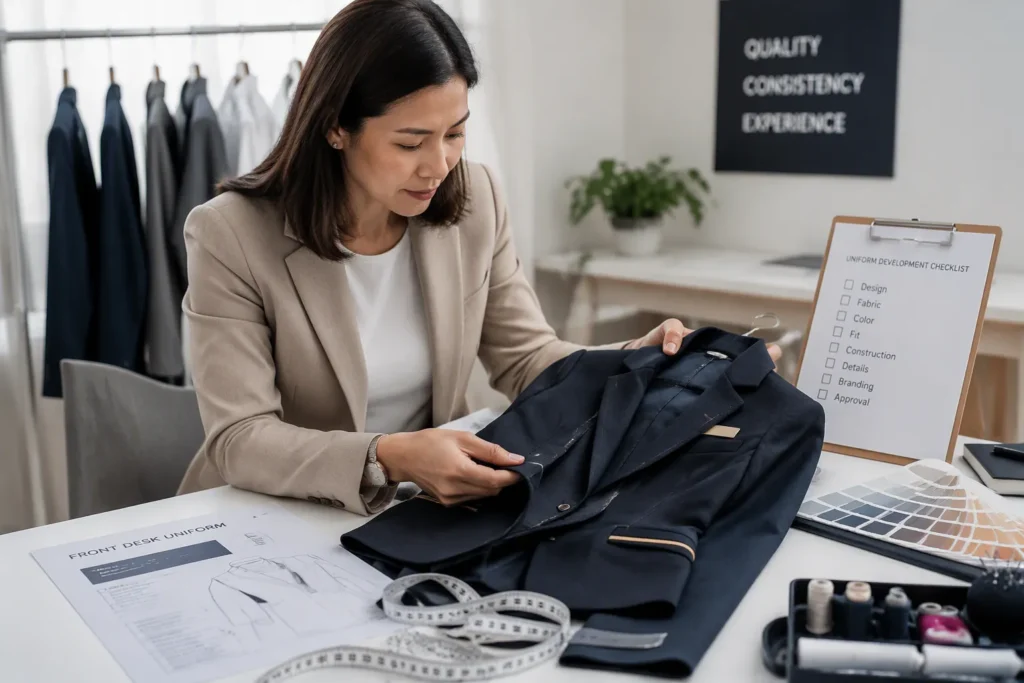
Three approval gates protect your uniform program. Each gate answers a different question. The development sample asks whether the design works. The pre-production sample asks whether the factory can repeat it exactly. Bulk inspection asks whether the shipment matches what you signed. Open no gate on a verbal yes. Keep every signed sample on file as the reference for future reorders.
Gate 1: Development Sample
Fit, Fabric Hand, Color
The development sample is your first physical look at the design. Judge it against the spec sheet, not against personal taste. Use the table below as your review frame.
Evaluation Factor | What to Assess in the Development Sample |
|---|---|
Fit | Sizing and fit consistency across sizes; front-of-house staff hold higher standards for fit; avoid over-buying a single size and use size distribution or historic usage |
Fabric hand | Cotton offers a natural, comfortable hand; cotton-polyester blends and polyester give greater dimensional stability, durability, and easy-care performance; match the fabric to the job function |
Color | Color matching and consistency matter most for front-of-house; centralized purchasing keeps color and style consistent; fading or loss of shape makes uniforms look inconsistent |
Construction and durability | Fabric strength, seam quality, closures, stress-point reinforcement, laundering compatibility |
Laundering performance | The garment must withstand frequent commercial washing and hold shape, color, and finish |
Department needs | Housekeeping prioritizes movement, laundering, and durability; front desk prioritizes presentation |
Fabric choice carries real weight in hospitality, because staff launder uniforms daily. Check the sample for wrinkle resistance, moisture-wicking, and stain-resistant finishes that survive repeated commercial washing. Fit consistency comes from detailed tech packs covering measurements, materials, and construction. A solid tech pack lets the same garment fit consistently across sizes and across reorders years later. Fabric weight may vary by property type, such as a coastal resort versus a mountain lodge, while centralized brand standards stay fixed. One pattern maker spent a full week testing a housekeeping tunic through repeated commercial laundry cycles before signing off on the blend. Treat that level of validation as your baseline.
Gate 2: Pre-Production Sample
Sign-Off Against Spec
The PPS proves the factory can build your approved design in production fabric with production methods. Review it item by item against the written spec. Confirm the following before you sign:
Fabric quality and feel
Color
Fit and measurements
Stitching
Pockets and components
Logo placement
Embroidery or printing
Overall finishing
Verify the fabric data that matters for frequent washing: composition, GSM, color, shrinkage, colorfastness, durability, washing performance, and breathability where relevant. Check branding on the physical garment, including logo position, logo dimensions, thread or print colors, artwork, and placement across each garment style. The approved physical sample then becomes the reference standard for bulk production and quality checks. Sign and date it, and store it with the spec file.
Gate 3: Bulk Production
Inline and Final Inspection
Bulk runs need checks at more than one point. Inline checks happen during sewing, when you can still catch construction issues, measurement deviations, and workmanship problems without reworking finished goods. Measurement and construction audits compare a sample of finished units against the approved spec, covering key points and size extremes.
During Production Inspection, or DUPRO, takes place when roughly 20%–60% of production is finished. It checks consistency, flags recurring defects, and confirms that corrective actions were implemented. This step lowers the risk of large-scale rework or shipment delays. Final visual inspection at end of line covers workmanship, finishing, trim attachment, labeling, and overall presentation against the approved sample.
Pre-shipment inspection is the last gate. It runs when production is 100% complete and at least 80% is packed. An AQL-based check of packed goods covers measurements, construction, packaging, and labeling before the shipment leaves the factory. Approve or reject the shipment at this point, and record the result against the PPS reference.
Catalog vs OEM Comparison
Both sourcing routes work well in the right setting. Catalog uniforms suit fast, low-effort needs. A hotel brand uniform OEM program suits multi-property consistency and department-specific specs. Match the route to your property count, staff turnover, and brand standards.
When Catalog Fits
Speed and Lower Effort
Catalog uniforms ship in about 2–3 weeks. That timeline suits a property that needs garments on staff quickly, such as a new opening with a tight date or a seasonal hire wave. You order from existing stock and skip the sampling cycle entirely.
The minimum order quantity is low, at only 5–10 units. That low threshold reduces ordering complexity and keeps cash tied up in inventory to a minimum. Consistent sizing also eliminates the need for individual custom measurement, so department heads can hand out uniforms without a fitting session.
For hotels with 30–80 staff, off-the-rack is a practical recommendation for high-turnover roles such as housekeeping and F&B. For fewer than 20 staff, off-the-rack is the most cost-efficient path with no custom investment needed. Catalog fits best when speed and simplicity outweigh bespoke branding.
When Hotel Brand Uniform OEM Fits Best
Brand Consistency and Department Specs
A hotel brand uniform OEM program coordinates all departments through one approved palette, sizing system, sampling process, and repeat-order standard. That unified system keeps the brand visually cohesive across roles. You can share one visual identity without forcing front desk and housekeeping into the same cloth — unify the brand language, not every garment.
Department-specific fabric logic drives the spec. Front desk and concierge benefit from stable-drape, color-controlled suiting fabrics. Housekeeping prioritizes low-maintenance washing and movement comfort. Restaurant service works best when shirts, vests, and aprons are planned as one coordinated system. Accessories such as scarves, ties, aprons, and badges are where brand identity becomes visible and where repeat-order drift often starts, so control them as their own system.
Keeping approved fabric standards, trim references, and fit samples on file ensures every new-hire or new-property order matches the original launch. Easy-care blends or commercial-friendly constructions let premium feel come from silhouette, color discipline, and accessory control while withstanding heavy wash cycles. Explore the hotel hospitality uniform OEM program for a full view of this route.
"A good uniform system should do more than make everyone look consistent. It should connect people, function, environment and identity." — YM Clothing, on building uniforms around a system rather than isolated SKUs, so one identity can be worn multiple ways across guest-facing, operational, and outdoor environments.
Side-by-Side Table
Fabric, Branding, Sizing, MOQ, Lead Time
The table below summarizes the practical differences. Use it to brief your team before you choose a route.
Factor | Catalog | Hotel Brand Uniform OEM |
|---|---|---|
Fabric | Pre-selected stock fabrics | Department-specific fabrics you approve |
Branding | Limited logo options | Custom embroidery, woven labels, placement files |
Sizing | Consistent standard sizing | Full size run, including EU sizing where needed |
MOQ | 5–10 units | About 2,000 pieces per style |
Lead time | About 2–3 weeks | Sampling plus bulk production schedule |
Catalog and OEM both serve real needs. Pair catalog polos with an OEM program when you want speed for some roles and brand precision for others. See the custom polo shirt OEM manufacturer and corporate polo shirts OEM pages for garment-level detail, and the custom softshell jacket OEM workwear page for outerwear.
Copy-Paste Procurement Checklist
Pre-RFQ Checklist
Department Specs and Budget
Talk to department heads and HR before you contact any supplier. Decide what front desk and housekeeping each need, then agree on a budget range for each role. This step stops a spec that looks good on paper but fails on the floor.
Add your opening timeline to the checklist. Count backward from the hotel opening date and save time for sampling, PPS sign-off, bulk production, and shipping. A first order usually takes about five to nine weeks from tech-pack review to delivery, and repeat orders go faster. Set the uniform delivery date by the opening schedule, not by the order date.
Supplier and Sample Checklist
Evaluation, Swatches, Fit Trials, Wash Tests
Judge suppliers on product quality, design and customization, range coverage, cost and value, reliability, fitting services, compliance, after-sales support, and financial stability. Give each one a score so the comparison stays fair.
Then run the sample stage in order:
Ask for fabric swatches with third-party test reports, and skip any swatch without wash-cycle data.
Order fit samples in the full size range, not just medium or large.
Run a planned fit trial with staff from each department and collect written feedback.
Wash samples in your property’s industrial laundry for at least 20 cycles before you approve.
Wash-test branded samples to confirm the embroidery or print holds up.
Place a pilot order of 10–20% of the total need in one department or property before you commit fully.
Three sample sets — front desk, housekeeping, and food and beverage — tested across two full shifts in real conditions can cut revision rounds by up to 40% compared with single-department samples. Check seam strength after washing, collar stiffness after eight hours, and breathability during peak check-in. Confirm seams at 12–14 stitches per inch, with double-stitched or flat-felled seams at stress points. Ask for colorfastness to washing under AATCC 61 or ISO 105-C06 and shrinkage under AATCC 135 or ISO 6330.
Pre-Order and Bulk Checklist
PPS Sign-Off, Size Sets, Delivery Terms
Sign the PPS against the written spec and treat it as the contract reference for bulk. PPS sign-off usually takes three to five days, including courier time. Confirm the size set covers your full run, including new-joiner sizes, and agree on delivery terms such as FOB or CIF before production starts.
Protect reorder consistency from day one. Keep the approved spec file, the signed PPS, the logo placement file, and Pantone color standards in one shared folder. Any hotel brand uniform OEM reorder then points to the same documents, so colors and placement stay fixed across properties. Write down the laundering protocol for each garment category and share it with your laundry team before the uniforms go into service.
FAQ
Questions Buyers Ask Most
Scope, MOQ, and Quoting
Are these the same as school uniforms? No. This program is for adult staff at hotel brands, property groups, and procurement teams. Front desk and housekeeping uniforms follow hospitality fit, fabric, and branding standards. School uniform sizing, wear targets, and decoration rules do not apply here.
What is the minimum order? The program runs on a per-style minimum sized for multi-property rollouts. Confirm the current figure with the team when you ask for pricing. Ask how shared trims across departments affect the count, because one fabric used by two styles may change how the order is grouped.
How do I get a quote? Email rill@topfortunemail.com or message WhatsApp +86 13524210501 with your spec sheets. Include department, style, fabric and weight, size range, logo files, and target delivery date. A complete brief gets priced in one pass. An open inquiry needs a second round of questions, and that round costs you days.
How long do sampling and PPS take? Custom designs usually sample in about 7 days, and existing styles in 1–3 days. PPS sign-off adds roughly three to five days with courier time. Plan backward from your opening date, since standard bulk production and ocean freight run 8–12 weeks. Hold a 10%–15% time buffer to absorb supply and customs delays without moving the opening.
Can one program use different fabrics for each department? Yes. Front desk and housekeeping can run separate fabric, weight, and finish specs under one approval trail. Both departments still share the color standard, the logo placement file, and the size grade rules. That split gives each team the cloth its work demands while the brand stays visually unified.
Which laundry conditions should I share? Tell the team your wash temperature, cycle type, and whether your laundry uses chlorine bleach. Fabric tested at one temperature may not hold at a hotter setting. Match the test to your real process, and share the laundering protocol with your laundry team before the uniforms enter service.
How do I handle size ranges and fit trials across properties? Build one size set that covers your full run, including new-joiner sizes and EU sizing where needed. Run fit trials with staff from each property before you approve the PPS. Collect written feedback by department, then fold the results into the approved spec file.
Can franchise owners order against the same brand spec? Yes. Franchisees order from the approved spec file, the signed PPS, and the logo placement file. That keeps colors and placement fixed across properties while local teams keep flexibility on delivery timing and quantity.
Call to Action
Next Step for Your Uniform Program
Send Your Specs for Review
You now have the checklist, the department specs, and the gate structure. The next step is to have your actual program reviewed. Send your front desk and housekeeping specs to rill@topfortunemail.com or message WhatsApp +86 13524210501. The team checks fabric, construction, branding, and size range against your property count and opening dates, then sends back a quote.
A complete brief gets you to pricing faster. Prepare a tech pack with flat sketches, a measurement chart with tolerances for every size, fabric and trim specs, stitch and seam types, and branding positions. Add your logo artwork in vector format with Pantone references, plus order quantity by style, color, and size. Include your target delivery date and destination country. Expect a scope call to confirm OEM versus ODM and to review what already exists.
Timing decides whether uniforms arrive before staff do. Start the inquiry at least 5 months before the required delivery date for multi-department opening programs. Allow 4–6 weeks for sample approval when several departments are involved. Build branding setup into the plan too, since woven labels usually need 14–18 days from approved artwork.
Send a reference garment if you need to match an existing uniform; exact fabric matching needs a dye lot or an approved lab dip from the current supplier.
Confirm fabric and trim choices in writing before pattern work starts.
Book your fit review window early so revisions do not collide with the opening schedule.
From there, the process follows the gates you already know: pattern and first sample, fit review and revision, pre-production sample sign-off, then bulk production and inspection. Each step has a named owner on your side and a signed document on file.
Keep the full address on record for samples and courier shipments: Floor 3 Building 20 Haier Zhigu No.66 Guangfulin East Road Songjiang Shanghai 201600. Label every sample package with your program name and department so the team routes it to the right spec file. One clear brief, one approval trail, and one OEM spec carry your brand across every property and every reorder.
Every step in this checklist helps protect your brand. Department-specific specs, fabric testing, construction review, fit and inclusivity, laundering compatibility, supplier evaluation, and the sample-to-PPS-to-bulk gates all work together. They keep uniforms consistent across properties and keep replacement costs down.
Use the copy-paste checklist as a regular procurement document. Share it with brand HQ, regional operations, and franchise owners. One OEM spec then keeps every reorder in line, from color standards to logo placement.
A careful procurement process changes the result. Uniforms become a brand asset you can count on, not a repeated operational problem that comes back at every opening.