

Last-Mile Courier Uniform OEM Program China | Fleet & Delivery Teams
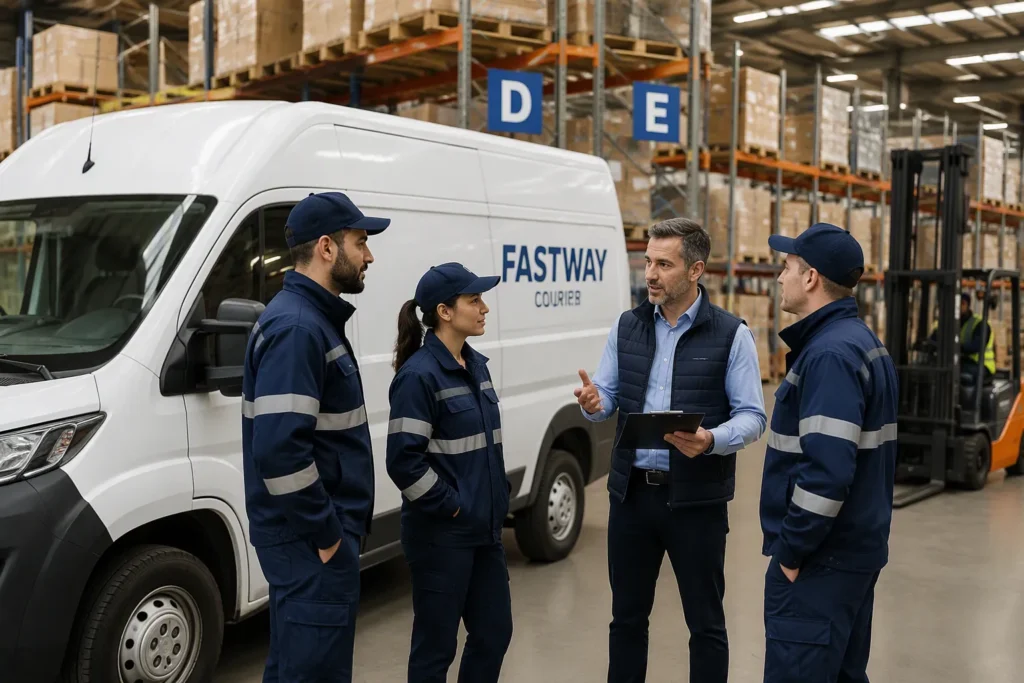
A last-mile courier uniform OEM program in China is a factory-direct arrangement. A manufacturer produces branded driver apparel to a fleet’s own specification, rather than supplying stock items from a catalog. Fleet and delivery teams gain control over design, materials, and size grading from a single production partner.
The practical stakes are clear. Cost per driver shapes the annual budget. Brand consistency on the street protects recognition. Durability under daily wear decides replacement frequency. Replenishment reliability keeps new hires dressed on schedule. Fit across mixed fleets covers every body type and role. This guide weighs the benefits and considerations of a last-mile courier uniform program for delivery operations.
Key Takeaways
An OEM program lets fleets design custom uniforms and save money by ordering in bulk.
Fleets control design and sizing to keep brand consistent across all depots.
Written quality checks and durable materials ensure uniforms last through daily wear.
The OEM process follows clear steps from sample approval to bulk production and shipping.
Fleets should plan for safety rules and use a procurement checklist for multi-depot operations.
Cost and MOQ Implications
Unit Pricing and Volume Tiers
A last-mile courier uniform OEM program in China sets a minimum order quantity of about 2,000 pieces per style. Fleets commit this volume once, at program launch. After that, reorders follow agreed replenishment packs rather than the original MOQ. This structure suits multi-depot operators who need a stable supply without holding excess stock at every site.
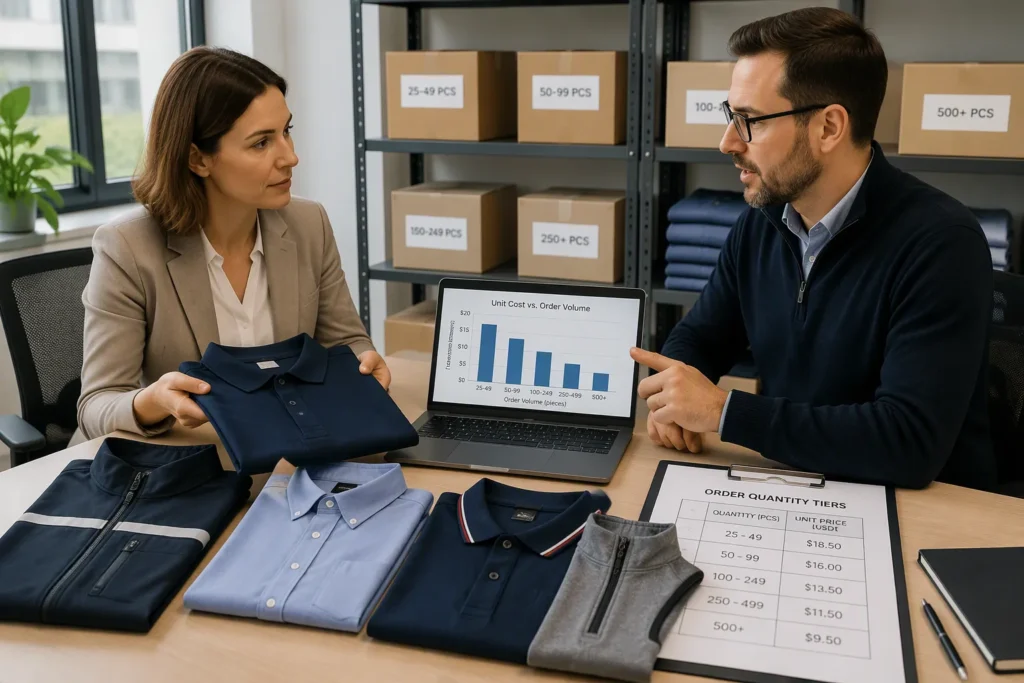
Per-unit cost falls as volume rises. Setup, sampling, and overhead spread across more units in each production run. The table below shows how order quantity tiers affect unit cost.
Order quantity tier | Unit cost impact |
|---|---|
< 500 pcs | Highest per-unit; setup cost concentrated |
Standard production run | Mid tier; standard production run |
Full production line | Lower per-unit; full production line |
> 10,000 pcs | Lowest per-unit; dedicated line time |
Multi-depot operators gain the most from planning volume at the program level. A single program-volume commitment per style covers every depot in one production run. Reorder packs then top up individual depots without restarting the setup cycle. Depot managers draw from a shared size pool instead of ordering alone. Volume tiers reward this planning discipline. A fleet that consolidates depot demand reaches a lower tier than depots buying separately. This approach keeps the per-unit price stable across the fleet and simplifies depot-level distribution.
The writer’s company may supply multiple sourcing options. Each option carries its own cost profile, and each fits a different fleet requirement. A cost-focused option suits high-turnover roles. A durability-focused option suits drivers who wear the same garment through long shifts. Buyers should compare options on total program value, not unit price alone.
Total Cost Beyond Unit Price
Unit price is built from four cost blocks: material (fabric, trim, print), labor, packaging, and overhead. Total cost divided by order quantity gives the base unit price. GSM tier, printing method, and order complexity then adjust that base figure. The factory delivers the final per-unit figure in a written quote valid for 30 days.
Fabric accounts for roughly 50–60% of factory cost. Labor adds another 20–30%. Four levers move the per-piece price: fabric type and weight (GSM), quantity tier, construction complexity, and decoration method. Extra pockets, reinforced seams, and knit cuffs add sewing time. Embroidery and print carry different setup costs.
Factory quotes vary by fabric, construction, and decoration, so fleets should request a written price per style instead of relying on catalog ranges. Basic poly and performance stretch sit in different tiers. Quotes exclude freight and duty. A fleet that mixes garment types should request a quote per style, because each style carries its own tier.
Fleet teams should budget beyond the unit price. Freight, duty, decoration, and depot-level distribution all add cost. Ask the factory for a written quote per style at the planned program volume, rather than using a smaller trial quantity as the cost model. Teams should also model replacement rates. High-wash garments wear faster, and a realistic replacement forecast prevents mid-season shortages. A program-level view also exposes hidden savings, because fewer stockouts mean fewer emergency purchases.
Customizing the Last-Mile Courier Uniform
Design Control and Brand Consistency
A program OEM approach gives fleet teams direct control over the last-mile courier uniform design. Buyers approve fabric, color, logo placement, and trim before bulk production starts. A single specification then governs every garment in the program. Drivers in different cities wear the same shade, the same logo position, and the same cut. Street recognition stays consistent across the whole network.
The core garment set covers each working condition. Custom polos form the base layer for warm months and indoor depot work. Softshell and outer layers handle cold, wind, and rain. Trousers, caps, and optional mid-layers complete the kit. Fleets can add or drop pieces per climate zone without breaking the visual system. See the jackets category for outer layers: https://www.workwearmanufacturer.com/product-category/jackets/ Softshell options: https://www.workwearmanufacturer.com/custom-softshell-jacket-oem-workwear/
Role-Based Sizing and Optional Reflective Accents
Program roles differ, and the size grading should reflect that. Drivers need a full size run with room to move. Sorters and depot staff often prefer a closer fit. Supervisors may need a distinct colorway or trim to stand out on site. A graded size run across all roles keeps every team member in a garment that fits properly.
Reflective accents work as an optional branding element. Reflective threads and tapes let a company logo glint in the dark, and the uniform becomes a mobile billboard after sunset. Fluorescent colors stand out in bright daylight, while retroreflective materials bounce light back in low light. Combined use covers both conditions. Fleets choose accents for brand presence, not as a safety claim.
Accent material | Best lighting condition | Branding benefit |
|---|---|---|
Fluorescent colors | Bright daylight | Stands out sharply against backgrounds |
Retroreflective materials | Low light | Keeps logos visible as daylight fades |
Combined use | All conditions | Reinforces brand presence day and night |
Quality Control and Durability
Setting Standards and Inspection Points
A last-mile courier uniform program lives or dies on repeatable quality. Fleet teams should agree on a written inspection plan before bulk production starts. The plan defines where the factory checks garments and what it records at each stage.
Inspection Point | Key Checks |
|---|---|
Incoming inspection | Fabric weight and width, color matching, defect identification |
Cutting inspection | Pattern alignment, size accuracy, notch verification |
In-line inspection | Stitch quality, seam alignment, construction accuracy |
Final inspection | AQL 2.5 sampling, 4-point system, measurement check, appearance review |
The factory verifies every fabric and trim before cutting. Rolls are checked for weight, width, shade against the approved lab dip, and visible faults, then grouped by shade. Cut panels are verified against the pattern for size and shade consistency within each bundle. During sewing, garments are pulled and checked for seam quality, stitch density, collar and cuff alignment, and key measurements. Decoration gets its own check: logo color against the approved strike-off, placement measured with a template, embroidered names against the list. A measurement audit follows, with finished garments from each size measured at chart points against agreed tolerances. Final random inspection draws from packed cartons and compares against the sealed pre-production sample for appearance, measurement, decoration, labels, packing, and carton marks. Inspection results are recorded and supplied with the shipment.
Materials for High-Wash Daily Wear
High-wash polos and seasonal outer layers carry the heaviest durability load. Drivers wear them shift after shift, and laundry cycles punish weak fabric fast. Material choice should follow the wash regime, not the other way around.
Material | Durability and Wash Resistance | Best Suited For |
|---|---|---|
Tough, fast-drying, shrink-resistant; holds color over hundreds of washes | High-wash polos, logistics uniforms | |
Polyester-Cotton Blends | Durable, wrinkle-resistant, good color retention with softness | Multi-purpose, frequent-movement roles |
Nylon Blends | Resists abrasion, moisture, tearing, and mildew; dries fast | Delivery workers, field crews |
Heavy Twill | Firm, holds shape, resists wear from frequent washing | Trousers and outer layers |
A 100% polyester polo suits daily wash cycles and keeps its color. A polyester-cotton blend balances softness with shape retention for mixed roles. Nylon blends fit outer layers that face abrasion and weather. Heavy twill holds a tailored shape through long hours, which makes it a strong choice for trousers and jackets. Fleets should match each garment to its wear pattern and confirm the choice on the pre-production sample.
OEM Process and Supply Chain
Inquiry to Sample to PPS to Bulk to Ship
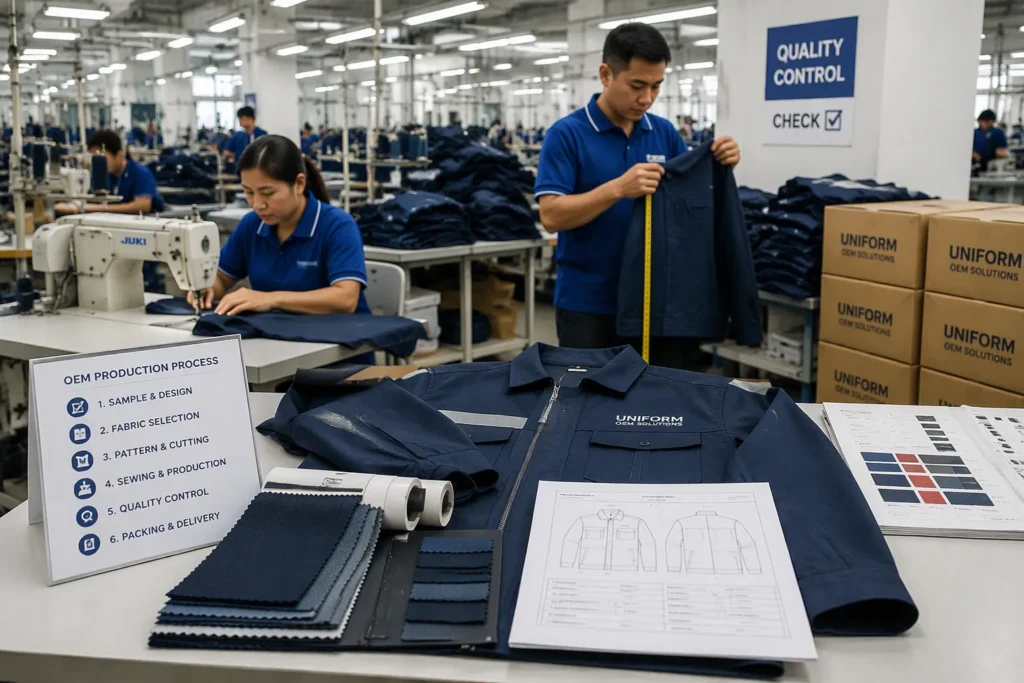
A program OEM order follows a fixed sequence. Each stage locks down details before the next one begins, which protects both the fleet and the factory.
Requirement confirmation. The buyer states product type, order quantity and size breakdown, destination country, fabric needs, color or pattern, logo and label requirements, packaging, target delivery date, and whether a pre-production sample is required.
Fabric and material selection. The factory matches fabrics to end use and climate. Options include TC ripstop, TC twill, polyester-cotton blends, stretch fabrics, and softshell. Repeat-order availability matters here.
Pattern development and sample making. The spec sheet becomes a physical sample. The buyer checks design, fit, fabric hand feel, color accuracy, trim quality, logo placement, and sewing quality. Sample lead time typically runs 2–4 weeks.
Sample approval and pre-production confirmation. Both sides confirm fabric, size chart, logo artwork, color reference, quantity by size, packaging, timeline, and payment terms in writing. This sealed pre-production sample (PPS) becomes the quality benchmark for bulk.
Bulk production. The line runs fabric preparation and incoming inspection, cutting, sewing, reinforced stitching, pocket and panel attachment, closure installation, logo and label application, inline checks, finishing, and final inspection.
Quality control before shipment. Inline inspection runs during production. Final inspection covers color consistency, measurements, stitching strength, closures, logo placement, and packing quantity, often using AQL 2.5 sampling. Third-party inspection is optional.
Packing, export, and delivery support. Packaging options include polybags, size and color labels, inner carton sorting, marked master cartons, and barcode or SKU labels. The factory coordinates packing lists, commercial invoices, and certificates of origin for customs clearance.
Shanghai Top Fortune Industry Co., Ltd. runs this process from its 1,506 m² factory in Songjiang, Shanghai. The company was founded around 2002 and handles OEM/ODM work and export. Fleet teams can review its capabilities and company background before starting an inquiry.
Catalog vs. Program OEM
Catalog buying and program OEM serve different needs. A fleet with urgent, small-volume demand fits the catalog route. A fleet building a consistent last-mile courier uniform across depots fits the program route.
Factor | Catalog buying | Program OEM |
|---|---|---|
Design control | Stock designs, limited changes | Full control of fabric, color, logo, trim |
Minimum order | Low, per-item | Program volume per style, once |
Brand consistency | Varies by stock availability | One specification across all depots |
Replenishment | Reorder the same stock item | Agreed reorder packs after launch |
Best fit | Small fleets, trial runs | Multi-depot operators, long-term programs |
A strong RFQ speeds either route. Buyers should state five variables up front: climate (hot, cold, wet, mixed), wash method (industrial laundry or home wash), logo method (embroidery, print, or patch), color reference (Pantone number), and size run (graded breakdown by role). Clear answers here reduce sample rounds and prevent bulk surprises.
Fleet teams can send these details to rill@topfortunemail.com or WhatsApp +86 13524210501. The factory address is Floor 3 Building 20 Haier Zhigu No.66 Guangfulin East Road Songjiang Shanghai 201600.
Compliance, Safety, and Fleet Integration
Safety Standards and High-Visibility Options
Safety requirements vary by market and by route. Some cities regulate what delivery riders and drivers must wear on public roads. Fleet teams should confirm local rules before they lock a design. A program OEM partner can then build the required features into the specification from the start.
High-visibility garments remain one option within a broader branded fleet apparel range. A fleet can order fluorescent or retroreflective pieces for night routes and dark-season work. Day-shift drivers may wear standard branded logistics courier uniforms instead. The program treats hi-vis as a route-based choice, not a blanket requirement. Buyers should state any mandated standard by name in the RFQ, and the factory will confirm whether it can meet that specification.
A Procurement Checklist for Multi-Depot Fleets
Multi-depot operators need a procurement plan that works across sites. The checklist below covers the points that most often cause problems after launch.
Reorder packs. Agree on fixed replenishment quantities per style and size before bulk production ends.
Size runs. Set a graded breakdown by role and depot, and review it after the first season.
Depot-level distribution. Assign each depot a stock allocation and a named contact for reorders.
Lead-time buffers. Build a buffer into the schedule for peak seasons and new-hire waves.
Corporate polo programs often anchor the base layer across all depots, which simplifies the size-run planning. A shared specification also keeps the last-mile courier uniform consistent as the network grows. Fleet teams should review the checklist with each depot manager before signing off. This step catches local gaps early and keeps the rollout on schedule.
A China-based OEM program gives fleet teams one specification, one quality benchmark, and one replenishment plan across every depot. Cost and MOQ favor operators who consolidate demand, customization covers each role and climate, and the sample-to-bulk process locks quality before production. Compliance features fit into the same specification when local rules require them.
In practice, the program turns the last-mile courier uniform into a managed supply line. Fleets gain brand consistency on the street and predictable replacement cycles.
Fleet teams should define uniform standards, size runs, and volume needs first. They can then request a quote with those details in hand.
FAQ
Does a fleet pay the minimum order quantity again on every reorder?
No. The fleet commits the program volume once, at program launch. After that, reorders follow agreed replenishment packs. This structure lets multi-depot operators top up individual depots without restarting the setup cycle or repeating the original commitment.
How long does sampling take before bulk production?
Sample lead time typically runs 2–4 weeks. The buyer then checks design, fit, fabric hand feel, color accuracy, trim quality, logo placement, and sewing quality. Both sides seal the approved sample as the pre-production standard before the production line starts.
Can each depot order its own size mix?
Yes. The program sets a graded size run by role and depot at launch. Each depot receives a stock allocation and a named contact for reorders. Depot managers draw from the shared size pool, which keeps fit consistent across the network.
When does catalog buying make more sense than a program?
Catalog buying fits small fleets, trial runs, and urgent low-volume demand. A program OEM approach fits multi-depot operators who need one specification, stable replenishment, and full design control over the long term. Each route serves a different stage of fleet growth.
What details should a fleet include in the first inquiry?
Buyers should state product type, quantity and size breakdown, destination country, fabric needs, color or Pantone reference, logo method, packaging, target delivery date, and climate. Clear answers reduce sample rounds. Fleets can send these details to rill@topfortunemail.com or WhatsApp +86 13524210501.