
Escape Room Staff Uniform OEM China | Branded Front Desk & Game Master Workwear
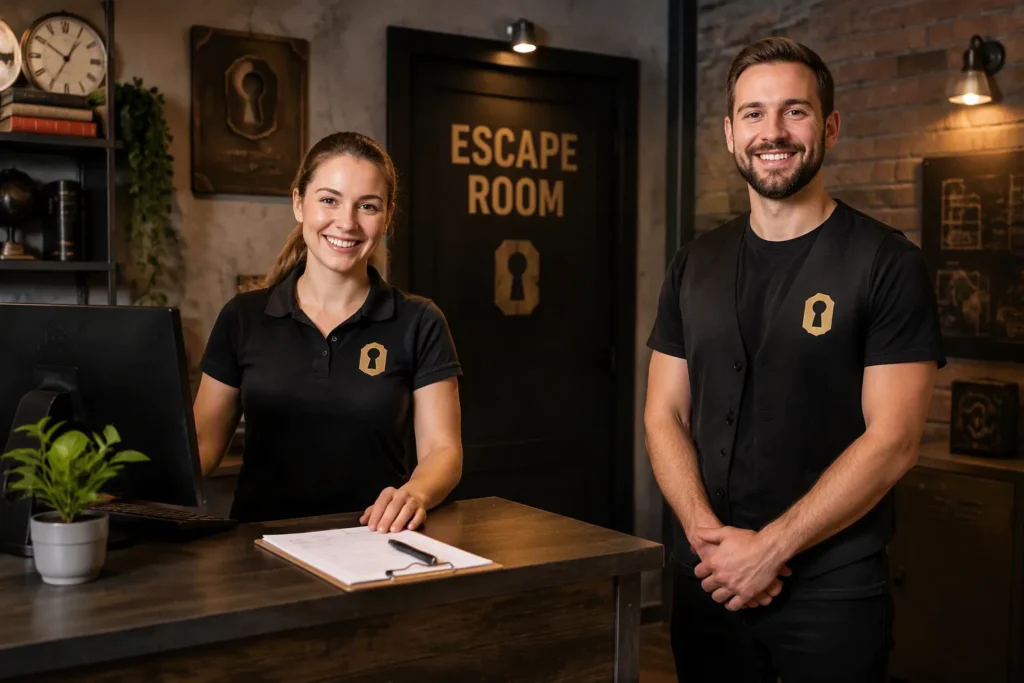
You can find trustworthy OEM manufacturers for your escape room staff uniform OEM China project. Success requires careful checking, clear details, and smart use of B2B sites like Alibaba. A third-party inspection gives extra protection.
China is popular with escape room owners for good reasons. Lower costs, many fabric choices, and strong customization options make branded workwear affordable and special.
There are real risks. Scams, uneven quality, and communication problems can ruin your order. Following safety rules is also important.
This guide gives you a simple, no-nonsense plan. You will learn to source uniforms safely and successfully.
Key Takeaways
Create a detailed tech pack with exact sizes and Pantone color codes. This plan helps factories make uniforms that match your brand.
Always ask for a real sample before you place a big order. Check the sample yourself to test for shrinking and color accuracy.
Look out for warning signs like missing safety certificates or poor communication. A good supplier provides documents and quickly answers questions.
Before you send your order, hire an outside inspector, like QIMA or SGS. This check keeps your money safe and makes sure your order is good quality.
Why Source Escape Room Uniforms from China
Cost Savings and Fabric Variety
Factories give you lower production costs and many fabric choices. Sites like Made-in-China.com and Accio.com list checked suppliers with good prices. Alibaba shows minimum order amounts from 2 to 1,000 units and prices from $5.50 to $70 per unit. This range works for small escape room teams and large chains alike.
The savings become clear at volume. For custom polo shirts from a Chinese OEM, your order size directly affects the cost.
Order size | Price per piece (USD) |
|---|---|
10–50 pieces | $5–$19 |
100 pieces or more | $3–$15 |
The exact price depends on fabric weight, fiber type, decoration amount, trims like contrast collars or custom buttons, private labeling, packaging, and quantity. A one-time setup fee per design and freight are quoted separately. You can pick from cotton blends, polyester, and moisture-wicking fabrics. This variety lets you match your escape room theme perfectly. Picking the right attire for your staff improves comfort and brand perception. Common fabric choices include 100% cotton for breathability and polyester-cotton blends for durability. Front desk staff may prefer professional cotton polos. Game masters benefit from flexible materials that allow easy movement through rooms. This flexibility makes sourcing from this region attractive for operators of all sizes.
Custom OEM Branding Options
An escape room staff uniform oem china project gives you full control over branding. Factories like China Loong Garment Limited offer sample development through to bulk manufacturing. You first send in your design files and specifications. The factory then makes a sample for your approval. This sample check makes sure logo placement, color accuracy, and sizing meet your expectations. Only after approval does bulk production begin. This process cuts down errors and guarantees your branded workwear matches your vision.
You benefit from custom oem/odm services that fit your needs. Color matching makes sure your team uniforms reflect your brand identity. Many factories use Pantone codes for accurate results. Your branding options include embroidery, screen printing, and heat transfers. You can place your logo on polos, jackets, aprons, or hats. You can add custom trims like contrasting collars or reflective stripes for outdoor roles. Picking fabrics requires attention to safety compliance. This becomes especially important for staff working outdoors during peak seasons.
Step-by-Step OEM Sourcing Process
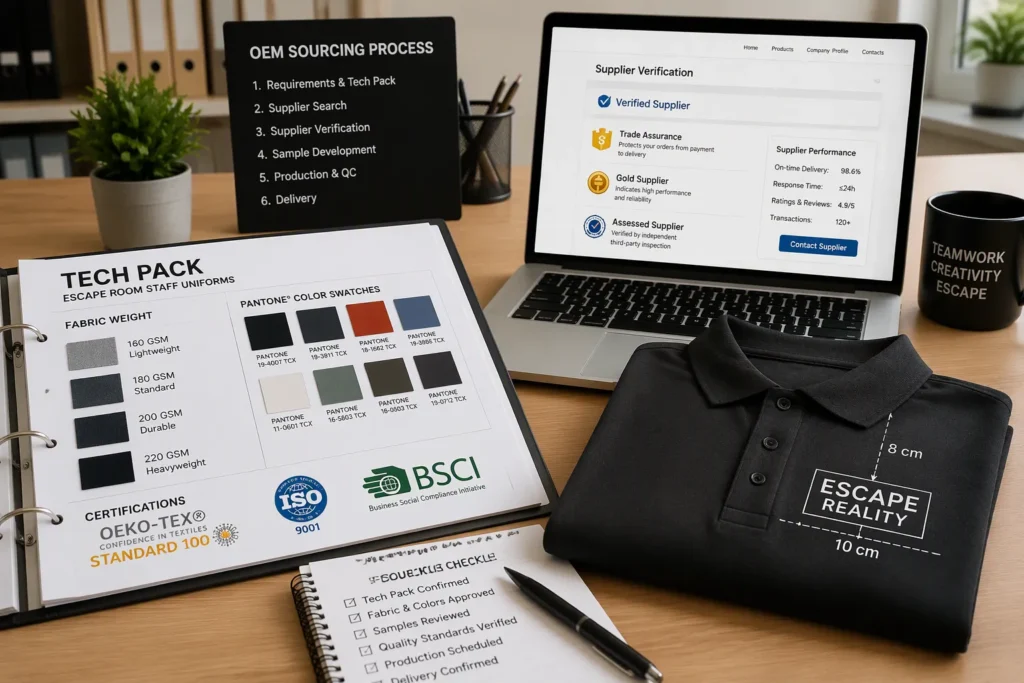
Your escape room staff uniform OEM China project has two clear steps. First, you list every detail of the clothing in a document called a tech pack. Second, you check potential factories and ask for real proof of their work. Skipping either step can cause delays, confusion, or clothes that do not fit your team.
Define Requirements and Tech Pack
A tech pack changes your idea into a plan the factory can use. You must write down every measurement for each job. Front desk staff often need fitted polos. Game masters need flexible tops that let them crouch and reach. Add the target fabric weight because it affects how long the clothes last.
Fabric Weight (GSM) | Recommended Use for Active Roles |
|---|---|
Outdoor work, frequent washing, trades (standard for durable workwear polos) | |
210 or higher | Heavy-use roles, outdoor trades, frequent washing |
Your tech pack must also say where the logo goes using exact numbers from a seam or collar. You give Pantone codes for each color. You add the certifications you need to avoid problems later. Each certification checks a different part of quality or safety. OEKO-TEX checks fabric safety. ISO 9001 shows a quality management system. BSCI covers social responsibility in making clothes. A manufacturer like HuiFang can handle these needs. It has served over 15,000 companies. They use your tech pack to make a proto sample. That sample checks fit and size accuracy before bulk production starts.
Vet Suppliers and Request Samples
You cannot judge a factory by its website alone. Start with sites like Alibaba. Check supplier trust badges like Trade Assurance and Gold Supplier. These badges show the supplier is verified on the site. After you pick a few candidates, follow a clear vetting process. This process checks every claim before you spend money.
Define your non-negotiables first. Stick to 2–3 key needs like a max MOQ of 100 pieces or OEKO-TEX certification. This focus removes bad suppliers early.
Request real production photos, not stock images. Ask for photos of your fabric lot, the sewing line working, and packed boxes with your labels. A factory that shares these shows it is open about its work.
Order a physical sample. Pay for a real pre-production sample with your fabric, trim, and wash. Wash the sample yourself to test for shrinkage and colorfastness. Never skip this step even if the factory has great reviews.
Verify contact consistency. Make sure the person who gives you the price is the same person who handles production. This one check helps coordination and cuts confusion.
Look for reliability indicators. Check for clear export terms like FCA Shenzhen. Look up the factory address on Google Maps. Confirm clear freight plans that show the supplier knows how to ship internationally.
A custom prototype costs between $150 and $500 per design. This fee covers pattern making, finding materials, and setup work. The sample fee is usually taken off the final bill when you place a bulk order.
Always use third-party inspectors like QIMA or SGS for pre-shipment checks. They check that your order matches the approved sample before it leaves the factory. This step protects your money and makes sure your order meets your brand rules and legal needs.
With a full tech pack and a tested factory, you move toward production with confidence. The next part covers common problems that can still ruin your order.
Red Flags When Choosing a Chinese Manufacturer
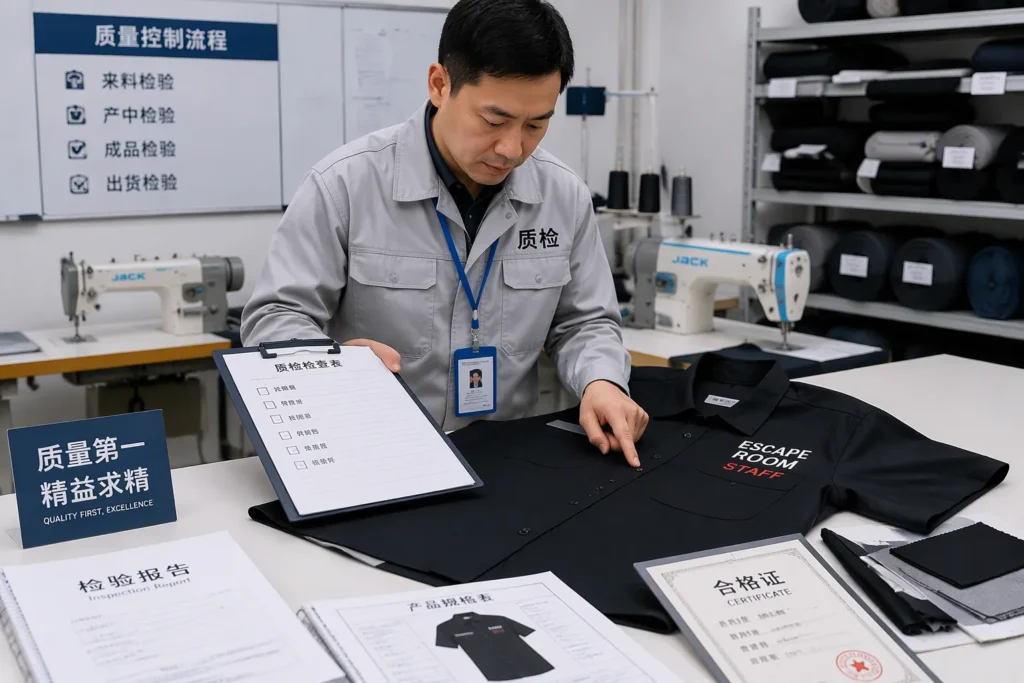
Not all suppliers are good for your business. Spotting warning signs early protects your money and your brand. Smart importers look for five red flags. These include bad communication, no references, prices that seem too good to be true, strange payment terms, and missing business papers. Knowing these patterns helps you avoid costly mistakes.
No Sample Policy or Vague QC
A factory that refuses to send a physical sample is a problem. Any real factory knows samples are normal. A custom sample costs between $150 and $500 per design. The factory takes this fee off your bulk order. If they refuse, they may not have the ability to make it or they hide quality issues.
Answers about quality control must be clear. When you ask about their check process, watch for unclear replies. Good factories share clear steps. They explain every stage from fabric check to final packing. Guangzhou Hanguang Fashion, started in 2002, shows this standard. The company has its own production with skilled pattern makers. They control every step of making. This lets them share their process with trust.
Documents tell serious suppliers apart from fakes. A real factory should give you several papers when asked. Ask for inspection reports that prove their factory meets standards. Ask for certificates that show product quality. Demand test reports for function, safety, and performance. Check for customs papers that make shipping smooth. Raw material certificates from pre-production checks prove fabric quality matches your needs. If a supplier cannot give these documents, treat that as a big warning.
Third-party checks protect your money. Companies like QIMA or SGS do pre-shipment checks. They make sure your order matches the approved sample before it leaves the factory. This step catches problems early. A supplier that fights third-party checks is hiding something. Do not accept excuses. The cost of checking is small compared to getting uniforms you cannot use.
Meeting safety rules for uniforms needs documents. Escape room staff work in many places. Some handle props while others manage outdoor lines. Certifications like OEKO-TEX show fabric safety. ISO 9001 checks quality management. BSCI covers fair labor in making clothes. A factory that cannot give you these papers makes you take a risk. Your brand depends on safe, good workwear. Do not give in on this.
Unrealistic MOQs and Poor Communication
Minimum order quantities show what a supplier can really do. Some factories offer MOQs way below normal to get orders. A price that seems too good is almost always a trap. Low prices often hide bad materials or rushed work. Compare quotes from many suppliers. If one price is much lower, check it before you commit.
Bad communication gives clear signals. Response time matters in supplier deals. According to best practices, any communication failure like a response time over 48 hours is not okay. Zero delays beyond forty-eight hours are acceptable when checking a supplier. One slow reply might be a one-time thing. Many delays show a lack of order or interest. Move on to candidates who respect your time.
Zero communication delays beyond 48 hours are acceptable when checking a supplier. Any failure needs quick attention or a new supplier.
Payment terms show what a supplier wants. Real factories ask for a fair deposit, usually thirty to fifty percent. The rest is due when they ship. Suspicious terms include asking for all money upfront or sending money to personal accounts. Use platforms like Alibaba Trade Assurance for safety. This service holds your money until you get the order and are happy.
Business papers give basic proof. A supplier that cannot share business licenses, export certificates, or factory registration papers should worry you. Check the address on Google Maps. Ask for video calls to see the factory floor. These simple steps confirm the factory exists and works at a real scale.
Write down your concerns as you check suppliers. Make a checklist of your must-haves. Mark suppliers who pass each step. Remove those who raise many flags. This step-by-step method lowers risk and helps you find a good partner. China has many great manufacturers. The trick is to find them early and filter out the rest.
Ensuring Brand Consistency Across Workwear
Your escape room staff uniform oem china project needs the same branding on every piece. Front desk staff and game masters wear different clothing styles. But your brand must look the same on each person. Fabric choice, logo placement, and color accuracy change how customers see your business. Paying attention to these details keeps your team looking unified.
Embroidery, Fabric, and Color Matching
Screen printing works well for simple logos on flat polo fronts. It puts ink right onto the fabric and makes a smooth finish. Embroidery gives a nicer look that lasts through many washes. Game master jackets and aprons work better with embroidery. The stitching holds up during active movements.
Color matching is the hardest part of staying consistent. Factories use calibrated tools to match your brand colors. They keep color difference to a Delta E of ≤2. A Delta E around 1 is the smallest difference the human eye can notice. For brand-critical colors, factories use dedicated Pantone spot inks instead of mixing from standard process colors. This approach makes sure your logo looks the same on every piece.
Element | Requirement |
|---|---|
Color standard | Calibrate every press with the G7 method to ISO 12647-2 |
Verification | Measure printed color with a spectrophotometer |
Tolerance | Hold to a Delta E of ≤2 |
Brand-critical colors | Run as dedicated Pantone spot inks |
Quality system | Approved golden sample, per-batch inspection |
Fabric selection changes color accuracy. Cotton takes in dye differently than polyester. A logo on a cotton polo may look a bit different from the same logo on a polyester jacket. Work with your factory to pick fabric blends that take color the same way. This step lowers visual differences between uniform pieces.
Sizing Charts for Front Desk and Game Masters
A shared sizing chart must cover both roles. Front desk staff need fitted polos that give a professional image. Game masters need flexible tops that let them crouch and climb. Your sizing chart must include measurements for both fit profiles. A single chart stops ordering mistakes and keeps your team looking consistent.
Factories in china handle multiple sizing standards through digital systems. They use Gerber AccuMark software with region-specific grade rules pre-loaded into a centralized database. This system lets you order uniforms that follow the correct standard for your market.
Size Standard | Region | Factory Application |
|---|---|---|
EN 13402 | European | Strict grading at master quality protocols |
ASTM D5585 | US | Region-specific grade rules for consistency |
AS 1182 | Australian | Region-specific grade rules for consistency |
Each production run gets digitally tagged by destination market. This allows automatic cutting and cross-market size correlation. You can order the same uniform style for teams in different countries.
OEM factories can also make matching reflective safety jackets for staff working outdoor queues. These jackets share the same fabric quality, brand colors, and logo placement as your main uniform. Following safety standards makes sure those jackets meet rules for visibility and durability. This keeps your brand consistent across every staff role.
Safety Workwear and Logistics for Your Order
Sourcing Reflective Safety Jackets from China
Your escape room staff might need high-visibility gear for outdoor lines or repair jobs. A trusted chinese safety jacket manufacturer can make reflective safety jackets that match your brand colors. Many safety jackets manufacturers in china have certifications for hi-vis workwear. These factories make safety jacket options that meet rules for different roles.
VizGlo Safety in Nanjing lists EN ISO 20471 among its certifications. Qualified Chinese hi-vis manufacturers can make garments for ANSI/ISEA 107 and EN ISO 20471-oriented requirements when materials, design, reflective tape layout, testing, and paperwork are properly controlled.
High visibility clothing, accept customized products. With certificates like EN ISO 20471, EN343, ANSI 107-2020, AS/NZS 1906.etc.
Chinastars has over 20 years of experience in safety clothing and reflective fabrics. The company mentions EN ISO 20471:2013, the European standard for high visibility clothing. You can order custom hi-vis workwear that meets these standards. A specialist hi-vis factory handles safety jacket manufacturing with proper compliance checks.
Manufacturer | Location | Relevant Certification / Statement |
|---|---|---|
VizGlo Safety | Nanjing, China | Lists EN ISO 20471 among its certifications |
Qualified Chinese hi-vis manufacturers | China | Can produce garments for ANSI/ISEA 107 and EN ISO 20471-oriented requirements when materials, design, reflective tape layout, testing, and documentation are properly controlled |
You can source hi-vis vests & jackets, a waterproof safety jacket, or custom safety outerwear from these suppliers. A bulk hi-vis supplier offers reflective outerwear supplier services for large orders. Specialist hi-vis factories in china make high-visibility garments for your team. You can order a hi-vis jacket or reflective jacket that fits your brand. Custom reflective jackets keep your staff safe and visible.
FOB vs. EXW and Shipping Lead Times
FOB means the seller delivers goods to your chosen port. EXW means you pick up goods at the factory. FOB gives you more protection because the seller handles export clearance. EXW puts more responsibility on you.
Typical lead times run 30 to 60 days after sample approval. Customs clearance adds time at your destination. Final-mile delivery depends on your local carrier. Plan for these steps to avoid delays.
Your action checklist keeps the escape room staff uniform OEM China project organized and on track.
Write down every detail in a full tech pack. Include exact sizes and Pantone color codes.
Check each possible supplier. Always ask for real samples before you order in bulk.
Use a third-party inspector to check quality before the items ship.
Decide on shipping terms like FOB or EXW before you pay.
This plan lowers risk at each step. With careful checking, you can find a good factory partner. China gives you lower costs and many ways to customize for your brand. Many well-known factories follow strict safety rules for fabric and quality. They make workwear that fits your theme and staff sizes.
Start your sourcing journey today with confidence. Your team deserves uniforms that show your brand in a professional way.
FAQ
What is the smallest order I can place for custom escape room uniforms?
Alibaba shows MOQs from 2 to 1,000 units. Small escape room teams can order just 10 pieces. Big chains get lower prices per unit at 100 pieces or more. Always check the MOQ before you ask for a quote.
How long do production and shipping take?
Production takes 30 to 60 days after you approve the sample. Customs clearance adds more time at your destination. Final-mile delivery depends on your local carrier. Plan your order well before your busy season begins.
Do Chinese factories give safety certifications for workwear?
Yes. Good factories offer OEKO-TEX for fabric safety, ISO 9001 for quality management, and BSCI for social responsibility. For high-visibility gear, look for EN ISO 20471 or ANSI/ISEA 107. Always ask for certificates before you place a bulk order. These papers prove compliance with international standards.
What should I check before paying a deposit?
Check that the factory has Trade Assurance or Gold Supplier status on Alibaba. Ask for real production photos, not stock images. Confirm the business license and factory address. Use third-party inspectors like QIMA or SGS for pre-shipment checks. These steps protect your money and make sure your order follows your brand rules.
Can I get a sample before I commit to a bulk order?
Yes. A custom prototype costs between $150 and $500 per design. The factory takes this fee off your final bill. Wash the sample yourself to test shrinkage and colorfastness. Never skip this step, even when reviews look great.