

Parking Garage Uniform OEM China | Attendant & Facility Staff Workwear
Table of Contents
Display
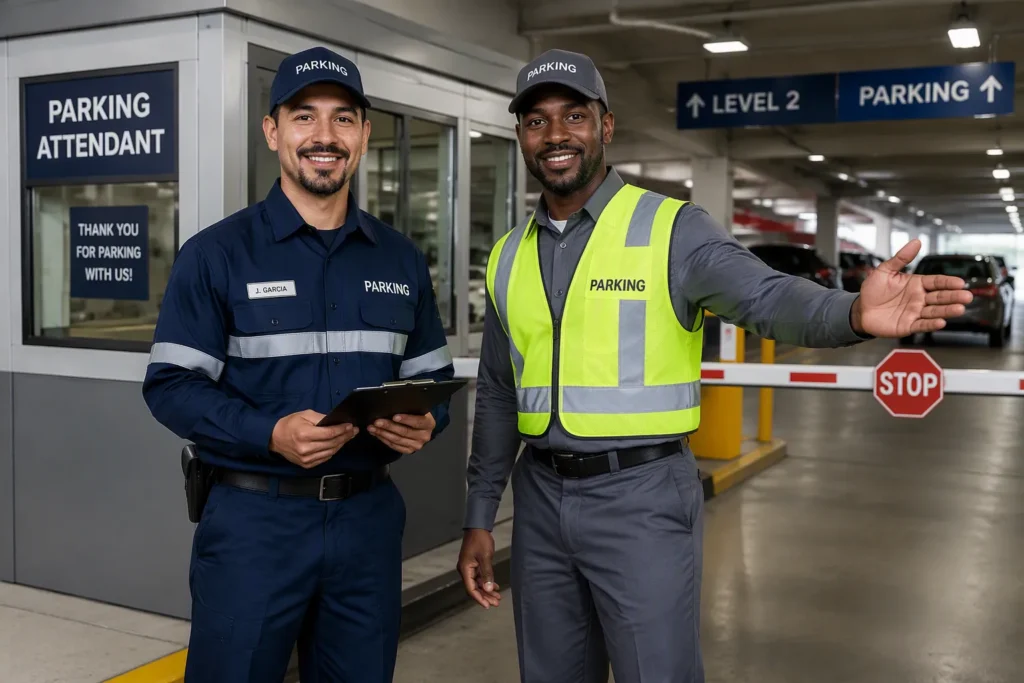
A parking garage uniform OEM China program has five main features. These are high-visibility safety parts, strong weather-resistant fabrics, comfort and function, custom branding, and tested quality. These features keep workers like attendants, cashiers, helpers, and supervisors safe. They work inside booths and outside in parking lots all year.
A qualified Chinese OEM/ODM workwear maker can provide these features, with a minimum order of about 1,000 per style.
Table of contents:
High-Visibility and Safety Features
Durability and Weather Resistance
Comfort and Functionality
Customization and OEM Options
Quality Assurance
Role Scope
RFQ Checklist
OEM Process
Standard vs. OEM Comparison
Buyer Checklist
FAQs
Key Takeaways
Bright features like reflective trim help keep your staff safe near moving cars.
Strong cloth and double stitching help uniforms last longer in bad weather.
Features like breathable fabrics and handy pockets keep staff comfortable and help them work better.
Using your own logo and colors for custom branding makes your team look professional.
Quality checks and certifications make sure your uniforms meet safety and durability standards.
1. High-Visibility and Safety Features
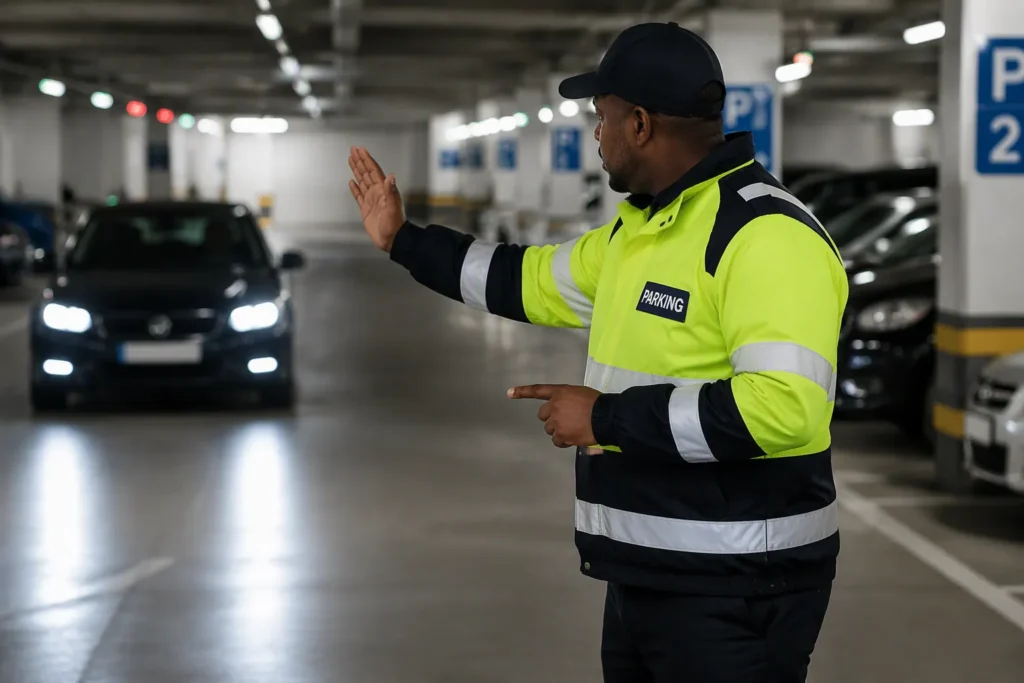
Your parking garage staff work near moving cars every day. They guide traffic when the light is low. They walk through busy lanes. High-visibility uniforms lower the chance of accidents. They keep your team safe. They also help you follow safety rules.
Reflective Trims and ANSI Compliance
Reflective trims catch headlights at night. They let drivers know staff are there. ANSI/ISEA 107 is the rule for high-visibility workwear. This rule sets three classes of protection.
Parking attendants are in Class 1 (Type O). This class needs at least 155 square inches of reflective material. Each reflective band must be at least 2 inches wide. The garment needs one horizontal band around the torso. It also needs reflective material on the shoulders or arms. Where you place the bands matters more than the amount. Bands must show a human shape to drivers.
Class | Min. Reflective Material | Min. Band Width | Traffic Speed |
|---|---|---|---|
Class 1 | 155 in² | 2 in. | Under 25 mph |
Class 2 | 201 in² | 2 in. | Above 25 mph |
Class 3 | 310 in² | 2 in. | Above 50 mph |
Class 1 (Type O) garments need one horizontal band of reflective material around the torso. Reflective material must also be on the shoulders or arms. Parking attendants are the typical use case.
Your parking garage uniform OEM China partner checks these specs. Each garment is tested against ANSI rules to ensure reflective tape placement meets the standard and stays bright after many washes.
Your team works in parking garages. They do not work on highways. Class 1 gives the right protection level. You can add reflective vests for more safety. Your OEM partner makes these features for your facility.
2. Durability and Weather Resistance
Parking garage staff deal with hard conditions every shift. They work in damp concrete buildings. They stand in open lots in rain and sun. Your uniforms must handle these challenges. A good parking garage uniform OEM China program makes clothes that last.
Reinforced work pants guard against everyday wear. Heavy-duty rain gear keeps your team dry in storms. Insulated jackets add warmth for cold morning shifts. These items make a full system for comfort all year.
Ripstop Fabrics and Reinforced Stitching
Ripstop fabric keeps tears from spreading. The weave uses thick threads at set intervals. A small rip stays small. Your uniforms last longer and need fewer replacements.
Reinforced stitching at stress points adds strength. Look for double-stitched seams at shoulders, knees, and pockets. These spots take the most abuse. Bar tacks at pocket corners stop blowouts. Your OEM partner puts reinforcement where your team needs it most.
A quality OEM partner uses ISO 9001-based quality systems and modern cutting and sewing equipment for consistent quality across every piece.
Water-Repellent Coatings and UV Protection
Water-repellent coatings shed rain and spills. A durable water repellent finish makes water bead up and roll off. Your staff stay dry in light rain. For heavy storms, pair coated shells with waterproof membranes.
UV protection matters for attendants in open-air lots. Long sun exposure damages fabric and harms skin. Choose fabrics with built-in UV blockers. These treatments reduce fading and protect your team.
Your parking garage uniform OEM China supplier applies these finishes during production. They test coating durability after repeated washes. They check UV protection levels meet your facility needs.
Ask your manufacturer about fabric options for your climate. A humid garage needs breathable waterproofing. A sunny lot needs strong UV resistance. Your OEM partner can match fabrics to your conditions.
3. Comfort and Functionality
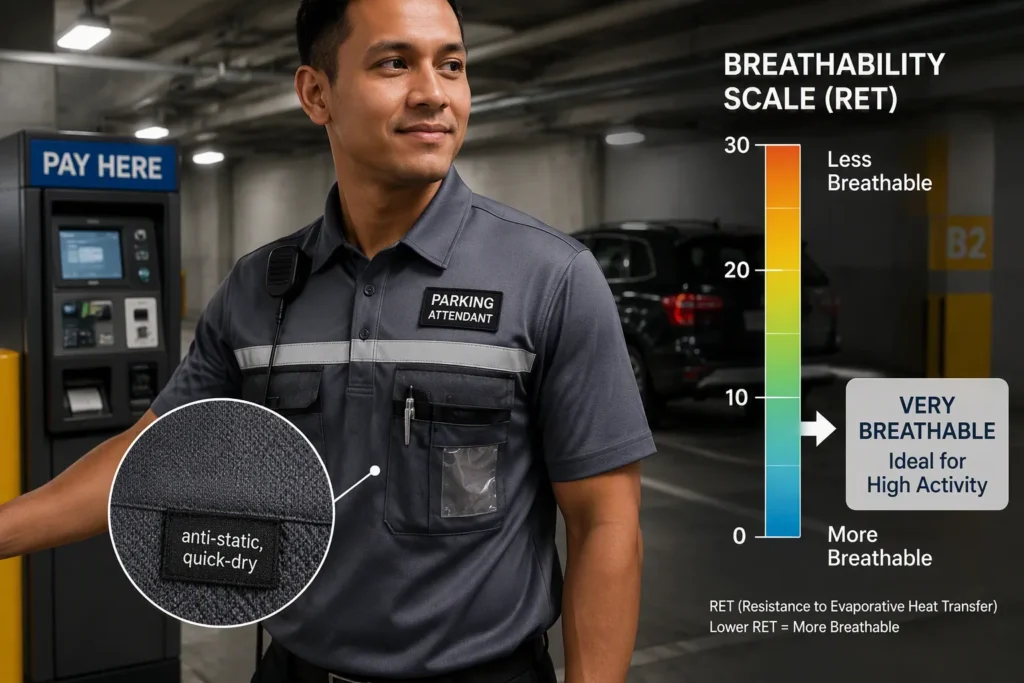
Your parking garage team wears uniforms for eight to twelve hours each shift. Comfort decides if they stay focused or get tired early. Breathable fabrics, smart design, and useful pockets turn a basic uniform into a tool your staff can trust.
Breathable Materials and Ergonomic Design
Underground garages trap heat and moisture. Your staff need fabrics that pull sweat away from the skin. Moisture-wicking materials move vapor to the surface. Soft, breathable weaves let air flow through. These features keep your team cool during long shifts.
Fabric breathability uses a measurable scale. Lower RET values mean better airflow.
RET Range (Pa·m²/W) | Breathability Level | Comfort at Activity Rate |
|---|---|---|
0–6 | Very Breathable | Comfortable for high activity |
6–13 | Good Breathability | Comfortable for medium activity |
13–20 | Average Breathability | Uncomfortable for high activity |
20–30 | Low Breathability | Okay for low activity |
30+ | No Breathability | Uncomfortable quickly |
For hot climates, aim for MVTR above 5,000 g/m²/24h, air permeability above 150 L/m²/s, and RET below 6. Air permeability testing is faster and cheaper than RET testing. You can use it as a practical stand-in when choosing fabrics.
MVTR depends on a pressure difference. If you are in a place where outside humidity is 95%, the 'push' of vapor from inside the garment to the outside becomes much weaker. In these places, mechanical venting (like pit zips) often works better than the membrane itself.
This matters for underground garages. Even good fabrics work poorly in high humidity. Ask your parking garage uniform OEM China partner for mechanical venting options like pit zips.
Ergonomic design lowers strain. Articulated sleeves let arms move freely. Gusseted crotches help staff bend and kneel. Your OEM partner can use the same approach for your full team.
Multiple Pockets and Tool Loops
Your staff carry radios, ticket rolls, keys, pens, and scanners each shift. They need pockets that hold gear safely. They need tool loops that keep hands free.
Cashiers need chest pockets for pens and badge holders. Facility helpers need deep hip pockets for tools and gloves. Supervisors need pockets for phones and notebooks. Attendants need radio loops and ticket pouches within easy reach.
Your OEM partner builds role-specific pocket layouts into every design. The minimum order is about 1,000 per style.
Reinforced pocket corners stop blowouts. Zippered pockets protect valuables. Tool loops hold flashlights and keys. These small features cut downtime and keep your team moving.
4. Customization and OEM Options
A parking garage uniform OEM China program lets you control how your team looks. You choose the fabrics, the fit, and the branding. Your staff wear uniforms that match your facility’s identity. This builds trust with drivers and visitors.
Logo Placement, Sizes, and Colors
You decide where your logo goes. Common spots are the left chest, right sleeve, and back yoke. Embroidery works great for polo shirts and jackets. Screen printing is good for lightweight vests. Your manufacturer puts logos exactly where you want them.
Size ranges need to fit every team member. Chinese OEM factories offer sizes from small to 5XL and more. You can ask for tall and petite cuts. This gives a professional fit for all body types.
Color choices are not just basic navy and gray. You can match your brand colors or choose high-visibility lime and orange. Your OEM partner shows you color swatches for approval before making the clothes. This step stops surprises in the final order.
Private Labeling and Role-Specific Designs
Private labeling lets you sell or give out uniforms under your own brand. Your company name is on the neck label and hangtag. Drivers see your brand, not the factory’s. This makes your market presence stronger.
Role-specific designs keep each team member ready. Attendants need reflective trim and radio loops. Cashiers need chest pockets and badge holders. Facility helpers need strong knees and deep tool pockets. Supervisors need clean, professional looks with light branding.
Your OEM partner can provide custom polo shirts and retail-style branding solutions.
5. Parking Garage Uniform OEM China: Quality Assurance
Quality assurance is what makes uniforms last a long time instead of falling apart early. Your parking garage uniform OEM China partner must show quality through certifications, audits, and sample testing. Do not skip this step. It protects your money and keeps your team safe.
Certifications and Factory Audits
ISO 9001:2015 is the world standard for quality management. This certification means the factory follows written procedures. It means auditors check their work on a regular basis. A quality OEM partner works under ISO 9001:2015 standards for every production run.
A factory audit shows you real manufacturing practices. You check incoming material inspection. You see size checks during cutting. You watch working tests of sample batches. These checks during production catch problems early. They stop bad uniforms from reaching your team.
Sample Testing and Production Timeline
Sample testing protects your uniform investment. You approve a pre-production sample before bulk manufacturing starts. Your manufacturer runs size checks on every garment. They verify seam strength through pull tests. They check color fastness after repeated washing. These tests prove your uniforms survive real conditions.
The production timeline follows these phases: raw material procurement (Day 1–7), tooling and golden sample approval (Day 8–15), mass production (Day 16–30) for MOQ ~1,000 per style, final assembly and packaging (Day 31–40), and balance payment and container loading (Day 41–45).
Role Scope: Attendant, Cashier, Helper, Supervisor
Your parking facility runs on four job types. Each one faces different risks and carries different tools. Attendants direct traffic and walk the lanes. Cashiers sit in booths and handle payments. Facility helpers clean, repair, and move equipment. Supervisors inspect the site and manage the team. One uniform style rarely fits all four.
Matching Uniform Features to Job Functions
Match the clothing to the daily task. An attendant needs reflective trim and a radio loop close at hand. A cashier needs a clean front, a chest pocket for pens, and a badge holder that stays visible through a booth window. A helper needs reinforced knees, deep hip pockets, and fabric that fights oil and grime. A supervisor needs a sharp look with light branding and a pocket for a phone or notebook.
Role | Priority Feature | Why It Matters |
|---|---|---|
Attendant | Reflective trim, radio loop | Works near moving cars in low light |
Cashier | Badge holder, chest pocket | Faces drivers and handles payments |
Facility helper | Reinforced knees, deep pockets | Kneels, lifts, and carries tools |
Supervisor | Clean branding, document pocket | Inspects the site and meets visitors |
Your parking garage uniform OEM China partner builds these differences into one order, with a minimum order of about 1,000 per style.
Layering and Seasonal Variations
Layering keeps your team comfortable all year. Start with a moisture-wicking base layer for hot summer shifts. Add a breathable polo or shirt for spring and fall. Top it with a water-repellent shell or an insulated jacket for winter. Each layer works alone or together.
Seasonal swings hit open-air lots hardest. Summer demands UV protection and quick-dry fabrics. Winter demands insulation that does not bulk up the arms. Your OEM partner can supply a matching layering system so every role stays covered.
RFQ Checklist for Parking Garage Uniform OEM Buyers
A good RFQ saves you time and money. It tells your parking garage uniform OEM China partner what you need. You get correct quotes faster. You avoid expensive changes later.
Essential Specifications to Include
Begin with the fabric type. State the fiber blend, weight, and finish you want. Ask for moisture-wicking, anti-static, or water-repellent choices. List your size range from small to 5XL. Add tall and petite cuts if your team needs them.
Color is important for branding and safety. Give your OEM partner Pantone numbers or real swatches. Explain logo placement in detail. The left chest, right sleeve, and back yoke are common spots. State your quantity for each style and size. Mention any certifications you need, like ANSI/ISEA 107 for high-visibility garments or ISO 9001:2015 for quality systems.
Questions to Ask Your China OEM Partner
Ask these questions before you place an order:
Is your production capacity enough for my order volumes, both now and later?
What is your usual lead time, and are you open about capacity limits?
Do you offer fast turnaround times for urgent orders?
Can you do mid-production inspections around day 25 to catch defects early?
What are your packaging standards and final AQL inspection timeline?
Learn their production schedule in phases. Raw material procurement takes Day 1-7. Ask if they keep inventory or order after your deposit. Tooling and golden sample approval runs Day 8-15. Mass production happens Day 16-30. Final assembly and packaging occur Day 31-40. Balance payment and container loading finish Day 41-45.
OEM Process: From Design to Delivery
A clear process keeps your parking garage uniform OEM China order on track. You go through eight stages from first contact to final shipment.
Talk about needs — product type, market, quantity, use
Suggest material and style — fabric, color, tape layout, sizing
Give a quote — product cost, logo cost, packaging, delivery time
Make a sample — fabric, fit, logo, reflective tape, work quality
Approve the sample — final OK before bulk production starts
Run bulk production — cutting, sewing, branding, line control
Inspect quality — size, stitching, tape, logo, packaging
Pack and ship — carton marks, size sorting, delivery plan
Design Consultation and Sampling
You start with a design talk. Your OEM partner asks about your facility, your team roles, and your safety needs. They suggest fabrics, colors, and reflective tape layouts. You look at a quote that covers product cost, logo cost, packaging, and delivery time.
Sampling comes next. The factory makes a pre-production sample with your fabric, fit, logo, and reflective tape. You check the workmanship and approve the sample before bulk production begins.
Bulk Production, QC, and Shipping
Bulk production starts after you approve the sample. The factory cuts, sews, and brands your order under line control. Quality control runs through the whole process, not just at the end.
QC is not a final check or one-time task. Instead, it should be part of the entire product journey: during design and prototyping to check if it can be made, during production with in-process checks and statistical sampling to watch consistency across many units, and after production through final inspection and functional testing to confirm performance and durability before it reaches the user.
![Bar chart showing the number of specific quality control checkpoints for each category in high-visibility uniform production.] (https://statics.mylandingpages.co/static/fact/41c020f86eed46feaa0b6f620d1ca0de/chart_1789684549922776045.webp)
QC Checkpoint Category | Specific Checkpoints |
|---|---|
Fabric | Fabric color, fabric weight |
Reflective Elements | Reflective tape position |
Construction | Stitching, zippers, buttons |
Branding | Logo position |
Sizing | Size measurement |
Labeling & Packaging | Labels, packaging |
Final Output | Final inspection |
Communication tips help you work smoothly with Chinese OEM manufacturers. Confirm every spec in writing. Ask for mid-production photos. Request a pre-shipment inspection report before you release final payment.
Comparison: Standard vs. OEM Custom Uniforms
Off-the-shelf workwear looks cheap at first. You buy it today and hand it out tomorrow. That speed feels good. Then the seams split, the colors fade, and your team looks like a mix of strangers. A parking garage uniform OEM China program costs more upfront. It pays you back through longer garment life and a sharper brand image.
Cost, Durability, and Branding Trade-Offs
Standard uniforms carry a low unit price. You order from a catalog and accept the sizes and colors on the shelf. The trade-off shows up fast. Generic fabric wears thin at the knees and elbows. Sizing runs narrow or short, so your staff roll up sleeves or leave jackets open. Your logo goes on as an afterthought, often as a cheap iron-on patch that peels.
OEM custom uniforms flip that equation. You pay for the right fabric, the right fit, and the right branding from the start. Reinforced stitching and ripstop weaves extend wear life. Your logo sits exactly where you want it, stitched to last. The table below shows the core differences.
Factor | Off-the-Shelf | OEM Custom |
|---|---|---|
Unit cost | Lower upfront | Higher upfront |
Durability | Basic seams, thin fabric | Reinforced, task-matched fabric |
Branding | Generic or iron-on | Embroidered, placed to spec |
Fit | Fixed size chart | Sizes to 5XL, tall and petite cuts |
When to Choose OEM Over Off-the-Shelf
Choose OEM when your team works hard and your brand matters. Parking garages and facility management companies fit that profile. Your attendants walk traffic lanes every shift. Your cashiers face drivers all day. Cheap uniforms fail these roles fast.
OEM makes sense when you need role-specific features. Reflective trim for attendants, badge holders for cashiers, reinforced knees for helpers. Off-the-shelf cannot match that. OEM also wins when you run multiple locations and want one consistent look. A quality OEM partner builds these programs with a minimum order of about 1,000 per style.
Buyer Checklist: Selecting the Right OEM Partner
Factory Capabilities and Communication
Pick a partner who can really make what you need. Visit the factory or ask for a video tour. Look for CAD/CAM patterning, laser cutting, and automatic sewing. These tools keep quality the same across 1,000 pieces. Ask about their quality system. A real ISO 9001:2015 certification means they follow written rules and pass regular checks.
Communication decides how smooth your order will be. Check their response speed before you pay a deposit. Send a detailed question about fabric or sizing. See how fast they reply and how clear their answer is. A partner who answers in hours is better than one who answers in days.
MOQ, Lead Times, and After-Sales Support
Know the numbers before you agree. A parking garage uniform OEM China program usually needs at least 1,000 pieces per style. Confirm this early. Ask about lead times in steps, not just one number. Fabric sourcing, cutting, sewing, and final QC each take their own time. Get the full schedule in writing.
After-sales support protects your investment. Ask these questions:
Checkpoint | What to Confirm |
|---|---|
Defect policy | Get replacement or credit terms for bad units |
Reorder speed | Time to reorder the same items |
Size exchanges | If they help with sizing problems |
Contact person | A specific person to contact |
A strong partner answers all four without delay.
You now know the five features that make a strong parking garage uniform OEM China program: high-visibility safety, weather resistance, comfort, custom branding, and tested quality. Put these features first. Your team works better, garments last longer, and your brand looks sharper.
Ready to begin? Contact a trusted OEM partner for a quote, sample request, or design consultation. Explore their facilities management, airport ground crew, hotel, retail, and custom polo uniform solutions. A dependable OEM partner builds uniform programs that grow with your facility for years.
FAQ
What is the minimum order for a parking garage uniform OEM China program?
Most Chinese OEM factories ask for a minimum order of about 1,000 pieces per style. You can mix sizes within that style. Plan your order well so you meet this number.
How long does production take for a custom parking garage uniform order?
Plan for 45 days in total. Raw material procurement takes Day 1–7, tooling and sample approval Day 8–15, mass production Day 16–30, final assembly and packaging Day 31–40, and container loading Day 41–45. Get your timeline in writing before you pay a deposit.
Can I add reflective trim and my company logo to the same uniform?
Yes. Your OEM partner adds reflective trim where you say. They put your logo on the chest, sleeve, or back. Both features work together with no problem. State your exact placement and Pantone colors in your RFQ.
What fabrics work best for parking garage staff in hot and humid conditions?
Pick moisture-wicking fabrics with high air permeability. Look for quick-dry and anti-static finishes. For underground garages, ask about mechanical venting like pit zips. These features move heat away from your team during long shifts. Your OEM partner matches fabrics to your climate.
Do Chinese OEM manufacturers offer plus sizes and tall cuts?
Yes. Good factories offer sizes from small to 5XL and beyond. You can ask for tall and petite cuts for a professional fit. Include your full size range in the RFQ. This step stops fit problems after bulk production starts.
How do I verify quality before my parking garage uniforms ship?
Ask for a pre-production sample first. Approve it before bulk manufacturing begins. Request mid-production photos around day 25. Get a pre-shipment inspection report before you release final payment. A quality OEM partner follows ISO 9001:2015 quality systems for every production run.