

Moving Company Uniform OEM China | Crew & Warehouse Staff Workwear
About Shanghai Top Fortune Industry Co., Ltd.
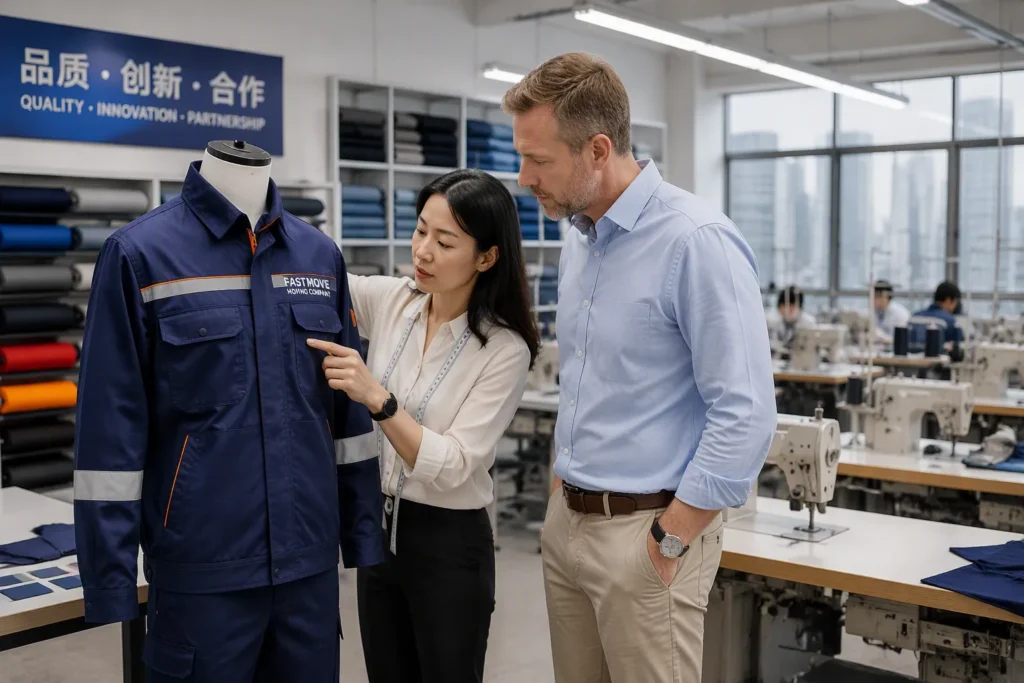
Shanghai Top Fortune Industry Co., Ltd. has served the uniform industry since around 2002. Our 1,506 m² Songjiang facility supports OEM and ODM workwear development for adult moving crews, truck teams, warehouse packers, dispatch staff, and supervisors. Typical programs start at an MOQ of about 1,000 pieces per style. We can develop durable polos, jackets, cargo trousers, and buyer-specified reflective accents for professional relocation teams. Request a quote at rill@topfortunemail.com or WhatsApp +86 13524210501. Our Haier Zhigu address supports coordinated sampling and production follow-up.
For related sourcing requirements, see our warehouse uniform OEM manufacturer China, logistics courier uniform OEM China, cold storage logistics uniform OEM China, custom polo shirt OEM manufacturer China, and industrial maintenance uniform OEM China resources:
Moving Company Uniform RFQ FAQ
Tell us the adult crew roles, size range, fabric and color requirements, logo files, delivery country, and target schedule. We will confirm sampling, pricing, MOQ, and production lead time for your moving-company uniform RFQ.
The single most important factor is verifying the manufacturer’s credibility and proven experience with moving company uniforms. Your uniforms need reinforced seams for heavy lifting, moisture-wicking fabrics, reflective strips for safety, and durable branding that survives frequent washing. A manufacturer with relevant experience understands these needs and maintains reliable quality control. A moving company uniform OEM China partner that specializes in workwear will deliver those features consistently. You must define your specifications, research suppliers, negotiate terms, and implement quality checks. Investing time upfront prevents costly mistakes later.
Key Takeaways
Define uniform specifications first. Include durable fabrics, safety features, and precise branding details.
Research manufacturers on B2B platforms, at trade shows, or through sourcing agents. Verify certifications and request samples.
Negotiate clear terms for minimum order quantity, pricing, and lead time. Use sampling and inspections to ensure quality.
Build a long-term relationship with your manufacturer. Document all specifications and visit the factory when possible.
Start early and invest time upfront. This prevents costly mistakes and ensures consistent quality.
Define Your Moving Company Uniform Specifications
Start with your specifications before you contact any supplier. A clear specification sheet prevents defects, delays, and extra costs. Your spec sheet acts as a blueprint for the manufacturer. Every measurement, fabric type, and stitch detail must be documented.
Key Fabric and Design Needs for Movers
Movers need fabrics that handle heavy lifting and frequent washing. Two common options show different tear strengths:
Fabric Type | Tear Strength (ASTM D1424) |
|---|---|
Cotton Duck Canvas (standard cotton blend) | 10 lbs force |
Ripstop (nylon/poly-cotton) | 15 lbs force |
Ripstop provides 50% greater tear strength than standard cotton canvas. This makes ripstop a better choice for uniforms that face daily wear and tear. Cotton blends offer comfort but tear more easily under stress.
Moisture-wicking fabrics keep workers cool during physical labor. Look for polyester-cotton blends that pull sweat away from the skin. This feature matters for crews working in hot warehouses or outdoor conditions.
Safety requirements demand reflective elements. High-visibility workwear must comply with ANSI/ISEA 107 standards. This regulation defines design requirements and performance classes for hi-vis garments. OSHA standards also govern workplace visibility. When you select reflective strips for your uniforms, understand these ANSI types and classes.
Branding needs precise specifications. Define logo embroidery placement, thread colors, and stitch density. Provide Pantone codes or physical color swatches for accurate color matching. This prevents mistakes during production.
Match Your Order to OEM, ODM, or CMT
Three factory models serve different needs. OEM means you provide exact specifications and the manufacturer produces your design. ODM means you choose from pre-designed options and customize colors or logos. CMT means you supply the fabric and trims while the factory cuts, makes, and trims the garments.
OEM works best for established moving companies with specific uniform requirements. You control every detail from fabric to branding. CMT suits larger orders where you source fabric directly. ODM works for smaller quantities or first-time buyers testing the market.
A comprehensive tech pack is essential for OEM orders.
A comprehensive tech pack specifying garment measurements, construction methods, seam types, stitch density, fabric composition, color standards, trim specifications, labeling, artwork placement, packaging, testing, and quality tolerances acts as an engineering blueprint. Any ambiguity must be clarified before sampling to prevent minor interpretation errors from affecting the final product.
When you work with a moving company uniform OEM China partner, locked specs drive sampling and bulk production. Your documented requirements guide every stage. This keeps the final product matching your design intent.
Sourcing a Moving Company Uniform OEM in China
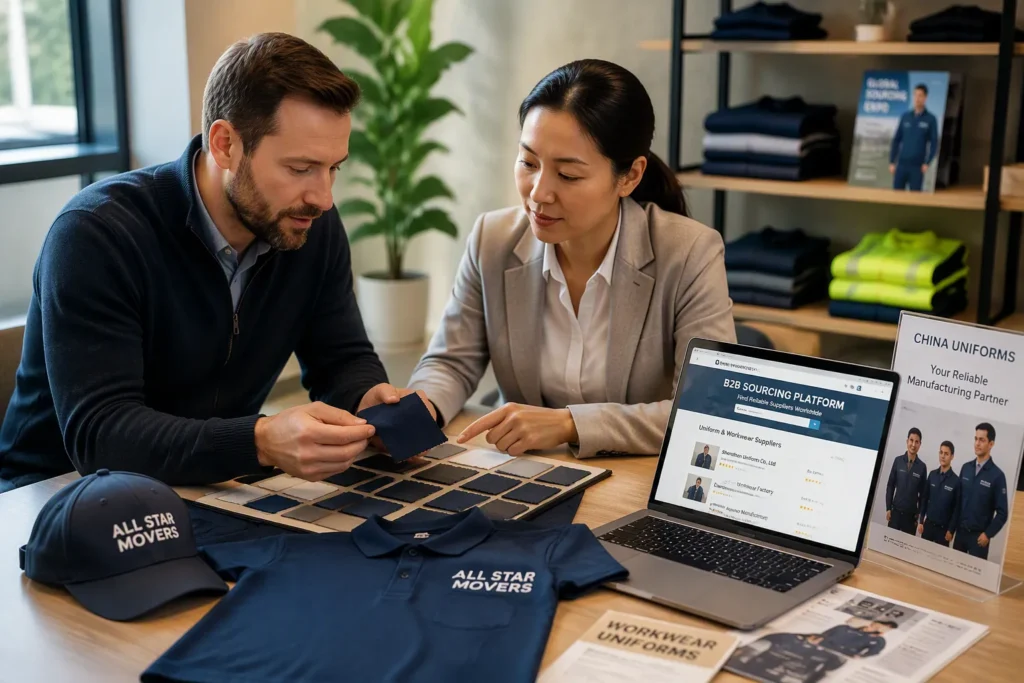
Finding the right uniform maker takes research. You have several paths to locate suppliers. Each option carries distinct trade-offs between cost, time, and risk.
Research Platforms, Trade Shows, and Sourcing Agents
B2B platforms like Alibaba and Made-in-China remain the most common starting points. Alibaba lists thousands of verified suppliers. You can filter by certifications, transaction history, and customer reviews. Look for Gold Supplier badges and Trade Assurance coverage. These indicators show the factory has passed third-party verification. Search for keywords like “workwear OEM” or “moving uniforms.” Made-in-China.com offers similar features with a strong focus on garment manufacturers. Global Sources provides another alternative with higher factory vetting standards.
Trade shows allow face-to-face vetting. The Canton Fair in Guangzhou is the largest. It runs twice each year in spring and autumn. You meet factory owners directly. You inspect fabric samples in person. This builds trust faster than online chats. Trade show visits also reveal production scale and quality standards. You see what a factory can actually produce. Many moving company owners find their long-term partners through these events.
Industry referrals carry significant weight. Ask other moving company owners for their manufacturer contacts. A recommendation from a trusted peer reduces your research time. It also lowers the risk of dealing with an unreliable factory.
Sourcing agents bridge the gap between you and Chinese factories. A Western agent with Chinese connections handles factory vetting, price negotiation, and quality checks. The cost savings compared to direct sourcing are substantial:
Cost Component | Direct from Factory | With Sourcing Agent |
|---|---|---|
Unit price (ex-works) | USD 3.00 | USD 2.40 |
Product subtotal (1,000 pcs) | USD 3,000 | USD 2,400 |
Agent fee (5%) | USD 0 | USD 50 |
Quality control inspection | USD 0 (none) | USD 0 (included) |
Freight | USD 1,100 | USD 650 |
Defect / rework reserve | USD 450 (15% defect rate) | USD 75 (3% after inspection) |
Your time (40 hrs × USD 50/hr) | USD 2,000 | USD 250 |
Total landed cost | USD 6,750 | USD 3,525 |
Total savings reach USD 3,225 on a 1,000-unit order — about 47.8% less. Agents typically secure 10–25% better pricing than foreign buyers negotiating alone. Their 3–8% fee becomes a net saving after factoring in lower unit prices and fewer defects.
Choosing a Reliable Moving Company Uniform OEM China Partner
Vetting separates professional factories from unreliable ones. Start with certifications. Priority goes to manufacturers with ISO 9001 quality management systems, BSCI or Sedex social audits, and OEKO-TEX STANDARD 100 textile safety certification. Verify each certificate through official platforms. Use IAF CertSearch for ISO 9001 checks. Use the Amfori BSCI platform for social audit verification. Use OEKO-TEX Label Check for textile safety certificates.
Different manufacturer types carry different certification profiles:
Manufacturer Type | Typical Certifications to Verify |
|---|---|
Business jacket/trouser/uniform makers | ISO-type QMS, export compliance (confirm) |
Men's suit/shirt/trouser makers | ISO 9001, BSCI/Sedex |
Multi-category apparel makers | OEM-level audits, ISO where available |
Woolen and workwear specialists | Material safety (OEKO-TEX) and ISO |
B2B-platform suit makers | Platform-verified docs; ISO/BSCI vary |
Request factory audits or third-party inspection reports. A legitimate moving company uniform OEM China partner welcomes these checks. Ask for client references and contact them. Inquire about on-time delivery rates and defect handling processes. Ask how they handle defective batches. Professional factories have clear procedures for rework or replacement.
Always request samples before bulk production. Samples reveal fabric quality, stitch consistency, and color accuracy. Test wash the sample at least three times. Check for shrinkage, seam splitting, and logo fading after each wash. A factory that delivers poor samples will not improve during bulk production. Reject any factory that asks you to skip sampling.
Communication reliability matters. Work with factories that assign an English-speaking account manager. Response times under 24 hours indicate good service. Delayed or vague replies signal potential problems. Set up weekly video calls during sampling and production. This keeps you informed and builds the relationship.
Finding the right moving company uniform OEM China partner takes effort. The payoff is consistent quality and competitive pricing. Each factory you vet brings you closer to a reliable production partner.
Negotiate Terms and Control Quality
Set Clear MOQ, Pricing, and Lead Time Agreements
Start negotiations with minimum order quantities. According to Renrui Textile, a Chinese OEM custom uniform manufacturer, the MOQ for custom uniforms is 100 pieces per color when the factory dyes the fabric to your specified color. Within that 100-piece minimum, you mix sizes freely without any size multiplier. This MOQ works well for moving companies launching a new uniform program or testing a new design.
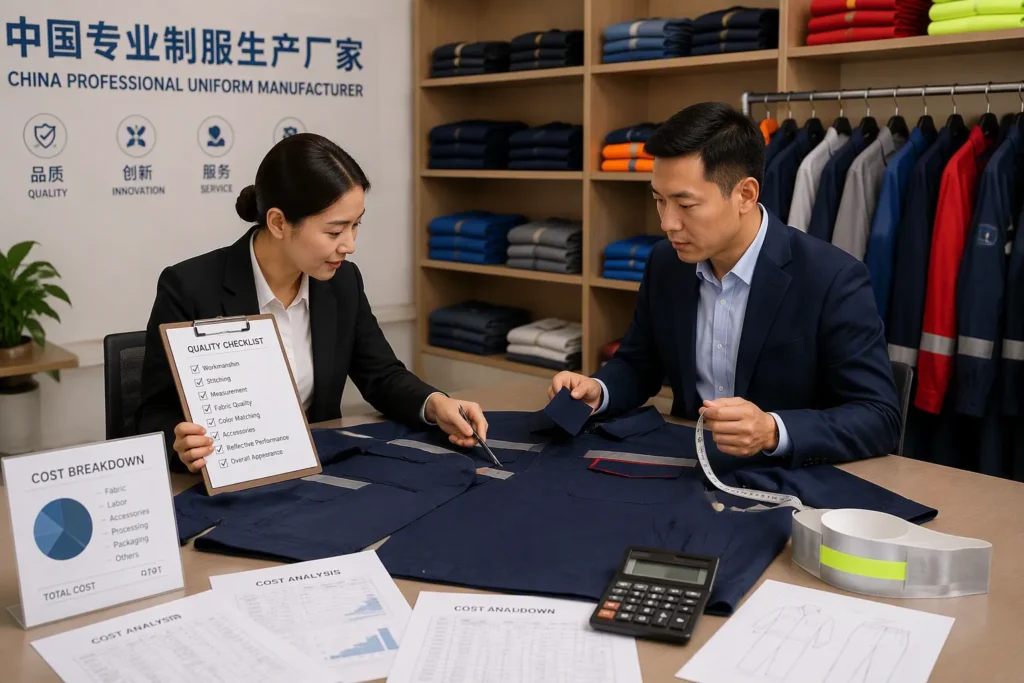
Request a full cost breakdown from each moving company uniform OEM China partner. Ask for separate line items for fabric, labor, trims, and shipping. Fabric cost usually represents the largest portion. Labor costs vary based on construction complexity. Reflective strips and reinforced seams add production time. Payment terms typically use T/T with a 30% deposit and 70% balance before shipment. L/C works for orders over $10,000. Lead times range from 45 to 60 days from sample approval. Order early to avoid gaps in coverage.
Use Sampling and Inspections for Consistent Quality
Order a pre-production sample before bulk production begins. Demand the sample comes from the actual production line, not a controlled sample room. The factory must use exact production materials, not hand-selected premium batches. Material discrepancies caught at this stage cost nothing to fix. After production runs, those same discrepancies cost thousands to rework. Hold a signed reference sample on your side. This sample anchors quality expectations for every future order.
In-process inspections catch defects before they compound. Inline QC during sewing prevents bulk defects and shipment rejection. QC checks stitch quality, seam strength, and panel alignment while operations run. Immediate correction prevents hundreds of defective pieces. Common inline checks cover seam slippage tests, fabric defect checks for knots and holes, color shading verification, and size consistency measurement. Manual end-of-shift quality reporting creates a blind spot. By the time you log an issue, dozens or hundreds of nonconforming parts may already exist. Real-time checksheet data collection surfaces quality deviations as they occur, enabling immediate intervention before scrap compounds.
This shift from end-of-line inspection to in-process control keeps factories competitive. When defects are found early, rework cost drops, production flow stays stable, and shipment risk reduces significantly.
Schedule a final inspection before shipment. Third-party inspection services cost $250 to $350 per man-day in China. TradeAider offers an all-inclusive rate of $199 per man-day with no hidden fees. Specialized lab tests for flame resistance or tensile strength add $150 per batch. This small investment prevents receiving a shipment full of defects.
Build a long-term relationship with your manufacturer. Document every specification in writing. Cover material grades, thread colors, hardware finishes, lining weights, and stitching density. Visit the factory during production when possible. Boots-on-ground verification catches deviations before they scale. A factory that knows you will return for repeat orders invests more in your quality. Consistency improves with each order.
Your success depends on three core steps. First, define your uniform specifications with durability, safety, and branding priorities. Second, research and vet manufacturers through platforms, sourcing agents, and sample reviews. Third, negotiate transparent terms and implement quality control at every stage. Credibility and proven experience with moving company uniforms form the foundation of success. A moving company uniform OEM China partner with a strong track record delivers consistent results.
Start early. Request samples from shortlisted manufacturers. Invest time upfront to avoid costly mistakes. Professional uniforms build your company’s image and reputation. They show customers you value quality. Your crew represents your brand on every job. Choose a partner who helps you look your best.
FAQ
What is the minimum order quantity for custom moving company uniforms?
You can order as few as 100 pieces per color. Within this minimum, you mix sizes freely with no extra charge. This works well when you launch a new uniform program.
How do I verify a factory’s certifications?
You can check ISO 9001 on IAF CertSearch. Use the Amfori BSCI platform for social audits. Use OEKO-TEX Label Check for textile safety. A reliable manufacturer welcomes this verification.
How long does production usually take?
Production takes 45 to 60 days after you approve the sample. Order early to avoid gaps in your uniform supply. Lead times vary with order complexity and factory workload.
What payment terms should I expect?
Most factories ask for a 30% deposit upfront. You pay the remaining 70% before shipment. For orders over $10,000, you can use a letter of credit.
Should I hire a sourcing agent?
Yes, if you want to save money. An agent can cut your total cost by nearly 48%. They handle factory vetting, price negotiation, and quality checks. This saves you time and reduces defects.