

Electronics Assembly Uniform OEM China | ESD-Aware Production Apparel
Shanghai Top Fortune Industry Co., Ltd. supplies OEM/ODM workwear for adult electronics assembly teams in China. For production operators, SMT support staff, PCB handling support, QC inspectors and supervisors, the right uniform program balances movement, identification, wash durability and buyer-defined process controls. This guide is for adult B2B production staff only—not school or children’s apparel.
Buyer intent and scope
Electronics plants often need a repeatable apparel system for line operators, incoming and outgoing QC, engineering support, material handlers and shift supervisors. A practical uniform can be a work shirt, coat, smock, trousers or a coordinated set. It should fit the work zone, badge system, climate and laundering route. It is not automatically ESD PPE or cleanroom PPE. Buyers must name the applicable IEC, ANSI, customer or site standard and request evidence, testing and validation for any ESD or cleanroom requirement.
Table of contents
Role and zone scope
2. Fabrics and ESD-aware specifications
3. RFQ information table
4. OEM process
5. Catalog versus custom
6. Buyer checklist2. Fabrics and ESD-aware specifications
Common starting points include polyester/cotton blends for wash durability, polyester-rich woven fabrics for dimensional stability, and lightweight twill or poplin for warm production floors. Confirm fabric weight, weave, colorfastness, shrinkage tolerance, seam construction and trim with samples and the buyer’s laundering instructions.
ESD-aware does not mean certified. A garment should not be described as ESD-certified, antistatic PPE or cleanroom-certified by default. If a buyer needs ESD control, the buyer should name the required IEC, ANSI or customer standard, resistance range, test method, environmental conditions, grounding approach, footwear and complete workstation controls. For cleanroom use, the buyer must name the cleanliness class, particle or lint limits, packaging, laundering and evidence required. We can quote a buyer-defined specification and coordinate sample testing, but performance claims require agreed documentation and approval.
Useful design details include covered snaps, low-profile zips, rounded pocket corners, reinforced stress points, secure badge loops and consistent logo placement. Avoid loose dangling features near equipment.For an accurate RFQ, send role quantities by size, a size chart or wearer measurements, artwork, color references, pocket and closure requirements, wash and packaging instructions, destination, required date and any named ESD or cleanroom standard. Identify whether garments are dedicated to one zone, shared across shifts or returned through an approved laundry.
OEM process
First, send the brief to Shanghai Top Fortune Industry Co., Ltd. We review the role map, zones, quantity, artwork, fabrics, trim and buyer-named standards. Second, we recommend a catalog base or prepare a custom direction and confirm the measurement chart. Third, we develop a sample for fit, color, pocket placement, branding and construction review. Fourth, the buyer approves the pre-production sample and any requested evidence or testing plan. Fifth, bulk production proceeds with agreed inspection, packing and shipping documents. Finally, repeat orders use the approved style, BOM, grading and artwork so the program remains consistent.
A written approval should cover color, logo scale, label content, size tolerances, carton marks, folding, polybagging and release criteria. If a standard is required, record who supplies the method, what is tested and which report is accepted. Do not rely on a generic “ESD” label without a buyer-approved specification.5. Catalog versus custom
A catalog base is efficient when the team needs a proven silhouette, standard colors and a faster sample decision. It can still accept logo placement, labels, color accents and selected pocket changes, subject to feasibility. Custom development is better when the buyer needs a unique fit block, a specific zone color system, special closures, a defined fabric, integrated identification or a documented technical requirement. Custom work normally needs more sample rounds and a clear approval record.
The best route is often a controlled adaptation: start with a workwear base, then change only the features that matter to the electronics process. This reduces unnecessary complexity while leaving room for buyer-defined ESD-aware or cleanroom-related controls.
Before approval, confirm that the program is for adult electronics production staff; role and zone quantities are separated; fabric, weight, color and laundering route are recorded; pockets and closures are suitable for the equipment; badge and logo locations are approved; the size chart and tolerances are signed off; MOQ and delivery timing are confirmed; packaging and carton marks are specified; and any ESD or cleanroom claim is tied to a buyer-named standard and evidence plan. Confirm whether the garments are ordinary workwear, controlled-area apparel or part of a larger validated PPE system.
Frequently asked questions
Our usual starting point is approximately 1,000 pieces per style, subject to fabric, color, construction and RFQ confirmation. Send the role mix and size breakdown so we can review the practical quantity.
4. Which adult roles can use the program?
The scope includes adult production operators, SMT support, PCB handling support, QC inspectors, material or line support and supervisors. Role colors and badge treatments can be planned by zone. This program is not for schools or children.
5. Can you make custom colors and branding?
Yes, subject to fabric and trim availability. Provide a logo file, color reference, placement, decoration method and size range. A sample is used to confirm scale, thread or print color and construction.
6. What should be included in an RFQ?
Include quantities by role and size, destination, target date, fabric preference, color, style, pockets, closures, labels, logo artwork, packaging and any named ESD or cleanroom standard. Measurements or an approved size chart help avoid fit revisions.
7. Where is the factory and where do you export?
Shanghai Top Fortune Industry Co., Ltd. operates a 1,506 m² factory in Songjiang, Shanghai. Founded around 2002, the company supports OEM/ODM programs exporting to Europe, the Middle East, Oceania, Southeast Asia and the Americas.
8. How do we request a sample or quotation?
Email the brief to rill@topfortunemail.com or contact WhatsApp at +86 13524210501. Include the role map, quantity, size details, artwork and buyer-named standards. We will review the request and return a practical sample and quotation path.2. Are these uniforms ESD-certified by default?
No. They are quoted as ordinary workwear unless the buyer names the applicable IEC, ANSI or customer requirement. The buyer should define the test method, resistance range, environment and evidence needed before any performance claim is made.
3. Can you supply cleanroom garments?
We can review a buyer-defined controlled-area or cleanroom apparel brief. The buyer must identify the cleanliness class, lint or particle limits, laundering, packaging, qualification and documentation requirements. Do not assume a standard work coat is cleanroom-certified.cleanroom-uniform-oem-china/ ; https://www.workwearmanufacturer.com/industrial-maintenance-uniform-oem-china/ ; https://www.workwearmanufacturer.com/warehouse-uniform-oem-manufacturer-china/ ; https://www.workwearmanufacturer.com/custom-polo-shirt-oem-manufacturer-china/ ; https://www.workwearmanufacturer.com/cold-s//Request a quotation
Shanghai Top Fortune Industry Co., Ltd. can review an adult electronics assembly uniform program from catalog adaptation through custom OEM/ODM development. MOQ is approximately 1,000 pieces per style, subject to RFQ confirmation. Send your brief to rill@topfortunemail.com or WhatsApp +86 13524210501.
For sampling, approval and commercial coordination, use this contact address: Floor 3 Building 20 Haier Zhigu, No.66 Guangfulin East Road, Songjiang, Shanghai 201600, China. Tell us the roles, zones, quantities, fabrics, branding and buyer-named IEC, ANSI or customer requirements. We will not assume ESD or cleanroom certification; we will align the apparel specification and evidence plan to the buyer’s stated need.torage-logistics-uniform-oem-china/
7. Frequently asked questions//
8. Request a quotation
Role and zone scope
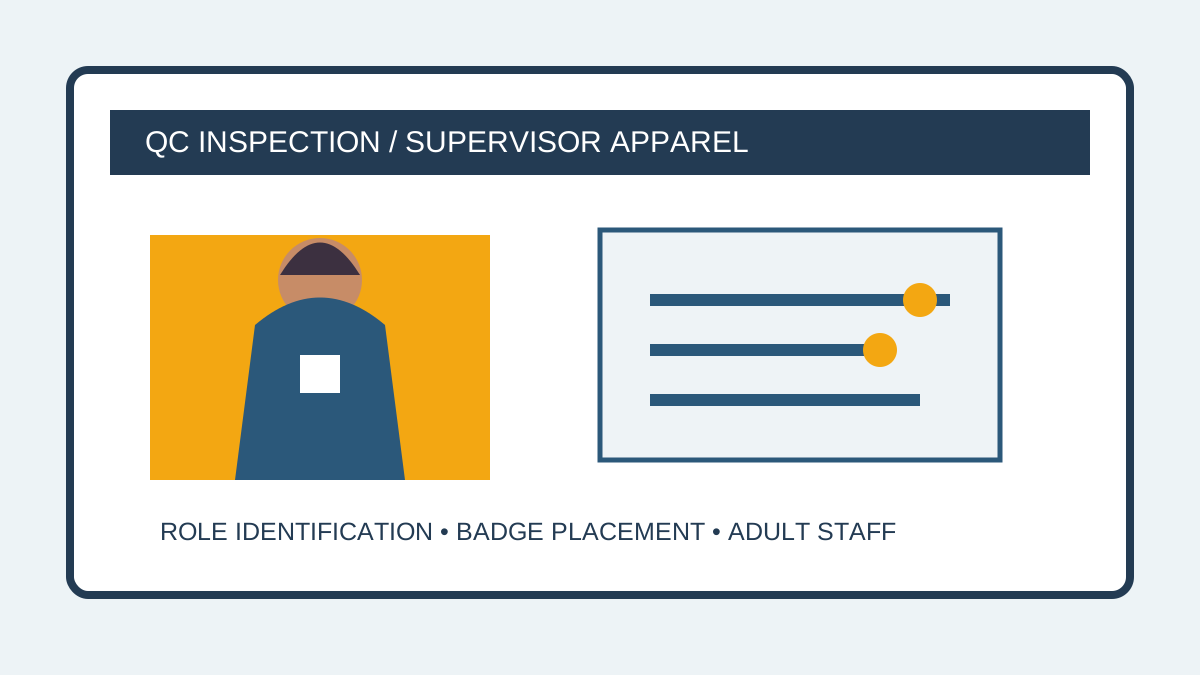
Production operators need comfortable movement at benches and lines, secure pockets and a consistent badge position. SMT support and PCB handling teams may need low-lint construction and smooth closures. QC inspectors benefit from clear role identification and sleeves that do not obstruct inspection. Supervisors may use a different color or trim within the same fit and branding system.
Separate receiving, kitting, assembly, inspection, packing and engineering zones should be reviewed before finalizing styles. Keep the program adult workplace focused; it is not a school uniform range and should not be specified for children.
/
/
/