

Tire Shop Technician Polo Shirt OEM | Auto Service Floor Crews
Table of Contents
Display
3)
Spec stack: technician polo / auto service polo — stain-aware fabrics, embroidery, colorways
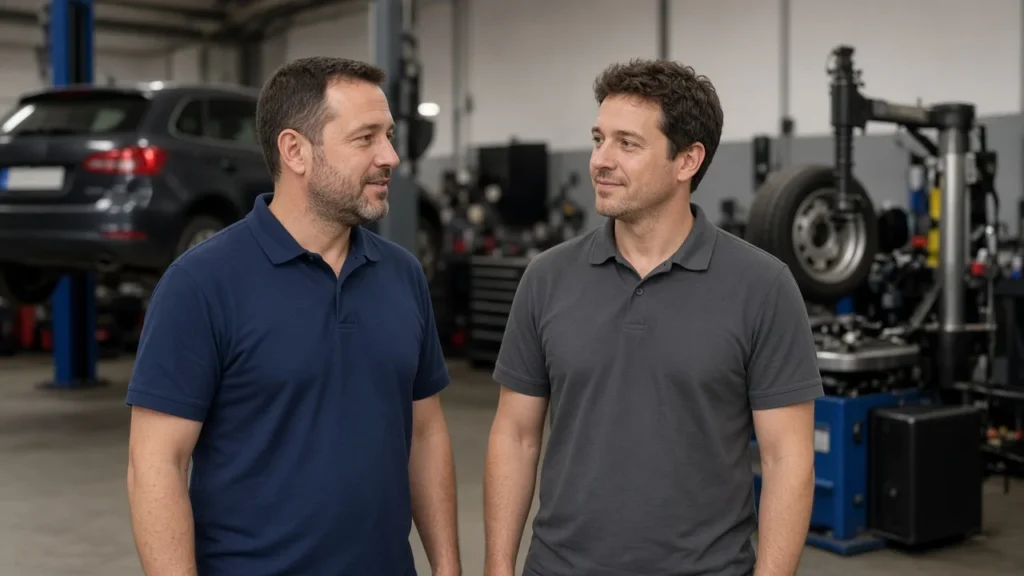
Your shops share one brand. But the logo on a Cedar Bay Tires polo looks different at each location. The Milepost Auto Service counter crew wears something else entirely. Bay technicians and front-desk staff end up in mismatched gear.
The fix follows a clear path. Define what each role needs, lock a spec stack, and vet suppliers for your tire shop technician polo shirt OEM. Then settle branding, sizing, and overseas logistics. Finish with QC and reorder rhythms.
One program covers bay and counter crews. Treat it as your tire service center staff uniform OEM foundation. Compare corporate polo shirts OEM options with a custom polo shirt OEM manufacturer before you commit.
Why tire-shop technicians specify a polo shirt for floor and counter duty
One polo from bay to counter
A polo gives you one shirt that works in two places. Your counter staff at Cedar Bay Tires greet customers in a crisp collared shirt. Your bay technicians wear the same polo in the same shop colors. Customers see one brand, not two teams. The collar shows a customer-facing role, and the shared colorway keeps the whole shop looking tied together.
This matters because a profitable shop runs on efficient workflows, dependable equipment, and trained people. A clear uniform program supports that operating structure. Everyone knows who works the floor and who works the desk. Nobody wastes time hunting for the right shirt before a shift.
Durability and appearance expectations
Aftermarket service centers depend on skilled technicians. Those technicians bend, reach, and lean over tires all day. A polo for this work must resist snags, hold its shape, and survive frequent washing. The same shirt must still look presentable when a counter crew member steps in front of a customer.
Set expectations early with your supplier. Ask how the fabric behaves after repeated wash cycles. Confirm that embroidery stays flat and legible. Check that the collar keeps a clean edge. A polo that fades or pills in the first month undercuts the professional image you paid to build.
What a multi-site program solves
Multiple locations create drift. One Cedar Bay Tires store orders navy, another orders charcoal. A Milepost Auto Service manager buys a different style for the front desk. Soon your network looks like a group of unrelated shops.
A single program fixes this. You lock one spec stack, one logo standard, and one colorway matrix. Each site orders from the same source. Bay crews and counter crews get role-appropriate versions of the same polo. Your brand stays consistent from the first location to the tenth. Reordering becomes a routine task instead of a redesign project.
Who this guide is for (overseas tire dealers and auto-service buyers)
Independent dealers and small chains
You own or run a few tire shops, and you buy the shirts yourself. Maybe you are the owner or general manager of a Cedar Bay Tires location. Maybe you manage a small chain of three or four stores under one name. You know the problem of mixed logos and mismatched colors because you see it every morning.
This guide speaks to you directly. It explains fabric choices, embroidery standards, and colorways in simple terms. You do not need a sourcing department to follow it. You can take the RFQ table, fill in your shop details, and send it to a supplier the same week.
Multi-site auto-service buyers
Larger networks bring more people into the buying decision. An operations manager or area manager owns the daily look of each site. A purchasing or procurement manager controls the vendor relationship and the budget. A brand or marketing lead for the dealer network protects logo consistency across every location. A fleet or facility contact joins only when that person really buys technician apparel. A uniform distributor may sit in the middle as your channel partner.
Each of these buyers cares about a different part of the program. The area manager wants shirts that hold up to real bay work. Procurement wants a clear spec and a steady price. Marketing wants the logo to look the same at every Milepost Auto Service counter. This guide gives all of you one shared reference.
Roles: bay technicians and counter crews
Your program must serve two different groups. Bay technicians work with tires, tools, and equipment all shift. Counter crews meet customers, write tickets, and answer phones. Both groups wear the same brand, but their daily needs are not the same.
Technician training programs set skill levels, and TIA’s Automotive Tire Service program is a common example. Those levels give you an easy way to tell staff apart by sight. A senior technician can wear a different accent color or a sleeve mark than an entry-level tech. Counter staff can have their own accent. The polo becomes a quiet sign of role and experience, and customers understand it without anyone explaining it.
Spec stack: technician polo / auto service polo — stain-aware fabrics, embroidery, colorways
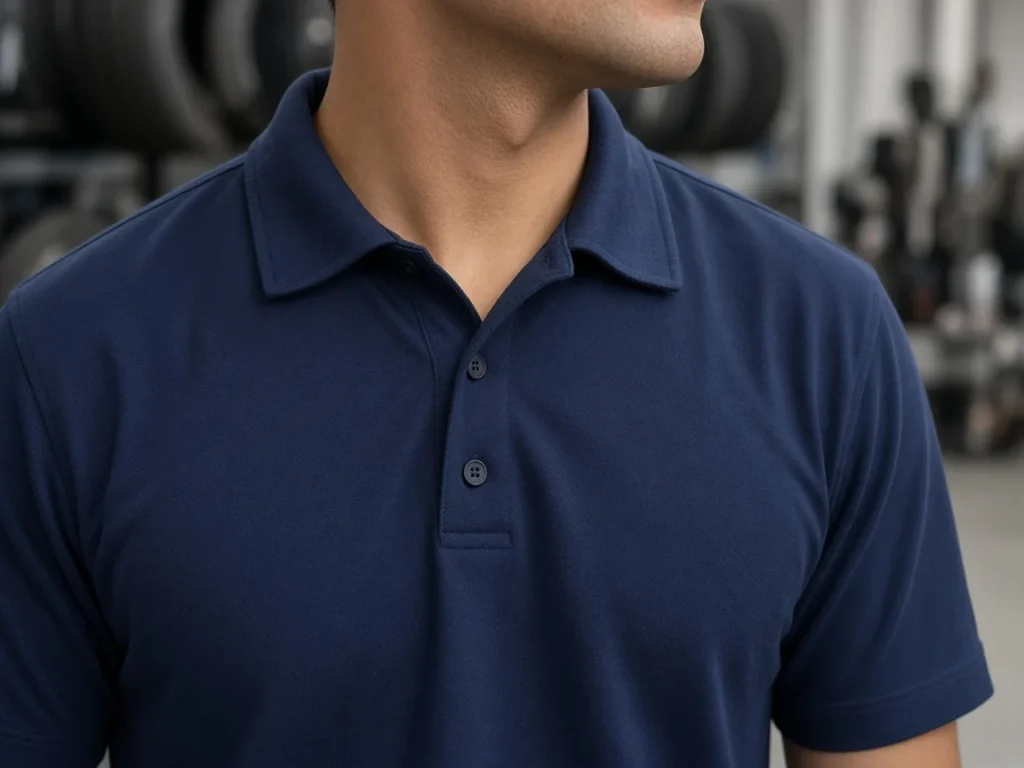
Stain-aware fabric blends
Soil-release finishes and weight
Grease, tire dust, and road grime meet your polo every shift. Choose a fabric blend with a soil-release finish. These finishes help stains lift in a normal wash instead of setting into the fiber. Ask your supplier which finish they apply and how many wash cycles it survives.
Weight matters too. A mid-weight knit feels substantial on the floor and still looks neat at the counter. A very light knit shows every mark and clings after a few washes. A very heavy knit traps heat in a busy bay. Request swatches in two or three weights and wash them before you decide.
Stretch and breathability for bay heat
Your bay technicians reach overhead, kneel at the wheel, and lean into the engine compartment. A small amount of stretch keeps the polo from pulling across the back and shoulders. Look for a knit that recovers its shape after stretching, not one that sags by midday.
Breathability keeps the crew comfortable through a hot afternoon. Ask how the fabric handles moisture. A knit that moves air and dries quickly beats a dense fabric that holds sweat. Test both qualities on a wear trial at one Cedar Bay Tires location before you commit the whole network.
Embroidery that survives washing
Stitch density and backing
Embroidery fails in two ways. It puckers the fabric, or it unravels after repeated washing. Both problems trace back to stitch density and backing. A dense stitch count on a thin knit pulls the surface and creates a stiff patch. A stable backing holds the design flat and spreads the load.
Ask your supplier to match backing to fabric weight. Request a wash test on the finished sample. Check that the logo edge stays sharp and the thread ends stay buried. This step protects the tire shop technician polo shirt OEM investment across every site.
Chest, sleeve, and collar placement
Placement decides how the logo reads at a glance. The left chest is the standard spot for your shop mark. A sleeve placement works well for a role indicator or a small secondary mark. Collar placement suits a subtle brand touch on counter polos.
Confirm spelling and lettering on every logo and name patch before production starts. One wrong letter on a Cedar Bay Tires patch means a wasted run. Send a written approval with the exact text, font, and thread color codes. Require that logos and name patches stay legible through repeated washing, and put that requirement in the purchase order.
Colorways that hide grease and hold brand color
Navy, charcoal, and heather gray logic
Dark, muted shades hide shop marks best. Navy reads professional and masks grease well. Charcoal handles tire dust and looks sharp at a Milepost Auto Service counter. Heather gray hides fine smudges and shows less fading over time.
Pick one base shade per role and keep it fixed. A consistent base color makes reorders simple and keeps every location on brand. Avoid pale shades for bay work. They show every fingerprint and lose their crisp look fast.
Accent piping and contrast plackets
Accents add brand identity without shouting. Piping along the shoulder or a contrast placket in your brand color gives the polo a finished look. Use accents to separate roles. Bay technicians might wear a charcoal body with a dark accent. Counter crews might wear the same body with a brighter placket.
Keep accents small and repeatable. A simple accent is easy to reproduce across sites and across reorders. Send the exact thread and trim colors with your spec. That way the tenth location matches the first.
Bay vs service-counter looks in one polo program
Bay technician needs
Movement, snag resistance, wash frequency
Bay work demands freedom of movement. Your technicians reach over tires, crouch at the lift, and stretch across engine bays. A polo cut too slim binds at the shoulder and rides up the back. Choose a fit with room through the chest and armhole. Test it on a real shift at Cedar Bay Tires before you approve bulk.
Snag resistance matters just as much. Sharp edges on tools and equipment catch loose knits and pull threads. A tighter knit with a smooth surface sheds contact better than an open, fuzzy weave. Ask your supplier how the fabric performs against abrasion.
Wash frequency drives fabric choice. Bay polos may see daily washing, so the blend must hold color and shape under that cycle. Confirm the expected wash life with your supplier in writing.
UV exposure questions to verify with suppliers
Technicians spend long hours outdoors at some locations. Ask your supplier whether the fabric carries any UV-blocking treatment. Request the test method behind any claim. Verify how the treatment holds up after repeated washing. Treat UV performance as a question to confirm, not an assumption to make.
Service-counter needs
Crisp collar build and customer-facing fit
Counter crews meet customers face to face. A flat, structured collar frames the face and reads as professional. Ask for a collar with a firm interlining that keeps its shape through the day. Check the placket for clean stitching and even button spacing. A neat front makes a strong first impression at the Milepost Auto Service desk.
Lightweight options for front-desk wear
Front-desk staff work in climate-controlled spaces. A lighter knit keeps them comfortable without the bulk a bay shirt needs. Offer a lighter-weight version in the same colorway and logo standard. The counter crew stays cool, and the brand stays consistent.
One brand identity across both looks
Two role-specific polos can still read as one brand. Keep the base color, logo standard, and accent palette identical across both versions. Vary only the fabric weight and fit. A customer at Cedar Bay Tires sees one team, whether the person behind the counter or under the hood. This approach protects your identity and simplifies every reorder.
RFQ / specs table (sizes, logo placement, multi-site colorways)
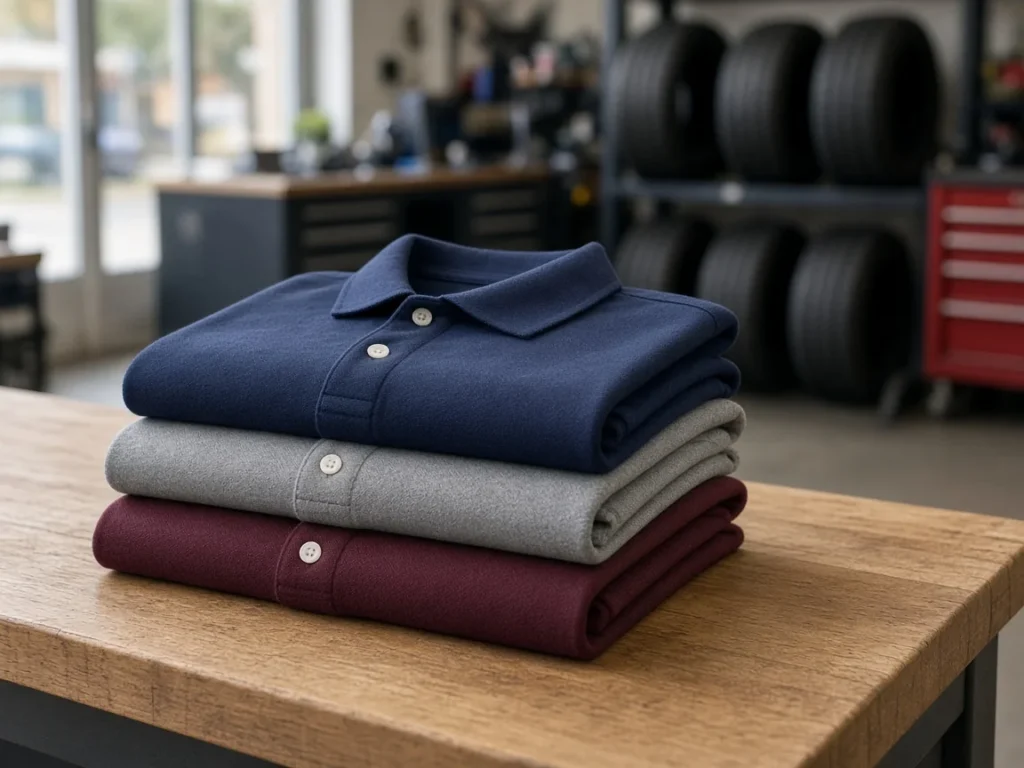
Building the RFQ document
A written RFQ turns a vague request into a comparable quote. You send the same document to every supplier. Each supplier prices the same spec, so you compare like with like. Build the RFQ as a table with one row per parameter. Add a column for your requirement and a column for the supplier’s response.
Parameter | Your requirement | Supplier response |
|---|---|---|
Style | Technician polo, short sleeve, 3-button placket | |
Fabric | Stain-aware blend, soil-release finish, mid-weight knit | |
Fit | Regular fit, room through chest and armhole | |
Sizes | Full range with grading rules | |
Logo | Left chest embroidery, exact text and thread codes | |
Name patch | Optional, above right chest | |
Colorways | Base shade per role, accent per site | |
Packing | Size-assorted cartons, role labels | |
QC | Wash test on finished sample, pre-shipment inspection |
Size range and grading for overseas crews
State your full size range in the RFQ. List every size you need, from the smallest to the largest. Ask the supplier to confirm grading rules between sizes. Grading decides how much the chest, shoulder, and length grow from one size to the next. Poor grading makes a large size fit like a stretched medium.
Your tire shop management software already tracks inventory by size. Use that data to plan uniform orders by bay and counter roles. You see which sizes your crews actually wear, so you order the right mix instead of guessing.
Logo files, placement map, thread color codes
Send vector logo files, not screenshots. Attach a placement map that shows each logo position with a measurement from a fixed point, such as the shoulder seam. List thread color codes for every element of the design. Name patches need the same treatment: exact spelling, font, and thread code. A written placement map removes doubt and protects the tire shop technician polo shirt OEM run from costly rework.
Multi-site colorway matrix
A colorway matrix assigns one base shade and one accent to each site or role. Build it as a simple grid. Rows list your locations. Columns list base color, accent color, and logo variant.
Location | Base | Accent | Logo variant |
|---|---|---|---|
Cedar Bay Tires — Site 1 | Navy | Brand red placket | Standard chest |
Cedar Bay Tires — Site 2 | Navy | Brand red placket | Standard chest |
Milepost Auto Service — Counter | Charcoal | Light gray placket | Chest plus collar mark |
Milepost Auto Service — Bay | Charcoal | Dark accent | Chest plus sleeve mark |
Assigning colorways by location or role
You have two ways to assign color. Assign by location when each site needs its own identity under one brand. Assign by role when you want customers to read job function at a glance. Many networks combine both: one base shade for the whole brand, with role accents for bay and counter crews. Keep the matrix fixed once you approve it. Every reorder then follows the same grid.
Questions every RFQ should ask
Close the RFQ with direct questions. Ask for the fabric composition and the soil-release finish details. Ask how many wash cycles the embroidery survives. Request the supplier’s standard grading chart. Ask for a wash-test report on the finished sample. Confirm packing method and carton labeling by size and role. Ask for lead time from PPS approval to bulk shipment. Ask how the supplier handles a reorder six months later. Clear answers here save weeks of back-and-forth later.
Sample → PPS → bulk for dealer networks
First sample round
Fit, hand-feel, embroidery review
Your first sample round answers one question: does this polo work on a real body in a real shop? Ask the supplier to send samples in the sizes your crews actually wear, not a single medium. Put a bay technician from Cedar Bay Tires in one sample for a full shift. Have a Milepost Auto Service counter crew member wear another at the desk. You learn more from one working day than from an hour in a meeting room.
Check three things during that trial. First, fit: the shoulder seam should sit on the shoulder, and the placket should lie flat when buttoned. Second, hand-feel: the knit should feel substantial without stiffness, and it should not cling after movement. Third, embroidery: run your thumb across the logo and confirm the stitching sits flat with no puckering. Wash the sample before you judge it, then inspect the logo edge and the collar shape again.
PPS approval
Sign-off checklist before bulk release
The pre-production sample, or PPS, is your final reference piece. Once you approve it, that sample becomes the standard every bulk unit must match. Treat the sign-off as a formal step, not a quick nod. Compare the PPS against your RFQ line by line, and confirm the fabric, weight, fit, colorway, logo placement, thread codes, and name patch text all match what you specified.
Approve the PPS in writing, and keep one sealed copy at your office and one with the supplier. A signed reference sample settles most disputes before they start.
Walk the checklist with your area manager and your procurement contact together. Confirm the spelling on every patch, the measurement of each logo position, and the packing labels by size and role. Note any deviation and decide whether it is acceptable or needs correction. Release bulk only after every item passes.
Bulk milestones
Inline checks and pre-shipment inspection
Bulk production needs checkpoints, not a single look at the end. Ask the supplier for an inline check once cutting and sewing are underway. At that stage, you can still catch a fabric substitution, a shifted logo position, or a colorway mix-up before the whole run repeats the error. Request photos and a short written report at each checkpoint.
Before shipment, arrange a pre-shipment inspection on the finished goods. The inspector should verify quantity by size and role, logo placement against the PPS, thread color, and carton labeling for each site in your colorway matrix. Confirm the packing matches your matrix so Cedar Bay Tires Site 1 and Site 2 receive the correct base and accent. A clean pre-shipment report protects your reorder rhythm and keeps every location on brand.
Catalog vs private-label tire-shop technician polo OEM
When a catalog polo fits best
A catalog polo works well when you need shirts fast and your brand standards are simple. You pick an existing style, add your logo, and skip most of the development work. The supplier already holds the pattern, the fabric, and the color range. Lead time stays short, and pricing is easy to predict.
This route suits a single Cedar Bay Tires location or a small group still testing a uniform idea. You get a professional look without committing to a full custom build. The trade-off is limited control. Fabric weight, collar build, and color options come from the supplier’s list, not your spec sheet. If your logo is straightforward and your crew is small, a catalog polo covers the need well.
When private-label OEM fits best
Private-label OEM fits when your brand must look identical across many sites. You define the fabric, the fit, the colorway matrix, and the embroidery standard. The supplier builds to your spec and puts your label inside the collar. Nobody else sells your exact polo.
This model rewards volume. A custom tire shop technician polo shirt OEM run makes sense when you plan to dress bay and counter crews across a whole network. Expect a higher commitment: about 2,000 pieces per style is a common threshold for a full private-label build. You also take on more approval work, from sample rounds to PPS sign-off. In return, you own the design and control every detail that reaches your crews.
Hybrid approach for growing networks
Many dealer networks start with one model and move to the other. You can launch with a catalog polo for counter crews at Milepost Auto Service while a private-label bay polo moves through sampling. Or you run a catalog base style and customize only the embroidery and accent trim.
A hybrid plan lets you dress crews now and refine the program later. Compare both sourcing models side by side at corporate polo shirts OEM and custom polo shirt OEM before you decide. Match the model to your site count, your brand rules, and your reorder plans. Neither option is better in every case. The right choice depends on how much control your network needs and how fast you need shirts on backs.
Copy-paste procurement checklist
Treat this section as a working document. Copy each list into your RFQ, remove what does not apply, and send the same version to every supplier. A shared checklist keeps quotes easy to compare and stops small details from slipping through.
Requirements and spec checklist
Begin with the product itself. Write each requirement as a line you can measure, not a general wish. The table below covers the main parameters for a tire shop technician polo shirt OEM order.
Item | What to specify |
|---|---|
Style | Short sleeve, three-button placket, side vents |
Fabric | Blend with soil-release finish, mid-weight knit |
Fit | Regular fit with room through chest and armhole |
Sizes | Full range plus grading rules between sizes |
Logo | Left chest embroidery, vector file, thread codes |
Name patch | Exact spelling, font, and placement above right chest |
Colorways | Base shade per role, accent per site |
Packing | Size-assorted cartons with role labels |
Add your wash-test requirement and your UV question to the same document. State the expected wash life in plain terms. Suppliers respond better to a clear list than to an open-ended request.
Supplier and sampling checklist
Check out the supplier before you talk price. Ask for the fabric composition and the finish details in writing. Request the standard grading chart and a wash-test report on a finished sample. Confirm the supplier can hold your thread color codes across reorders.
Then move to sampling. Order samples in the sizes your crews actually wear. Put a Cedar Bay Tires technician in one sample for a full shift and a Milepost Auto Service counter crew member in another. Wash both samples before you judge them. Approve the pre-production sample in writing, and keep one sealed copy at your office and one with the supplier.
Logistics, QC, and reorder checklist
Lock the shipping and quality steps before bulk release. Confirm the packing method, carton labeling by size and role, and the delivery terms. Ask for an inline check during cutting and sewing, plus a pre-shipment inspection on finished goods. Require photos and a short written report at each checkpoint.
Plan the reorder rhythm last. Record the PPS date, the bulk lead time, and the expected wash life of each style. Set a reorder trigger before stock runs low, and confirm the supplier still holds your pattern and thread codes six months later. A fixed matrix and a written reference sample make every future order a repeat, not a redesign.
About Top Fortune (entity once) + CTA
OEM polo capability for overseas buyers
Shanghai Top Fortune Industry Co., Ltd. has built OEM/ODM polo programs since about 2002. The company runs a 1,506 m² facility in Songjiang. There, it handles fabric sourcing, sampling, embroidery, and bulk production all in one place. That setup gives overseas tire dealers and auto-service groups one contact from first sample to final shipment.
You get more than a factory contact. The team works with your spec stack, your colorway matrix, and your logo files. They build the pre-production sample against your written RFQ. Then they hold bulk units to that approved reference. For a multi-site network, that discipline keeps Cedar Bay Tires and Milepost Auto Service locations on the same brand standard. You can review the company background at about us before you send your first inquiry.
Planning a tire shop technician polo shirt OEM rollout
A smooth rollout starts with a written plan, not a single email. Map your sites first. List every location, the roles at each site, and the headcount by size. Then set your colorway matrix and lock your logo placement map. Send that package to the supplier as one RFQ. Ask for a sample round in the sizes your crews actually wear.
Build the timeline backward from your target wear date. Allow time for the sample round, the PPS approval, bulk production, and pre-shipment inspection. Keep one sealed PPS copy at your office and one with the supplier. Set your reorder trigger before stock runs low. Confirm the supplier still holds your pattern and thread codes months later. A tire shop technician polo shirt OEM program rewards this kind of planning with consistent shirts and predictable reorders.
Ready to dress your bay and counter crews in one brand? Request a tire-shop technician polo program quote: rill@topfortunemail.com | WhatsApp +86 13524210501
Think of your polo rollout as a cycle you can repeat. First, define the bay and counter roles. Next, lock the spec stack. Check suppliers with a written RFQ, then approve a PPS before bulk release. Handle sizing, logistics, QC, and reorders on a steady rhythm. Each round makes the next tire shop technician polo shirt OEM order faster and easier to predict.
One program serves both crews. Bay technicians and counter staff wear the same base color, logo standard, and accent palette. Your brand stays whole at Cedar Bay Tires and Milepost Auto Service.
Ready to start? Request a tire-shop technician polo program quote: rill@topfortunemail.com | WhatsApp +86 13524210501