

Supermarket Staff Polo Shirt OEM | Grocery & Convenience Crews
Table of Contents
Display
1)
Why supermarket and c-store crews specify a staff polo shirt, not a generic retail uniform
3)
Spec stack: staff polo / grocery staff polo / cashier polo — fabric, colorways, embroidery
4)
Front-end vs floor-crew color coding without adding other product families as main keywords
5)
RFQ / specs table (sizes, gender fit, logo placement, multi-banner colorways)
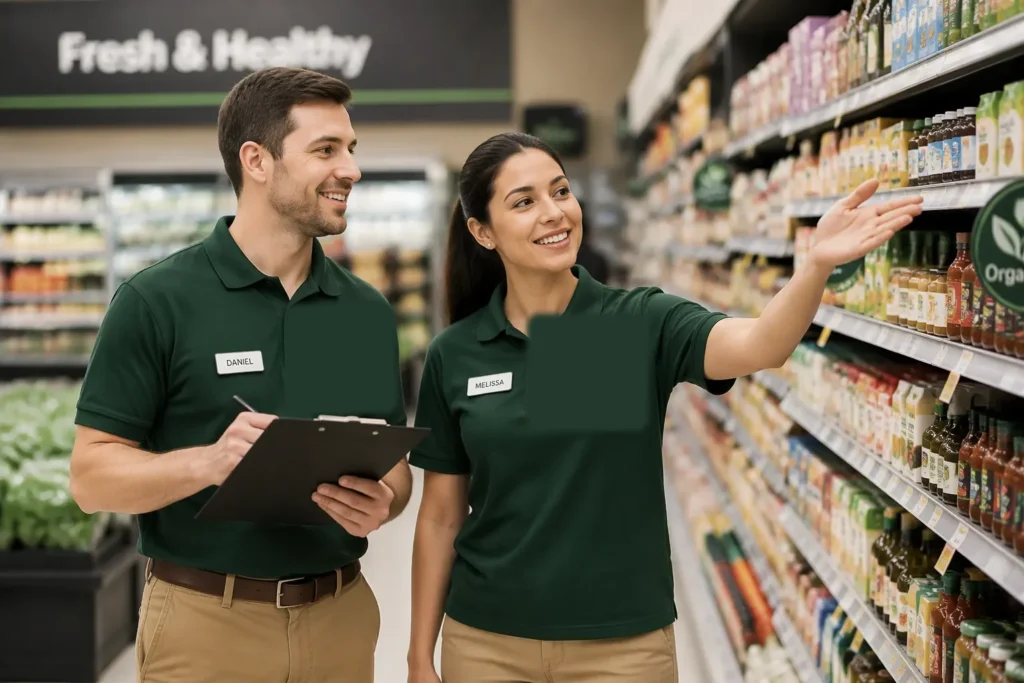
You have one real choice to make: which supermarket staff polo shirt OEM can supply polos that last through frequent washing, long shifts, and branding for multiple stores. This guide covers what crews need, customization, compliance, cost, supplier evaluation, and a step-by-step selection process. It is written for overseas grocery, supermarket, and convenience-store buyers, plus distributors who serve those accounts. Two practical tools come with it: an RFQ specs table and a copy-paste procurement checklist. Use them to compare supermarket retail staff uniform OEM offers, corporate polo shirts OEM programs, and custom polo shirt OEM options on the same terms. Start with your crew requirements, then let the specs do the judging.
Why supermarket and c-store crews specify a staff polo shirt, not a generic retail uniform
A staff polo shirt earns its place on the grocery floor through structure, not style. Your crews spend long shifts reaching, lifting, and moving between the sales floor and the stockroom. The polo shirt gives them a knit collar that stays upright, a placket that keeps its shape, and a body cut that allows full arm movement. Those details matter more in a supermarket than in a fashion retail setting.
Polo strengths for grocery work
Knit collar holds shape
A knit collar keeps its structure through repeated washing and wear. It resists the curling and flattening that soft collars show after a few cycles. Your staff look presentable at the front end without constant pressing or replacement.
Side vents for stocking and lifting
Side vents at the hem let the polo shirt move with the body. Stockers reach overhead and bend low many times per shift. The vents reduce pulling across the hips and keep the shirt tucked or untucked cleanly.
Where generic uniforms fall short
Fashion cuts restrict movement
Fashion-oriented uniforms favor a slim silhouette. That cut limits arm raise and shoulder rotation. A cashier scanning items and a stocker lifting cases both need room through the chest and armhole. A relaxed polo fit solves this without looking loose.
Thin fabrics wear at front ends
Lightweight fashion fabrics thin out at high-friction points. Front-end staff lean on counters and brush against belts and scanners all day. A durable polo fabric holds its surface and color far longer under that contact.
What a polo program delivers
Consistent look across banners
A polo program sets one visual standard across every store. North Aisle Grocery and Harbor Corner Market can share the same polo base while each banner applies its own accent color. Shoppers read the crew as one organized team.
Repeatable reorder specs
A documented polo spec makes reorders predictable. Fabric, color, embroidery placement, and size range stay fixed from run to run. New hires get the same shirt as the original crew, and your multi-store rollout stays visually consistent.
Who this guide is for (overseas grocery, supermarket, and convenience buyers)
This guide is for buyers who get staff polo shirts for grocery and convenience stores outside China. You may run one store or several hundred. You may buy for your own banner or resell to other retailers. Each role below looks at the same spec stack in a different way, and each one gets a practical path through this guide.
Grocery procurement teams
You work in a purchasing or procurement role, and you own the business side of the polo program. You compare quotes, negotiate terms, and track delivery against store opening dates. In smaller groups, you also handle merchandising, category, or vendor manager duties. That means you balance cost per unit against how the shirt performs on the floor.
Multi-store standardization
Standardization is your main problem. Ten stores with ten polo variants create ten reorder headaches. You need one documented spec that every store can order against, with banner-level color differences handled inside that spec. This guide shows you how to build the RFQ table so each banner gets its own colorway line without breaking the shared base.
C-store and franchise operators
You work as an operations, store, area, regional, or franchise manager, or you own and run an independent grocer or c-store group. Your crews are small and your floor space is tight. You feel every uniform decision directly, because you see the shirts on shift every day.
Compact size runs, fast replenishment
Franchise and independent formats rarely need deep inventory. You need compact size runs that cover your actual crew mix, plus a replenishment path that replaces worn shirts without a long wait. Read the sampling and bulk sections with this in mind. They explain how to plan reorder runs around your hiring cycle instead of a single annual order.
Distributors and resellers
You supply uniforms or promotional apparel to grocery and c-store accounts. Your clients expect you to carry the program, yet you do not want to own a factory or manage raw material sourcing. Brand and marketing managers for retail banners also land here when they evaluate how a supplier backs a multi-banner identity.
OEM backing without owning a factory
An OEM partner gives you factory-level production without the capital burden. You keep the client relationship and the spec ownership. The supplier handles fabric, cutting, embroidery, and packing to your approved standard. The catalog versus private-label section helps you decide which model fits each account, and the checklist gives you a repeatable approval trail for every client you serve.
Spec stack: staff polo / grocery staff polo / cashier polo — fabric, colorways, embroidery
Fabric performance
Cotton-rich vs poly-cotton blends
Cotton-rich polo fabric feels soft and lets air through during long shifts. It holds embroidery well and keeps its color. Poly-cotton blends are stronger and dry faster after washing. For grocery crews, a blend often wins for durability and wrinkle recovery. Match the fabric to the job: cashiers at North Aisle Grocery stay near the front end and do well with a crisp, low-crease blend. Stockers who move all day may want more cotton for comfort.
Colorfastness and shrinkage control
Set colorfastness and shrinkage limits in the spec before you approve any sample. Ask the supplier for wash-test results on the exact fabric and color you plan to order. A polo that fades or shrinks after a few washes ruins your multi-store look fast. State the test method and the acceptable limit in your RFQ. Then check the bulk run against the approved sample.
Stain-resistant finishes
Stain-resistant fabric matters for crews who handle spills and messy products. Deli staff work near oils, sauces, and produce residue all shift. A stain-resistant finish helps the polo release marks in the wash. It keeps the shirt presentable between laundry cycles. Confirm the finish survives repeated washing, and check that it does not change the fabric feel or the embroidery look.
Colorways for grocery branding
Core neutrals plus banner accents
Build each program on a core neutral base, then add banner accent colors. Navy, charcoal, white, and black cover most grocery identities. Harbor Corner Market can carry a green accent on the collar or placket. It still shares the same navy body as your other banners. This approach keeps your volume consolidated and your visual system consistent.
Light vs dark shade trade-offs
Light shades look clean and fresh, but they show stains and soil sooner. Dark shades hide marks and suit stockroom and receiving roles well. Weigh each shade against the role and the lighting in your store. A mid-tone often balances both concerns for floor crews.
Embroidery and logo placement
Left chest, sleeve, back yoke
Left chest placement gives you the standard, readable brand position. Sleeve embroidery suits smaller marks and role identifiers. Back yoke placement works for larger logos visible across the sales floor. Pick one main placement per banner and write it down. That way every reorder lands in the same spot.
Thread color matching and artwork files
Send vector artwork and a named thread color reference with every RFQ. Vague files and verbal color descriptions cause mismatches between runs. Ask the supplier to embroider a strike-off on the actual polo fabric for approval. Lock that approved strike-off as your reference for all future orders.
Front-end vs floor-crew color coding without adding other product families as main keywords
One program, two color roles
Accent color for front-end roles
Front-end staff are the first people shoppers see. Give cashiers and service-desk crews an accent color that says “ask me” from a few lanes away. At North Aisle Grocery, a teal collar and placket on a navy polo body helps a shopper find an open lane without searching. Keep the accent to trim areas — collar, placket, sleeve edge — so the shirt still looks like one uniform family.
Base color for floor crews
Floor crews need the opposite treatment. Stockers, receivers, and shelf teams move through back halls and aisles, and they brush against carts, crates, and shelves all shift. A darker base color hides contact marks and keeps the polo looking good between washes. Harbor Corner Market runs its floor team in the shared navy body with no accent trim. This separates the roles at a glance and makes replacement simple when a shirt wears out.
Readable coding across formats
Contrast under store lighting
Test your color pairing under the real lighting of each store before you approve it. Cool overhead lighting can blend a subtle accent into the base color, and the role difference disappears. Ask your supplier for a strike-off in both colors and view it on the sales floor, not in an office. If the accent does not stand out clearly, deepen the contrast instead of adding a second design element.
Badges that complement the polo
Name badges and role pins should support the polo coding, not fight it. Place a badge on the opposite chest from the embroidered logo so both stay easy to read. Match the badge background to the polo base color, and let the accent color carry the role signal. This keeps the front-end and floor-crew difference visible up close and from a distance.
Scaling across banners
Shared base, banner accents
One shared base color across every banner protects your volume and keeps reorders simple. Each banner then adds its own accent to the collar or placket. North Aisle Grocery keeps teal, Harbor Corner Market keeps green, and both order the same navy body. You combine fabric and cutting while each store still looks like itself.
Documented color matrix
Write the color matrix down and attach it to every purchase order. List each banner, its base color, its accent color, the exact placement of the accent, and the thread references for embroidery. A written matrix stops a new store from ordering an off-brand shade and gives your supplier one reference for every run. Update it once, and every future reorder follows the same standard.
RFQ / specs table (sizes, gender fit, logo placement, multi-banner colorways)
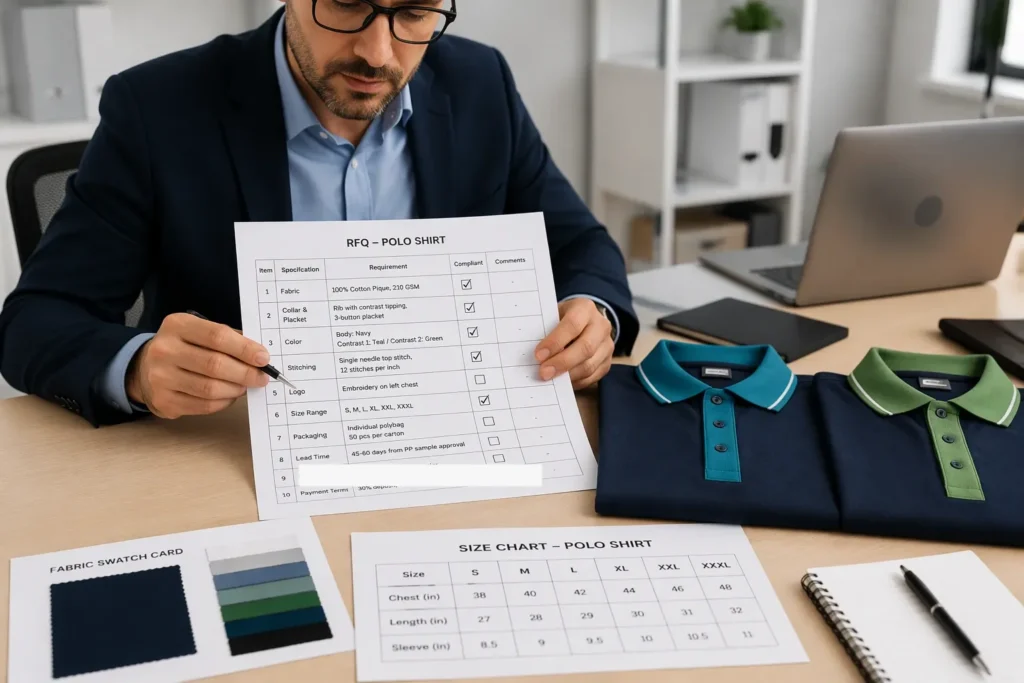
A written RFQ table turns a vague request into a quote you can compare. Every supplier prices the same shirt, the same colors, and the same size spread. You stop comparing apples to oranges and start comparing real offers.
Building the RFQ table
Columns every RFQ needs
Build one row for each style and banner combination. Give each row a style reference code, a fabric composition, a colorway, a logo placement, a size range, a gender fit, and a quantity. Add a column for wash-test requirements and one for label and packing instructions. These columns cover everything a factory needs to quote accurately. Send the same table to every supplier you contact.
Gender fit and size coverage
State the fit you want for each style: men’s, women’s, or unisex. Unisex cuts make stock simpler, yet some crews prefer a shaped women’s fit. List the size range for each fit and the quantity you expect in each size. Ask each supplier to check their size chart against your crew measurements before quoting. A missing size break causes split orders later.
RFQ specs table
Use this table as your working template. Replace the sample rows with your own banner data.
Style reference | Fabric composition | Colorways per banner | Logo placement | Size range | Gender fit | Quantity per style |
|---|---|---|---|---|---|---|
SP-100 (shared base) | Cotton-rich pique, mid-weight | Navy body for all banners | Left chest, embroidered | S–3XL | Unisex | Per banner forecast |
SP-100-NA | Same as SP-100 | Navy body, teal collar and placket (North Aisle Grocery) | Left chest plus sleeve mark | S–3XL | Unisex | Per banner forecast |
SP-100-HC | Same as SP-100 | Navy body, green collar and placket (Harbor Corner Market) | Left chest only | S–3XL | Unisex | Per banner forecast |
SP-200 (women's) | Same as SP-100 | Banner base plus accent trim | Left chest, embroidered | XS–2XL | Women's | Per banner forecast |
Style reference and fabric composition
Give every polo a unique style code. Write the fabric as a composition, not a marketing name: fiber types, approximate blend ratio, and knit structure such as pique. Add fabric weight in grams per square meter if your supplier quotes it that way. A precise composition lets each factory price the same cloth.
Colorways per banner and logo placement
List each banner on its own row with its base color and accent color. Name the exact placement for every logo: left chest, sleeve, or back yoke. Add the thread color reference beside each placement. This row structure keeps a multi-banner program organized inside one document.
Size range, gender fit, quantity per style
Break quantity down by style and banner, not as one grand total. Ask suppliers to quote size ratios separately. A factory that sees your real size mix can plan cutting more efficiently and flag gaps in the range.
Common RFQ mistakes
Missing wash-test requirements
Many RFQs skip wash testing entirely. The supplier then quotes a fabric that may fade or shrink after a few cycles. State the test method and the acceptable limit in the table. Ask for results on the exact fabric and color before you approve anything.
Vague logo files and thread colors
A screenshot or a verbal color description invites mismatch. Attach vector artwork and a named thread reference for every logo. Request an embroidered strike-off on the actual polo fabric. Lock the approved strike-off as the standard for all future runs.
Sample → PPS → bulk for multi-store grocery and c-store groups
A staged approval path protects a multi-store rollout. Each stage lowers the risk before the next one starts. If you skip a stage, that risk moves onto your stores and your budget.
Sampling stage
Proto sample for fabric and fit
The proto sample is your first physical check. The supplier makes it in the proposed fabric and cut so you can judge hand feel, weight, and drape. Wear it, wash it, and check the collar and placket after drying. Write down any change in shape, color, or surface before you move ahead.
Fit samples across size range
Order fit samples in the smallest and largest sizes of each gender fit. Ask for one mid-size sample too. Check armhole room, body length, and hem placement on real crew members when you can. A fit that works at size M may bind at 3XL, and you want to find that now, not after bulk cutting.
PPS stage
Final fabric, color, embroidery, labels
The pre-production sample (PPS) must match the bulk order in every detail. Confirm the final fabric lot, the approved color, the embroidered logo placement, and the thread references. Check the neck label, care label, and packing method against your RFQ. Treat the PPS as the contract sample for the whole program.
Written approval before bulk cutting
Sign off the PPS in writing before the factory cuts fabric. Keep the approved sample on file at your office and ask the supplier to keep a matching sealed sample. Put the approval date and sample code on the purchase order. This written trail settles any quality dispute during inspection.
Bulk and delivery
Multi-store rollout timelines
Plan the bulk window around your store opening and refit dates. Share a delivery schedule that lists each banner, its quantity, and its required arrival week. Ask the supplier to confirm production and shipping lead times against that schedule in writing. Build a buffer before launch so stores get shirts with time to hand them out.
Planning replenishment runs
Set your reorder trigger before the first bulk run ships. Track wear rates by store and hold a small reserve for new hires. A combined reorder of about 2,000 pieces per style keeps fabric and cutting efficient across banners. Document the reorder spec, the approved PPS code, and the color matrix so every future run matches the first.
Catalog vs private-label supermarket staff polo shirt OEM
You have a model decision to make before you pick a supplier. A catalog program uses polo styles the supplier already makes. A private-label program builds a polo to your own spec. Both models work well for grocery and c-store buyers. The right choice depends on your banner count, your exclusivity needs, and your timeline.
When catalog fits best
Faster starts, pilot programs
A catalog polo shortens the path from decision to delivery. The supplier already holds the fabric, patterns, and size grading. You pick a style, add your embroidery, and place the order. This speed helps when a new store opens soon or when you want to test a polo design in a few locations first. A pilot run in two stores shows you how the shirt performs before you roll it out.
Lower upfront development effort
Catalog styles carry no development cost for you. You skip pattern making, fit sampling across the full size range, and fabric development. Your team spends its time on logo placement and color selection instead. For a single independent grocer, this lower effort often outweighs the exclusivity trade-off. Review the corporate polo shirts OEM program to see how catalog bases work with your branding.
When private label fits best
Exclusive colors and fits
Private label gives you a polo that no other banner can buy. You control the fabric weight, the collar build, the fit block, and the exact color. A large grocery group with several banners gains a distinct look at every store. You also gain the freedom to adjust the fit for your crew measurements.
Consistent reorder specs
A private-label supermarket staff polo shirt OEM locks your specification for the life of the program. Fabric, color, and build stay fixed across every reorder. New stores receive the same shirt as the original rollout. This consistency protects your brand image over many years. Explore the custom polo shirt OEM process when exclusivity matters most.
Hybrid approach
Catalog base with private-label trims
A hybrid model combines the strengths of both. You start from a catalog polo body and add private-label elements: your own collar color, placket trim, woven labels, and embroidery. Development effort stays modest, and your banner still looks distinct. North Aisle Grocery can run a catalog navy body with a custom teal placket and its own neck label.
Deciding per banner and format
Decide banner by banner, not for the whole company at once. A flagship banner with high volume may justify full private label. A small franchise format may fit a catalog base with custom trims. Write the choice into your spec matrix so every buyer and store manager follows the same rule. This per-banner logic keeps cost and exclusivity balanced across your group.
Copy-paste procurement checklist
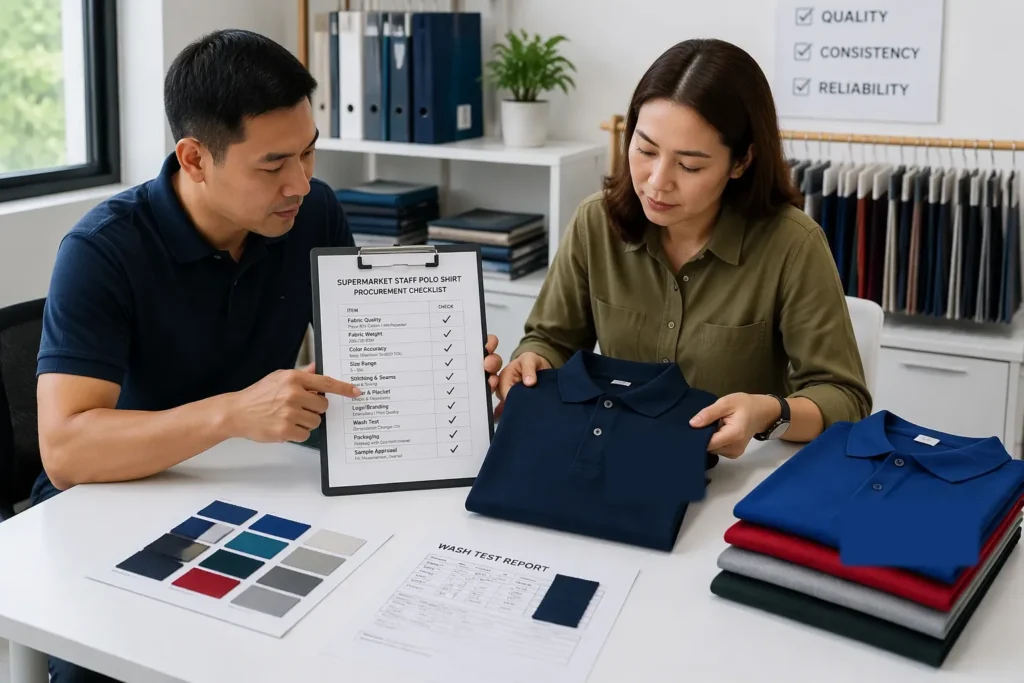
A checklist turns your polo program into a process you can repeat. You run the same checks for every banner, every supplier, and every reorder. The list below covers the three areas that decide whether a rollout works: the spec, the supplier, and the delivery plan. Copy it into your project file and check each line before you release a purchase order.
Spec and compliance checks
Fabric, colorfastness, shrinkage, labels
Start with the fabric. Confirm the composition, the knit structure, and the fabric weight in writing. Ask for wash-test results on the exact fabric and color you plan to order. Check colorfastness and shrinkage against the limits you set in the RFQ. Review the neck label, care label, and any woven flag label against your brand standards. A missing label detail turns into a store-level complaint after delivery.
Supplier and production checks
Sample approvals, QC steps, lead times
Confirm that the supplier approved your proto and fit samples before making the PPS. Ask how the factory runs in-line and final inspection, and who signs the inspection report. Request the production lead time and the shipping lead time as separate figures. A supplier who answers these questions in writing gives you a partner you can plan around. The supermarket retail staff uniform OEM page shows how a full program fits together when you need a broader view.
Copy-paste checklist
Use this list as your working document. Add your banner names and style codes, then share it with every supplier you evaluate.
Spec and compliance
Fabric composition, knit structure, and weight confirmed in writing
Wash-test results received for the exact fabric and color
Colorfastness and shrinkage limits stated in the RFQ and met by the sample
Stain-resistant finish confirmed to survive repeated washing (if specified)
Neck label, care label, and woven labels approved against brand standards
Size chart checked against crew measurements for every gender fit
Supplier and production
Proto sample approved for fabric hand feel and fit
Fit samples reviewed at the smallest and largest sizes of each gender fit
PPS approved in writing before bulk cutting
Sealed PPS kept by the supplier and a matching sample kept in your office
QC steps and inspection sign-off named in the order documents
Production and shipping lead times confirmed against your rollout dates
Delivery and reorder
Delivery schedule lists each banner, quantity, and required arrival week
Packing method and carton labeling match your store distribution plan
Reorder terms documented, including the approved PPS code and color matrix
Reorder trigger and reserve stock level set before the first bulk run ships
Supplier contact and escalation path recorded for every store group
Approved PPS on file before bulk
The approved PPS is your quality anchor. Keep it on file with the approval date and sample code. Reference that code on every purchase order. When a dispute comes up during inspection, the PPS settles it fast.
Size range and gender fit confirmed per banner
Each banner may have a different crew mix. Confirm the size range and gender fit for every banner before you combine quantities. A shared base style still needs its own size breakdown for each store group.
Logo files, thread colors, placements locked
Lock the vector artwork, the named thread references, and the exact placement for every logo. Attach the approved embroidery strike-off to the checklist. Any change after this point needs a new approval, not a verbal note.
Delivery schedule and reorder terms documented
Write the delivery schedule and the reorder terms into the same document. List each banner, its quantity, and its arrival week. Record the reorder spec, the PPS code, and the color matrix. A supermarket staff polo shirt OEM that follows this document gives you runs you can predict across every store.
FAQ (MOQ; distinct vs existing supermarket uniform pages)
What is a typical starting quantity for a supermarket staff polo program? Typical OEM programs are planned per style, and the supplier confirms the starting quantity on your RFQ. See the replenishment section for the volume used to keep fabric and cutting efficient.
How is this page different from existing supermarket uniform pages? This guide stays on staff polo shirts for grocery, supermarket, and convenience crews. It is distinct from the supermarket retail staff uniform OEM page, which covers a broader uniform program rather than a polo-only spec.
About Top Fortune + supermarket staff polo shirt OEM quote
Company background
OEM/ODM since ~2002
Shanghai Top Fortune Industry Co., Ltd. has made staff polo programs for overseas buyers since about 2002. That history matters to your procurement team. The factory has handled fabric sourcing, pattern development, embroidery, and export packing for many grocery and c-store accounts. You get a supplier that already knows how a multi-banner polo program runs.
1,506 m² Songjiang facility
The company runs a 1,506 m² facility in Songjiang. That space covers cutting, sewing, embroidery, and inspection under one roof. You keep one point of contact for the whole order instead of chasing separate workshops. Ask for a production walkthrough during sampling, and confirm the embroidery equipment matches your logo complexity. You can read more on the about page.
Request a quote
Email and WhatsApp contact
Send your RFQ specs table by email or WhatsApp. Both channels reach the same sales team, and both accept artwork files and size breakdowns. Use email for formal documents and WhatsApp for quick questions during sampling. Keep one thread per program so your approval trail stays in one place.
Request a supermarket staff polo program quote: rill@topfortunemail.com | WhatsApp +86 13524210501
First message contents
Style, fabric, colorways, sizes, quantities, delivery date
A complete first message gets you a usable quote faster. Include these items:
Style reference and any catalog base you want to start from
Fabric composition, knit structure, and weight
Colorways per banner, with base and accent colors named
Logo placement, vector artwork, and thread color references
Size range and gender fit for each style
Quantity per style and per banner
Required delivery date and destination port
Add your wash-test limits and label requirements to the same message. A supermarket staff polo shirt OEM that receives this package can quote accurately on the first try. You avoid the back-and-forth that delays a rollout by weeks.
Start with your crew needs. Lock the spec stack, confirm the color coding, and build the RFQ table. Approve samples and the PPS next. Then judge each OEM on quality control, communication, and lead times.
A written spec and checklist protect every multi-store rollout. They also make reorders predictable across banners.
Catalog and private-label OEM each fit different situations. Your banner count, exclusivity needs, and timeline decide the right model.
Send your completed RFQ specs table to the supplier contact and request samples. That single step turns this guide into a working polo program.