

Bulk Uniforms: Local Factory vs. Cross-Border OEM
Table of Contents
Display

When I choose between local clothing manufacturers and overseas suppliers for bulk uniforms, my priorities shape the decision. Local production gives me fast shipping, more flexibility with customization, and supports jobs in my community. Manufacturing locally usually costs more than overseas options. If I look at overseas sourcing, I find lower unit prices. However, international freight, import duties, and taxes can push the final cost higher than expected.
Key Takeaways
Local clothing manufacturers offer faster shipping and better communication, making them ideal for urgent needs.
Overseas sourcing can reduce costs per unit, especially for large orders, but requires careful planning for hidden fees.
Customization is easier with local manufacturers, allowing for quick adjustments to designs and features.
Quality control is more manageable with local suppliers, as you can inspect production and address issues directly.
Consider the total cost of overseas sourcing, including shipping and tariffs, to avoid unexpected expenses.
Evaluate your specific needs, such as order size and timeline, to choose the best sourcing option for your uniforms.
Building strong relationships with suppliers, whether local or overseas, enhances communication and reduces risks.
Always ask for samples and set clear standards to ensure the final product meets your expectations.
Bulk Uniforms Sourcing Options
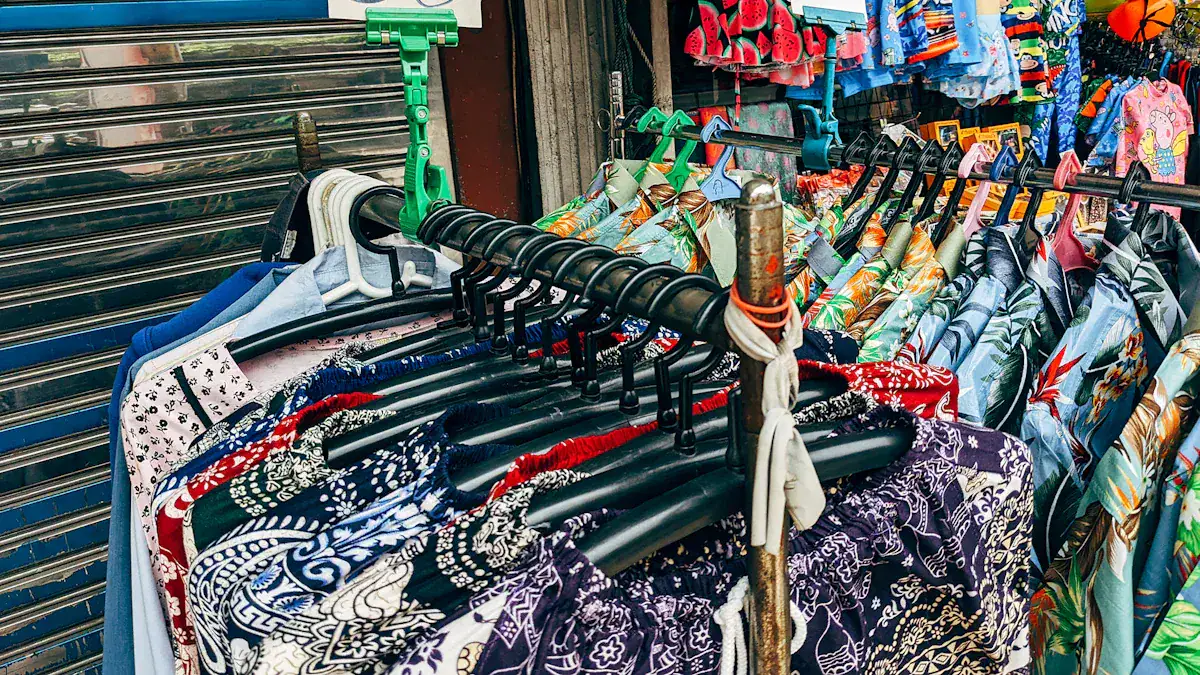
When I look for bulk uniforms, I see two main sourcing paths: local clothing manufacturers and overseas sourcing through OEM (Original Equipment Manufacturer) partners. Each option shapes my experience, from design to delivery, and affects my responsibilities, costs, and the final product.
Local Clothing Manufacturers
What They Offer
Local clothing manufacturers give me direct access to their teams. I can visit their facilities, discuss my needs face-to-face, and check on progress. This approach works well for both athletic wear, like sports jerseys and performance tops, and workwear, such as medical scrubs or construction uniforms. I also get to choose from different fabric sources, including mills, converters, and jobbers, depending on my order size and fabric needs.
Here’s how their production process usually works:
Step | Description |
|---|---|
Sample Creation | I receive physical samples based on my approved designs. I can check fit, finish, and branding. |
Quality Control | They perform checks at several stages to ensure my uniforms meet standards for consistency and accuracy. |
Packaging & Labeling | Uniforms are packed as I request, with options for custom labels and branding. |
I notice that local clothing manufacturers often offer quick turnarounds. Their proximity allows me to communicate easily, which helps with quality control. I also support my local economy and build trust with my community. Local teams understand cultural dress codes, and I rarely face language or time zone barriers.
When to Choose Local
I choose local clothing manufacturers when I need fast delivery or want to oversee production closely. If I value supporting local jobs and want to avoid complex logistics, local is my go-to. Minimum order quantities can be low, sometimes as few as 20 to 50 pieces per style, which suits smaller teams or frequent design changes.
Overseas Sourcing (OEM)
What Is OEM
Overseas sourcing through OEM means I partner with a manufacturer in another country. I provide my designs, and they handle large-scale production. This model works well for brands that need high volumes or want to access a wider range of materials and products.
I often work with sourcing agents who help me find reliable suppliers and negotiate terms. Overseas factories, especially in countries like China and India, offer lower manufacturing costs due to cheaper labor. I can scale up production quickly and choose from many fabric and product options.
When to Choose Overseas
I turn to overseas sourcing when I want to reduce my cost per unit and need to produce bulk uniforms at scale. This option makes sense if I have clear designs and can manage longer lead times. I must consider import tariffs, shipping fees, and currency exchange rates, which can affect my final cost. If I need unique materials or want to expand my product line, overseas partners give me more choices.
Tip: I always weigh the benefits of local clothing manufacturers against the global reach and cost savings of overseas sourcing before making my decision.
Local Production Pros & Cons
Advantages
Customization & Flexibility
When I work with local clothing manufacturers, I notice a huge advantage in customization options and flexibility. I can request special features, unique colors, or extended sizes for bulk uniforms. Local production allows me to make changes quickly if my team needs a new logo or if I want to adjust the fit. I find that domestic apparel producers respond well to feedback and can adapt to my requirements. This flexibility helps me create uniforms that match my brand and meet my team’s needs.
The pros of local clothing manufacturers include enhanced customization, streamlined supplier relationships, and support for school branding and identity. I also see better pricing and discounts for repeat orders, which helps with long-term cost efficiency.
Fast Shipping
Local production gives me a faster turnaround time compared to overseas options. I receive samples quickly and approve them without waiting for international shipping. Delivery times are shorter because the uniforms travel less distance. I communicate easily with local teams, which speeds up the process and reduces delays. When I need bulk order uniforms for an event or emergency, local production helps me stay prepared.
Local production leads to faster turnaround times due to shorter lead times.
Quicker sample approvals are possible with local manufacturers.
Delivery times are reduced because of shorter shipping distances.
Better communication and customer service enhance the overall speed of delivery.
Quality Control
I value the quality control standards that local clothing manufacturers maintain. I can visit their facilities and check on progress. They perform inspections at every stage, which helps ensure the quality of my bulk uniforms. I trust local teams to catch defects early and fix them before shipping.
Quality Control Step | Description |
|---|---|
Pre-Production Inspections | Fabric inspection and lab testing to ensure quality before production begins. |
In-Line Inspections | Continuous checks during production to catch defects early and maintain quality. |
Final Checks Before Shipment | Comprehensive inspections to verify that all garments meet required standards before delivery. |
Random Sampling | Randomly selected samples from production batches are inspected to assess overall quality. |
AQL Standards | Specifies the maximum number of defects allowed per batch, ensuring quality expectations are met. |
Third-Party Inspections | Independent inspections provide unbiased verification of quality, adding credibility to the process. |
I see that local production helps me maintain consistency in uniform quality and design. This is important for corporate uniforms sourcing, where my brand image matters.
Support Local Economy
When I choose local production, I support jobs in my community. I help local businesses grow and keep money circulating in my area. This decision benefits parents, schools, and organizations by saving time and reducing administrative burdens. I also notice environmental benefits because shipping distances are shorter and less fuel is used.
Supporting local businesses
Reduced administrative burden
Environmental benefits
Enhanced student safety
Improved inventory management
Challenges
Higher Costs
One of the cons of local clothing manufacturers is the higher cost. Local manufacturing has higher labor costs, which affects the price of bulk uniforms. Specialized materials and technologies can increase expenses. I see that fluctuations in raw material prices also impact my budget. When I compare local production to overseas options, I pay more for better quality control and faster turnaround.
High production costs due to specialized materials and technologies.
Fluctuations in raw material prices affecting overall expenses.
Increased costs associated with the demand for custom and branded workwear.
In the 1990s, many US apparel factories moved overseas because of lower labor costs. This shift helped companies save money, but it also led to job losses in the US. As labor costs rise globally, some companies are reconsidering the benefits of offshoring and looking at local production again.
Limited Scale
Local production works well for small to medium bulk orders, but scaling up can be difficult. Vendor reliability is crucial for timely delivery and meeting specifications. Not all local clothing manufacturers have the capacity to handle very large orders. Expertise in specialized uniform requirements is necessary for accuracy and efficiency. When I need thousands of uniforms for corporate uniforms sourcing, I must check if my vendor can deliver on time.
Vendor reliability is crucial for timely delivery and adherence to specifications.
Expertise in specialized uniform requirements is necessary for accuracy and efficiency.
A vendor’s production capacity must be sufficient to handle large orders consistently.
I find local production ideal when I need fast delivery, want to oversee quality control, and value supporting my local economy. For smaller teams, frequent design changes, or urgent needs, local clothing manufacturers offer the best solution. When deciding between local and overseas, I weigh these pros and cons to match my priorities.
Overseas Sourcing Pros & Cons
When I consider overseas sourcing for bulk uniforms, I see both advantages and challenges. I need to provide my own designs and manage communication with overseas clothing manufacturers. This approach gives me access to large-scale production, but I must pay close attention to details and timelines.
Benefits
Lower Costs
I choose overseas apparel production when I want to reduce my cost per unit. Overseas clothing manufacturers offer lower prices because wages are cheaper in countries like China, Bangladesh, and Vietnam. This makes overseas sourcing attractive for bulk order uniforms. I can save money, especially when I need thousands of pieces.
Benefit | Description |
|---|---|
Cost Efficiency | Overseas manufacturing is generally cheaper due to lower wages, especially beneficial for bulk orders. |
I notice that the final cost can include hidden fees, such as duties, samples, and freight. I always check these extra charges before placing my order.
Scalability
Overseas apparel production gives me the ability to scale up quickly. Overseas clothing manufacturers have large factories and advanced technology. They can handle big orders and help me grow my business fast. If I need to increase my order size or add new styles, overseas sourcing makes it possible.
Benefit | Description |
|---|---|
Scalability | Overseas manufacturers are equipped to handle large production runs and can accommodate rapid growth. |
I find that overseas apparel production works best when my business is expanding and I need reliable partners for high-volume orders.
Material Access
I turn to overseas sourcing when I want more choices in fabrics and finishes. Overseas clothing manufacturers have access to a wide range of materials, including specialty fabrics that may not be available locally. I can select from different colors, textures, and performance features.
Benefit | Description |
|---|---|
Specialist Skills | Countries like China, Bangladesh, and Vietnam have specific expertise and technology for certain clothing types. |
I often see overseas apparel production offering unique options for sportswear, medical uniforms, and custom branding.
Drawbacks
Longer Lead Times
One challenge with overseas apparel production is the longer lead time. Overseas sourcing usually takes more time than local production. I must plan ahead because shipping can take weeks. Repeat orders from China often require three months for production and delivery.
Production Type | Average Lead Time (Days) |
|---|---|
Overseas OEM | |
Local Production | 60-90 |
Local manufacturers have faster turnaround times than overseas.
Shipping for overseas orders can take weeks, adding to the lead time.
I notice that domestic orders are often a month shorter than overseas orders. If I need uniforms quickly, I must consider this delay when deciding between local and overseas.
Quality Risks
Quality control can be harder with overseas apparel production. I face risks such as communication delays, sizing inconsistencies, and long production times. Sometimes, I receive uniforms with color variation or defects. I also deal with hidden fees and unexpected costs.
Quality Risks |
|---|
Communication delays |
Sizing inconsistencies |
Long production times |
Hidden fees (duties, samples, freight) |
Color variation
Defects
Fabric wastage and rework
Idle time and low productivity
Quality failures and rejections
I always ask for samples and set clear standards to reduce these risks. I work closely with sourcing agents to improve communication and avoid mistakes.
Design Responsibility
When I use overseas sourcing, I must provide detailed designs and specifications. Overseas clothing manufacturers expect me to manage the design process and communicate my needs clearly. I need to create tech packs, choose fabrics, and approve samples. If I miss details, I risk getting uniforms that do not match my expectations.
Tip: I always double-check my designs and instructions before sending them to overseas clothing manufacturers. Clear communication helps me avoid costly errors and delays.
I find that overseas apparel production works best when I have experience with design and project management. If I am new to bulk uniforms, I may need extra support to get the results I want.
Comparison Table: Local vs. Overseas

Cost
When I compare local and overseas suppliers for bulk uniforms, I notice that cost plays a major role in my decision. Local factories usually charge higher prices because labor costs are greater in the United States. Shipping costs stay low when I order from domestic vendors. Overseas suppliers offer lower unit prices, but I must factor in international shipping, duties, and taxes. Sometimes, these extra fees make the final cost higher than I expect. I always ask for a full breakdown before placing an order. If I need a small batch, local production often makes more sense. For large orders, overseas sourcing can help me save money, especially if I plan ahead and manage logistics carefully.
Speed
Speed matters when I need uniforms quickly. Local manufacturers give me faster turnaround times. I can get samples and finished products in days, not weeks. Domestic distributors sometimes offer same-day shipping, which helps me meet tight deadlines. Overseas suppliers need more time for production and shipping. International transit can take several weeks, so I must plan my turnaround well in advance. I use the table below to compare shipping speed:
Factor | Domestic Distributors | International Distributors |
|---|---|---|
Shipping Speed | Faster (same-day options) | Slower (weeks for overseas transit) |
When I need a quick turnaround time, I choose local production. If my timeline is flexible, overseas sourcing works for larger orders.
Quality
Quality stands out as a key difference between local and overseas suppliers. I find it easier to manage quality control with American vendors. I can visit their facilities and check on production. Local suppliers follow strict standards for ethical production and sustainability. Overseas vendors offer moderate quality control, but I must communicate clearly and set expectations. Sometimes, I face challenges with sizing or color consistency. I use the table below to compare qualities:
Qualities | American Vendors | Foreign Vendors |
|---|---|---|
Labour Cost | High | Low |
Shipping Cost | Low | Moderate |
Lead Time | Shorter | Depends on Vendor |
Quality Control | Easier to Manage | Moderately Easy |
Ethical Production & Sustainability | High | Low-to-Moderate |
I choose local suppliers when I want reliable quality and ethical standards. Overseas suppliers work well for bulk uniforms if I have experience managing production and can handle possible risks.
Customization
When I order bulk uniforms, customization stands out as a key factor. Local factories give me more control over the design process. I can visit their facilities, discuss my ideas in person, and make quick changes. If I want unique colors, special fabrics, or custom branding, local manufacturers respond quickly. They often handle small batch orders, which helps when I need frequent updates or limited-edition uniforms.
Overseas OEMs offer a wide range of customization options, especially for large orders. I can choose from many fabrics, finishes, and printing techniques. However, I must provide detailed specifications and clear instructions. If I miss a detail, the final product may not match my vision. Making changes after production starts can be slow and expensive. I find that local production works best for projects that require flexibility and hands-on involvement. Overseas sourcing suits me when I have finalized designs and need to produce uniforms at scale.
Tip: I always finalize my designs and double-check details before sending them to overseas suppliers. This step helps me avoid costly mistakes.
Communication
Communication shapes my experience with both local and overseas suppliers. When I work with local factories, I speak the same language and share similar business practices. I can call, email, or visit in person. This direct contact helps me solve problems quickly and build strong relationships.
When I source uniforms from overseas OEMs, I face language and cultural barriers. These challenges sometimes lead to misunderstandings about design, quality, or delivery schedules. Miscommunication can affect the final product and even harm my business relationships. I must write clear instructions, use visuals, and confirm every detail. I also rely on sourcing agents or translators to bridge the gap. Good communication helps me get the uniforms I want, but it takes extra effort with international partners.
Risk
Every sourcing option comes with its own risks. I weigh these carefully before making a decision. Local sourcing gives me faster delivery, lower shipping costs, and easier communication. I support local businesses and enjoy better quality control. However, I may face higher costs, limited product choices, and challenges meeting high demand. Regional economic issues can also affect my orders.
International sourcing offers cost savings, a wider product selection, and the ability to scale production. I can access global markets and diversify my supply chain. On the downside, I deal with longer delivery times, language and cultural barriers, and quality control challenges. Regulatory compliance and supply chain disruptions add more risk.
Option | Advantages | Disadvantages |
|---|---|---|
Local Sourcing | Faster product delivery, lower shipping costs, easier communication, supporting local businesses, better quality control, reduced environmental impact | Limited product choices, potentially higher costs, difficulty meeting high demand, vulnerability to regional economic issues |
International Sourcing | Wider product selection, cost savings, ability to scale production, diversified supply chain, access to global markets | Longer delivery times, language and cultural barriers, quality control challenges, regulatory compliance requirements, potential supply chain disruptions |
I always balance these risks with my business needs. Careful planning and clear communication help me reduce problems, no matter which option I choose.
Deciding Between Local and Overseas
Key Questions
When I start deciding between local and overseas uniform sourcing, I ask myself several important questions. These help me understand the impact on cost, quality, and risk. Here are the questions I always consider:
Cost Analysis: I break down all expenses, including production, transportation, tariffs, and possible bulk discounts. This gives me a clear picture of the total impact on cost.
Quality Standards: I check if the supplier’s quality matches my expectations. Local suppliers often follow stricter standards, while overseas partners may offer more innovation.
Supply Chain Visibility: I think about how easy it is to track my order. Local sourcing usually gives me better transparency and lets me inspect products on-site.
Risk Management: I look at risks like natural disasters, political issues, or global crises. I decide if I need to diversify my suppliers to protect my business.
I find that answering these questions helps me choose the best path for my business and avoid surprises later.
Matching Needs to Options
I know that every business has unique needs. To match my requirements to the right sourcing option, I focus on a few key areas. I start by understanding the purpose of the uniform. I evaluate customization options to make sure the uniforms fit my brand and team roles. I consider my budget and look for cost efficiency in every step. I always try to find a supplier who can deliver both quality and value.
A scalable uniform program must offer a full range of sizes and styles. This keeps my team comfortable and maintains a consistent brand image. I also make sure the uniforms meet industry regulations and use ethical materials. When I plan for growth, I choose a supplier who can scale with me and provide faster turnaround times when needed.
Evaluate design and customization options
Consider budget constraints
Select the right supplier
Ensure employee satisfaction and compliance
Develop a structured and scalable uniform program
Tips for Success
I have learned that a few practical steps can make bulk uniform sourcing much smoother. Here are some tips that help me succeed, whether I source locally or overseas:
Actionable Tips | Description |
|---|---|
I estimate costs and set aside enough funds for uniform procurement. | |
I research and check references to find a supplier I can trust. | |
Implementing a Centralized Ordering System | I use a platform that tracks inventory and orders efficiently. |
Training Employees | I train my team to use the ordering system and follow clear guidelines. |
Streamlining Inventory Management | I use just-in-time inventory and do regular audits for efficiency. |
Establishing Clear Policies | I set up standard procedures and approval workflows. |
Monitoring Supplier Performance | I track supplier performance and review it regularly. |
Embracing Sustainability | I choose eco-friendly materials and promote recycling. |
Partnering with the right manufacturer and planning ahead always improves my results. I focus on efficiency and clear communication to keep my uniform program running smoothly.
When I choose between local and overseas bulk uniform sourcing, I weigh several trade-offs. Local suppliers give me faster turnaround, easier logistics, and better market knowledge. Overseas partners offer lower prices and more material options, but I face longer shipping times and complex logistics.
Aspect | Local Sourcing | Overseas Sourcing |
|---|---|---|
Accessibility | Nearby | International shipping |
Cost | Higher unit price | Lower unit price |
Shorter | Longer | |
Material Options | Limited | Wide variety |
I use the comparison table and decision guide to match my needs with the right sourcing strategy. This helps me balance cost, speed, customization, and risk for my business goals.
FAQ
What is the difference between local and overseas manufacturers?
I notice local manufacturers offer faster delivery and easier communication. Overseas manufacturers provide lower costs and more material options. I choose local manufacturers when I want quick turnaround and direct oversight. Overseas manufacturers help me scale up production and save money on bulk orders.
How do I find a supplier for bulk uniforms?
I start by researching manufacturers and suppliers online. I read reviews and ask for references. I visit trade shows to meet suppliers in person. I compare manufacturers based on quality, price, and reliability. I always check if suppliers can meet my specific needs.
Why do manufacturers require minimum order quantities?
Manufacturers set minimum order quantities to keep production efficient. I see that suppliers need to cover setup costs and material expenses. Manufacturers prefer larger orders because it helps them plan production and reduce waste. I ask suppliers about their minimums before placing an order.
What should I check before choosing manufacturers or suppliers?
I review manufacturers’ experience, production capacity, and quality standards. I ask suppliers for samples and inspect their facilities. I compare manufacturers’ pricing and turnaround times. I always confirm that suppliers understand my design requirements and can deliver on schedule.
Can manufacturers customize uniforms for my team?
Manufacturers offer many customization options. I request special colors, logos, and sizes. Suppliers work with me to create uniforms that match my brand. I communicate my needs clearly to manufacturers. Suppliers provide samples so I can approve the design before full production.
How do manufacturers handle quality control?
Manufacturers perform inspections at every stage. Suppliers check fabrics, stitching, and finishing. I visit manufacturers to see their process. Suppliers use random sampling and third-party audits. I trust manufacturers who maintain strict quality standards and communicate openly about any issues.
What are the risks of working with overseas manufacturers and suppliers?
I face longer shipping times and possible delays. Overseas manufacturers may have language barriers. Suppliers sometimes struggle with quality consistency. I manage risks by setting clear expectations and working with reliable manufacturers. Suppliers who communicate well help me avoid costly mistakes.
Is clothing manufacturing in the UK different from other regions?
I see that clothing manufacturing in the UK focuses on quality and ethical standards. Manufacturers in the UK offer faster delivery for local orders. Suppliers in the UK understand local regulations and trends. I choose UK manufacturers when I want reliable service and support for my business.
Tip: I always compare manufacturers and suppliers from different regions to find the best fit for my needs.