

Food Delivery Rider Uniform OEM Buyer Guide | Courier Brands
Table of Contents
Display
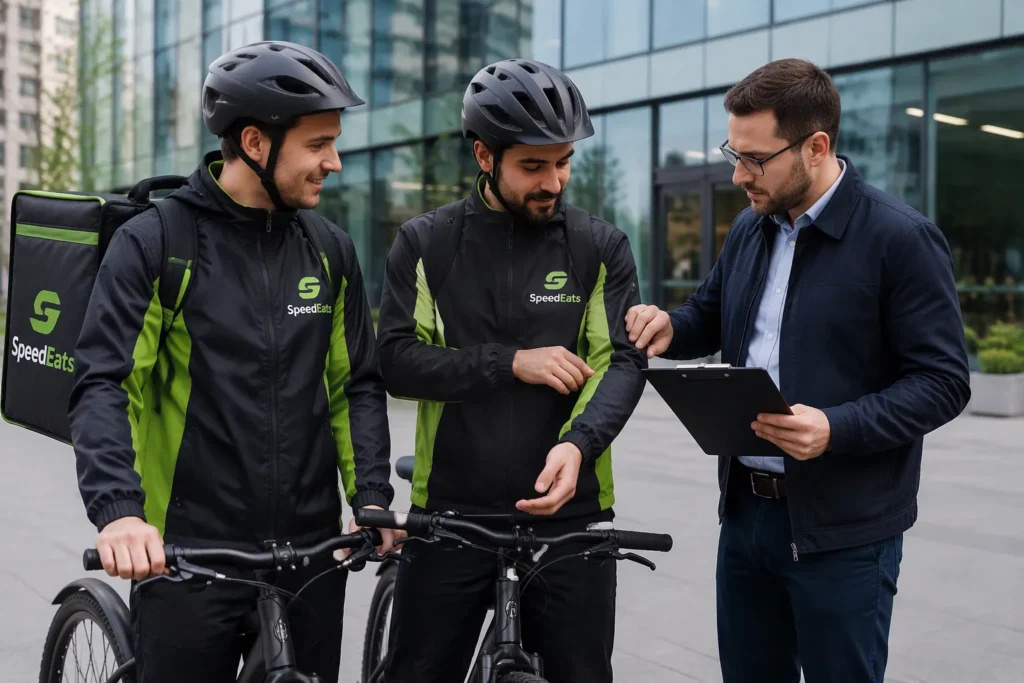
A food delivery rider uniform typically consists of four parts: a branded top layer, a weather layer, a base layer, and accessories such as caps and bags. Each piece works as a module. Riders face variable weather and long shifts, so this layered system covers more conditions with fewer SKUs. Modular pieces also simplify replacement when one item wears out.
This guide walks courier brand buyers through briefing a food delivery rider uniform OEM factory. It covers the spec stack, the RFQ, sampling gates, and reorder planning. Buyers learn what to specify, what to approve, and what to lock before bulk production starts. Clear specifications reduce costly revisions later.
Key Takeaways
Build a modular uniform system with layers for different weather. This covers more conditions with fewer SKUs and simplifies replacement.
Specify exact fabric, color, and construction details in your RFQ. Clear specs reduce costly revisions later.
Use three sampling gates: development sample, pre-production sample (PPS), and bulk approval. Each gate catches problems before they become expensive.
Choose OEM custom for consistent branding and fit across regions. Catalog stock works for quick pilots but limits customization.
Plan starter kits and calculate cost-per-wear to balance upfront cost with durability. Lock specifications and color standards for easy reorders.
Food Delivery Rider Uniform OEM: Buyer Intent and Scope
Shanghai Top Fortune Industry Co., Ltd. is the entity behind this guide. The company was founded around 2002 and operates a 1,506 m² factory in Songjiang, Shanghai. It handles OEM/ODM workwear and courier staff apparel and exports to Europe, the Middle East, Oceania, Southeast Asia, and the Americas. Buyers can review the company profile at workwearmanufacturer.com and the about-us page.
Who This Guide Serves
This guide serves adult B2B buyers only. The audience covers food-delivery brands, courier companies, and last-mile operators. It does not cover school uniforms. It also does not treat PPE or hi-vis gear as the main pitch. The focus stays on branded rider apparel for commercial fleets.
Fleet managers, procurement leads, and regional franchise buyers all brief a food delivery rider uniform OEM in similar ways. They need garments that survive daily use and carry the brand clearly. The minimum order quantity is about 2,000 pieces per style. Buyers can reach the team at rill@topfortunemail.com or WhatsApp +86 13524210501. The factory address is Floor 3 Building 20 Haier Zhigu No.66 Guangfulin East Road Songjiang Shanghai 201600.
What Buyers Brief an OEM Factory On
A strong brief starts with the operating environment. Buyers record average temperatures, rain frequency, terrain such as stairs or cobblestone, and vehicle access. These facts set the baseline protection needs before anyone discusses style.
Fit testing comes next. Staff should try samples while wearing backpacks, holding tablet mounts, or bending with boxes. Buyers reject patterns where zippers bind or sleeves ride up. This step catches problems early and protects the bulk order.
The Rider Uniform Spec Stack
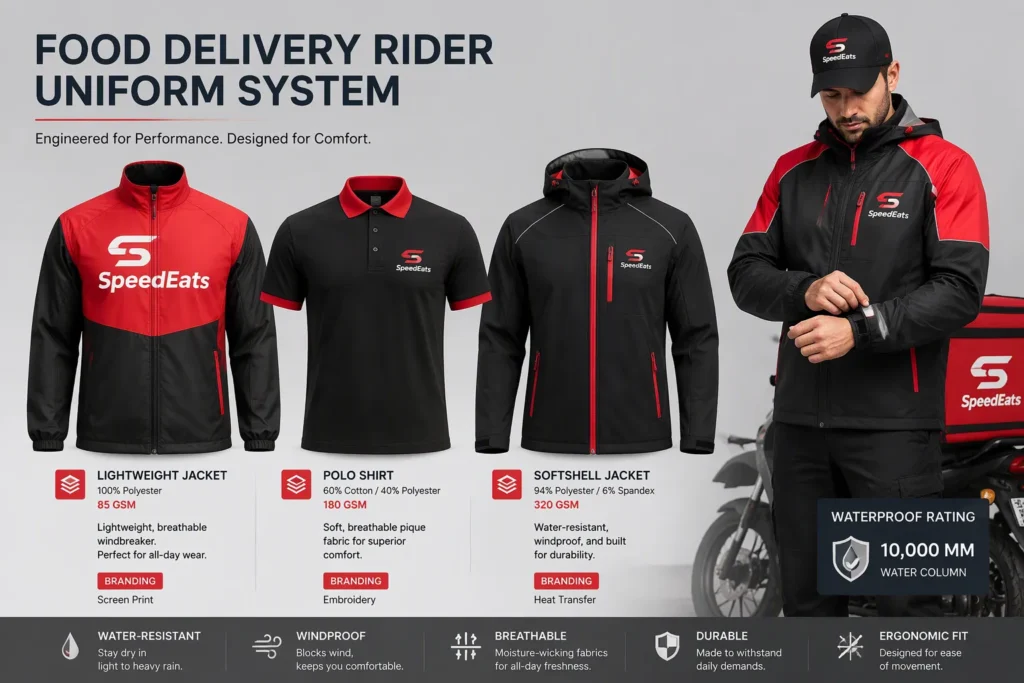
A rider uniform program rests on four garment types. Each one answers a different question about weather, visibility, and cost. Buyers who treat the stack as a system make better decisions than buyers who shop for a single jacket.
Jackets, Polos, and Softshells
The jacket is the brand carrier. It holds the largest logo placement and the most visible color block. A lightweight shell suits mild climates, while an insulated version covers cold mornings. The polo serves as the base layer for warm months. It sits closest to the skin, so fabric weight and breathability matter more than decoration. The softshell fills the middle ground. It blocks wind, stretches with movement, and handles light rain.
Made-to-order variables stay with the buyer. Fabric, GSM, color, fit, and branding method are all chosen by the purchasing team. A heavier GSM adds warmth and structure. A lighter GSM improves packability and airflow. The food delivery rider uniform OEM partner builds to the approved specification rather than pushing a fixed catalog item.
Weather Layers vs. Brand Visibility
Weather protection and brand visibility pull in different directions. A heavier membrane blocks rain but can dull print clarity. A bright, lightweight shell shows the logo well but offers less protection in sustained rain. Buyers balance the two by climate and season.
Waterproof ratings give buyers a common language. Procurement teams compare published water-resistance figures in millimetres and breathability figures, then confirm the rating on the fabric spec sheet rather than a marketing name.
A waterproof fabric alone does not make a waterproof jacket. Full protection depends on several build details:
Taped or sealed seams
Water-resistant or covered zips
Adjustable cuffs
A properly constructed hood
Storm flaps
Membrane or coating quality
Softshell construction varies widely, and the spec sheet should state the rating.
Softshell Style | Construction | Waterproof Rating |
|---|---|---|
Light bonded shell | Three-layer bonded with inner membrane | 3,000 mm |
Knit tech-shell | Three-layer knit tech-shell with inner membrane | 8,000 mm |
Fleece-bonded shell | Two-layer fleece-bonded with water-repellent finish | Water-repellent finish (no mm rating) |
Standard softshells handle light rain but not prolonged heavy rain. A waterproof outer shell or a layered system covers sustained downpours. Coated polyester offers accessible rain protection, though lower-quality coatings degrade after abrasion, repeated folding, or frequent washing. Buyers should review composition, lining, stretch, weather figures, and care instructions on the exact product sheet before approving a weather layer.
RFQ and Specs Table for Courier Uniforms
A request for quotation works well when the uniform need is simple, well-defined, and price-focused. Courier buyers use an RFQ to compare suppliers on a fixed product scope. A program with self-service portals, eligibility controls, or per-employee packing needs a request for proposal instead. An RFQ would force those vendors to compete on price alone and skip their ability to manage operational layers.
What to Put in the RFQ
The product scope comes first. Buyers list the uniform type, attach reference photos or a tech pack, and state the intended use. They also confirm whether the project covers apparel, caps, bags, or field gear. Specification details follow: fabric target, color reference, size breakdown, logo method, patch position, labels, trims, packing method, and carton marks.
Order conditions close the document. Buyers state estimated quantity, sample requirement, delivery country, deadline, inspection needs, and the expected repeat-order plan. A vague RFQ without reference photos or a clear product list invites mismatched quotes. Confirming packaging and carton marks late also delays production. The food delivery rider uniform OEM partner should receive every field in one document.
Reading a Spec Sheet Correctly
A spec sheet turns adjectives into checkable values. General-duty workwear woven cloth typically sits at 180–240 GSM. Work shirts and polos run 160–220 GSM, and corporate polos target 170–220 GSM. Buyers specify a tolerance in the purchase order, such as 180 GSM +/- 5%, alongside fiber content and construction.
Color consistency deserves its own line. A tolerance of ΔE ≤ 1.0 across lots keeps new hires matching veteran staff. Buyers request a ΔE figure per lot rather than a photograph. Lab data should back every claim: shrinkage limits, colorfastness scores, and pilling results.
Field | What to Specify |
|---|---|
Garment type | Jacket, polo, softshell, rain shell, cap |
Fabric / GSM | Fiber blend, weave or knit, GSM with tolerance |
Color standard | Reference standard and ΔE ≤ 1.0 across lots |
Size run | Size breakdown and grading rules |
Branding method | Embroidery, print, or patch with position |
Packaging | Poly bag, size stickers, carton marks |
Sample to PPS to Bulk Gates
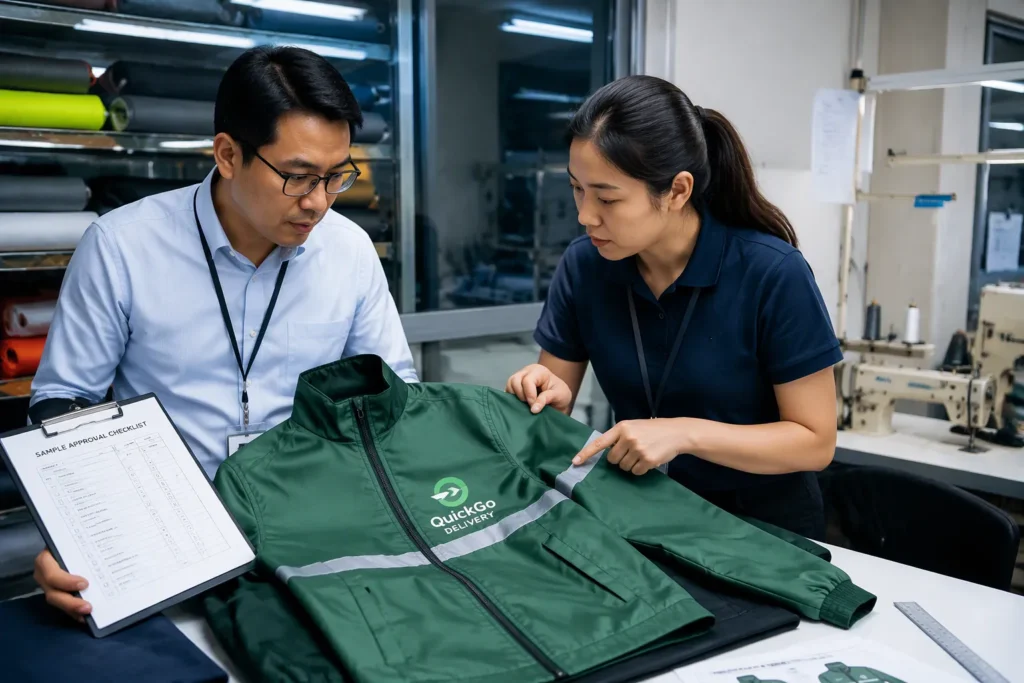
Three approval gates separate a good idea from a reliable bulk run. Each gate answers a different question. The development sample asks whether the design works. The pre-production sample asks whether the factory can reproduce it. Bulk approval asks whether the whole order matches the approved reference. A food delivery rider uniform OEM program that skips a gate pays for the shortcut later.
Typical Lead Time | |
|---|---|
OEM sampling | |
ODM sampling (with design work) | ~2 to 3 weeks |
Bulk production (after approval) | ~3 to 6 weeks |
Development Sample and Fit Sign-Off
The first gate converts the spec sheet into a physical garment. Pattern making translates the 2D design into 3D pieces, and the proto sample checks silhouette, proportions, and basic fit. A proto typically takes about 1 to 2 weeks. Buyers then review the fit sample, which uses actual production fabrics and trims, on a fit model. Revisions at this stage add roughly 2 to 4 weeks.
Fit sign-off deserves real attention. Riders bend, reach, and carry loads all shift. The buyer should test the sample with a backpack, a phone mount, and a delivery box in hand. Sleeves that ride up or zippers that bind fail the gate. Buyers document every correction in one consolidated record before approval.
Logo durability belongs in this review too. High-wash jackets lose embroidery and prints faster than polos. The buyer should confirm stitch density, backing, and placement on the actual fabric, not on a photo.
PPS Approval Before Bulk
The pre-production sample is the first garment made on the factory’s actual production line. It uses the real fabrics, trims, labels, and construction methods intended for the full run. It acts as a test run. The factory proceeds to bulk only after the brand approves it.
The PPS locks the production recipe. It confirms final materials, construction, finishing standards, and the details that must stay consistent across the run. It also catches errors in measurements, fit, printing, embroidery placement, and workmanship before they affect hundreds or thousands of garments. Skipping this step often produces bulk orders with quality problems that cost far more to fix afterward.
Several pitfalls weaken this gate. Buyers sometimes treat an attractive early sample as production permission, even though it used temporary fabric or incomplete branding. Others accept “equivalent” materials without checking how a different collar rib or body fabric changes appearance, fit, and wash behavior. Late changes to a label, logo, or button after approval mean the retained sample no longer describes the order, so the reference and approval record need an update. Scattered comments across separate messages hide what has been corrected. Approving from photos alone is risky as well, because lighting and camera angles can hide defects. Physical inspection under daylight remains the standard.
From concept to final sample approval, the full sequence typically runs 4 to 8 weeks, longer for intricate garments. Sample costs are usually creditable against the bulk order.
Catalog vs OEM: A Comparison for Buyers
Catalog stock and OEM custom solve different problems. Neither option is better in every case. The right choice depends on how much control the brand needs over fit, branding, and long-term consistency.
Dimension | Catalog Stock | OEM Custom |
|---|---|---|
Customization depth | Fixed patterns and fabric blends | |
Branding options | Standard logo placement on stock styles | Woven labels, patches, hangtags, and SKU stickers to spec |
Size runs | Published size chart only | Buyer's own grade rules, adjusted per market |
MOQ | Lower entry quantities | Higher per-style minimums |
Lead time | Short, stock-dependent | Longer, driven by sampling and production |
Reorder consistency | Limited to available stock | Locked to the approved PPS reference |
Where Catalog Stock Fits Best
Catalog stock suits pilot programs and small fleets. A brand testing a new city can issue uniforms quickly without a sampling cycle. Stock also works for accessories and backup pieces, where a close match to the main uniform is acceptable. Buyers gain speed and predictable pricing, and they accept the pattern and color range the catalog offers.
Where OEM Custom Fits Best
OEM custom fits fleets that need a consistent identity across regions. The buyer controls every panel shape, seam placement, fabric combination, and branding detail. Fabric choice stays open: fiber, knit structure, and finishing all follow the brief. Pattern and grading follow the brand’s own rules rather than catalog averages. Construction details such as reinforced shoulder seams and bar-tacked stress points are specified, not inherited.
Branding depth grows as well. A food delivery rider uniform OEM program can carry custom woven neck labels, size labels, care and composition labels, brand patches, hangtags, individual polybags, and barcode or SKU stickers where required. That level of control supports multi-year reorders without drift.
Many courier brands run both. Catalog covers immediate needs, and OEM builds the core fleet uniform.
Sizing and Seasonal Rotation Across Cities
A single size chart rarely fits a crew spread across several cities. Body shapes vary by region, and riders often wear layers underneath. Buyers should plan a size run from measured staff data rather than catalog averages. A practical approach samples the middle of the range first, confirms grading at the extremes, and then releases the full run.
Size Runs for a Mixed Crew
Fit tolerance belongs in the purchase order. Buyers state an acceptable measurement window per size, such as a chest tolerance of plus or minus one centimeter, and hold the factory to it across lots. Tight tolerances protect consistency. Excessively tight tolerances raise cost without visible benefit, so buyers should set them by garment zone.
Fit feedback needs a single channel. Fleet managers collect comments from riders, group them by pattern area, and send one consolidated report per season. This practice prevents SKU bloat. A brand that adds a new size or fit variant for every complaint ends up with fragmented inventory. Most feedback resolves through pattern adjustment at the next reorder, not a new style.
Hot, Cold, and Transitional Configurations
Climate drives the configuration. Hot-weather markets need a light polo as the base layer and a breathable shell for sun and sudden showers. Cold markets add an insulated jacket and a warmer base layer. Transitional seasons call for a softshell that blocks wind and handles light rain.
Climate | Core Pieces | Rain Layer |
|---|---|---|
Hot | Polo plus light shell | Packable rain shell |
Transitional | Polo, softshell | Softshell or rain shell |
Cold | Polo, insulated jacket | Rain shell over insulation |
Tropical and mixed climates demand the most flexibility. A rain layer earns its place in both, and it should pack small enough for a rider to carry all shift. Buyers build one core uniform and rotate layers by season. This approach keeps the SKU count low while covering every market.
Starter Kits and Cost-per-Wear
A standard issue kit gives every driver the same starting point. It also gives fleet ops a fixed unit for planning and replacement. The kit should cover a full shift week between washes, so riders do not run short on laundry day.
What Belongs in a Starter Kit
A practical kit mixes daily workhorses with customer-facing and cold-weather pieces. The table below shows a workable baseline for a full-time driver.
Item | Quantity | Notes |
|---|---|---|
Branded t-shirts | 3 | Performance/blend, dark color, daily workhorses |
Branded polos | 2 | Embroidered left chest, for customer-facing routes |
Quarter-zip or fleece mid-layer | 1 | Embroidered, worn three seasons |
Softshell or insulated jacket | 1 | Embroidered chest/back branding, winter wear |
Cap | 1 | Embroidered front |
Cuffed beanie (optional) | 1 | Embroidered cuff, for cold climates |
That totals 7 to 9 branded pieces per full-time driver, covering a five to six shift week between washes. Part-time riders can receive a reduced kit. Fleet ops should set a replacement cadence by garment type. Base layers wear fastest, so they reorder more often than jackets. A planned reorder pack keeps sizes in stock without a rush order.
Calculating Cost-per-Wear
Unit price alone misleads buyers. A cheap polo that fades after a few washes costs more per shift than a durable one. Cost-per-wear divides the garment cost by the number of wears before replacement. Buyers estimate wears from shift frequency and wash cycles. A jacket worn daily across several seasons spreads its cost across many wears. A t-shirt rotates through the wash more often and reaches replacement sooner.
Buyers should compare garments on this basis, not on invoice price. Durable fabric, secure embroidery, and colorfast dye all extend the wear count. Each of these raises the upfront cost and lowers the cost per wear. A food delivery rider uniform OEM partner can supply wash-test data to support the estimate.
Scaling Your Food Delivery Rider Uniform OEM Program
Growth exposes weak specifications. A program that works in one city often breaks in five. Most multi-city rollout failures trace back to process design rather than the garments themselves. A scalable program must coordinate sizing, brand standards, stock levels, replacements, and distribution at every location. Control erodes without a central system. Splitting responsibility across manufacturing, branding, inventory, and distribution adds a handover at each step, and every handover creates a point where information, stock, or deadlines fail. Reducing those handovers is the main lever for keeping a large program manageable.
Locking Specs and Color Standards
A food delivery rider uniform OEM partner should hold the approved specification on file, not in an email thread. The colorway, pattern, grading, fleet mark, and embroidery list stay on the account. Reorders then build against the original reference instead of a photo. Fabric color ties to a reserved dye lot behind the fleet color, so next-season sets match earlier deliveries instead of drifting a shade. A single fleet list on file keeps names, roles, and placement identical for new hires. Personalization does not split the minimum, because the whole fleet orders as one style mixed across sizes. Top-ups reprint against the logged file in roughly 3–4 weeks, since nothing is re-developed.
Mechanism | How it prevents specification drift |
|---|---|
Fleet logged to a file | Reorders build against the original reference, not a photo |
Color held to a reserved dye lot | Next-season sets match earlier deliveries |
Single fleet list on file | New hires reprint identical names and placement |
New-hire top-ups | Mid-season sets match the existing crew |
A Copy-Paste Procurement Checklist
Fleet ops and regional franchise buyers can reuse this checklist for every reorder:
Confirm the approved PPS reference number on the purchase order.
State the size breakdown per site, not a single fleet average.
Set replacement stock by garment type and turnover rate.
Name one branding method and one logo position per garment.
Require a color tolerance figure per lot.
Assign one contact per region for fit feedback.
Schedule reorders ahead of seasonal peaks.
Inconsistent sizing information across sites drives exchanges and complicates stock planning. Assumptions about average rider size create unusable stock. A central checklist closes both gaps.
Internal Links and Next Steps
Where to Go Next
Buyers can move through the site in the same order they would brief a factory. The company homepage introduces the OEM/ODM workwear and courier staff apparel range. The about-us page covers the Songjiang factory, its founding around 2002, and the export markets across Europe, the Middle East, Oceania, Southeast Asia, and the Americas.
Program and product pages then narrow the scope:
The last-mile courier uniform OEM program page explains how a fleet program runs from brief to reorder.
The custom jacket manufacturer page covers outer layers and weather shells.
The custom polo shirt manufacturer page and the corporate polo shirts OEM page cover base layers and embroidery options.
The blog holds further guides on fabrics, sampling, and fleet planning.
A buyer who reviews these pages first arrives at the RFQ stage with sharper questions. That shortens the sampling cycle and reduces revision rounds.
Request a Quote
A quote request moves fastest when it carries the full spec stack. Buyers should attach reference photos, state fabric and GSM targets, list the size breakdown per site, and name one branding method per garment. The food delivery rider uniform OEM team then returns pricing against a defined scope instead of a guess.
Buyers can send the brief to rill@topfortunemail.com or message WhatsApp +86 13524210501. The factory sits at Floor 3 Building 20 Haier Zhigu No.66 Guangfulin East Road Songjiang Shanghai 201600. Early contact lets the team flag sampling lead times before seasonal peaks arrive.
Buyers should sequence decisions deliberately: define intent and scope, build the spec stack, issue a clear RFQ, pass each sampling gate, weigh catalog against OEM fit, plan sizing and seasonal rotation, set starter kits, calculate cost-per-wear, then scale with consistency. Consistency rests on three habits. Locked specifications hold every reorder to one reference. PPS discipline turns approval into a documented standard, and a sample succeeds only when the approved information is clear enough to reproduce the garment consistently in production. Planned reorders with the food delivery rider uniform OEM partner keep sizes and colors stable across seasons.
"A sample is not successful because it looks good once. It is successful when the approved information is clear enough to reproduce the garment consistently in production."
Fleet uniforms work best as ongoing infrastructure, not a one-time purchase. Buyers ready to brief a program can contact rill@topfortunemail.com or WhatsApp +86 13524210501.
FAQ
What is the minimum order for a custom rider uniform?
The minimum order is about 2,000 pieces per style. Buyers can mix sizes within that style. A fleet that needs several garment types places one order per style. This structure keeps pricing predictable and supports a consistent reorder pack across seasons.
How does a courier brand get a quote?
Buyers send a brief to rill@topfortunemail.com or WhatsApp +86 13524210501. The brief should include reference photos, fabric and GSM targets, the size breakdown per site, and one branding method per garment. The team then prices a defined scope instead of a guess.
How long does sampling and bulk production take?
OEM sampling runs about 1 to 2 weeks. ODM sampling with design work runs about 2 to 3 weeks. Bulk production takes about 3 to 6 weeks after approval. The full sequence from concept to final sample approval typically runs 4 to 8 weeks.
Does the factory handle school uniforms or safety gear?
No. The program serves adult B2B food-delivery, courier, and last-mile brands. School uniforms fall outside the scope. Hi-vis and PPE gear are not the main pitch. The focus stays on branded rider apparel that carries the fleet identity.
How do buyers keep colors consistent across reorders?
Buyers set a color tolerance of ΔE ≤ 1.0 across lots and request a figure per lot rather than a photograph. The factory holds the approved specification and a reserved dye lot on file. Reorders then build against the original reference instead of a photo.