

Cost to make a polo shirt
Table of Contents
Display

When I break down the cost to make a polo shirt, I see prices range from $18 to $80 per piece, depending on the choices I make. Most shirts average around $30, but basic options can cost less, while premium or custom polos reach the higher end. Here’s a clear look at current industry prices:
Pricing Tier | Cost Range (per piece) | Average Price | Description & Examples |
|---|---|---|---|
Budget | $18 – $25 | ~$20 | Basic cotton polos, value brands. Example: Harriton Ringspun Cotton Pique Polo at $21 each for 50 pieces. |
Midrange | $25 – $50 | ~$30 | Better fabrics and construction. Example: UltraClub Men’s Cool & Dry Sport Performance Polo at $35 each for 50 pieces. |
Premium | $50 – $80 | ~$60 | Top-tier brands, performance materials. Example: Nike Dri-FIT Vertical Mesh Polo at $55-$73 depending on quantity. |

I notice that material, labor, location, customization, and order size all play a part in the final price. Each factor can shift the total, whether I want basic polos or high-end custom designs.
Key Takeaways
Material quality and type are the biggest factors affecting polo shirt costs, with cotton, polyester, and blends varying in price.
Labor costs depend heavily on manufacturing location, with overseas factories offering lower prices but longer lead times.
Customization like embroidery and printing adds to the cost, so keeping designs simple helps control expenses.
Ordering in bulk lowers the price per shirt through volume discounts and reduces setup costs.
Domestic production offers faster delivery and easier quality control but usually costs more per shirt.
Choosing ethical and sustainable materials may increase costs but builds brand trust and supports long-term success.
Careful supplier selection and asking detailed questions prevent hidden fees and ensure good quality.
Balancing price and quality requires inspecting materials, monitoring production, and planning orders to fit your brand’s needs.
Cost to Make: Breakdown

When I look at the cost to make a polo shirt, I see that several main components drive the final price. These include materials, labor, and overhead. Each part has its own impact, and I want to break down how these costs add up.
Materials
Materials make up the largest share of the cost to make a polo shirt. Fabric, trims, and accessories all play a role.
Fabric Types
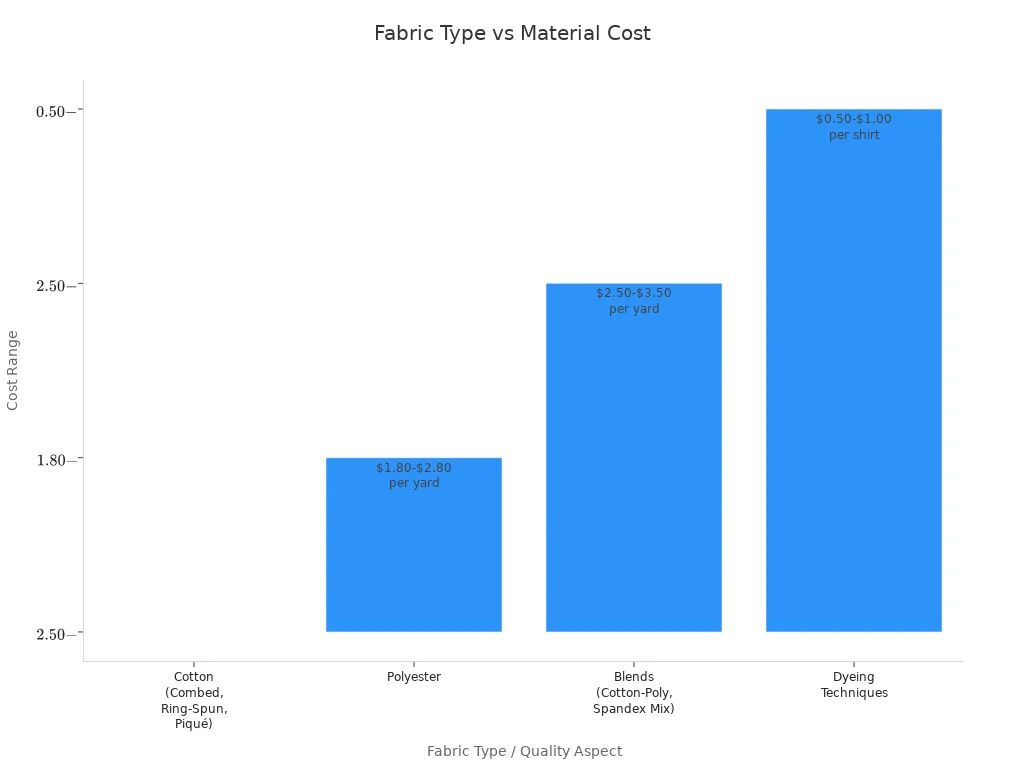
The type of fabric I choose changes the price a lot. Cotton is popular for its softness and breathability. Polyester offers durability and moisture-wicking features. Blends combine the best of both worlds.
Fabric Type / Quality Aspect | Description / Features | Cost Range (per yard or per shirt) |
|---|---|---|
Cotton (Combed, Ring-Spun, Piqué) | Breathable, soft fabric | $2.50 to $4.00 per yard |
Polyester | Durable, moisture-wicking, cost-effective | $1.80 to $2.80 per yard |
Blends (Cotton-Poly, Spandex Mix) | Balanced performance and cost | $2.50 to $3.50 per yard |
Dyeing Techniques | Reactive dyeing for vibrant colors | Adds $0.50 to $1.00 per shirt |
For example, basic cotton polos use pique knit fabric and cost less. Performance polos with advanced polyester blends cost more because of their special features.
Fabric Quality
Quality matters. Higher quality yarns make shirts last longer and feel better. Heavier fabrics and special dyeing techniques add to the price. I notice that fabric alone can account for 60–70% of the total garment cost. If I choose premium fabrics, the cost to make each shirt goes up.
Labor
Labor costs cover every step from cutting to sewing. Where the shirt is made and the skill level of workers affect the price.
Sewing
Skilled sewing makes a big difference. In low-cost countries, labor can be as low as $0.19 to $1.00 per shirt. In the U.S. or other developed countries, labor jumps to $2.00 or more per shirt. Efficient techniques, like improved hooping for embroidery, can lower labor costs.
Cost Component | Typical Cost Range (per shirt) | Notes |
|---|---|---|
Labor (Low-cost countries) | $0.30 to $1.00 | Labor cost depends on country |
Labor (U.S. and developed countries) | $2.00 or more | Higher labor costs in developed regions |
Location Impact
Location changes everything. If I order shirts from a factory in Bangladesh or Vietnam, I pay less for labor. If I choose a U.S. factory, I pay more, but I may get better working conditions and faster delivery. Labor costs also reflect the skill and experience of workers. High-quality stitching and finishing add value but increase the cost to make each shirt.
Overhead
Overhead includes all the extra costs that keep the factory running. These costs may seem small, but they add up quickly.
Equipment
Factories need machines for cutting, sewing, and finishing. Setting up these machines costs money. For example, machine setup can add about $0.50 per shirt in a batch of 300.
Cost Component | Amount (USD) | Batch Quantity (Polo Shirts) | Cost per Polo Shirt (USD) |
|---|---|---|---|
Machine setup cost | 150 | 300 | 0.50 |
Quality inspection cost | 75 | 300 | 0.25 |
Material handling cost | 50 | 300 | 0.17 |
Total batch-level cost | 275 | 300 | 0.92 |
Quality Control
Quality control protects against defects and returns. I learned that a defect rate of 20% in collars could have cost $280,000 in rework for a large batch. By improving training and inspection, the defect rate dropped to zero. Daily inspections and standard procedures help keep costs down and maintain quality.
Tip: Continuous quality control not only saves money but also protects brand reputation.

Real-World Cost Allocation
I use activity-based costing to track each expense. Industry benchmarks suggest that material costs should be 50–75% of the cost of goods sold, and labor should be 20–35%. Overhead should stay below 65% of total revenue. This helps me compare my costs to industry standards and find ways to save.
Cost Category | Benchmark Range / Ideal Value |
|---|---|
Total Manufacturing Cost | Ideally below 65% of total revenue |
Cost of Goods Sold (COGS) | Around or below 65% of revenue |
Labor Costs (as % of COGS) | Ideally between 20% and 35% |
Material Costs (as % of COGS) | Typically 50% to 75% |
Summary Table: Typical Cost Ranges
Cost Component | Typical Cost Range (per shirt) | Notes |
|---|---|---|
Materials (fabric, trims, accessories) | $0.40 to $3.59 | Depends on fabric type and quality; includes buttons, zippers, labels |
Labor | $0.19 to $2.10 | Varies by region and skill level; lower in low-cost countries, higher in developed countries |
Overhead (factory rent, utilities, maintenance, equipment depreciation) | $0.10 to $1.12 | Includes factory operating expenses; varies by location and efficiency |
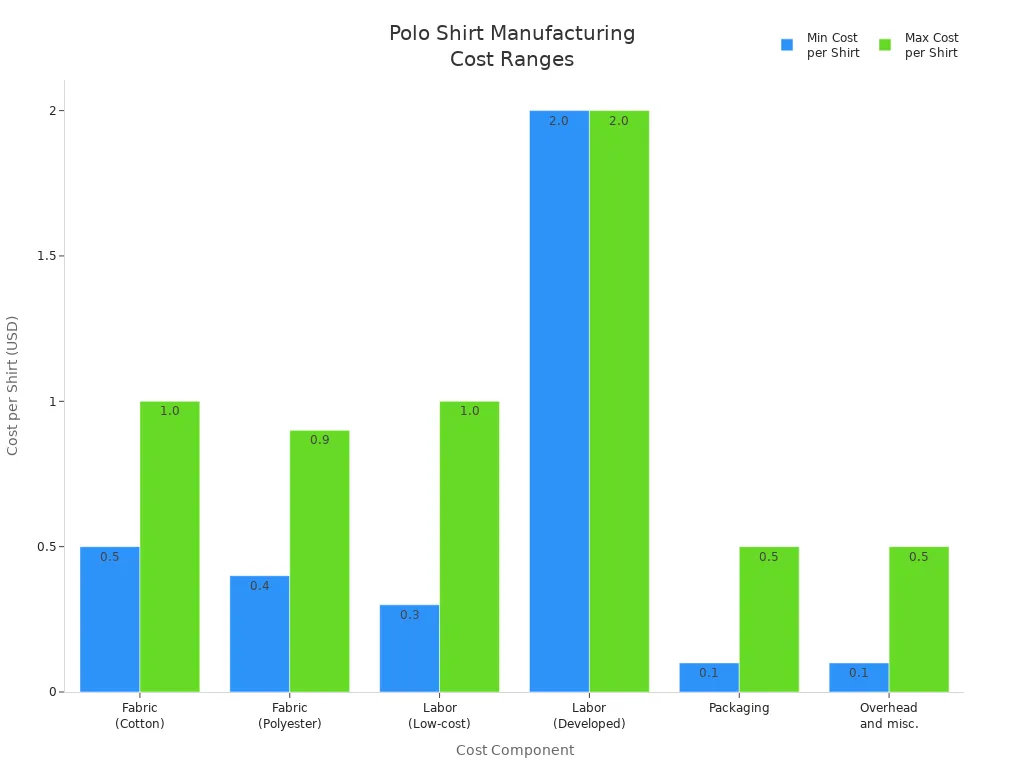
When I add up all these factors, I see that the cost to make a basic polo shirt in a low-cost country can be as little as $1.50 to $3.50. In higher-cost countries, the total rises to $5 to $8 or more. If I choose premium fabrics, advanced features, or strict quality control, the cost to make each shirt increases. By understanding each component, I can make smarter choices and control my budget.
Manufacturing Location

Domestic vs. Overseas
When I decide where to manufacture polo shirts, I see big differences in cost, speed, and quality. Domestic production in the U.S. usually means higher labor costs, which pushes the price per shirt up to $30–$60. Overseas factories, like those in Bangladesh or Vietnam, can drop the per-unit price to $10–$25. However, I must consider more than just the numbers.
Here’s a table that helps me compare the main factors:
Cost/Factor | Domestic (U.S.) Production | Overseas Production |
|---|---|---|
Labor Costs | Higher labor costs leading to higher per-unit price | Lower labor costs reducing per-unit cost significantly |
Minimum Order Quantity (MOQ) | Smaller MOQs suitable for small batch production | Larger MOQs (typically 800-1,000 units) increasing upfront investment |
Lead Time | Shorter lead times (60-90 days) | Longer lead times (90-120 days) |
Shipping Costs | Lower shipping costs, no import duties | Higher shipping costs plus import duties |
Quality Control | Easier to manage quality control | Harder to manage quality control |
Ethical & Sustainability | Higher standards with ethical labor practices | Varies; some regions have lower labor standards |
Domestic factories let me order smaller batches and respond quickly to market changes. Overseas production saves money on labor but often requires bigger orders and longer wait times. I find that quality control is easier when I work with local manufacturers because I can visit the factory and solve problems faster.
Shipping Costs
Shipping plays a major role in the total cost to make a polo shirt. When I produce shirts domestically, I avoid import duties and pay less for shipping. Local delivery is faster and more predictable. If I choose overseas production, I must pay for international freight, customs fees, and insurance. These extra costs can add $2–$6 per shirt, depending on the shipping method and destination.
Tip: I always ask suppliers for a detailed breakdown of shipping costs before placing an order. This helps me avoid surprises and plan my budget better.
Longer shipping times from overseas factories can delay my product launch. I also need to factor in the risk of lost or damaged goods during transit.
Ethical Factors
Ethical manufacturing matters to me and my customers. U.S. factories follow strict labor laws, offer fair wages, and maintain safe working conditions. Overseas factories vary in their standards. Some regions have lower wages and less oversight, which can raise concerns about worker safety and fair treatment.
I see that some overseas suppliers, like SiATEX Bangladesh, focus on transparency and fair labor practices. They offer eco-friendly polo shirts made from organic or recycled materials. Wuxi Kuanyang Textile uses recycled polyester and organic cotton blends, which cost more but support sustainability. Certifications such as OEKO-TEX and GRS prove their commitment to ethical production. These practices increase the cost to make each shirt, but they add value to my brand and help me meet customer expectations.
Note: Choosing ethical and sustainable manufacturing may raise costs, but it builds trust and supports long-term business success.
Customization Costs
When I customize polo shirts, I see that embroidery, printing, and special features all add to the cost to make each shirt. The choices I make for design and decoration can change the price a lot.
Embroidery
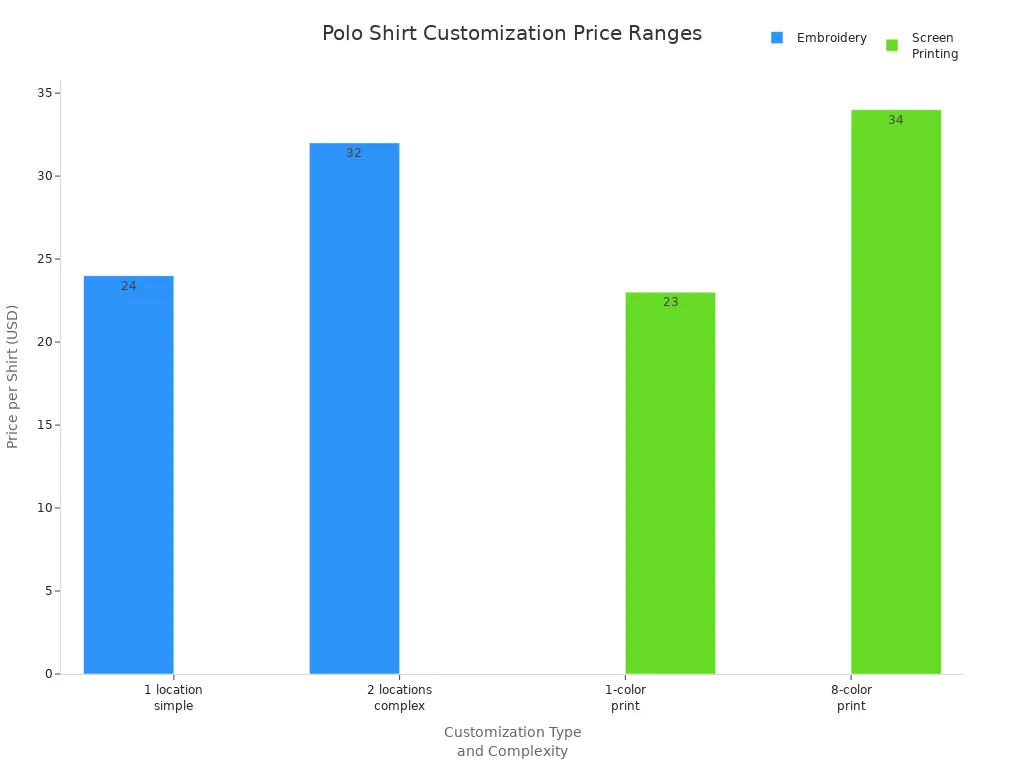
Embroidery gives polo shirts a raised, textured look that feels professional. I often choose embroidery for logos or names. The price depends on the stitch count, the number of colors, and how many places I want the embroidery. Simple designs with one location cost less. If I add more colors or put embroidery in more than one spot, the price goes up.
Customization Type | Price Range (per shirt) | Pricing Factors and Notes |
|---|---|---|
Embroidery | Simple logos cost less; more colors and locations increase price |
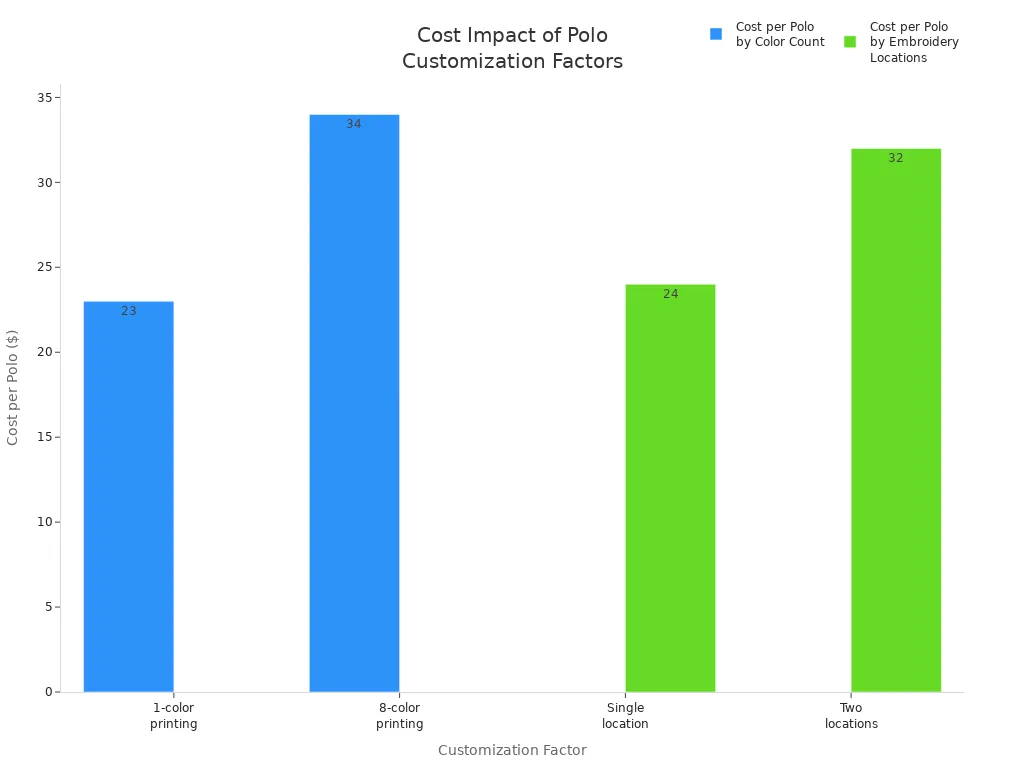
For example, a single embroidered logo on the chest costs about $24 per shirt. If I want a second logo on the sleeve, the price jumps to $32. I always check the stitch count because bigger, more detailed logos need more work and cost more.
Tip: I save money by keeping my embroidery design simple and using fewer colors.
Printing
Printing is another way I customize polo shirts. Screen printing works well for bold designs and logos. The price changes based on the number of colors and print locations. Each color needs a separate screen, which adds to setup costs. If I use just one color, I pay less. Adding more colors or printing in more places increases the price.
Customization Type | Price Range (per shirt) | Pricing Factors and Notes |
|---|---|---|
Screen Printing | $23 – $34 | 1-color printing costs less; each extra color or location adds about $8 per shirt |
If I print a one-color logo on 50 shirts, I pay about $23 each. An eight-color design costs up to $34 per shirt. Adding a second print location, like the back or sleeve, adds about $8 per shirt.
Note: Simpler designs with fewer colors help keep printing costs low.
Special Features
Sometimes I want my polo shirts to stand out. Special features like puff embroidery, tackle twill, or ombre colors add extra style. These options cost more than standard embroidery or printing. I see extra charges for each special feature I add.
Puff embroidery creates a 3D effect.
Tackle twill uses fabric patches for bold designs.
Ombre colors blend shades for a unique look.
Each special feature adds to the cost to make a shirt. I always ask my supplier for a full price list before I order. Bulk orders and simple designs help me save money, but complex customizations increase the final price.
Callout: The more custom areas and design details I add, the higher the price per shirt. I balance my budget by choosing only the features that matter most.
Order Size and Bulk Savings
Small Orders
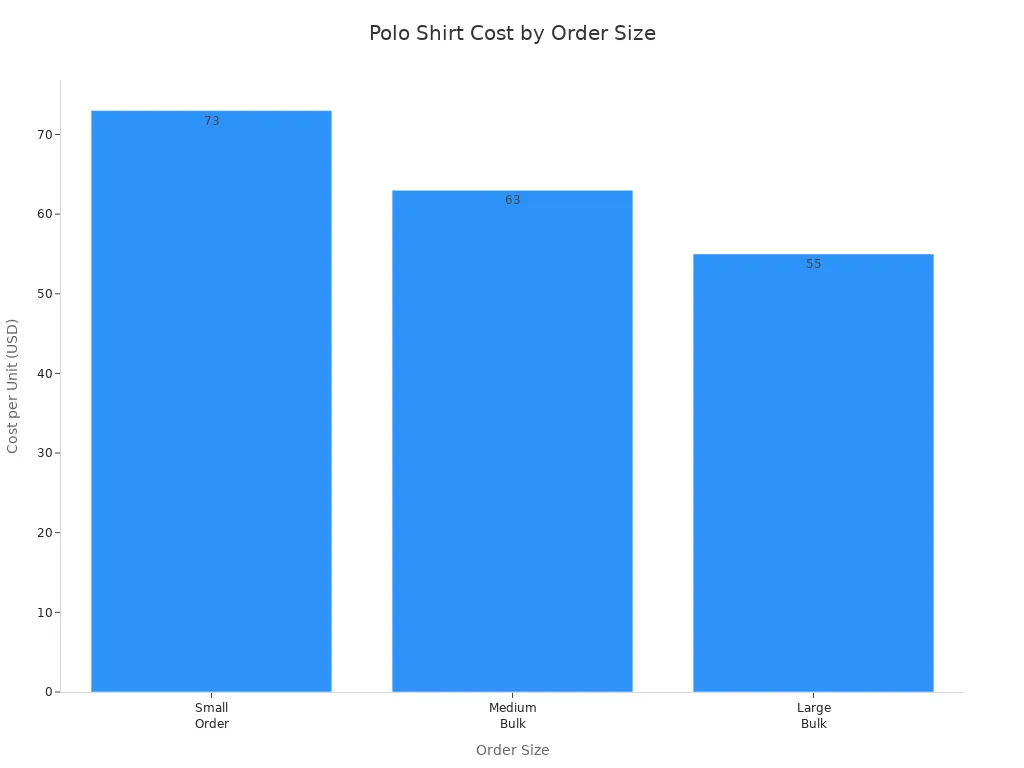
When I order a small number of polo shirts, I notice the price per shirt stays high. Suppliers charge more for small runs because setup costs do not spread out over many pieces. For example, if I buy just six Nike Dri-FIT Vertical Mesh Polos, I pay about $73 per shirt. This price includes setup fees and lacks any volume discount. Small orders work well for personal use or small teams, but I pay a premium for this flexibility.
Order Quantity | Example Product | Cost per Unit | Discount Compared to Small Order |
|---|---|---|---|
Small Order | Nike Dri-FIT Vertical Mesh Polo | $73 (6 pieces) | N/A |
Tip: Small orders give me flexibility, but I always expect to pay more per shirt.
Bulk Orders
Bulk orders change the game. As I increase my order size, the price per shirt drops. Suppliers reward larger orders with tiered discounts. For the same Nike polo, ordering 30 shirts brings the price down to $63 each—a 14% savings. If I go up to 100 shirts, the price falls to $55 each, saving me 25% compared to a small order. These savings happen because suppliers can run longer production cycles and reduce waste.
Order Quantity | Example Product | Cost per Unit | Discount Compared to Small Order |
|---|---|---|---|
Medium Bulk | Nike Dri-FIT Vertical Mesh Polo | $63 (30 pieces) | 14% savings |
Large Bulk | Nike Dri-FIT Vertical Mesh Polo | $55 (100 pieces) | 25% savings |
I see that most suppliers use price break tiers. The more I order, the better the deal. Here is a quick look at common price break points:
Price Break Tiers | Minimum Order | Notes |
|---|---|---|
24 | 24 pieces | Minimum order for screen print & embroidery |
50 | N/A | Next price break tier |
100 | N/A | Price break tier |
150 | N/A | Price break tier |
300 | N/A | Price break tier |
600 | N/A | Orders above 600 require special quote |
Ordering more shirts lets me mix and match styles to reach higher tiers. I always ask for a special quote if I need more than 600 pieces. Bulk orders help me save money, but I must balance savings with the risk of unsold inventory.
Note: Suppliers often offer special pricing for very large orders, but I need to plan carefully to avoid overstock.
Minimums
Minimum order requirements affect my buying strategy. Some suppliers, like Kavy’s Customs, let me order just one shirt, but the price stays high. Others, such as RushOrderTees, set a minimum of six embroidered polos. Volume discounts usually start at 25 pieces and get better at 50, 100, or more. I find that print-on-demand options work for single shirts, but the per-unit price is much higher.
I always check the minimums before I order. If I want the best price, I try to reach the next price break tier. Sometimes, I combine different shirt styles with the same design to hit a higher tier and unlock better pricing.
Callout: I save the most money by planning my order size to match supplier price breaks. This strategy helps me get the best value for my budget.
Real-World Price Examples
Basic Polo
When I look for basic polo shirts, I see that leading brands like Gildan, Hanes, and Jerzees offer some of the best deals, especially for bulk orders. These polos work well for uniforms, events, or giveaways. They use simple cotton or polyester blends and come in a wide range of sizes. Wholesale prices start as low as $1.98 per shirt for men’s and kids’ polos. Retail prices can reach up to $49.99, but most basic polos sell for $18 to $25 each when I buy in moderate quantities.
Here’s a quick table showing typical prices for basic polos:
Polo Shirt Category | Wholesale Price | Retail Price | Brands | Notes |
|---|---|---|---|---|
Men’s Polo Shirts | $1.98+ | Up to $49.99 | Gildan, Hanes, Jerzees | Bulk discounts available, wide size range |
Women’s Polo Shirts | $1.50+ | N/A | Same as above | Tailored fit, feminine styles |
Kids’ Polo Shirts | $1.98–$2.25 | $8.25–$8.95 | Same as above | Good for school uniforms |
Tip: I always check for volume discounts and free shipping on orders over $250 to save even more.
Custom Polo
Custom polos let me add logos, names, or special designs. The price depends on the type of customization, the number of colors, and how many shirts I order. Embroidery and screen printing both add to the price, especially for complex designs. For example, a Gildan DryBlend® Jersey Sport Polo with a single embroidered logo costs about $23 per shirt when I order 50 pieces. If I want more colors or extra embroidery locations, the price increases.
Here’s what I usually see for custom polos:
Simple embroidery (one logo, one location): $23–$32 per shirt
Screen printing (one color): $23–$28 per shirt
Extra features (multiple logos, puff embroidery): Add $5–$10 per shirt
I find that ordering more shirts lowers the price per piece. Bulk orders help me get the best value for custom polos.
Premium Polo
Premium polos stand out because of their high-quality fabrics, advanced features, and brand reputation. Brands like Nike and TravisMathew use performance materials, moisture-wicking technology, and stylish designs. These shirts feel softer, last longer, and look more professional. The price reflects these upgrades.
For premium polos, I see prices ranging from $50 to $80 per shirt. Some high-end options, like the TravisMathew Oceanside Heather Polo, can cost up to $107 each, especially for small orders or when I add custom embroidery.
Polo Shirt Category | Price Range (per piece) | Example Product & Price (50 pieces, embroidered) |
|---|---|---|
Basic | $18–$25 | |
Midrange | $25–$50 | Harriton Ringspun Cotton Pique Polo – $21 |
Premium | $50–$80+ | TravisMathew Oceanside Heather Polo – $107 |
Note: Premium polos cost two to four times more than basic models, but they offer better comfort, durability, and brand appeal.
Save on Polo Shirt Costs
Material Choices
When I want to save money on polo shirts, I start by looking at my material options. I find that negotiating better prices with fabric suppliers works well, especially when I buy in bulk. Bulk purchasing lets me take advantage of economies of scale, which lowers the price per yard. I also focus on reducing waste by using lean manufacturing techniques. This means I plan my fabric cuts carefully and avoid leftover scraps.
I have learned that investing in automation technology can speed up production and reduce mistakes. This helps me keep quality high without raising costs. I always maintain strict quality control at every stage. By catching problems early, I avoid expensive rework later. I also try to combine skilled workers with new technology. This mix gives me fast turnaround times and consistent results.
Sustainability matters to me and my customers. I look for ways to use less water and energy during production. Choosing recycled or organic materials sometimes costs more upfront, but it can lower my long-term expenses and attract eco-conscious buyers. Streamlining my operations from fabric purchase to final stitching helps me save both time and money.
Tip: I always ask suppliers about sustainable options and bulk discounts before making a decision.
Order Strategies
Order strategies play a big role in how much I pay for polo shirts. I save the most when I buy in bulk. Large orders lower the unit cost because suppliers can produce more shirts at once. Sometimes, I join group buys with other brands to reach the minimum order quantity and unlock better pricing.
Building long-term relationships with my suppliers helps me get flexible terms and occasional discounts. I often negotiate tiered pricing, so the more I order, the less I pay per shirt. I also ask about payment terms that let me spread out my costs. Using stock fabrics and standard patterns reduces my risk and investment.
Here are some order strategies I use:
Buy in bulk to lower unit costs and qualify for free shipping.
Consolidate orders with others to meet minimums and get bulk pricing.
Negotiate for seasonal discounts or promotional pricing.
Use standard designs to simplify sourcing and reduce costs.
Build strong supplier relationships for better deals and reliability.
Note: I always clarify product requirements with my supplier to avoid misunderstandings and hidden fees.
Customization Tips
Customizing polo shirts adds value, but it can also increase costs if I am not careful. I keep my designs simple to control expenses. For example, I limit embroidery to one location, such as the left chest, and use single-color logos. This reduces setup and thread costs.
I choose standard materials like basic cotton pique unless I need premium fabrics for a special project. I select budget-friendly brands for most orders and reserve premium brands for when brand recognition is important. Planning ahead helps me avoid rush fees, since standard shipping is usually free and more cost-effective.
I also look for providers who offer free digitizing and setup. Mixing sizes, styles, and colors within one order helps me reach higher price break tiers without overcommitting to one style. I balance my size mix carefully, since larger sizes may cost more, but averaging them out keeps my budget in check.
Limit embroidery to one area to avoid extra charges.
Choose standard materials for most projects.
Keep designs simple and use single-color embroidery or printing.
Plan orders early to avoid rush fees.
Mix sizes and styles to reach better pricing tiers.
Callout: I always ask for a full quote, including all setup and shipping fees, before I place my order. This helps me avoid surprises and stick to my budget.
Supplier Selection
Choosing the right supplier shapes my entire polo shirt project. I always start by researching potential partners and checking their reputation. I look for suppliers who communicate clearly, offer transparent pricing, and have a track record of delivering quality products on time. Before I commit, I request samples to check fabric, stitching, and customization quality. This step helps me avoid surprises later.
I never rush the vetting process. I ask for references from other clients and read online reviews. If possible, I visit the supplier’s facility or request a virtual tour. This gives me confidence in their production standards and working conditions.
To avoid hidden fees and ensure cost transparency, I use a checklist of questions. Here’s a table I rely on during my supplier interviews:
Key Questions to Ask Suppliers | Explanation |
|---|---|
Minimum Order Quantities (MOQs) | Confirm if there is a minimum order size, as embroidery often has a 6-piece minimum, while printing may have none. |
Setup and Digitizing Fees | Ask if these fees exist or are waived; some suppliers offer free digitizing and no setup fees. |
Shipping Costs and Turnaround Times | Verify if shipping is free or charged, and confirm expected delivery times including rush options. |
Volume Discounts | Inquire about price breaks for larger orders to reduce per-shirt cost. |
Customization Fees | Check for extra charges for additional embroidery locations or complex designs. |
Satisfaction Guarantees | Understand the supplier’s policy on product satisfaction and defect handling. |
I also make sure to ask these important questions:
What are your minimum order quantities? Are they flexible?
How does the price per shirt change with order size?
Do you charge setup or digitizing fees?
What is your policy on defects and returns?
What are your shipping costs and lead times?
How do you handle quality control and inspections?
Can you meet my custom design requirements?
Do you follow ethical and sustainable manufacturing practices?
I pay close attention to extra costs that might not appear in the initial quote. I ask about packaging, labeling, and pre-shipment inspection fees. If I work with international suppliers, I confirm if currency exchange fees apply. I always clarify who pays for defective items and how returns are handled.
Tip: I never hesitate to ask for a full, itemized quote before placing an order. This helps me avoid unexpected charges and keeps my budget on track.
A reliable supplier answers my questions openly and provides clear documentation. By staying organized and asking the right questions, I protect myself from hidden fees and ensure a smooth production process.
Cost vs. Quality
Balancing Price
When I choose a manufacturer for polo shirts, I always try to find the right balance between price and quality. I know that going for the lowest price can lead to problems with fabric, stitching, or fit. To avoid this, I follow a step-by-step approach:
I inspect the fabric before cutting. This helps me spot defects early.
I ask for in-process quality checks during cutting, sewing, and adding logos.
I request a final inspection for visual defects, sizing, and function.
I test random samples for wash durability, pilling, and strength.
I make sure the supplier uses the same standards for all order sizes.
I look for sustainable practices like water and energy savings, waste reduction, and eco-friendly materials.
I check for certifications such as GOTS, Oeko-Tex, or Bluesign.
I also compare countries. For example, China offers good prices for large orders and advanced technology, but quality can vary. Bangladesh has the lowest labor costs and is improving in quality, but lead times are longer. Vietnam provides skilled workers and ethical practices at moderate prices. India is great for cotton polos but sometimes has inconsistent quality. Turkey costs more but meets high European standards and ships quickly to Europe.
I always consider my brand’s needs. If I want a premium image, I pay more for better materials and finishing. For basic uniforms, I might choose a budget option with reliable quality. Customization, like embroidery, adds value but increases the price. Ordering in bulk helps me lower the per-shirt cost.
Supplier Questions
Before I pick a supplier, I ask key questions to make sure I get both quality and value:
Can you break down the materials, costs, and each step of your process?
What experience do you have with polo shirts, and how skilled is your team?
How do you handle quality control and what checks do you perform?
Do you have certifications for quality or sustainability?
How do you manage delays or problems with orders?
What is the fabric composition and weight? Does it include stretch?
What branding options do you offer, and how durable are they?
Can you prove your claims about ethical and environmental standards?
How do you set your prices, and are there any hidden fees?
I also check how fast and clearly they respond to my questions. Good communication builds trust and helps avoid mistakes.
Red Flags
I watch for warning signs that a supplier might not deliver good quality or fair pricing:
Vague sizing, like only Small, Medium, Large, with no details.
Uneven seams, crooked buttonholes, or mismatched patterns.
Loose threads, unraveling hems, or pilling on samples.
Poor finishing, such as crooked plackets or pocket flaps.
Prices that seem too low or have unclear components, like hidden sample or shipping fees.
Poor sample quality or refusal to improve samples.
Tip: If a supplier avoids questions or offers prices that seem too good to be true, I look elsewhere. Quality issues and hidden costs can hurt my brand and budget.
When I look at the cost to make a polo shirt, I see several key drivers:
Understanding each cost component helps me plan my budget and avoid surprises. To make smart decisions, I:
Ask about minimum order quantities, customization, and shipping
Asking the right questions and exploring options ensures I get the best value for my brand.
FAQ
How much does it cost to make a basic polo shirt?
I usually see basic polo shirts cost between $5 and $15 each when I order in bulk from overseas suppliers. Domestic production costs more, often $18 or higher per shirt.
What is the biggest factor in polo shirt pricing?
Material quality makes the biggest difference. Premium fabrics and special blends raise the price. Labor and customization also add to the total cost.
Can I order just one custom polo shirt?
Yes, I can order a single custom polo from some suppliers. The price per shirt will be much higher, often $30 or more, because setup costs do not spread out.
How do I save money on large orders?
I save the most by ordering in bulk. Suppliers offer price breaks at higher quantities. I also keep designs simple and use standard materials to lower costs.
Does embroidery cost more than printing?
Embroidery usually costs more than screen printing. It adds texture and durability but takes more time and skill. I choose printing for large, colorful designs to save money.
What should I ask my supplier before ordering?
I always ask about minimum order quantities, setup fees, shipping costs, and turnaround times. I request a full quote and check for hidden fees or extra charges.
Are sustainable polo shirts more expensive?
Sustainable polos often cost more because of eco-friendly materials and ethical labor. I find the extra cost worth it for better quality and brand reputation.