

Cafe Staff Uniform OEM Procurement Checklist | Barista & Floor Teams
Table of Contents
Display
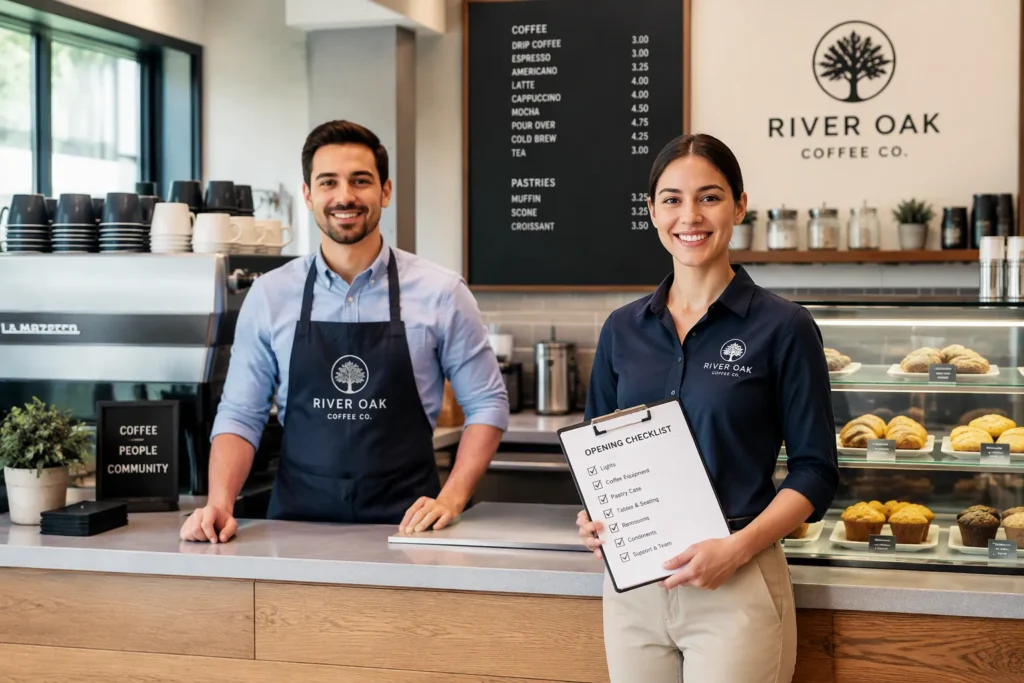
Baristas and floor teams have different needs, so you need separate specs for aprons and polos versus floor shirts. This cafe staff uniform OEM checklist covers both roles at once. You will go through the practical steps only: role split, stain and wash notes, size runs across stores, logo placement, sample, PPS, bulk, and reorder packs.
The checklist is for cafe brand HQ teams, franchise operations, and regional coffee chains. Each step builds on the one before it, and skipping one costs you time later. A copy-paste checklist is at the end, ready for your next supplier talk.
Key Takeaways
Follow these six steps in order: split up the roles, note the stains, set the size runs, place the logos, do the sample and PPS, then handle bulk and reorder packs.
Make separate specs for baristas and floor teams. Each role needs different fabrics and features.
Use three quality checks: the development sample, the PPS sign-off, and the bulk inspection.
Lock colorways and size breaks in the RFQ before you ask the factory to quote.
Pool size adds up from all city stores to make one size run that fits everyone.
Set one logo placement rule in millimeters for every garment and every store.
Sign and date the PPS, and keep copies at HQ and the factory for reorders.
Use the copy-and-paste checklist at the end to help you plan your next talk with a supplier.
Cafe staff uniform OEM: quick takeaways
You can treat this whole program as a short list of gates. Each gate has a clear pass or fail, and each one protects the next. The bullets below give you the short version before the detailed sections.
The six stages run in order: role split, stain and wash notes, size runs across stores, logo placement, sample and PPS, then bulk and reorder packs.
Baristas need aprons and polos built for heat and spills, while floor teams need shirts built for presentation and movement.
Three gates decide quality: the development sample, the PPS sign-off, and the bulk inspection.
Your minimum order quantity sits in the low thousands per style, so plan colorways and size breaks with that volume in mind.
A copy-paste checklist waits at the end, and you can hand it straight to a supplier.
Six stages at a glance
The six stages form one chain. You start with the role split, because barista and floor work pull fabric in different directions. Next comes stain and wash notes, where you record how espresso, milk, and daily laundering affect each garment. Size runs across stores follow, and this step catches gaps between city locations. Logo placement standards come next, so every store shows the same mark in the same spot. Sample and PPS approval follow, and bulk with reorder packs close the chain.
Skip a stage and the cost shows up later. A missing size run turns into emergency orders. A loose logo standard turns into mismatched stores. Treat each stage as a checkpoint, not a formality.
Barista vs floor team in one line each
A barista works behind a hot machine, reaches across steam, and leans into spills, so the apron and polo must handle heat and repeated washing without losing shape. A floor team member moves between tables, carries trays, and faces guests up close, so the floor shirt must stay crisp, allow free arm movement, and hold a clean front through a full shift.
Both roles share your brand mark and your color palette. The specs diverge on fabric weight, pocket layout, and stain response. Write the two briefs separately, even when one supplier makes both.
The gate most buyers skip
Most buyers approve a sample and then jump straight to bulk. They skip the PPS, or pre-production sample, which is the sealed reference built from your final fabric, trim, and logo placement. The PPS is the garment your factory must match on every unit. Without it, bulk inspection has no benchmark, and disputes become opinion against opinion.
Seal the PPS with a signature and a date. Keep one copy at HQ and one at the factory. Every reorder then starts from that same reference, and your cafe staff uniform OEM program stays consistent across stores and seasons.
Table of contents
Use this map to go through the guide in the same order as your own buying cycle. Each heading below marks one decision point, and each one passes a finished result to the next.
Cafe staff uniform OEM: quick takeaways
Who this checklist is for
Buyer intent and factory
Barista vs floor-team spec differences
RFQ and specs table
Sample, PPS, and bulk gates
Catalog vs OEM comparison
Cafe staff uniform OEM procurement checklist
FAQ
Internal links
CTA
The opening sections set your scope. Quick takeaways give you the six-stage chain in short form, and the audience section confirms whether your team owns this project or shares it with franchise partners. Buyer intent and factory then shows you what a workable OEM partner looks like, so you can make a shortlist with confidence before you write a single spec line.
The middle sections carry the technical work. Barista versus floor-team specs split your brief into two documents, one for aprons and polos and one for floor shirts. The RFQ and specs table turns that brief into a form a supplier can quote against. Sample, PPS, and bulk gates then walk you through the three approval points that protect quality. The catalog versus OEM comparison helps you decide how much customization your brand really needs.
The closing sections turn planning into action. The copy-paste checklist collects every item into one page you can print or share. The FAQ answers the questions that come up in supplier calls, and the internal links point you to deeper pages on cafe, barista, and waitstaff programs. The CTA gives you the direct route to start an RFQ.
Read the guide once from top to bottom on your first project. On later orders, jump straight to the checklist and the gates. That habit keeps your barista and floor-team programs aligned across every city store you open.
Who this checklist is for
Cafe brand HQ teams
You own the brand standard, so you own this checklist. Your team sets the color palette, the logo file, and the fit that every store must follow. You also hold the final say on fabric weight and wash performance, because a weak spec in one city store becomes a brand problem in all of them.
Run the six stages in order and keep the paperwork at HQ. Store the sealed PPS next to the logo artwork and the size run. When a new city store opens, you send that same pack to the supplier. The store then receives garments that match every other location, and your brand looks the same from the first counter to the last.
Franchise operations
You balance two pressures at once. Franchisees want uniforms that fit their local staff and their local climate. Your brand agreement demands a consistent look across every outlet. This checklist gives you a shared language for both sides, so a franchisee can raise a real need without breaking the standard.
Use the role split and the size run sections as your negotiation tools. Agree on the barista apron and polo spec once, then let each franchisee order within that frame. Collect their size counts before you place the bulk order, and pool the numbers into one production run. A pooled order protects the brand, simplifies your reorder calendar, and saves each franchisee from running a separate sourcing project.
Regional coffee chains
You operate several stores across a region, and your store count grows in steps. That growth pattern shapes your buying. A single new store needs a small top-up, while a cluster of openings needs a full production run. This checklist helps you plan both without rebuilding the spec each time.
Treat the reorder pack as your core asset. Keep the approved fabric, trim, and logo placement on file with your supplier. When a new store joins the chain, you pull from that pack and place a top-up order. Your regional team then spends its time on store openings, not on re-specifying shirts. The same pack also keeps older stores supplied when a garment wears out mid-season.
Buyer intent and factory
What buyers want from an OEM partner
Cafe brands come to an OEM partner with a short list of demands. You want a supplier who reads your role split and quotes two specs, not one. You want fabric guidance for espresso stains and daily washing. You want a size run that covers every city store. You want logo placement held to one standard. Above all, you want a partner who treats the PPS as a sealed reference and repeats it on every reorder.
Price talk comes later. First, test whether the supplier asks the right questions. A strong partner asks about wash cycles, heat exposure at the bar, and the number of stores in your rollout. A weak partner sends a catalog and a unit cost. Use the first call to judge intent, and use the sample to judge execution.
Factory snapshot: Shanghai Top Fortune, about 2002, 1,506 m2 Songjiang
Shanghai Top Fortune Industry Co., Ltd. is one factory you can shortlist. The company started around 2002 and runs a 1,506 m² plant in Songjiang, Shanghai. Its core work is OEM/ODM workwear and F&B staff apparel, and it exports to Europe, the Middle East, Oceania, Southeast Asia, and the Americas. You can review the company at workwearmanufacturer.com and read its background on the about-us page.
The minimum order sits at about 2,000 pieces per style, so plan your colorways and size breaks around that volume. The team serves adult B2B cafe and coffee-shop brands and multi-unit F&B operators. School uniforms and PPE lines fall outside this focus.
Reach the team at rill@topfortunemail.com or WhatsApp +86 13524210501. The address is Floor 3, Building 20, Haier Zhigu, No.66 Guangfulin East Road, Songjiang, Shanghai 201600.
Using this section in shortlisting
Turn this snapshot into a scorecard. List three or four candidate factories, then mark each one against four points: F&B staff apparel experience, a clear sample and PPS process, a size-run method for multi-store brands, and a reorder pack offer. A factory that covers all four moves to the next round.
Keep the shortlist small. Two or three strong candidates give you enough comparison without spreading your brief too thin. Send the same RFQ to each one, and compare the answers side by side. The factory that asks sharper questions usually delivers the cleaner bulk order.
Barista vs floor-team spec differences
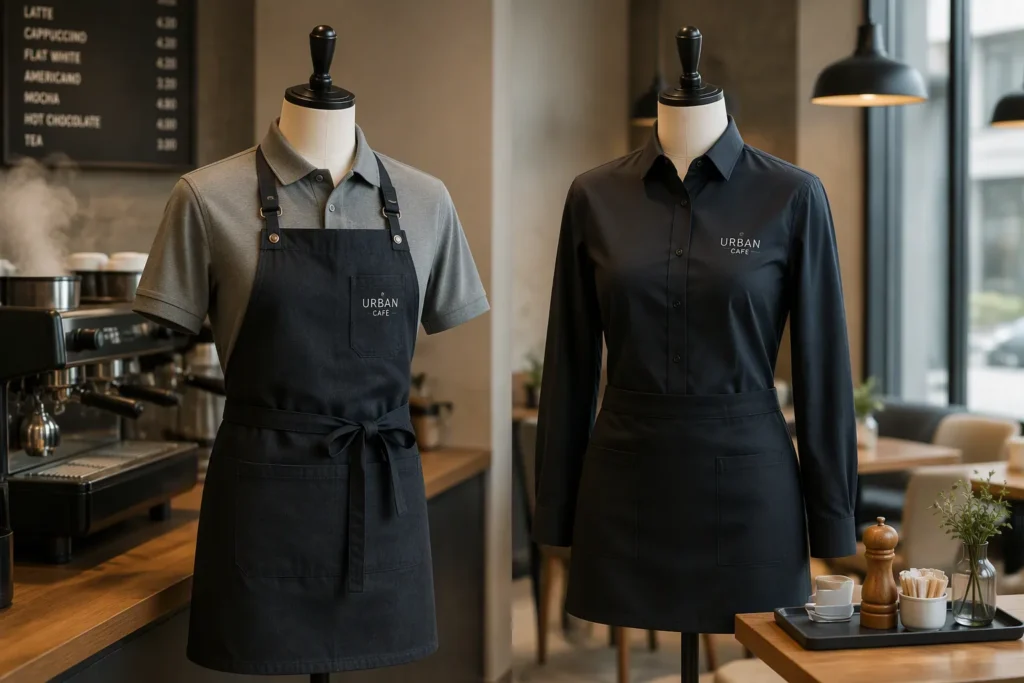
Your brief splits into two documents at this point. One covers the barista apron and polo. The other covers the floor shirt. Both carry your brand mark, yet each answers a different working day. Write them separately, then hand both to the same supplier.
Barista specs: heat and spills
A barista stands close to a hot machine for hours. Steam rises at the group head, milk pitchers pass hand to hand, and espresso grounds land on fabric. Your barista spec must answer that environment before it answers anything else.
Start with the apron. Choose a fabric that resists liquid absorption at the front panel, because spilled milk and espresso sit on the surface before they soak in. A tightly woven cotton or a cotton-blend twill works well here. Check the tie or strap system under real movement. A barista reaches forward, turns to the grinder, and leans to the fridge. Straps that loosen mid-shift force constant readjustment.
The polo underneath needs breathability. Heat at the bar builds through a full shift, so a fabric that traps air turns uncomfortable fast. Look for a knit with some airflow and a collar that holds its shape after washing. Espresso stains set quickly, so confirm the wash instructions with your supplier and test a sample through repeated cycles before you approve it.
Pocket layout matters more than buyers expect. A barista needs a small chest pocket for a pen or a thermometer, and it must sit clear of the apron bib. Deep pockets that catch on the apron edge slow the team down. Keep the pocket shallow and place it high.
Floor team specs: presentation and mobility
A floor team member meets guests at the table. The shirt is the closest garment to the customer, so presentation leads the spec. The fabric must hold a clean front through a shift, resist light marks from trays and condiments, and keep a pressed look without ironing between services.
Mobility comes second but ranks close. Floor staff carry trays, reach across tables, and move between rooms. A shirt with a narrow armhole restricts that reach. Test the sample through a full range of arm movement before you sign off. A back pleat or a slightly relaxed cut gives room without looking loose.
Pocket needs differ from the barista side. A floor shirt often needs no chest pocket at all, because a visible pen or notebook breaks the clean line. If your team carries an order pad, choose a discreet welt pocket instead of a patch pocket. Keep the front panel simple.
Shared specs and logo placement
Both roles share your color palette, your fabric care standard, and your logo standard. Set one logo placement rule for the whole estate. A common choice puts the mark on the left chest for polos and shirts, and on the apron bib for baristas. Fix the size, the thread color, and the position in millimeters on the tech pack. Every city store then shows the same mark in the same spot.
Size runs need the same discipline. Collect counts from each city store before you finalize the order. City teams vary in body size, and a run built from one store’s numbers leaves gaps elsewhere. Build the run from pooled counts, and keep a small buffer in the middle sizes.
Catalog uniforms fit some programs well. A chain with a tight timeline and a simple look can start from a catalog polo and add its logo. The catalog route moves faster and needs less development work. The OEM route gives you control over fabric, pocket layout, and fit across both roles. Many cafe staff uniform OEM programs combine the two: catalog floor shirts for speed, custom barista aprons for the front of house. Neither choice is wrong. Match the route to your timeline and your brand standard.
RFQ and specs table
What to put in the RFQ
Your RFQ turns the two role briefs into one document a supplier can quote against. Start with the program scope: the number of stores, the roles covered, and the colorways you plan. Name both garment types, the barista apron and polo and the floor shirt, and attach the tech pack for each. State your target delivery window and the city stores in the first rollout.
Add the working conditions next. Describe the espresso environment, the daily wash routine, and the heat at the bar. Give the supplier your logo file and the placement rule in millimeters. List the size counts you pooled from each store. Close with the approval path: development sample first, then the sealed PPS, then bulk. A supplier who sees the full path quotes more accurately and asks fewer questions later.
Specs table columns
A clean specs table keeps both roles side by side, so the supplier cannot blur them. Use one row per garment and one column per attribute. The table below shows the columns worth carrying into every RFQ.
Column | Barista apron and polo | Floor shirt |
|---|---|---|
Fabric and weight | Tight weave, liquid-resistant front panel | Crisp weave that holds a pressed look |
Heat response | Breathable knit at the bar | Lightweight for room movement |
Pocket layout | Shallow high chest pocket, clear of the bib | Discreet welt pocket or none |
Logo placement | Bib front, fixed position | Left chest, fixed position |
Size run | Pooled counts from all city stores | Pooled counts from all city stores |
Approval gates | Sample, PPS, bulk | Sample, PPS, bulk |
Add a wash-cycle column and a reorder-pack column if your program runs many stores. Keep the table to one page. A supplier reads a short table faster and misses less.
RFQ mistakes to avoid
The most common mistake is one blended brief. A supplier who receives a single spec for both roles will average the fabric and the fit, and neither team gets the right garment. Send two specs, even when one factory makes both.
Never send an RFQ without the logo placement rule and the pooled size counts. A missing rule invites guesswork, and guesswork shows up in bulk.
A second mistake is silence on the approval path. Name the sample, the PPS, and the bulk inspection in the RFQ itself. A third mistake is a vague wash note. Describe the real cycle your teams run, and the supplier can match the fabric to it.
Sample, PPS, and bulk gates
Three approval points protect your order. Each gate has a clear pass or fail, and each one feeds the next. Treat them as checkpoints you control, not steps you hand off to the supplier.
Gate 1: Development sample
The development sample is your first physical garment. You send the tech pack, the logo file, and the two role briefs, and the factory builds a prototype of the barista apron, the polo, and the floor shirt. This sample answers one question: does the factory understand your brief?
Test the sample against real work. Put the apron on a team member and run a shift. Check the strap system through reaching, turning, and leaning. Wear the polo near heat and confirm the knit breathes. Try the floor shirt through a full range of arm movement. Wash each piece through your real cycle and inspect the seams, the collar, and the logo after drying.
Mark every gap in writing. Note the pocket position, the fabric hand, and the logo size. Send the marked sample back with your comments. A factory that returns a corrected sample shows it reads feedback well. That habit matters more at the next gate.
Gate 2: PPS sign-off
The PPS is the pre-production sample built from your final fabric, trim, and logo placement. It is the sealed reference your bulk order must match. Approve it only after the development sample comments are fully resolved.
Check the PPS against the tech pack line by line. Confirm the fabric weight, the pocket layout, the logo position in millimeters, and the size grading across your pooled store counts. Compare the barista and floor specs side by side, so neither garment drifts toward the other. Sign and date the approval, then keep one copy at HQ and one at the factory.
A PPS approved without a signature and a date gives your bulk inspection no benchmark. Disputes then become opinion against opinion.
Gate 3: Bulk and inspection
Bulk production starts from the sealed PPS. Before the run begins, confirm the factory holds the correct fabric lot and the approved logo file. Ask for a production schedule with the inspection date built in.
Inspect the bulk order against the PPS, not against memory. Pull units from the start, the middle, and the end of the run. Check the logo placement, the size labels, and the seam quality on each pull. Compare the fabric hand to the sealed reference. Record every finding with photos and unit counts.
Pass the order only when the bulk matches the PPS. Hold back any units that fail, and agree on a correction plan before shipment. Close the gate with a signed inspection report, and file it next to the PPS. Your reorder pack then starts from a documented, repeatable standard.
Catalog vs OEM comparison
You face one clear decision at this point: start from a catalog garment or build from your own spec. Both routes reach a finished uniform. They differ in how much control you hold and how much development work you carry. The table below sets the three common routes side by side.
Attribute | Catalog | OEM | Hybrid |
|---|---|---|---|
Fit | Standard block, limited adjustment | Built to your measurements and role split | Catalog body with custom trim or logo |
MOQ | Lowest entry volume | Higher minimum volume per style | Mid-range, depends on the mix |
Lead time | Shortest, stock permitting | Longest, includes sample and PPS gates | Between the two |
Logo control | Placement varies by stock item | Fixed position in millimeters on the tech pack | Logo controlled, body standard |
Reorder ease | Simple repeat from stock | Repeat from the sealed PPS | Repeat from the PPS for custom parts |
When catalog fits best
A catalog route suits a chain with a tight opening date and a simple look. You pick a polo or shirt from a supplier range, add your logo, and place the order. The supplier already holds the pattern and the fabric, so development work stays small. A new city store can open on schedule without waiting for a full sample cycle.
Catalog also fits a brand that runs one role only. If your floor team wears a plain shirt and your baristas supply their own aprons, a catalog shirt covers the need. You keep the logo standard and skip the custom pattern work. The route moves fast and keeps your team focused on store openings.
When OEM fits best
OEM fits a brand with a distinct look and two roles to dress. You control the fabric weight, the pocket layout, the apron strap system, and the logo position. Your barista and floor specs stay separate, and each garment answers its own working day. A chain that wants its uniform to carry the brand identity chooses this route.
OEM also fits a program with steady volume across many stores. The higher minimum volume per style rewards a pooled order from all city stores. You build the spec once, seal the PPS, and repeat it on every reorder. The upfront work is larger, and the payoff is a uniform that matches across every location.
Hybrid approach
The hybrid route takes the best of both. You start from a catalog body for the floor shirt, then add your logo and a custom trim. For the barista side, you build a custom apron to your own spec. The floor team gets speed, and the front of house gets control.
A hybrid program keeps the reorder pack simple. The custom parts repeat from the sealed PPS, and the catalog parts repeat from stock. You hold one standard for the whole estate without rebuilding every garment. Many cafe staff uniform OEM programs run this way, and the mix lets you match each role to the route that serves it best.
Cafe staff uniform OEM procurement checklist
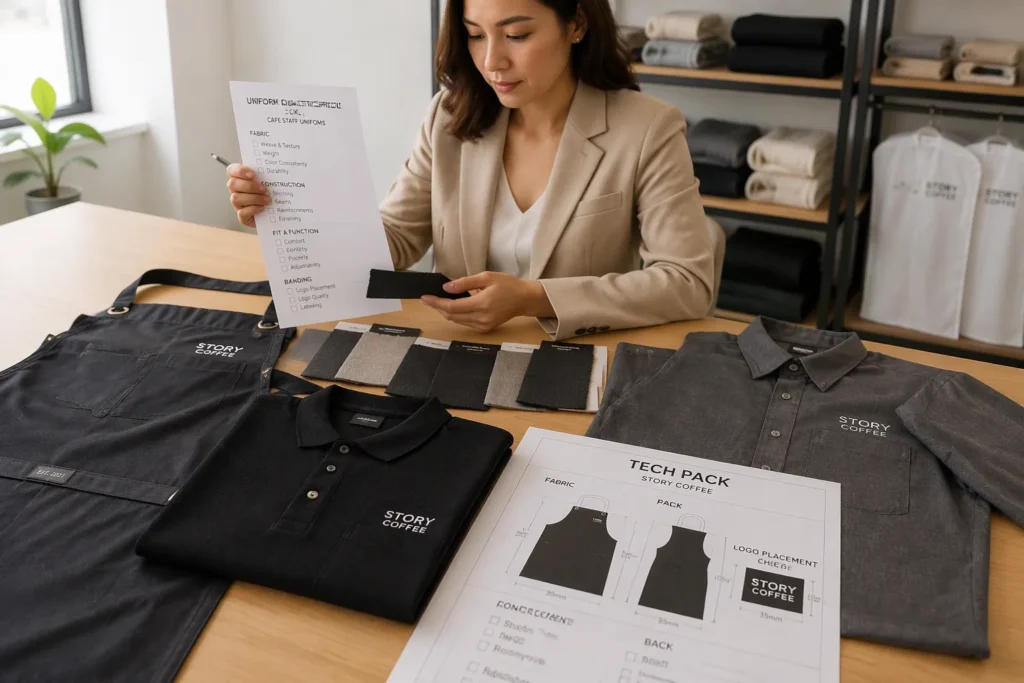
This section turns the whole guide into one working page. Print it, paste it into your project tool, or send it to your supplier as the agenda for the next call. Each block below matches one phase of the program, and each item has a clear done or not-done state. Work through the blocks in order on a first order. On a reorder, run the third block only.
Needs and design checklist
Start with the role split, because every later decision depends on it. Write two briefs, one for the barista apron and polo and one for the floor shirt. Keep them in separate files, even when one factory makes both garments.
List every role that wears a uniform, and mark each one as barista or floor.
Write the barista brief: apron front panel, strap system, polo knit, chest pocket position.
Write the floor brief: shirt weave, armhole width, front panel, pocket type.
Record the real wash cycle for each role, including temperature and drying method.
Note the heat exposure at the bar and the movement range on the floor.
Confirm the color palette and the fabric care standard for the whole estate.
Decide the route for each garment: catalog, OEM, or hybrid.
Collect reference garments from your current stores for the supplier to see.
Size runs, logo standards, and supplier checklist
Pooled size counts protect every city store. Collect numbers from each location before you finalize anything, then build one run from the total. A run built from a single store leaves gaps elsewhere.
Request size counts from every city store in the rollout.
Pool the counts into one size run, with a small buffer in the middle sizes.
Confirm the size grading method with the supplier before sampling.
Fix the logo position in millimeters on the tech pack for each garment.
Set one thread color and one logo size for the whole estate.
Send the logo file in the format your supplier requests.
Shortlist two or three factories with F&B staff apparel experience.
Score each candidate on role-split reading, sample process, size-run method, and reorder pack offer.
Send the same RFQ to every candidate, with both role briefs attached.
Name the sample, PPS, and bulk gates inside the RFQ itself.
Sampling, ordering, and QC checklist
The three gates decide the quality of your cafe staff uniform OEM program. Treat each one as a checkpoint you control. A gate passed without a signature gives the next stage no benchmark.
Receive the development sample for the apron, polo, and floor shirt.
Run a live shift test on each garment, including reach, heat, and lean.
Wash each sample through your real cycle and inspect seams, collar, and logo.
Return the sample with written comments on pocket, fabric hand, and logo size.
Approve the PPS only after every sample comment is resolved.
Check the PPS against the tech pack line by line, including size grading.
Sign and date the PPS, then keep one copy at HQ and one at the factory.
Confirm the fabric lot and logo file before bulk production starts.
Request a production schedule with the inspection date built in.
Pull units from the start, middle, and end of the run for inspection.
Compare each pull to the sealed PPS, and record findings with photos.
File the signed inspection report next to the PPS as your reorder pack.
FAQ
What is the MOQ?
The minimum order sits in the low thousands per style, as noted in the buyer-intent section above. Plan your colorways and size breaks around that volume. A single style in one fabric and one colorway counts as one unit of that minimum. If you need three colorways of the barista polo, treat each one as its own style for planning purposes. Pool your city-store counts before you commit, so the volume lands on styles your teams actually wear.
How do I get a quote?
Send your RFQ to rill@topfortunemail.com or message WhatsApp +86 13524210501. Attach both role briefs, the logo file, and your pooled size counts. Name the sample, PPS, and bulk gates inside the request. The team replies with questions first and a quotation second. A complete RFQ shortens that exchange considerably.
Not for schools. Also cover PPS checks, size runs, RFQ contents, distributor orders, and reorder calendars
This program serves adult cafe and coffee-shop brands and multi-unit F&B operators. School uniforms fall outside the scope, and so do PPE and hi-vis lines. Keep your brief focused on barista aprons, polos, and floor shirts.
A PPS check compares the sealed reference against the tech pack line by line. Confirm the fabric weight, the pocket layout, the logo position in millimeters, and the size grading. Sign and date the approval, then file one copy at HQ and one at the factory.
Size runs start with counts from every city store. Pool those numbers into one run, and add a small buffer in the middle sizes. A run built from one location leaves gaps in the others.
Your RFQ carries the program scope, both role briefs, the working conditions, the logo rule, the size counts, and the approval path. A distributor order follows the same logic, with the distributor collecting counts from its accounts and pooling them into one production run. Build a reorder calendar around your store openings and your wash-cycle wear rate. Review stock at each city store before the season turns, and place top-ups from the sealed PPS. That rhythm keeps your cafe staff uniform OEM program steady across every location.
Internal links
Use these pages as your reading path through the program. Each link below answers one question that comes up during procurement. Open the page that matches your current stage, and keep the others for the next step.
Start with the company pages. The main site shows the full product and service range for workwear and F&B staff apparel. The about-us page covers the factory background, the Songjiang plant, and the export markets. Read both before you shortlist a supplier, because they tell you whether the partner fits a multi-store cafe program.
Move next to the cafe and barista pages. The cafe barista uniform OEM page explains how a cafe program runs from brief to bulk. The barista cafe uniform page goes deeper on aprons and polos for the bar. The cafe coffee shop staff uniform page covers the full staff wardrobe across both roles. Read these three together when you write your role split, because each one shows a different slice of the same brief.
The floor team has its own page. The restaurant waitstaff uniform page covers shirts built for presentation and movement on the floor. Use it when you draft the floor brief, and compare its guidance against your own service style.
The polo pages support the shared specs. The custom polo shirt OEM page explains how a custom polo moves through sampling and production. The corporate polo shirts page covers logo placement and brand consistency across a multi-unit estate. Read both before you fix the logo rule in millimeters on your tech pack.
A simple order works well here. Read the company pages first, then the cafe and barista pages, then the waitstaff page, and finish with the polo pages. That sequence follows your own buying cycle, so each page lands when you need it. Bookmark the set, and share it with your franchise partners. Everyone then works from the same reference, and your barista and floor-team specs stay aligned across every city store.
CTA
Start your RFQ
You have the full checklist in hand. The next move belongs to you. Open your project file, attach both role briefs, and add the logo file with the placement rule in millimeters. Pull the pooled size counts from every city store. Name the sample, PPS, and bulk gates inside the request. A complete RFQ shortens the supplier exchange and protects your timeline.
Send that package to rill@topfortunemail.com or message WhatsApp +86 13524210501. The factory team reads the brief first and asks questions second. You then receive a quotation built on your own specs, not a catalog guess. Start the conversation today, and your barista and floor-team program moves from planning into production.
Reach the factory team
A strong cafe staff uniform OEM program depends on clear communication at the start. Write your first message with the program scope, the roles covered, and the colorways you plan. Attach the two role briefs and the tech pack for each garment. State your target delivery window and the city stores in the first rollout. The team replies with focused questions, and each answer sharpens the quotation.
Keep the channel open through every gate. Share the development sample comments in writing. Confirm the PPS approval with a signature and a date. File the inspection report next to the sealed reference. That habit keeps your reorder pack ready for the next store opening. Reach the team at rill@topfortunemail.com or WhatsApp +86 13524210501, and put this checklist to work on your next order.
You now hold the full chain. Split the roles first, then record stain and wash notes. Pool size runs across stores, and fix one logo placement rule. Approve the sample, seal the PPS, and inspect the bulk against it. Close with a reorder pack for every city store.
Run barista and floor-team specs as two separate briefs. Apply the three gates on every order, and keep the reorder pack current. The copy-paste checklist is ready for your next supplier call. Send your RFQ to rill@topfortunemail.com or WhatsApp +86 13524210501, and start production with confidence.
FAQ
What is the minimum order?
The minimum sits in the low thousands per style, as the buyer-intent section notes. Plan colorways and size breaks around that volume. Treat each fabric and color combination as its own style. Pool your city-store counts first, so the volume lands on styles your teams actually wear.
How do I get a quote?
Email rill@topfortunemail.com or message WhatsApp +86 13524210501. Attach both role briefs, the logo file, and your pooled size counts. Name the sample, PPS, and bulk gates inside the request. The team asks questions first and quotes second. A complete RFQ shortens that exchange.
Do you supply school uniforms?
No. This program serves adult cafe and coffee-shop brands and multi-unit F&B operators. School uniforms fall outside the scope, and so do PPE and hi-vis lines. Keep your brief on barista aprons, polos, and floor shirts.
What does a PPS check involve?
Compare the sealed reference against the tech pack line by line. Confirm the fabric weight, the pocket layout, the logo position in millimeters, and the size grading. Sign and date the approval. File one copy at HQ and one at the factory.
How do I build a size run across stores?
Collect counts from every city store first. Pool those numbers into one run, then add a small buffer in the middle sizes. A run built from one location leaves gaps in the others. Confirm the grading method with your supplier before sampling.
What belongs in the RFQ?
Include the program scope, both role briefs, the working conditions, the logo rule, the pooled size counts, and the approval path. State your target delivery window and the city stores in the first rollout. A supplier who sees the full path quotes more accurately.
How do distributor orders work?
A distributor order follows the same logic as a brand order. The distributor collects counts from its accounts and pools them into one production run. Both role briefs and the sealed PPS still apply. One run keeps every account on the same standard.
How do I plan reorders?
Build a calendar around store openings and your wash-cycle wear rate. Review stock at each city store before the season turns. Place top-ups from the sealed PPS. That rhythm keeps the program steady across every location.