

Supermarket Staff Polo Shirt OEM | Grocery & Convenience Crews
Table of Contents
Display
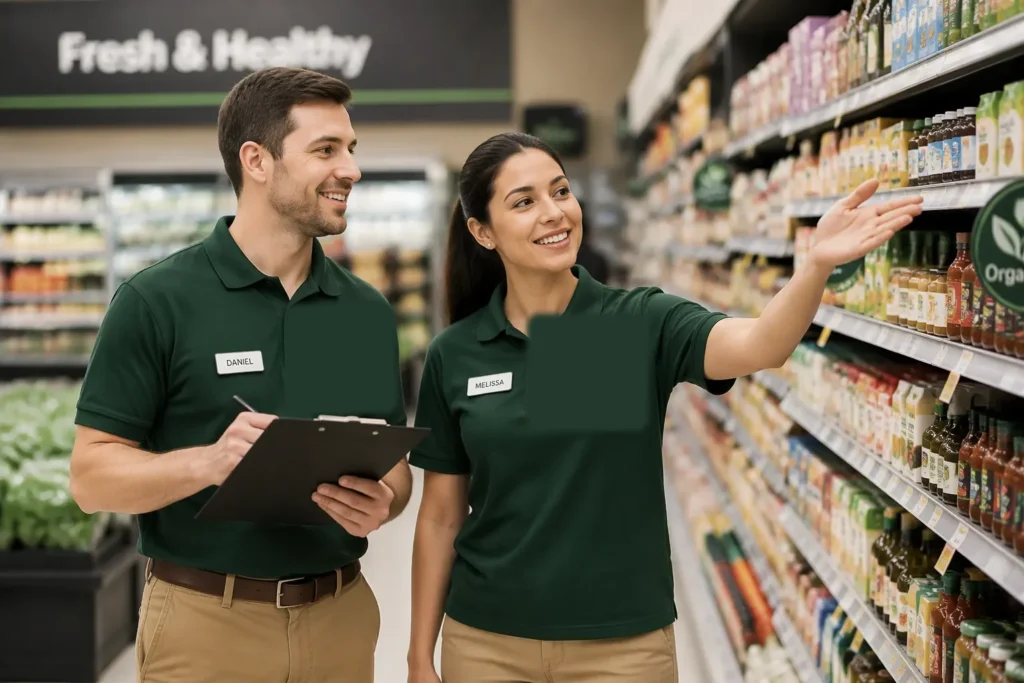
A supermarket staff polo has one job: look consistent across every store after frequent washing, long shifts, and contact with counters, carts, and crates. This guide is for overseas grocery, supermarket, and convenience-store buyers who need a polo-only program, not a full uniform catalog. Use it to lock fabric, colorways, and logo placement, then send one RFQ table to every supplier you compare.
It is written for:
Grocery procurement teams that need one documented spec across many stores, with banner-level color differences handled inside that spec.
C-store and franchise operators who need compact size runs and a clear replenishment path.
Distributors and resellers who want OEM backing without owning a factory.
Working examples in this brief use two banners: North Aisle Grocery and Harbor Corner Market. They share a navy base and differ only by accent trim. Stay on this page when the brief is a staff polo.
Why grocery crews specify a staff polo, not a generic retail uniform
A staff polo earns its place on a grocery floor through structure. Crews reach, lift, and move between the sales floor and the stockroom for a full shift. A knit collar that stays upright, a placket that keeps its shape, and a body cut with room through the chest and armhole matter more than a fashion silhouette.
Fashion-oriented uniforms often fail in two ways. A slim cut restricts arm raise at the register and in the aisle. Thin fabrics wear at the front end, where cashiers lean on belts and scanners all day. A mid-weight polo fabric holds its surface and color longer under that contact. Side vents at the hem let stockers reach overhead and bend low without the shirt pulling across the hips.
A documented polo program also gives you a repeatable look. North Aisle Grocery and Harbor Corner Market can share the same polo body while each banner applies its own accent. Reorders follow the same fabric, embroidery placement, and size range, so new hires wear the same shirt as the original crew.
Fabric, colorways, and embroidery that survive a grocery shift
Start with the cloth, not the logo. Cotton-rich pique feels soft and takes embroidery cleanly. Poly-cotton blends are stronger, dry faster, and recover from wrinkles better after a store or home wash. For grocery crews, a mid-weight blend is often the more practical starting point. Cashiers at North Aisle Grocery, who stay near the front end, do well in a crisp, low-crease blend. Stockers who move all day may want a slightly softer cotton-rich hand. Ask for swatches of both and wash them the way your crews actually wash shirts.
Set colorfastness and shrinkage limits in the spec before you approve a sample. Ask for wash-test results on the exact fabric and color you plan to order, and name the test method and the acceptable limit in the RFQ. If you specify a stain-resistant finish for deli or produce crews, confirm it survives repeated washing and does not change the hand or the embroidery surface.
Build each program on a core neutral base, then add banner accents. Navy, charcoal, white, and black cover most grocery identities. Harbor Corner Market can carry a green collar and placket on the same navy body that North Aisle Grocery uses with a teal accent. Light shades look fresh but show soil sooner. Dark shades hide marks and suit stockroom and receiving roles. Test the pairing under real store lighting; cool overhead light can swallow a weak accent.
Lock one main logo placement per banner: left chest for a readable brand mark, sleeve for a smaller identifier, back yoke only when you need a large floor-visible mark. Send vector artwork and named thread colors. Approve a sew-out on the actual polo fabric and keep that strike-off as the standard for every future run.
Front-end vs floor-crew color coding in one program
You do not need a second product family to tell roles apart. Use one polo program with two color roles.
Front-end staff are the first people shoppers see. Give cashiers and service-desk crews an accent on the collar, placket, or sleeve edge so a shopper can find help from a few lanes away. At North Aisle Grocery, a teal collar and placket on a navy body does that job without breaking the family look.
Floor crews need the opposite treatment. Stockers, receivers, and shelf teams brush against carts, crates, and shelves all shift. A darker shared base hides contact marks. Harbor Corner Market can run its floor team in the shared navy body with no accent trim, or keep its green accent only on front-end shirts.
Name badges should support that coding, not fight it. Place a badge on the opposite chest from the embroidered logo. Write the color matrix down and attach it to every purchase order: each banner, base color, accent color, accent placement, and thread references. One written matrix stops a new store from ordering an off-brand shade.
RFQ specs table
Send the same table to every supplier so you compare one shirt, not three different garments. Build one row for each style and banner combination. State men’s, women’s, or unisex fit, the size range, and the expected quantity by size. The table is the brief.
Style reference | Fabric composition | Colorways per banner | Logo placement | Size range | Gender fit | Quantity per style |
|---|---|---|---|---|---|---|
SP-100 (shared base) | Cotton-rich pique, mid-weight | Navy body for all banners | Left chest, embroidered | S–3XL | Unisex | Per banner forecast |
SP-100-NA | Same as SP-100 | Navy body, teal collar and placket (North Aisle Grocery) | Left chest plus sleeve mark | S–3XL | Unisex | Per banner forecast |
SP-100-HC | Same as SP-100 | Navy body, green collar and placket (Harbor Corner Market) | Left chest only | S–3XL | Unisex | Per banner forecast |
SP-200 (women's) | Same as SP-100 | Banner base plus accent trim | Left chest, embroidered | XS–2XL | Women's | Per banner forecast |
Write fabric as a composition, not a marketing name: fiber types, blend, knit structure, and weight if the factory quotes it that way. Two common gaps ruin otherwise complete RFQs: missing wash-test limits, and logo files that are screenshots or verbal color descriptions. Attach vector artwork and named thread references, and require a sew-out on the production pique.
Sample, PPS, and bulk for multi-store groups
The proto sample is your first physical check: hand feel, weight, drape, and how the collar and placket look after a wash. Order fit samples at the smallest and largest sizes of each gender fit, plus one mid-size, and check armhole room and body length on real crew members when you can.
The pre-production sample (PPS) must match the bulk order: final fabric lot, approved color, embroidery placement, thread references, neck and care labels, and packing. Sign it off in writing before the factory cuts. Keep the approved sample on file and ask the supplier to keep a matching sealed sample. Put the approval date and sample code on the purchase order.
Plan the bulk window around store opening and refit dates. Share a delivery schedule by banner, quantity, and arrival week, and confirm production and shipping lead times as separate figures. Set your reorder trigger before the first bulk run ships. Track wear rates by store and hold a small reserve for new hires. A combined reorder of about 2,000 pieces per style keeps fabric and cutting efficient across banners. Document the reorder spec, the approved PPS code, and the color matrix so every future run matches the first.
Catalog vs private-label supermarket staff polo shirt OEM
A catalog program uses polo styles the supplier already makes. A private-label program builds a polo to your own spec. Neither is automatically better; the right model depends on banner count, exclusivity, and timeline.
Factor | Catalog polo | Private-label OEM |
|---|---|---|
Best fit | Pilots, new-store openings, single independents | Multi-banner groups that need an exclusive look |
Speed | Faster; fabric and patterns already exist | Longer; you approve proto, fit, and PPS |
Control | Color and fit come from the supplier list | You lock fabric, collar, fit block, and color |
Reorders | Shade or fit can drift between seasons | Spec stays on file for the life of the program |
A hybrid path is often enough: start from a catalog navy body and add private-label trims — collar color, placket, woven labels, and embroidery. North Aisle Grocery can run that model with a custom teal placket and its own neck label. Decide banner by banner. A flagship high-volume banner may justify a full private-label build; a small franchise format may not. For how catalog bases take branding, see corporate polo shirts OEM. When exclusivity is the point, see custom polo shirt OEM.
Copy-paste procurement checklist
Copy this list into your project file and check each line before you release a purchase order.
Spec and compliance
Fabric composition, knit structure, and weight confirmed in writing
Wash-test results received for the exact fabric and color
Colorfastness and shrinkage limits stated in the RFQ and met by the sample
Stain-resistant finish confirmed to survive repeated washing, if specified
Neck, care, and woven labels approved against brand standards
Size chart checked against crew measurements for every gender fit
Vector artwork, named thread colors, and placements locked, with an approved sew-out on file
Supplier and production
Proto sample approved for hand feel and fit
Fit samples reviewed at the smallest and largest sizes of each gender fit
PPS approved in writing before bulk cutting
Sealed PPS kept by the supplier and a matching sample kept in your office
QC steps and inspection sign-off named in the order documents
Production and shipping lead times confirmed against your rollout dates
Delivery and reorder
Delivery schedule lists each banner, quantity, and required arrival week
Packing and carton labels match your store distribution plan
Reorder terms include the approved PPS code and the color matrix
Reorder trigger and reserve stock level set before the first bulk run ships
Supplier contact and escalation path recorded for every store group
FAQ
What is a typical starting quantity for a supermarket staff polo program?
Typical OEM programs are planned per style, and the supplier confirms the starting quantity on your RFQ. See the sampling and bulk section for the volume used to keep fabric and cutting efficient.
How is this page different from existing supermarket uniform pages?
This guide stays on staff polo shirts for grocery, supermarket, and convenience crews. It is distinct from the supermarket retail staff uniform OEM page, which covers a broader uniform program rather than a polo-only spec.
Do front-end and floor crews need two different polo styles?
Usually no. One shared body with an accent on front-end trim is enough. Keep the base color, fabric, and logo standard the same so reorders stay simple.
About Top Fortune and how to request a quote
Shanghai Top Fortune Industry Co., Ltd. has built OEM and ODM staff polo programs for overseas buyers since about 2002. The company runs a 1,506 m² facility in Songjiang, covering cutting, sewing, embroidery, and inspection under one roof. You can read more on the About Shanghai Top Fortune Industry Co., Ltd. page.
Send your RFQ table by email or WhatsApp. Use email for formal documents and artwork, and WhatsApp for quick questions during sampling. Keep one thread per program.
Request a supermarket staff polo program quote: rill@topfortunemail.com | WhatsApp +86 13524210501
Include in the first message: style reference or catalog base; fabric composition, knit structure, and weight; colorways per banner; logo placement, vector artwork, and thread colors; size range and gender fit; quantity per style and per banner; required delivery date and destination port; wash-test limits and label requirements.