

Building Trades Private Label Workwear OEM | Contractor Brands
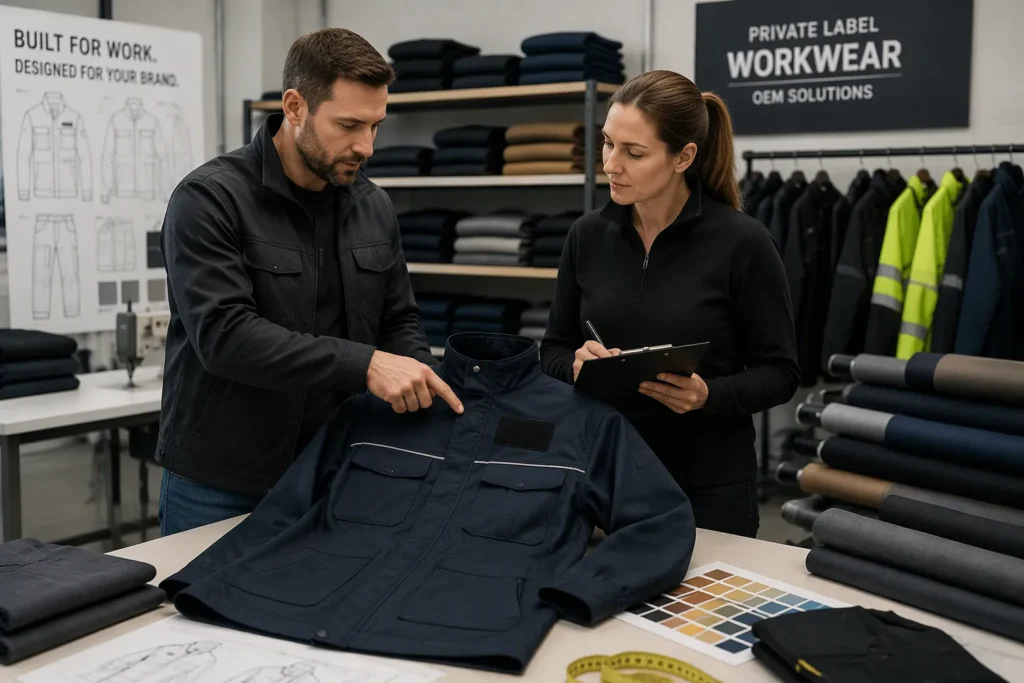
Picture your crew, your logo, and your standards on a garment you never had to manufacture. Building trades workwear OEM delivers that: a specialized manufacturing partner builds the apparel, and your contractor brand sells it as its own line — no factory, no production staff. In OEM, the brand owns the design and tech pack; private label just puts the brand’s name on a factory product. This guide explains the model, its fit for contractor brands, and how to launch with a partner.
Quick takeaways:
The brand owns the design and tech pack.
Sample-to-PPS-to-bulk gates protect quality.
The model suits electrical, plumbing, HVAC, and general contractor fleets.
Key Takeaways
OEM lets your brand own the design and pattern of your workwear.
Use sample approvals to catch problems before bulk production.
Launch with one or two core styles to manage risk and cost.
What Building Trades Workwear OEM Means
Shanghai Top Fortune Industry Co., Ltd. is a workwear manufacturing partner that has served OEM and ODM clients since around 2002. The company operates a 1,506 m² factory in Songjiang, Shanghai, and exports workwear to Europe, the Middle East, Oceania, Southeast Asia, and the Americas. Contractor brands can review the company’s capabilities at https://www.workwearmanufacturer.com/ and its background at https://www.workwearmanufacturer.com/about-us/. For buyer-intent planning, the minimum order quantity is about 2,000 pieces per style. Brands can reach the team at rill@topfortunemail.com, WhatsApp +86 13524210501, or Floor 3 Building 20 Haier Zhigu No.66 Guangfulin East Road Songjiang Shanghai 201600.
OEM Vs. Private Label, ODM, And White Label
These four sourcing models differ mainly in design control and pattern ownership, not just price. The table below shows where each model fits.
Model | Who designs the garment | Customization allowed | Who owns the pattern/design |
|---|---|---|---|
White label | Supplier's existing ready-made design; buyer picks from stock | Label/packaging only — no fit or fabric changes | Supplier owns it and can resell the identical garment to others |
Private label | Supplier's base/block garment, adapted to the buyer's spec | Fabric, color, fit tweaks, trims, branding (within limits) | Usually the supplier's block; ownership of the adapted pattern is contractual — agree in writing it is the buyer's or transferable |
ODM | Manufacturer's own catalogue design, rebranded for the buyer | Branding and usually color; close to white label with modifications | Manufacturer owns the design |
OEM / full custom | The brand — from its own pattern, tech pack and specification | Everything: pattern, fit, fabric, construction | The brand's (commission an original pattern; secure an exclusivity/ownership clause in writing) |
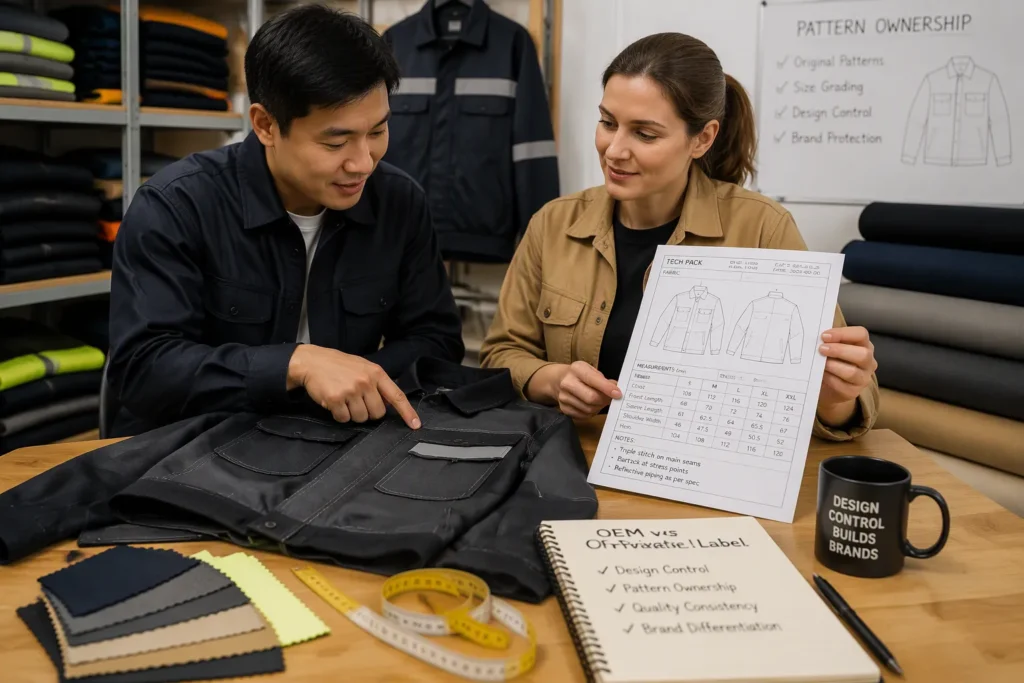
"The biggest practical difference is design control and pattern ownership, not just price." If a brand can hand a factory a tech pack, it needs OEM. If it picks from a catalog and rebrands, it needs private label. If it changes nothing but the label, that is white label. In white and private label, the factory keeps the base pattern and can resell that same silhouette to other buyers. In OEM, the brand commissions an original pattern from its tech pack, so it can negotiate exclusivity and pattern ownership. "Private label" is widely described as "sold exclusively under your brand," but exclusivity of the garment design is a separate, contractual matter.
Who This Guide Is For
This guide serves adult B2B buyers only. The primary audience is general contractor brands that want their own apparel line. Trades firms in electrical, plumbing, and HVAC work form a second group. Regional franchise contractors make up a third. Each group needs logo-durable jackets and polos across subcontractor fleets, and each benefits from a clear building trades workwear OEM brief. The sections that follow cover the spec stack, sampling gates, cost structures, and launch steps for these buyers.
Benefits Of Building Trades Workwear OEM
Brand Building, Cost Efficiency, And Scalability
A private label program turns everyday garments into brand assets. Contractor brands can place their logo, woven labels, hang tags, and brand colors on a coordinated collection. Factory-direct manufacturing removes intermediaries, which simplifies communication and keeps production decisions close to the source. A dedicated OEM partner also holds production steady as the brand grows, so a regional franchise contractor can add styles without rebuilding the supply chain.
The spec stack should serve brand visibility first. A work jacket carries the largest logo area and the strongest first impression on a jobsite. A polo supports daily wear and repeat orders across a subcontractor fleet. A softshell bridges cool mornings and indoor work, and weather layers extend the wearing season. Each layer earns its place by how often the crew wears it and how clearly the brand reads at a distance.
The RFQ table below organizes the details a brand should confirm before quoting.
Spec field | What to specify |
|---|---|
Fabric | Fiber blend, construction (twill, canvas, ripstop), target weight and tolerance |
Fit | Men's and women's blocks, size chart, grading rules, tolerances |
Decoration | Embroidery, screen print, heat transfer, or woven patch; logo placement |
Size runs by trade | Electrical, plumbing, and HVAC crews often need different size curves |
Packaging | Woven labels, care labels, poly bags, hang tags, carton marks |
Catalog buying and private label OEM each fit different goals. A catalog purchase suits a brand that needs stock quickly and accepts the supplier’s existing design. Private label OEM suits a brand that wants its own pattern, fit, and decoration across a fleet. Neither path is wrong; the choice depends on how much design control the brand needs.
Customization For Brand Visibility
Customization reaches fabrics, colors, trims, embroidery, printing, and packaging. Brands can choose standard colors such as navy, black, grey, or khaki, or match a custom brand color. Embroidery places logos on the chest, sleeve, back, or pocket. Printing methods vary by artwork, fabric, and desired finish, so the brand should approve a decoration sample before bulk.
This program is not a hi-vis or PPE catalog. Specify jackets, polos, and softshells for brand visibility and daily crew wear, and keep reflective safety claims out of the main brief.
Key Considerations
Partner Selection And Sample Discipline
Choose a partner by how it handles a tech pack, not by a certificate list. Ask for a written sample plan, a size run by trade, and a named contact for reorders. Do not treat a logo on a catalog garment as a private-label program.
Confirm the factory legal name, the address in Songjiang, and who signs the sample approval. A system document is not a substitute for a signed pre-production sample.
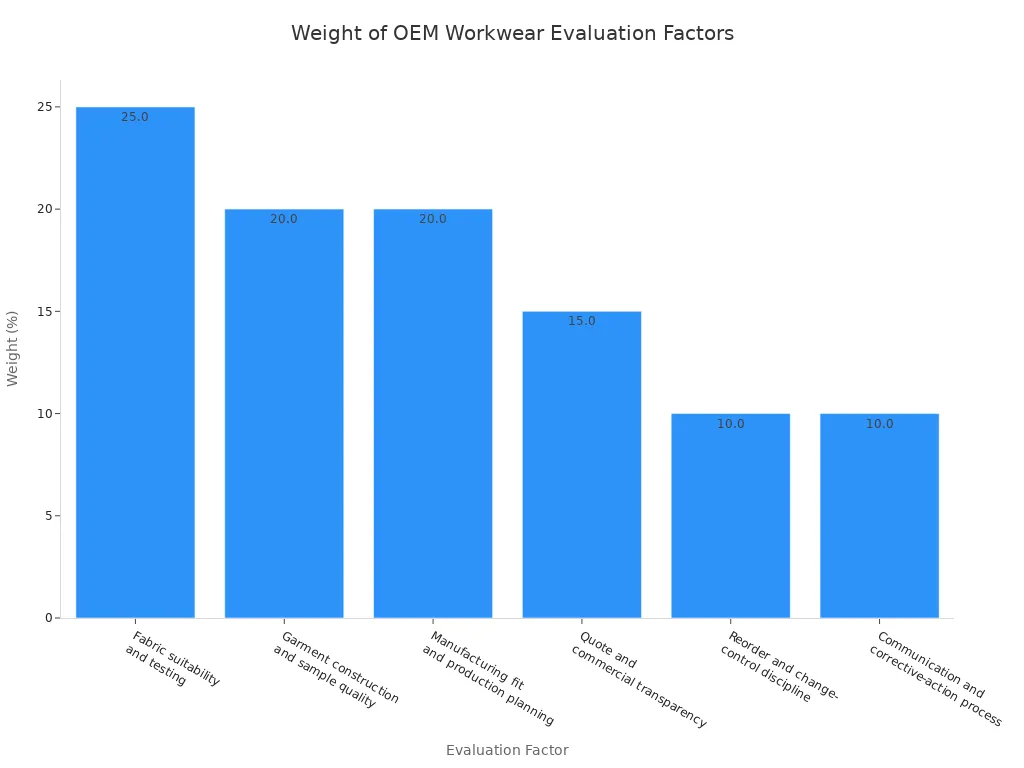
Partner scoring keeps the comparison honest. Fabric suitability and testing carry the heaviest weight, followed by garment construction and sample quality, then manufacturing fit and production planning. Quote transparency, reorder discipline, and communication fill the remainder.
Cost Structures, Lead Times, And Customization Limits
Customization limits follow material and color decisions. Stock colorways usually allow lower quantities than corporate colors, which face dye-house batch minimums. Custom-knitted or custom-dyed fabric carries a minimum set by the mill. Unusual sizes or custom trim can push production into a longer window, so brands confirm stock status and lead time early.
Reorder planning protects project peaks. Brands should book capacity and material schedules in advance, because factory-wide capacity is not a personal reservation. Size runs differ by trade, so electrical, plumbing, and HVAC fleets each need their own curve locked into the technical pack before bulk.
Launching Your Line Step By Step
From Needs Assessment To Sampling And Testing
A successful launch starts with a written needs assessment. The brand records product category, application, target market, quantity, colors, sizes, fabric, decoration, lead time, and the reorder window for project peaks. This document becomes the brief for every building trades private-label conversation that follows.
Sampling then moves through defined gates. Each gate has one approval decision, and the brand signs off before the next stage begins.
Gate | Sample type | What the brand approves |
|---|---|---|
1 | Proto sample | Overall design, proportions, and basic fit |
2 | Fit sample | Fit on a model, using production fabrics and trims |
3 | Final fabrics, trims, colors, and construction — the bulk benchmark | |
4 | TOP sample | A garment pulled from the line before completion |
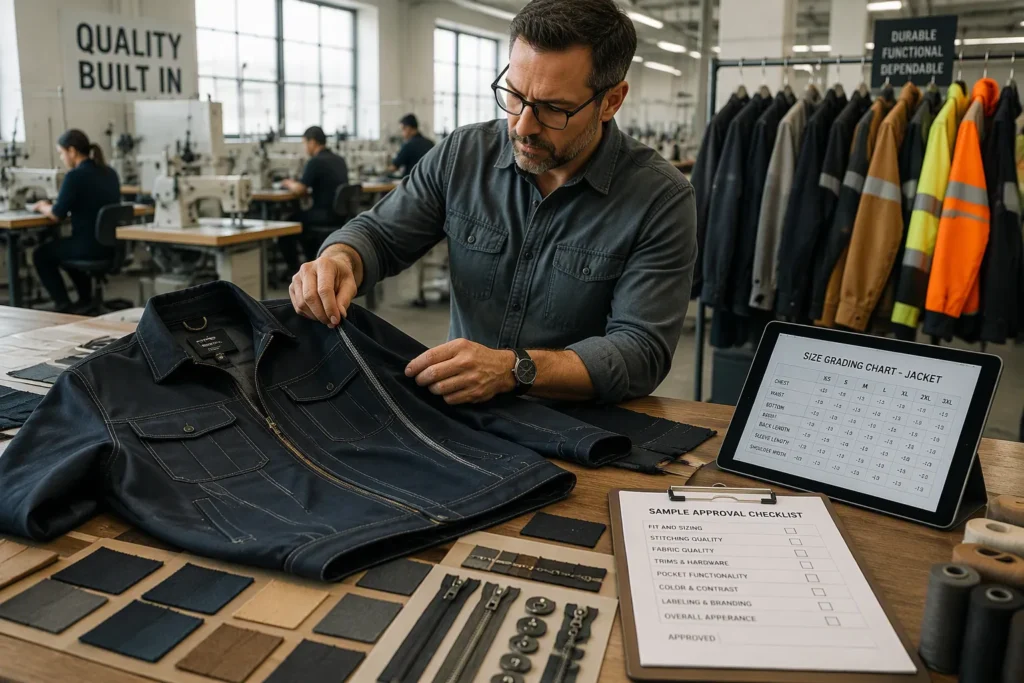
The PPS carries the most weight. Formal sign-off on it authorizes bulk manufacturing and becomes the reference point for quality control. Before mass sewing continues, the factory cross-checks fabric and trims, grading, stitch specs, and artwork against the signed sample, then runs a First Piece Inspection.
Testing supports the approval when the buyer names a wash or abrasion check that matches real crew use, plus the pass limit, before the sample is signed. A fit trial adds the human check: stand, sit, reach, walk, wash, then fit again.
Common pitfalls are avoidable. Buyers who compare unit price instead of landed cost miss the full picture. Approving samples without locking fabric details invites drift. Skipping a size set leaves grading unproven. A QC plan added only after defects appear costs more than one built in from the start.
Production, Launch, And Ongoing Partner Management
Final inspection checks seams, labels, and packing against the signed pre-production sample. Defective lots are segregated, root-caused, reworked, and re-inspected before shipment release.
A copy-paste procurement checklist keeps the launch on track:
Lock fabric details: composition, weight with test method, and shrinkage tolerance.
Name load-bearing seams for twin-needle construction.
Confirm logo placement, stitch color, and wash-test notes on the approved sample.
Approve a graded size set before bulk.
Confirm in-line and end-line QC stages.
Agree defect, rework, and replacement terms in the contract.
Set up inventory tracking, packaging, and returns processes.
Stabilize core styles before adding trims or new colors.
Further reading on this site: https://www.workwearmanufacturer.com/custom-jacket-manufacturer/ https://www.workwearmanufacturer.com/custom-polo-shirt-manufacturer/ https://www.workwearmanufacturer.com/corporate-polo-shirts-oem-china-manufacturer/ https://www.workwearmanufacturer.com/construction-site-workwear-oem-buyer-guide/ and https://www.workwearmanufacturer.com/blog/
Ready to start? Send the brief to rill@topfortunemail.com or WhatsApp +86 13524210501, and the team at https://www.workwearmanufacturer.com/ will map the sampling schedule.
Private label OEM gives contractor brands a realistic route to branded workwear. It reinforces a professional image on every jobsite. It also keeps manufacturing risk with a specialist partner.
Success depends on a clear brief, signed samples, and realistic lead-time planning. A building trades private-label launch works best in stages. Brands should draft a needs assessment, compare sample quality, and request a pre-production sample before bulk. Starting with one focused product category beats launching a full line.
FAQ
What is the minimum order for a private label workwear program?
The minimum order quantity is about 2,000 pieces per style. Brands plan this figure into the first brief, because it shapes color selection, size runs, and reorder timing. A focused launch on one or two core styles keeps the commitment manageable.
How does a contractor brand request a quote?
The brand sends a written brief to rill@topfortunemail.com or WhatsApp +86 13524210501. The brief covers fabric, fit, decoration, size runs, packaging, and target quantity. The team then maps the sampling schedule and confirms the specification before quoting.
Does this program focus on hi-vis and PPE?
No. The program centers on branded jackets, polos, and softshells for contractor crews. It is not a hi-vis or PPE catalog.
What should the first brief include?
The brief should name the style, fabric, logo placement, size run by trade, and target quantity. It should not ask the factory to invent a safety-certification claim. Send it to rill@topfortunemail.com or WhatsApp +86 13524210501.
How does the factory protect bulk quality?
The brand approves a pre-production sample, and that signed sample becomes the bulk benchmark. In-line checkpoints cover seams, stitching, and label placement. Shipment waits until the bulk matches that signed sample.