

Fitness & Sports Nutrition Retail Staff Apparel OEM | Shops & Sales Teams
Table of Contents
Display
2)
Spec Fitness Retail Staff Apparel by Role
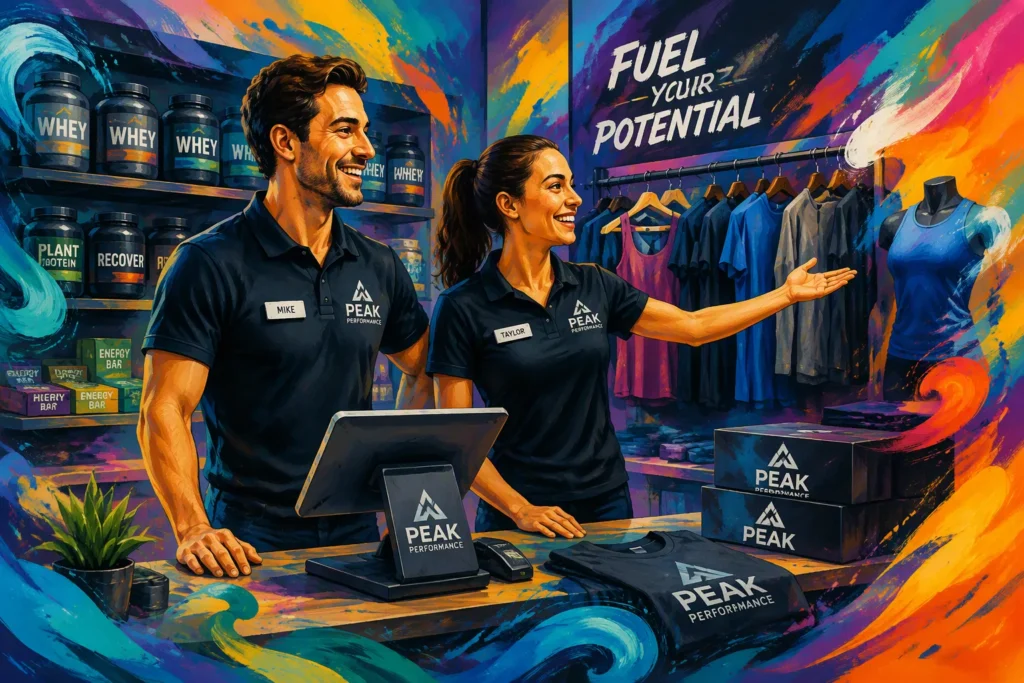
First, decide which roles need apparel. Store staff wear polos every day. Sales teams go to events and meet with accounts, so they often need a light jacket. Then make a short list of OEM makers that already make performance polos and light jackets.
Two buyer goals drive most projects. Sports-nutrition brand HQ wants one retail program that works across regions. Fitness store operations managers need to outfit local teams fast. Both need the same brand color and clear logo placement.
This guide is for brand HQ apparel buyers, store operations managers, and sales-team buyers. It follows the sourcing path for fitness retail staff apparel in order: role specs, factory vetting, fabric and decoration, compliance, costs, sampling, and replenishment.
Key Takeaways
Set up different clothing programs for shop staff and sales teams, but use the same brand color palette for both.
Pick the stock catalog for small or rush orders. Pick OEM custom builds for brand consistency at scale.
Check factories for their experience with performance fabric and their in-house decoration. This helps ensure both quality and speed.
Match fabrics to jobs: breathable knits for shop polos, packable shells for sales jackets.
Use a standard RFQ pack and a comparison table to get clear quotes from factories that you can compare.
Approve the fit samples and pre-production samples in writing before bulk production begins.
Plan restocking with a standard starter kit, and check size shortages every quarter.
Keep a buying checklist for each order to stay consistent as your store network grows.
Spec Fitness Retail Staff Apparel by Role
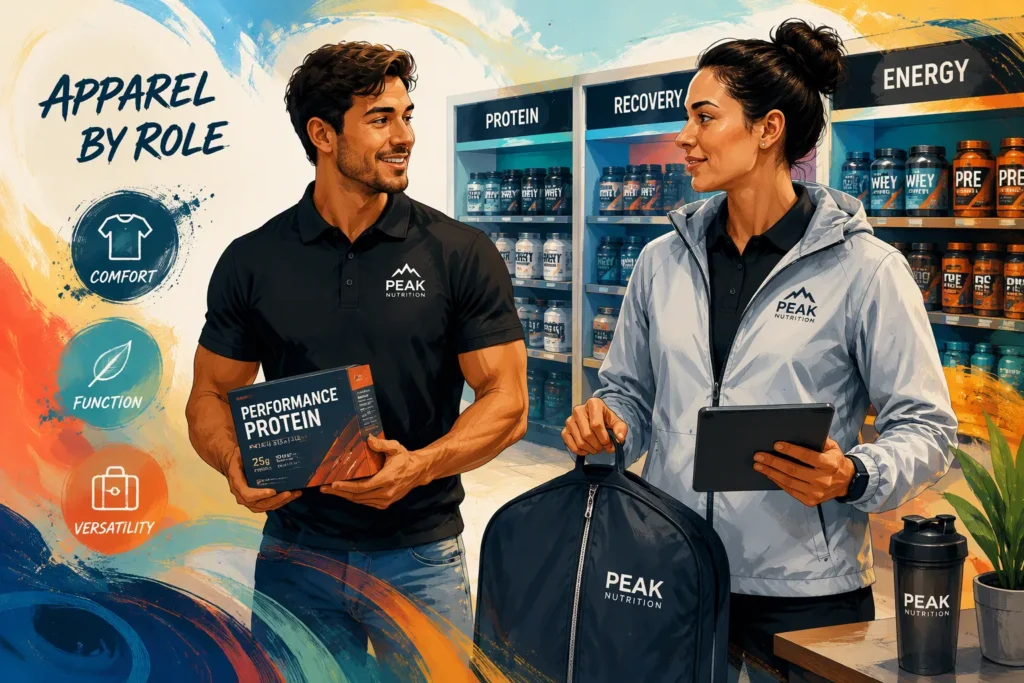
Role drives the spec. Shop staff stand, lift boxes, and restock shelves all day. Sales teams travel, present at events, and meet buyers indoors and out. Treat these as two programs that share one brand palette. This is retail staff apparel for shops and sales floors, so build it around comfort, visibility, and a clean brand look.
Retail-Shop Polo Program
The polo is the uniform backbone of the store. Choose a knit that holds its shape through repeated washing and keeps a neat collar on the floor. A slightly heavier knit reads more premium on the shop floor and hides wear better at the seams. Keep the placket simple and the buttons matched to the brand color.
Logo Placement for Retail Visibility
Place the primary logo on the left chest at a size that reads clearly from a few steps away. Add a smaller mark on the sleeve or back yoke for staff who work facing shelves. Keep placement identical across every store so customers see one consistent brand. Send the factory vector logo files with clear size callouts, and approve a sewn or printed strike-off before bulk.
Fabric Weight for All-Day Shop Wear
Shop staff wear the polo for a full shift, so prioritize breathability and stretch over thickness. A mid-weight knit with a touch of stretch moves with the body during lifting and reaching. Ask the factory for swatches in your brand colors and wash-test them before you commit. Check for pilling, shrinkage, and color bleed after several cycles.
Sales-Team Light Jacket Layer
The sales team needs a layer that looks sharp over a polo and packs easily. A light jacket works for event booths, account visits, and travel days. Keep the cut clean and the branding restrained so it reads as brand apparel, not outerwear for the gym floor.
Packable Shells for Events and Travel
Choose a shell that folds small and resists creasing in a bag. A packable design helps reps move between venues without bulky luggage. Confirm the zipper quality and seam finish, since these parts take the most stress. Ask for a sample you can stuff into a backpack and unpack to check recovery.
Brand-Color Consistency Across Channels
Match the jacket color to the polo program using the same color references. Share physical color standards or approved lab dips with the factory, and ask for both styles in one dye lot review. Small shade gaps between shop polos and sales jackets look careless at a joint event. Lock the palette once, then apply it to every style and every reorder.
Size Runs for High-Turnover Staff
Shop teams change often, so size coverage matters more than deep stock in any one size. Plan a broad run that fits most new hires on day one. Keep a small buffer of common sizes for quick replacements.
Size Grid Planning
Build one size grid for shop and field teams, then adjust quantities by role. The table below shows a simple planning frame you can adapt.
Size band | Shop staff share | Sales team share | Reorder trigger |
|---|---|---|---|
Small to medium | Higher | Moderate | Low stock on common sizes |
Large to extra-large | Moderate | Higher | Low stock after events |
Extended sizes | Small buffer | Small buffer | On request |
Review the grid each quarter against actual hires and returns. Track which sizes run short and adjust the next order. Keep one shared size chart with body measurements so new staff order correctly. This keeps your fitness retail staff apparel program predictable as teams grow.
Catalog vs OEM for Fitness Retail Staff Apparel
You have two sourcing routes for branded staff clothing. You can buy from a stock catalog, or you can commission a custom OEM build. Neither route wins by default. The right choice depends on your rollout size, your timeline, and how tightly you need to control brand color.
When Stock Catalog Apparel Fits
Catalog apparel works well for small or urgent rollouts. A new shop may need a handful of polos before opening day. A regional sales team may need light jackets for a trade show next month. Stock programs already hold fabric, patterns, and size runs, so you can move fast.
Catalog also suits buyers who want to test a look before scaling. You can place a small order, see how staff wear the pieces, and gather feedback. Then you decide whether to invest in a custom build. Keep in mind that stock colors and logo placement options stay limited. Check that the available palette sits close to your brand colors before you commit.
When OEM Custom Builds Pay Off
OEM custom builds pay off when brand-color and logo consistency matter at scale. A sports-nutrition brand with shops in several regions needs one palette across every store. A custom build lets you specify the exact fabric, the exact shade, and the exact logo placement on polos and jackets.
Custom production also lets you tune the garment to the job. You can choose a knit weight for all-day shop wear and a packable shell for the sales team. You control the size grid, the label content, and the decoration method. This route rewards buyers who plan ahead, because sampling and approval take time. The result is a fitness retail staff apparel program that looks the same in every channel.
Hybrid Approach for Mixed Teams
Many brands run both routes at once. You might order custom polos for permanent shop staff and pull stock jackets for a short-term event crew. Or you standardize the core polo through OEM and fill size gaps from catalog stock.
A hybrid plan keeps your brand look intact where it matters most. It also gives you a fast fallback for urgent needs. Track which items come from which route, and keep color references on file for both. That way a catalog top-up still matches your custom core.
Factor | Stock catalog | OEM custom build | Hybrid |
|---|---|---|---|
Best for | Small or urgent rollouts | Brand-color and logo consistency at scale | Mixed teams with core and seasonal needs |
Color control | Limited to available shades | Full control via lab dips | Full control on core, limited on fill-in |
Lead time | Short | Longer, includes sampling | Mixed by item |
Logo options | Standard placements | Fully specified | Fully specified on core items |
Vet OEM Manufacturers and Confirm Compliance

A short list of factories does not mean much until you check how each one really works. Checking them protects your brand color, your delivery dates, and your staff’s comfort. Think of this step as a filter. You want a factory that already makes performance knits and light shells, does decoration in-house, and gives you paperwork without delay.
Shortlisting and Factory Checks
Start with a desk review. Ask each candidate for its product list, recent similar projects, and a factory profile. Then move to a live check. Ask for a video walk-through or a visit in person to see the cutting, sewing, and finishing lines. Make sure the factory runs the machines its samples suggest.
Performance Fabric Experience
Performance fabric acts differently from basic cotton. Ask which knits the factory buys for polos and which shells it uses for light jackets. Ask for swatches and make sure the factory can match your brand colors through lab dips. A factory with real performance experience will answer fast and show you options.
In-House Decoration
In-house decoration keeps your logo consistent and your timeline short. Ask whether embroidery and heat transfer happen on site or through a subcontractor. In-house teams control stitch density, placement, and color matching. They also catch errors before bulk. Ask for a decoration sample on the actual fabric you plan to use.
Factory Snapshot
Shanghai Top Fortune Industry Co., Ltd. is one example of a factory built for this work. The company started around 2002 and runs a 1,506 m2 factory in Songjiang, Shanghai. It handles OEM and ODM workwear and branded retail staff apparel. Its exports reach Europe, the Middle East, Oceania, Southeast Asia, and the Americas.
That profile fits adult B2B buyers from overseas fitness and sports-nutrition brands. You are sourcing polos for shop staff and light jackets for sales teams. Minimum order quantity sits at about 2,000 pieces per style, so plan your size grid and color range around that volume.
Direct Contacts
You can reach the team through two channels. Email rill@topfortunemail.com with your spec sheet and logo files. Message WhatsApp +86 13524210501 for a faster reply on sampling questions. The factory address is Floor 3 Building 20 Haier Zhigu No.66 Guangfulin East Road Songjiang Shanghai 201600. Review the company profile at workwearmanufacturer.com and the background page at about-us before you send your brief.
Compliance Documents to Request
Compliance paperwork protects your brand at customs and in stores. Ask every shortlisted factory for the same document set. Compare the answers side by side. A factory that gives clean documents early usually runs a clean production line.
Fiber Content and Care Labels
Ask for the fiber content breakdown for each fabric you plan to use. Confirm the care instructions the factory recommends, then check them against your market rules. Ask for a sample label set with your brand details. Make sure the label text matches the actual fabric, because mismatches cause problems at retail.
Restricted Substance Reports
Ask for restricted substance test reports from an accredited lab. Request reports that cover the specific fabrics and dyes in your order. Make sure the report dates are current and the tested materials match your spec. Keep copies on file for each production run, and ask the factory to flag any material change that would need a new test.
Build a simple document tracker for each factory. List the fiber content sheet, care label proof, and substance report as separate line items. Mark each one as received, reviewed, or pending. This habit turns a pile of emails into a clear decision. You can then compare factories on evidence, not on sales talk.
Match Fabric and Decoration to the Job
Fabric and decoration decide how your program looks after a month of real wear. Match both to the role. Shop staff need a knit that breathes through a full shift. Sales teams need a shell that travels well and keeps its color.
Performance Fabrics for Shop and Field
Start with the job, then pick the fabric. A polo for the shop floor and a light jacket for the road ask different things from the same mill. Ask your factory for swatches of both and test them side by side. Our custom polo shirt manufacturer page shows the knit options you can compare.
Moisture Management and Stretch
Shop staff lift boxes and reach for shelves all day. A knit with two-way stretch moves with the body and recovers its shape. Moisture management helps on a busy floor and under event lighting. Ask the factory how the fabric wicks and how it feels after repeated washing. Sales shells need stretch at the shoulders and elbows, where travel and setup put the most strain.
Colorfastness After Washing
Brand color fades first at the collar, cuffs, and seams. Ask the factory for wash-test results on the actual dye lot you will produce. Compare the washed swatch against your color standard under daylight. A small shift looks fine on a hanger and wrong next to a fresh polo. Lock the dye lot before bulk and keep a retained swatch on file for every reorder.
Decoration Methods Compared
Decoration carries your logo, so treat it as a spec, not an afterthought. Embroidery and heat transfer each suit a different garment. Review the corporate polo shirts OEM options before you choose.
Embroidery for Polos
Embroidery gives a polo a raised, durable mark that survives heavy washing. Specify stitch density, thread color, and placement on the left chest. Ask for a sewn sample on the actual knit, because a dense logo can pucker a light fabric. Keep the design simple so the mark stays crisp at a small size.
Heat Transfer for Jackets
Heat transfer suits light shells, where a flat mark sits cleanly on a smooth surface. Confirm the transfer holds through folding, packing, and repeated wear. Ask the factory to test adhesion on the exact shell fabric. Our custom jacket manufacturer page covers shell and decoration pairings.
Fit Testing with Real Staff
Paper measurements miss how a garment feels on a shift. Put samples on real staff across your size range. Ask them to reach, lift, and sit in the polo, and to pack and unpack the jacket. Note where the fit pulls or bunches.
Collect feedback on one form and rank the issues. Fix the pattern before you approve the pre-production sample. This step protects your fitness retail staff apparel budget, because a fit fix at sample stage costs far less than a bulk rework. For teams that also outfit training spaces, our gym and fitness uniform page offers a useful reference point.
Build the RFQ and Compare Quotes
A clear request for quote saves weeks of back-and-forth. Send the same document to every factory on your short list, so you compare like with like. Include your role split, your size grid, your logo files, and your target ship window. Ask each factory to answer in the same order. Then you can read the replies side by side instead of chasing missing details.
RFQ Comparison Table
Build one table and fill it in as quotes arrive. The table turns a stack of emails into a decision tool. Share it with your team so everyone reviews the same facts.
Comparison Columns
Use these columns for every factory you contact.
Factory | MOQ | Fabric Options | Decoration | Sample Lead Time | Bulk Lead Time | Payment Terms |
|---|---|---|---|---|---|---|
Factory A | Per style | Knit weights and shell options offered | Embroidery, heat transfer, or both | Weeks from approval | Weeks from PPS sign-off | Deposit and balance split |
Factory B | Per style | Knit weights and shell options offered | Embroidery, heat transfer, or both | Weeks from approval | Weeks from PPS sign-off | Deposit and balance split |
Ask each factory to state lead times in weeks from a named start point. “Sample lead time” means little without a trigger date. The same applies to bulk lead time, which should count from pre-production sample approval. Note whether the factory quotes decoration as a separate line or bundles it into the garment price.
Cost Breakdown and MOQ Planning
Ask for a cost breakdown, not just a unit price. A useful quote separates fabric, cut and sew, decoration, labeling, packing, and freight. The breakdown shows where your money goes and where you can adjust. You might simplify a logo to cut stitch time, or consolidate colors to reduce fabric waste.
Plan your order around the minimum quantity per style. Split your budget across polos and jackets by role, then check that each style clears the factory minimum. Combine sizes and colors within one style to reach volume. If a style falls short, fold it into a related style or move it to a later phase.
Payment Terms and Price Validity
Compare payment terms across quotes. Typical structures split a deposit at order confirmation and a balance before shipment. Ask what triggers each payment and what documents accompany it. Confirm the currency and who covers bank charges, so the final cost matches the quote.
Check how long each price holds. Fabric and freight costs move, so a quote without a validity window tells you little. Ask the factory to state a validity period in writing. Request a written notice clause for any price change before production starts. Lock the terms into your purchase order, and keep the signed quote on file for the next reorder.
Gate Sampling, PPS, and Bulk Production
Sampling is where you catch problems while they are still cheap to fix. Treat each stage as a gate. Nothing moves forward until you sign off in writing.
From Sample to PPS Approval
The fit sample proves the pattern works on real bodies. The pre-production sample proves the factory can repeat that fit with your actual fabric, color, and logo. Approve both before you release bulk.
Fit Sample Sign-Off
Put the fit sample on staff across your size range. Ask them to reach, lift, and sit in the polo, and to pack and unpack the jacket. Record every issue on one form. Sign off only when the pattern needs no further change. A pattern fix at this gate costs little. The same fix after cutting costs far more.
Pre-Production Sample Checklist
The PPS is your reference garment for the whole run. Check the fabric against your approved swatch, the color against your standard, and the logo against your artwork. Confirm the label text, the care instructions, and the size markings. Measure key points and compare them to the spec sheet. Keep the signed PPS on file and send a photo set to the factory as the agreed standard.
Bulk Milestones and Inspection Points
Ask the factory to report progress at fixed milestones. You then know where the order stands without chasing updates.
Fabric and trim arrival, checked against approved swatches.
Cutting release, after you confirm the PPS.
Sewing completion, with an in-line check on measurements and logo placement.
Final inspection before packing, using the AQL level you agree in the purchase order.
Packing and shipping release, with carton counts confirmed.
Book a third-party inspection at the final stage if your volume justifies it. Review the report before you release the balance payment.
Replenishment for New Shop Openings
New stores create predictable demand. Build a standard opening kit for each location: a full size grid of polos, a smaller jacket allocation for the local sales contact, and a few spare pieces in common sizes. Keep the kit list on file so every opening follows the same pattern.
High-turnover shop teams need size top-ups between full orders. Track which sizes run short each quarter and reorder those first. Hold a small buffer of your most-used sizes so a new hire never waits weeks for a shirt. Review your fitness retail staff apparel plan against actual hires and returns, then adjust the next order. This keeps color and fit consistent as your store network grows.
Copy-Paste Shops and Sales Apparel Procurement Checklist
Checklist Items
Use this list as a working document for every order. Copy it into your RFQ email and check off each item as it clears. A complete pack saves rounds of questions and keeps every factory answering the same brief.
Spec sheet: role split, garment type, fabric weight, and color references for polos and jackets.
Size grid: quantities per size for shop and field teams, plus your buffer sizes.
Logo files: vector artwork with placement callouts and size measurements for chest, sleeve, and back.
Compliance docs: fiber content sheets, care label proofs, and restricted substance reports.
PPS sign-off: a signed pre-production sample with photos kept on file.
Inspection report: the final inspection result at your agreed AQL level.
Reorder trigger: the stock level that starts your next size top-up.
Attach the pack to your purchase order. Update it whenever a fabric, color, or logo changes. This single file becomes the reference for your whole fitness retail staff apparel program.
Packing, Labeling, and Shipping Modes
State your packing rules in the purchase order. Ask for a set number of pieces per polybag, a set number per carton, and a carton label that shows style, color, size, and quantity. Request a packing list that matches the carton marks. Mixed-size cartons suit shop openings, where one box should stock a whole team.
Choose a shipping mode that fits your timeline. Sea freight suits full container loads and planned store rollouts. Air freight suits urgent openings and sample runs. Ask the factory to confirm carton dimensions and total weight before booking. Confirm who handles insurance and who pays for it.
Customs Paperwork Basics
Customs paperwork decides how fast your goods clear. Ask the factory for a commercial invoice, a packing list, and the bill of lading or airway bill. Check that the invoice describes the goods accurately and matches the carton marks. Confirm the country of origin statement and the HS code with your broker before shipment.
Keep digital copies of every document in one folder. Match the invoice value and quantity to the packing list, because mismatches slow clearance. Ask the factory to send draft documents for your review before the goods leave. Fix errors at draft stage, when a correction costs nothing.
You now have a clear plan to follow. First, define what each role needs. Next, choose between catalog or OEM. Check factories, then lock in fabric and decoration. Confirm compliance, compare RFQ quotes, and approve the PPS. Ship the order and plan for restocking.
Keep the split between shop polos and sales light jackets as your main idea. Hold one brand color across both channels. Reuse the RFQ table and the procurement checklist as working documents on every order. They keep your fitness retail staff apparel program consistent as your store network grows.
Ready to start? Contact Shanghai Top Fortune Industry Co., Ltd. at rill@topfortunemail.com or WhatsApp +86 13524210501 to ask for a quote and sample plan.
FAQ
What is the minimum order quantity for branded shop polos and sales jackets?
Plan for about 2,000 pieces per style. You can combine sizes and colors within one style to reach that volume. If a style falls short, fold it into a related style or move it to a later phase of your rollout.
How do I get a quote for a mixed polo and jacket program?
Send one RFQ pack to every shortlisted factory. Include your role split, size grid, logo files, fabric preferences, and target ship window. Ask each factory to answer in the same order so you can compare replies side by side.
Should shop staff and sales teams wear the same garments?
No. Shop staff live in polos, so prioritize breathable knits that hold shape through a full shift. Sales teams travel and work events, so give them a packable light jacket layer. Keep one brand palette across both programs.
How does this differ from outfitting a gym floor team?
This program covers retail shops and sales floors, not gym PPE or safety gear. You are dressing store associates and field reps who need a clean brand look. Skip hi-vis and protective specs unless a specific role truly requires them.
Where should the logo go on a retail polo?
Place the primary logo on the left chest at a size that reads from a few steps away. Add a smaller mark on the sleeve or back yoke for staff who face shelves. Keep placement identical across every store.
Can I order a small batch first and scale later?
Yes. Stock catalog apparel suits small or urgent rollouts, such as a new shop opening or a trade show. Test the look with a small order, gather staff feedback, then move to a custom OEM build once you confirm the design.
How long does sampling and bulk production take?
Ask each factory to state lead times in weeks from a named start point. Sample lead time should count from design approval. Bulk lead time should count from pre-production sample sign-off. Compare these windows across quotes before you commit.
What documents should I request before placing an order?
Request fiber content sheets, care label proofs, and restricted substance test reports from an accredited lab. Ask for reports that cover your specific fabrics and dyes. Keep copies on file for each production run and flag any material change.