

Ski Rental Shop Uniform OEM China | Branded Counter & Fitting Staff Workwear
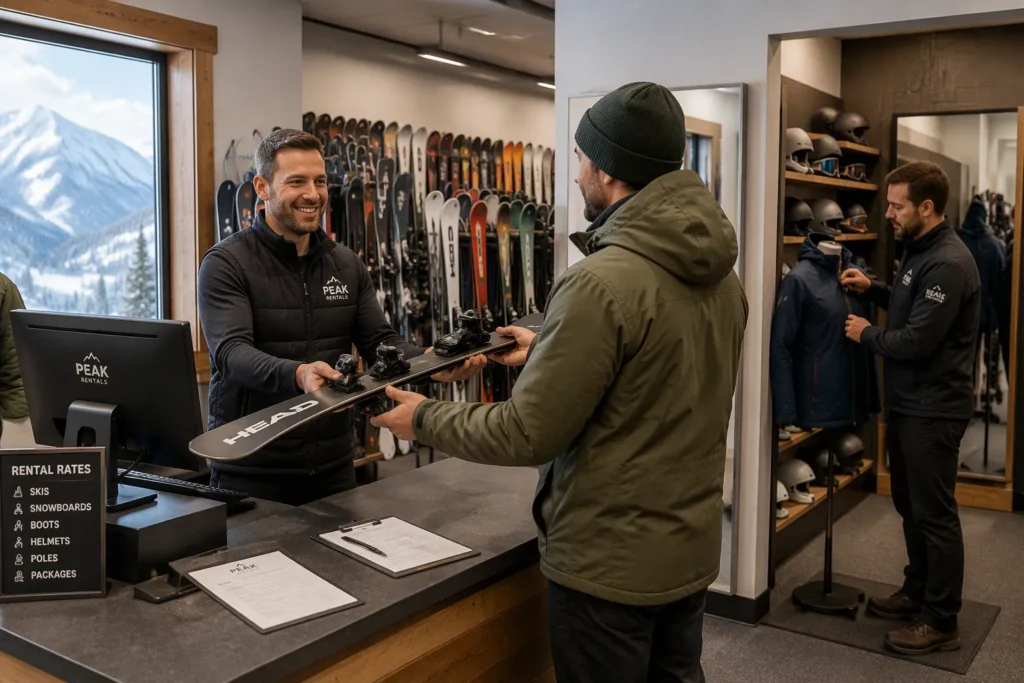
Sourcing your ski rental shop uniform OEM China gives you real cost savings. In 2024, China made 29.6% of the world’s clothing exports, based on WTO data studied by FASH455. This number shows China’s strength in making clothes. But to save money, you need to plan carefully. You must clearly list every detail you want. You must check each supplier closely. This guide helps you with every step. You go from setting your needs to getting the final products. You learn how to get good-quality branded work clothes at a fair price. The right process removes guesswork. You can get great results with the right method. Start with a clear plan. Begin your sourcing journey today.
Key Takeaways
Start with a detailed tech pack. It lists all uniform sizes and materials.
Check the supplier’s background. Look at papers and factory checks before you buy.
Test the samples carefully. Check the fit, stitching, branding, and how well the insulation works.
Use quality checks at each step. Inspect while work is being done to find problems early.
Define Uniform Specs and Source Ski Rental Shop Uniform OEM China
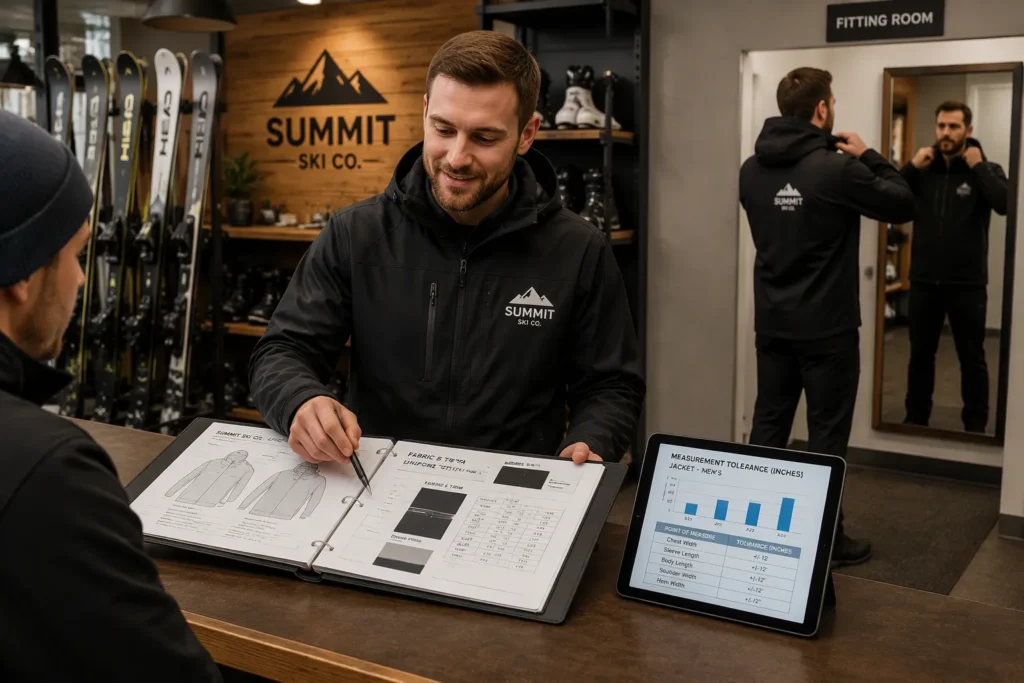
Your uniform project begins with clear details. Unclear instructions lead to costly errors. You need a tech pack that explains everything clearly. This document becomes your agreement with the factory. It keeps you from getting wrong sizes, poor fabric, or uneven branding.
Build a Detailed Tech Pack
A tech pack holds every measurement, material, and build detail for your uniforms. Exact numbers stop measurement mistakes during production. Your counter staff and fitting staff need different fits, so describe each style on its own.
Include fabric weight in GSM, fabric thickness, and brushing or fleece density. Add air flow and heat resistance values. Your ski rental staff work in the cold, so moisture control matters. Say how fast it wicks and dries, and if test results back these claims. Stretch and recovery in both directions affect comfort during long shifts. Elbow and shoulder bagging, waist recovery, and cuff recovery all need testing rules. Dimensional stability after washing keeps uniforms looking neat.
Measurement tolerances are key. The table below shows acceptable ranges for a sample size medium.
Measurement Point | Sample Size Medium (Inches) | Acceptable Range (Inches) | Tolerance (+/-) |
|---|---|---|---|
Chest (1" below armhole) | 20.0 | 19.5 - 20.5 | 0.5 |
Body Length (HPS) | 28.0 | 27.5 - 28.5 | 0.5 |
Sleeve Length (CB) | 34.0 | 33.75 - 34.25 | 0.25 |
Shoulder Width | 15.0 | 14.75 - 15.25 | 0.25 |
Armhole Depth (Curve) | 9.5 | 9.25 - 9.75 | 0.25 |
Collar Circumference | 16.0 | 15.875 - 16.125 | 0.125 |
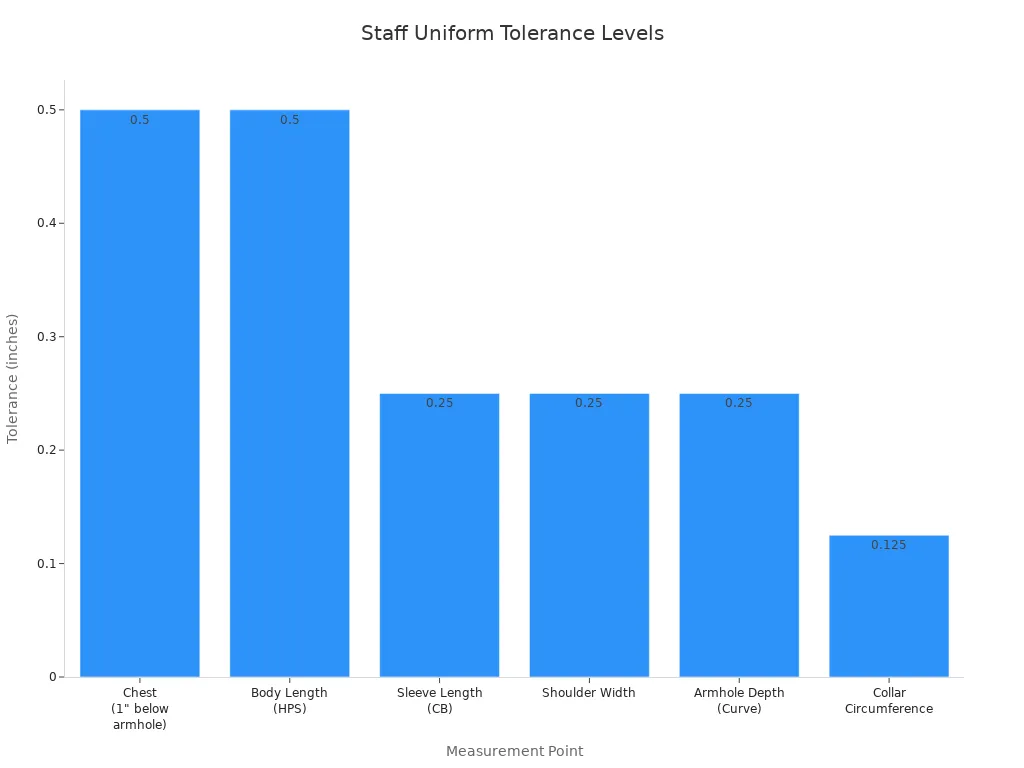
Collar and sleeve length tolerances are narrower because these points affect the fit most. A half-inch error on the chest is usually fine. A collar that is too tight or too loose ruins the uniform’s look.
Find OEM China Suppliers
Look for suppliers through several channels. Alibaba.com has the largest group of suppliers with Verified Supplier and Trade Assurance features. Made-in-China.com offers stricter checks and audit reports. Global Sources picks export-ready suppliers for long-term work. For low-cost sourcing, 1688.com gives cheaper domestic prices, but you may need translation tools and a freight forwarder.
Go to trade shows like the Canton Fair to meet uniform suppliers in person and check fabric samples. Hire a sourcing agent in China to review factories and negotiate for you. Ask other ski rental shops that have sourced uniforms for their suggestions.
Knowing manufacturing terms helps you talk clearly. MOQ means minimum order quantity. Sampling means pre-production samples. Quality control covers inline checks and final product tests. Reliable makers use AQL standards, automated cutters, and computerized sewing to keep quality steady across batches.
When you source ski rental shop uniform OEM China, check if the supplier is a factory or a trading company. Ask for company profiles, business licenses, and production samples with your exact logo, fabric, and stitching. This careful check protects your money.
Vet Suppliers and Evaluate Samples
A supplier’s paperwork tells you only part of the story. You must verify claims with documents, audits, and physical samples. This stage protects your money and your brand.
Screen Supplier Credentials
Start with the papers every real factory should have. Ask for the business licence (Business License), a manufacturing licence, ISO 9001 quality management certification, and any product-specific certifications. Request factory audit reports from recognized third-party audit firms. During factory vetting for apparel production, third-party audits double-check business licenses, valid export permits, and international certifications such as ISO 9001, OEKO-TEX, and BSCI. An on-site or live video workshop inspection is a must to evaluate production lines, equipment conditions, and daily output capacity. A qualified clothing supplier audit also includes checking past client references and real QC records to screen out fake trading companies and keep verified clothing manufacturers.
Third-party audits come in several forms. Choose the type that matches your order size and risk level.
Audit Type | What It Verifies | Typical Cost | Best Used When |
|---|---|---|---|
Social Compliance Audit | Labour practices, working conditions, health and safety | USD $300–600 | Required for retail buyers; brand reputation protection |
Quality Management Audit | QC processes, equipment, defect rates, production capacity | USD $400–700 | Before placing first large order |
Technical/Process Audit | Specific production processes, machinery capability, testing equipment | USD $500–1,200 | Complex or precision products |
Full Factory Audit | Combination of all above plus financial stability assessment | USD $800–2,000 | High-value, long-term supplier relationships |
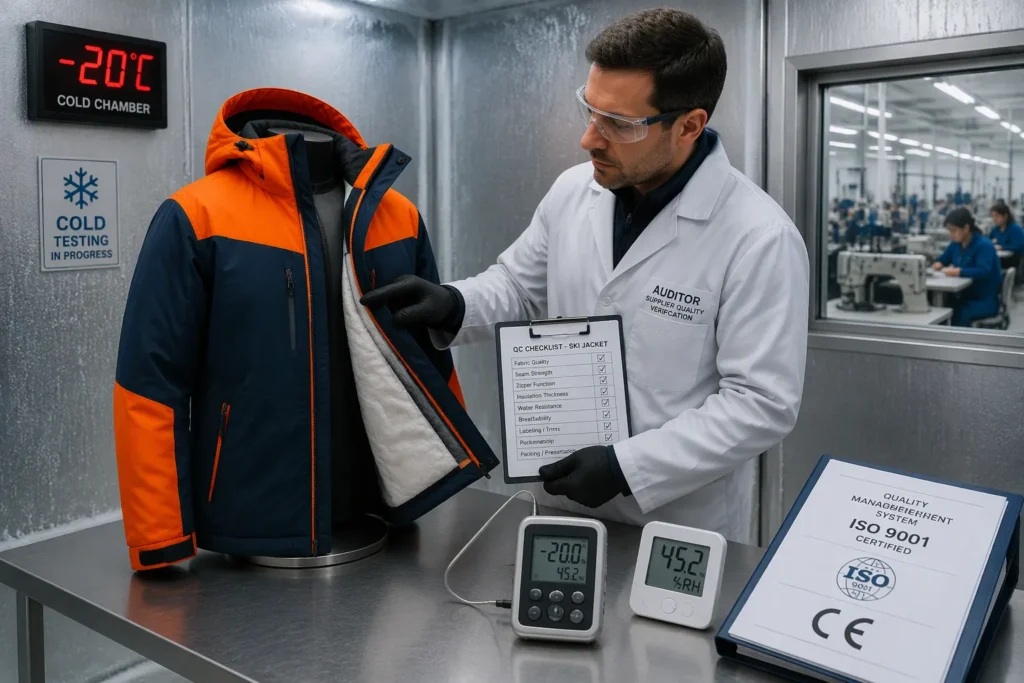
For ski uniforms, insulation testing matters most. A cold chamber is a walk-in environmental testing room that can simulate temperatures as low as -30°C. The factory places a finished jacket on a thermal manikin inside the chamber. Sensors measure the insulation value, expressed in CLO units, across different body zones. The test reveals cold spots where insulation is insufficient.
A legitimate outerwear factory will show you their cold chamber during a factory tour. Ask to see a recent test report. The report should show the date, the jacket style number, the target CLO value, and the actual measured CLO value. A factory that does not have a cold chamber, or claims their cold chamber is "broken" or "being repaired," is not testing their insulation performance. They are guessing. You can hire a third-party inspection company to verify the cold chamber's existence and operational status.
Assess Sample Quality
Order samples before you commit to bulk production. Evaluate each sample against a fixed checklist.
Sampling Area | What to Check |
|---|---|
Fabric | Stretch, opacity, weight, moisture feel |
Fit | Chest, waist, hips, length, shoulders |
Stitching | Seam strength and finishing |
Branding | Logo size, placement, color, durability |
Movement | Squat, stretch, run, lift, twist |
Wash test | Shrinkage, color, logo, shape |
Size chart | Measurements match buyer expectations |
Check branding with care. Confirm logo placement matches approved artwork, including horizontal alignment, vertical alignment, distance from seams, and consistency across sizes. Inspect print quality for blurred graphics, color differences, ink bleeding, incomplete prints, cracking, and peeling. Verify prints remain clear and vibrant after stretching. For silicone or rubber logos, check strong adhesion, smooth surface, correct thickness, consistent color, and no lifting at the edges.
Inspect high-stress seams such as shoulder straps, side seams, waistbands, leg openings, and crotch seams for secure stitching without gaps or loose threads. Verify thread quality by checking for broken thread, loose thread ends, skipped stitches, and thread color consistency. Check elastic attachment for even sewing without twisting or puckering. Confirm lining lies flat without wrinkles, twisting, uneven attachment, or visible lining edges.
Run performance tests on every sample. These include a moisture wicking test, a drying rate test, a breathability test, a water penetration test, a seam seal test, and a hydrostatic head test. A case study of an outdoor jacket demonstrates that while seams performed well in calm conditions, they failed under angled spray during water penetration and seam seal tests. After reinforcing the seams and retesting, the jacket passed all criteria. This example highlights the necessity of testing fabrics under realistic wet conditions.
Also run a stretch recovery test, a seam strength test, a colorfastness evaluation, and a fit verification. Compare random samples with the approved sample for silhouette, body balance, strap positioning, leg opening, and support level. When you source ski rental shop uniform OEM China, this sample review is your last chance to catch problems before mass production begins.
Negotiate Terms and Finalize the Contract
Agree on Pricing and MOQ
You now have quotes from a few suppliers. Custom team uniforms usually need a minimum order quantity of 30–50 pieces across all sizes. Custom snowboard jackets can range from a 1-piece sample to a 30-piece bulk order. If you order less than the factory’s standard MOQ, you will pay higher prices per unit or setup fees. Suppliers use these fees to cover their fixed costs.
Payment terms and lead times are different for each supplier. One comparison showed lead times of 25 days, 30 days, and 35 days at three factories. Deposits ranged from 30% to 50%. You can trade speed for savings. If you offer a 45–50 day window instead of a rushed 20–25 day window, you can cut prices by 5–12%. Factories will schedule your order during their slow times.
Typical Use | Buyer Exposure | |
|---|---|---|
50% deposit / 50% before shipment | First orders with new suppliers | High |
30% deposit / 70% before shipment | After one clean order | Moderate |
30% deposit / 70% against copy documents | Repeat buyers with proven trust | Low |
Letter of credit or escrow | Large first orders | Depends on terms |
Get three to five quotes with the same specs. Price gaps of 20–40% between suppliers are common. Ask for a breakdown of the costs. Raw materials usually make up 40–50% of the total, labor 20–30%, overhead 10–15%, and profit 15–20%. This clear view shows you where you can negotiate.
Lock Down Specs and Inspection Criteria
A written contract protects you from arguments. State detailed product features, including materials, design details, and what they are made of. Define acceptable tolerance deviations and link them to your approved sample. Make it clear that “close enough” will not count as meeting the standard. Allow in-factory quality control audits by you or your agent. Add a clause that says accepting non-conforming goods over and over does not waive future quality claims. This protects you from quality fading over time.
Set your AQL thresholds in writing before production starts. For a 125-unit inspection, AQL 0 for critical defects means zero acceptance. AQL 2.5 for major defects allows 7 and rejects at 8. AQL 4.0 for minor defects allows 14 and rejects at 15. Without agreed AQL settings, a pass result means nothing. State the remedies for failed inspections: repair, replacement, refund, or credit. Name the governing law and how to resolve disputes. When you source ski rental shop uniform OEM China, these clauses turn a handshake into a binding agreement.
Monitor Production, Ship, and Inspect Goods
Run Staged Quality Control
You can’t wait for goods to arrive before checking quality. Set up four inspection stages. First, do a pre-production inspection to check fabrics, trims, and factory ability. Second, run an inline check when 20–50% of sewing is done. This catches defects while fixes are still cheap. Third, do a pre-shipment inspection on finished goods using AQL sampling. AQL 2.5 for major defects and 4.0 for minor defects are common clothing standards. Critical defects like sharp edges or missing safety labels need zero tolerance. Fourth, watch container loading to confirm counts and sealed cartons.
Watch for common problems when you source ski rental shop uniform OEM China. Check GORE-TEX licenses through official channels. Compare capacity claims with virtual tours or third-party audits. Put MOQ terms for samples and bulk orders in writing. Protect your designs with non-disclosure agreements. These steps keep your production on track.
Manage Shipping and Customs
Pick an Incoterm that fits your risk comfort. FOB gives you control over freight costs. DDP offers the most hands-off experience, but the quoted price runs higher. CIF covers freight to the destination port, yet you still handle import costs after arrival. Incoterms define who pays duties and who files customs paperwork.
Prepare your documents early. You need a commercial invoice, packing list, bill of lading, and certificate of origin. The Form E certificate unlocks lower duty rates under the ASEAN-China Free Trade Agreement. Hire a freight forwarder with proven experience. Don’t pick one based only on the lowest price. When your goods arrive, check cartons for damage. Count units against your packing list. Check garments against your sealed approval sample. Report any defects to your supplier within the agreed claim window.
You have now gone through every step in the sourcing process. A detailed tech pack, careful supplier checks, and staged quality inspections stop mistakes. You get uniforms that fit well and hold up in cold conditions.
Build strong supplier relationships over time. Talk clearly. Send steady orders. Pay on time. Share honest feedback. Trust grows with each deal. Good partnerships bring better prices and priority scheduling.
Hard work pays off. When you source ski rental shop uniform OEM China, you save money without lowering quality. You can order branded workwear that boosts your brand image. Start your next uniform project with confidence.
Fabrics, Branding, and Counter Presentation for Ski Rental Shop Uniforms
Ski rental shop counter staff, fitting-room attendants, and shop-floor helpers need warm, durable, easy-clean fabrics, practical silhouettes for busy rental counters, and branding that survives wet boots and frequent washes. Embroidery on polos, soft shells, and aprons keeps multi-shop ski rental brands consistent after reorders.
Shanghai Top Fortune Industry Co., Ltd. (Top Fortune), established around 2002, operates a 1,506 m² Songjiang OEM/ODM factory serving Europe, the Middle East, Oceania, Southeast Asia, and the Americas. Typical MOQ is about 1,000 pieces per style for adult ski rental shop staff workwear — not school or kids apparel.
OEM Ski Rental Shop Uniforms vs Stock Winter Retail Wear
| Factor | OEM / ODM | Stock catalog |
|---|---|---|
| Spec control | Buyer-defined tech pack | Vendor SKU only |
| Role fit | Counter + fitting + floor kits | Generic retail cuts |
| Reorder match | Locked fabric + logo | SKU drift risk |
| MOQ | ~1,000 / style | Often lower, less flexible |
Buyer Checklist Before Approving Bulk Ski Rental Shop Uniforms
- Map garments to roles (counter hosts, fitting attendants, floor helpers, supervisors).
- Approve fabric warmth/durability, colorfastness, logo art, and wash-test samples.
- Confirm adult size curve across shops and packing marks for seasonal rollouts.
- Lock AQL inspection, lead time, payment terms, and export documents in writing.
Request a Ski Rental Shop Uniform Quote
Email rill@topfortunemail.com or WhatsApp +86 13524210501. Address: Floor 3, Building 20, Haier Zhigu, No.66 Guangfulin East Road, Songjiang, Shanghai 201600. MOQ about 1,000 pieces per style.
FAQ
What is the minimum order quantity for custom ski rental uniforms?
Most factories require 30–50 pieces across all sizes. Custom snowboard jackets can start from a 1-piece sample. If you order below the standard MOQ, you pay higher unit prices or setup fees. These fees cover the factory’s fixed costs.
How long does production take?
Lead times vary by supplier. One comparison showed 25 days, 30 days, and 35 days at three factories. You can trade speed for savings. A 45–50 day window instead of a rushed 20–25 day window can cut prices by 5–12%.
What is AQL and why does it matter?
AQL means acceptable quality limit. For a 125-unit inspection, AQL 2.5 for major defects allows 7 and rejects at 8. AQL 4.0 for minor defects allows 14 and rejects at 15. Critical defects like sharp edges need zero tolerance. Set these thresholds in writing before production.
How do I verify insulation quality?
Ask to see the factory’s cold chamber. This walk-in room simulates temperatures as low as -30°C. A thermal manikin measures insulation in CLO units across body zones. Request a recent test report showing the date, style number, target CLO, and actual measured CLO.
Which Incoterm should I choose?
FOB gives you control over freight costs. DDP offers the most hands-off experience, but the quoted price runs higher. CIF covers freight to the destination port, yet you still handle import costs after arrival. Pick the term that fits your risk comfort.