

Valet Parking Attendant Uniform OEM China | Branded Hotel & Venue Valet Workwear

The best Chinese OEM supplier for your valet parking uniforms depends on your needs for quality, customization, and budget. You must compare suppliers carefully to find the right one. Special uniforms build guest trust and make a strong first impression. Your supplier choice directly affects how guests see your brand. A sharp, well-made uniform tells guests they can trust your service. A poor-quality uniform sends the opposite message. This post covers comparison criteria, common supplier types, and useful ordering tips. You will learn how to judge valet parking attendant uniform OEM China options step by step. You will also see how to weigh things like fabric, logos, and pricing. With the right approach, you can find a supplier in China that meets your standards.
Key Takeaways
Compare suppliers by looking at fabric, MOQ, sampling, lead time, and quality control.
Pick certified suppliers to get better quality and less risk.
Order a sample first to check the fabric, stitching, and logo quality.
Plan your production and shipping time so you meet your deadline.
Talk about terms and payment plans to get better deals.
Valet Parking Attendant Uniform OEM China: Supplier Comparison
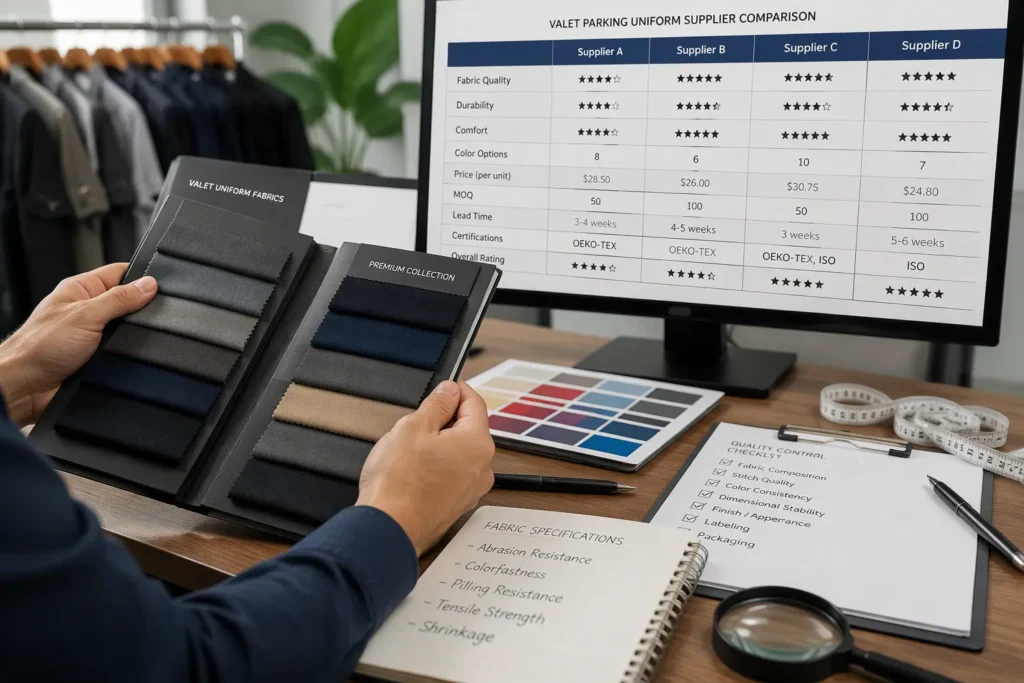
This part is your main guide for comparing suppliers. You need to check five things closely: fabric, MOQ, sampling, lead time, and quality control. Fabric changes how the uniform looks and feels. MOQ sets the smallest order you can place. Sampling checks quality before full production starts. Lead time affects your schedule. Quality control keeps everything the same. These things decide if a supplier meets your standards for a valet parking attendant uniform OEM china project. Certified Chinese OEMs are more reliable and cost less than uncertified ones. Certification means the supplier passed audits for production standards and fair labor practices. You avoid common problems when you work with certified makers. A certified supplier follows written steps for every part of production.
The quality of your uniforms depends on which supplier you pick. Reliable suppliers in china put money into good equipment and trained workers. They follow steady processes that give the same results every time. Uncertified factories may use cheaper materials or skip inspection steps. Picking a certified supplier lowers your risk of getting bad products. The manufacturing standards at certified factories keep large orders consistent.
Fabric And Color Matching
Fabric choice is the base of your uniform. A uniform fabric needs abrasion resistance of at least 5,000 cycles under ASTM D4157 standards. This resistance handles friction from car doors and seat belts every day. Colorfastness requires AATCC Test Method 16 certification. The fabric must keep its color after many washes. Tensile strength should reach at least 150 psi. Shrinkage rate must stay at or below 3% after five washes using ISO 6330. Fabric weight usually starts at 200 gsm. For outdoor valet staff, flame resistance per ISO 11612 and UV protection of UPF 30+ add safety benefits.
Different fabric types fit different roles and climates. Poly-cotton blends work for tough, easy-care uniforms that stay stable after washing. TR suiting gives good drape and wrinkle resistance for formal roles. Wool blends feel better to the touch. Stretch woven fabrics help staff move during long shifts. Oxford or twill fabrics add texture for daily wear. Water-resistant outer fabric shields staff in rain or cold weather.
Climate conditions change your fabric choice. One design cannot fit every climate. Employee comfort affects how well they work. In very hot summers, light breathable fabrics with moisture management help lower heat. Lighter colors also bounce heat away. Winter uniforms move toward layer-friendly designs that give warmth without too much weight. A valet standing outside needs a different answer than a receptionist in air conditioning. When uniforms match working conditions, employees feel more sure of themselves.
Color matching needs precision from your supplier. You must give Pantone codes or physical color swatches. The supplier should make lab dips for your approval before full production. This step stops color mismatches across different garment pieces.
Embroidery And Logo Accuracy
Your logo stands for your brand identity. Accurate embroidery keeps that logo sharp on every uniform. A simple abrasion test checks logo quality. Rub the embroidered logo with coarse sandpaper for 30 seconds. If threads lift or fade, the logo fails durability standards and you should reject the vendor. This test shows proper thread and stitching methods.
Reinforced stitching at high-stress points stops unraveling. Cuffs, plackets, and seams need extra stitching to handle repeated washing. For performance fabrics, special ballpoint needles stop snagging of fine synthetic threads. High UV-resistance thread stops bleaching of brand colors on outdoor uniforms.
The fabric blend changes embroidery results. For 100% polyester performance fabric, your supplier must use the right needle type. For 65/35 polyester-cotton blends, the garment must handle commercial drying cycles without shrinking. Standard care practices make logo life longer. Wash uniforms inside-out at a maximum of 30°C. Air-dry jackets to keep their structure. Avoid fabric softeners because they break down wickability. One verified complaint noted collar fraying after only eight washes.
Pick suppliers who use high-quality thread from trusted brands. Ask for logo samples on your actual fabric before ordering. Check that lettering stays readable after many washes. Proper fabric selection and accurate embroidery build guest confidence.
MOQ, Pricing, And Sample Policies
Minimum Order Quantities
Minimum order quantities vary widely across suppliers in china. Some factories set a low MOQ for stock designs. Others require a larger commitment for fully custom work. You should ask each supplier for their exact MOQ before you invest time in design talks. A low MOQ helps you test a new uniform style without tying up too much cash. A high MOQ often brings a lower unit cost, so you must balance risk against savings.
Think about your staff size and turnover rate. If you run a small venue, a huge MOQ leaves you with boxes of unused uniforms. If you manage a large hotel group, a higher MOQ may suit your needs. Ask whether the supplier counts MOQ per style, per color, or per fabric. This detail changes your total order size. Some suppliers also waive the MOQ for repeat orders, which rewards long-term partnerships.
Sample Costs And Refunds
Always order a sample before you commit to bulk production. A sample shows you the real fabric, stitching, and logo quality. Most suppliers charge a sample fee. That fee often covers materials, labor, and shipping. Ask if the supplier refunds the sample cost when you place a bulk order. Many factories credit the sample fee back against your first production run.
Request a quote that separates sample cost from bulk prices. This clarity stops surprise charges later. You should also confirm who pays for sample shipping. Express courier fees add up fast. Test the sample in real conditions. Have a staff member wear it for a full shift. Check the fit, the fabric breathability, and the logo after one wash. If the sample fails, you save money by walking away. If it passes, you order with confidence.
Lead Times And Shipping Options
Standard Vs. Rush Production
Standard production follows a predictable schedule. Most factories in china need several weeks to source fabric, cut panels, sew garments, and finish embroidery. You should confirm the exact production window in writing before you pay a deposit. Ask the supplier to break the timeline into stages. A clear schedule helps you plan staff fittings and launch dates.
Rush production costs more and carries higher risk. A factory may push your order ahead of others, but workers then skip careful checks. You should only choose rush service when a real deadline forces it. Confirm that the supplier still runs inline inspection during rush jobs. Otherwise, you may receive uniforms with crooked logos or weak seams.
Air, Sea, And Express Shipping
Your shipping choice balances cost against speed. Sea freight saves money on large orders, while air and express move smaller loads faster. The table below shows general estimates for shipping from China to the US.
Shipping Mode | Average Cost (2025) | Transit Time |
|---|---|---|
Ocean Freight (FCL) | $3,500–$6,000 per container | 15–35 days |
Ocean Freight (LCL) | $50–$80 per CBM | 20–40 days |
Air Freight | $5–$8 per kg | 5–10 days |
Express Courier | $8–$12 per kg | 3–5 days |
Ocean freight suits bulk uniform orders that can wait. Full container loads give you the lowest unit cost. Less-than-container loads work for smaller batches, but they take longer because your goods share space with other cargo. Air freight fits medium orders when you need uniforms within two weeks. Express courier serves urgent sample shipments or small top-up orders. These figures cover the US route only. Rates to Europe or the Middle East differ, so request a quote for your destination.
Quality Control And Certifications
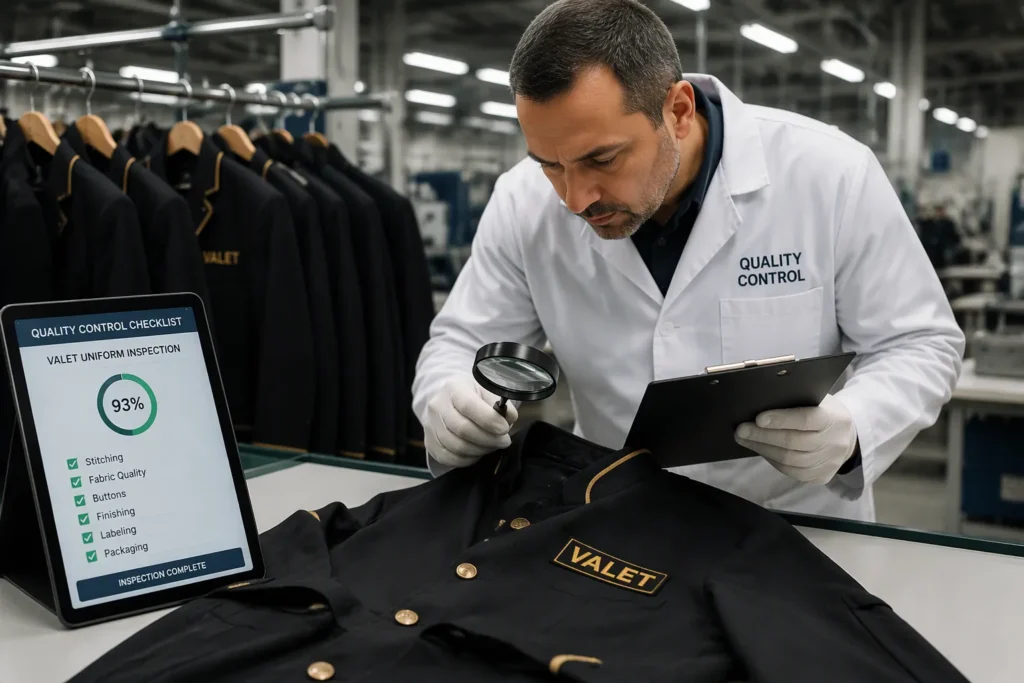
Quality control is a key thing to check before you order a large batch. A supplier without strong quality checks will send you uniforms that don’t match. Then you face returns, fixes, and unhappy workers. Strong QC protects your brand and your money. You should treat QC as a must-have, not a nice extra.
Inline And Pre-Shipment Inspection
You need to know the three main QC checkpoints. Each one finds different issues at different stages.
Inline inspection: This check happens when work is 30–50% done. Inspectors look for ongoing problems like stitching and build. They fix issues right away before defects spread across the whole order. This step stops quality problems in the middle of production.
Pre-shipment inspection (PSI): This check happens when work is 80–100% done. Inspectors run focused checks for visible and function problems. The goal is to allow fixes before packing. This step prevents rework after the final stage.
Final Random Inspection (FRI): This check happens after all production and 80% packing. Inspectors use statistical AQL random sampling. This step measures shipment quality and gives a pass or fail result based on defect rates.
Related OEM uniform programs
AQL sampling is the math method behind final inspection. Instead of checking every item, inspectors take a random sample and compare it to agreed limits. A common limit for major defects is 2.5%. This method balances inspection work with known, measurable risk. It ensures even quality across large orders without guesswork.
Together, these checkpoints give you two layers of safety. PSI gives quality assurance through early finding and fixing. FRI gives quantity proof through statistics of sameness. This two-way method catches problems at both the process level and the final product level.
A real example shows how this works. A composite factory faced 1 in 4 shipment rejections due to size drift on one garment style. The factory set up a formal inner final inspection using the buyer’s AQL level and random sampling at 80% completion. This pre-shipment review found system drift tied to a cutting table calibration issue. Because the problem was caught during production, fixing could happen on the remaining run. The rejection rate dropped sharply within one quarter. This case shows how inline inspection and pre-shipment AQL review work together to ensure uniform quality.
ISO, BSCI, And Compliance Certificates
Certifications prove that a supplier meets accepted standards. You should ask for certificates in four areas: quality management, social duty, safety compliance, and new ideas. One credential is not enough. Look for suppliers who hold certificates in all four areas.
The table below lists the key certificates you should ask for from any China-based valet uniform supplier.
Certification | Category | Purpose / Risk Addressed |
|---|---|---|
ISO 9001 | Quality Management System | Confirms set steps for production planning, raw material check, and final quality control; lowers risk of uneven product quality |
ISO 14001 | Environmental Management System | Shows structured steps to lower environmental impact during production |
ISO 45001 | Occupational Health & Safety | Confirms worker safety rules are formally checked and kept; lowers risk of unsafe factory conditions |
BSCI (Business Social Compliance Initiative) | Social Responsibility | Checks working conditions, pay, and worker rights; lowers reputation and rule risk tied to labor practices |
ECOVADIS | Environmental System | Judges environmental management practices against global sustainability marks |
French EV International | Social/Environmental Compliance | Extra social duty and environmental accountability credential |
ANSI/ISEA 107-2020 | Safety Compliance (US) | Sets rules for high-visibility clothing; lowers risk of bringing in non-compliant protective items |
EN ISO 20471 | Safety Compliance (EU) | Sets European standard for safety clothing visibility |
National High-tech Enterprise | Innovation Status | Given by Chinese authorities to companies showing steady R&D spend; shows supplier can adapt |
You should also ask about these extra certifications. WRAP certifies ethical making. SMETA checks labor, health and safety, environment, and business ethics. OEKO-TEX Standard 100 tests textiles for harmful substances. GRS checks recycled content and responsible practices. BCI supports sustainable cotton production.
BSCI deserves special focus. This social duty audit covers following laws, freedom to join groups, no discrimination, pay, work hours, workplace safety, no child labor, no forced labor, and environment and safety. Over 1,300 members from 11 countries, mostly European stores and buyers, push for supplier audits. A BSCI report gives you written proof of ethical labor practices.
Quality management certificates lower the risk of uneven product quality and unsafe factory conditions. Social duty certificates lower reputation and rule risk tied to labor and environment practices. Safety compliance certificates lower the risk of bringing non-compliant protective items into regulated markets. National High-tech Enterprise status and patent holdings lower the risk of working with a supplier that cannot adapt to changing fabric or build needs.
The durability of your uniforms depends on the making standards at the factory. A Chinese supplier with ISO 9001 certification follows written steps for every part of production. This consistency gives you reliability across large orders. You avoid the common problem of getting a good sample but poor bulk goods. Certified suppliers also put money into better equipment and trained workers. These investments show up in the final product.
Before you sign a contract, ask for copies of all relevant certificates. Check the expiry dates. Verify the certificate scope covers the products you plan to order. You can also ask for the supplier’s audit reports for BSCI or SMETA. These reports give you detailed info about working conditions and factory practices. A supplier who avoids sharing certificates may have something to hide. A supplier who gives them quickly shows confidence in their operations.
Communication And Account Management
Good communication with your valet uniform supplier in China sets the mood for your project. You need to know how quickly a supplier responds before you send a deposit. Two things matter most: response speed and account management.
Response Times And Language Support
Time zones create a natural gap between you and your supplier in China. When your workday ends, theirs begins. Response time matters when a production delay threatens your schedule. Ask potential suppliers for their average response time to emails. A reliable supplier replies within 24 hours on working days. Some factories promise same-day answers for urgent questions. Test this during your sample phase. If a supplier takes three days to answer a simple question about thread colors, imagine the delay during a production crisis. You need a partner who values speed as much as you do.
Most Chinese OEMs employ English-speaking sales staff. The quality of their English varies widely. Ask to speak directly with your contact person. Listen for comfort discussing terms like “fabric weight” or “embroidery density.” Some suppliers use translation apps for complex topics. This approach works but slows problem-solving. You prefer a supplier whose English can catch a shade difference on a Pantone swatch without several rounds of clarification. Strong language skills reduce errors in spec sheets and order confirmations.
Dedicated Account Managers
A dedicated account manager knows your brand from order to order. This person remembers your logo specifications from the first batch. They understand your color preferences and quality standards. For repeat buyers, this continuity saves time and prevents mistakes. You avoid explaining your requirements from scratch every time you place a new order.
Ask if the supplier assigns the same manager for every order. Some factories rotate staff, which breaks the knowledge chain. A new manager may misunderstand embroidery placement or fabric choice. Confirm your manager has authority to make decisions about sampling and QC checks. A manager who must escalate every small change slows your timeline. You want a manager who can approve a pattern adjustment or push a rush order forward without waiting for a supervisor.
Alibaba Sourcing Vs. Traditional Brands
You have a real choice to make between Alibaba sourcing and well-known uniform brands. Each option has its own strengths. Alibaba links you straight to thousands of suppliers in China. Traditional brands sell through dealers and put their own label on products. Knowing how Chinese suppliers fit into the market helps you compare both choices fairly.
Pros And Cons Of Alibaba Sourcing
Alibaba lets you reach a very large group of factories. You can compare prices from many suppliers all in one spot. This competition often brings your unit cost down. You also get the freedom to customize fabric, logos, and packaging. Many buyers begin here because the platform seems easy and quick.
The platform also comes with risks. Quality changes a lot from one factory to another. Some sellers are just middlemen who never touch a sewing machine. You must check every supplier before you pay. Communication gaps can slow your project down. You also deal with shipping, customs, and quality checks on your own. Alibaba works best when you have time to screen partners and handle the details.
When Traditional Brands Make Sense
Traditional brands give you a finished product with a known reputation. You buy a proven design with steady sizing and fabric. The brand takes care of manufacturing, quality control, and delivery. This convenience saves you time and lowers your risk. You also get customer service and return policies backed by a company.
These benefits come with a cost. Traditional brands charge more because of branding, overhead, and retail margins. Labor costs in Western countries push their production expenses higher. Customization options stay limited. You can rarely change fabric weight or logo placement. Pick a traditional brand when speed and certainty matter more than savings. Pick Alibaba sourcing when you want control and lower costs.
Comparing Representative Supplier Types
You can find two main kinds of valet uniform makers in China. Each kind serves different buyer needs. Top-tier full-service original equipment manufacturers handle everything from design to shipping. Budget-friendly specialists focus on a small range of products at lower cost. Your choice depends on your order size, timeline, and customization needs.
Top-Tier Full-Service OEM Suppliers
These suppliers work as true partners for your brand. They offer OEM and ODM capability for uniform brands, distributors, and businesses. You can send sketches, tech packs, or reference samples for design help. They provide private labeling with your designs, logos, labels, and packaging. Product development and fabric suggestions come as a standard part. Pattern changes follow your market needs. Logo embroidery and heat transfer printing sit alongside woven labels and hang tags. Custom packaging and special functional fabrics complete the service list.
Production capacity at this level is large. One reference factory runs 380+ skilled workers across 8 production lines. A strict quality control system covers stitching, colorfastness, and sizing at many stages. Export support includes documents, packaging, and shipping plans. After-sales support covers replacement, rework, or repair for defective items. MOQ flexibility ranges from 50 to 200 pcs depending on the supplier. Production cycles run 20–45 days depending on complexity and order size.
Ningbo Toprise Security Products Co., Ltd. stands for this tier. The company serves uniform brands and distributors with full customization. Jiangsu Fushi Uniform Co., Ltd. also fits this category. Both companies show the depth you expect from established Chinese manufacturers.
Budget-Friendly Specialist Suppliers
These suppliers keep costs low by limiting what they do. They often stock standard designs and offer fewer fabric choices. Customization stays basic, such as a simple logo print. You may face higher MOQs on some items and lower MOQs on others. Communication can be slower. Quality changes more from batch to batch. These suppliers suit buyers who need simple uniforms fast and cheap.
The table below compares the two groups side by side.
Feature | Top-Tier Full-Service | Budget-Friendly Specialist |
|---|---|---|
Design support | Full OEM/ODM, tech packs, sketches | Limited or none |
Fabric options | Wide range, functional fabrics | Narrow, stock fabrics |
Logo methods | Embroidery, heat transfer, woven labels | Basic print or patch |
MOQ | 50–200 pcs | Varies, often higher on custom work |
Production cycle | 20–45 days | Often shorter on stock items |
Quality control | Multi-stage system | Basic or inconsistent |
After-sales | Replacement, rework, repair | Limited |
Export support | Full documentation and shipping | Minimal |
Your budget and brand goals decide which type fits. A luxury hotel needs the full-service model. A small event crew may accept the specialist route. Weigh your priorities before you commit. The right manufacturing partner protects your brand image and your bottom line.
Practical Tips Before Ordering
Shortlisting Valet Parking Attendant Uniform OEM China Suppliers
You should make a shortlist before you spend money on samples. Start with at least three suppliers who match your fabric, logo, and volume needs. Then run a few checks on each one.
Ask for pre-production samples so your team can judge fit, quality, and function before you commit to bulk orders.
Ask for samples in multiple sizes. Have staff wear them during real shifts for one to two weeks. Collect feedback on comfort, movement, and laundering.
Confirm the supplier checks quality and compliance items like stitching standards, color fastness, and fabric performance before shipment.
Make sure the supplier will accept last-minute corrections based on real-world staff feedback before final production begins.
These steps show how a factory handles your valet parking attendant uniform oem china order. A supplier who resists corrections or delays samples will likely cause problems later. Request quotes from at least three shortlisted suppliers. Compare their prices side by side, and check what each quote includes.
Negotiating Terms And Payment Schedules
Good negotiation starts with leverage. Tell each supplier that you are considering multiple partners. This pressure often improves payment terms and bulk discounts. Ask for bulk discounts clearly, and clarify what bonuses come with a large order, such as free branding or free warehouse delivery.
If a supplier refuses your first terms, offer flexible alternatives. Propose different quantities, delivery timings, or payment methods. Put every agreement in writing, and request an on-site inspection in china to confirm compliance. Watch your manners during talks. Be patient, avoid direct refusals to preserve face, and stay ready to make concessions. This approach builds long-term cooperation, which can lead to better terms and lower prices on future orders. A supplier in china who trusts you will often match or beat a competitor’s offer.
You now have a clear plan to find the right valet uniform partner. Follow these steps:
Check your needs for fabric, MOQ, sampling, lead time, and quality control.
Pick at least three certified suppliers for your shortlist.
Approve a sample on your own fabric before full production.
Compare quotes side by side, then put the terms in writing.
The best supplier for your venue depends on your quality, customization, and budget needs. No single factory is best for every buyer. Ask your shortlisted suppliers for quotes today, and let their samples and answers guide your final pick.
FAQ
What is the typical MOQ for custom valet uniforms from China?
Most full-service OEM suppliers set minimums between 50 and 200 pieces. Budget specialists often require more for custom work. Ask each supplier whether they count the MOQ per style, per color, or per fabric. That detail changes your total order size.
Do I have to pay for samples?
Yes, most factories charge a sample fee that covers materials, labor, and shipping. Many suppliers credit that fee back when you place a bulk order. Always confirm the refund policy in writing before you pay.
How long does production and shipping take?
Full-service OEM production usually runs 20 to 45 days, depending on complexity. Ocean freight adds 15 to 35 days to the US. Air freight takes 5 to 10 days. Express courier delivers in 3 to 5 days.
Which certifications should I request from a supplier?
Ask for ISO 9001, ISO 14001, ISO 45001, and BSCI at a minimum. Add OEKO-TEX Standard 100 for textile safety and WRAP or SMETA for ethical labor proof. Check expiry dates and confirm the certificate scope covers your products.
Should I choose a top-tier OEM or a budget specialist?
Pick a top-tier full-service OEM when you need custom fabrics, accurate embroidery, and multi-stage quality control. Choose a budget specialist for simple stock designs and fast, low-cost orders. Your brand goals and budget decide the right fit.