

Why are uniforms mandatory in most Australian schools
Table of Contents
Display
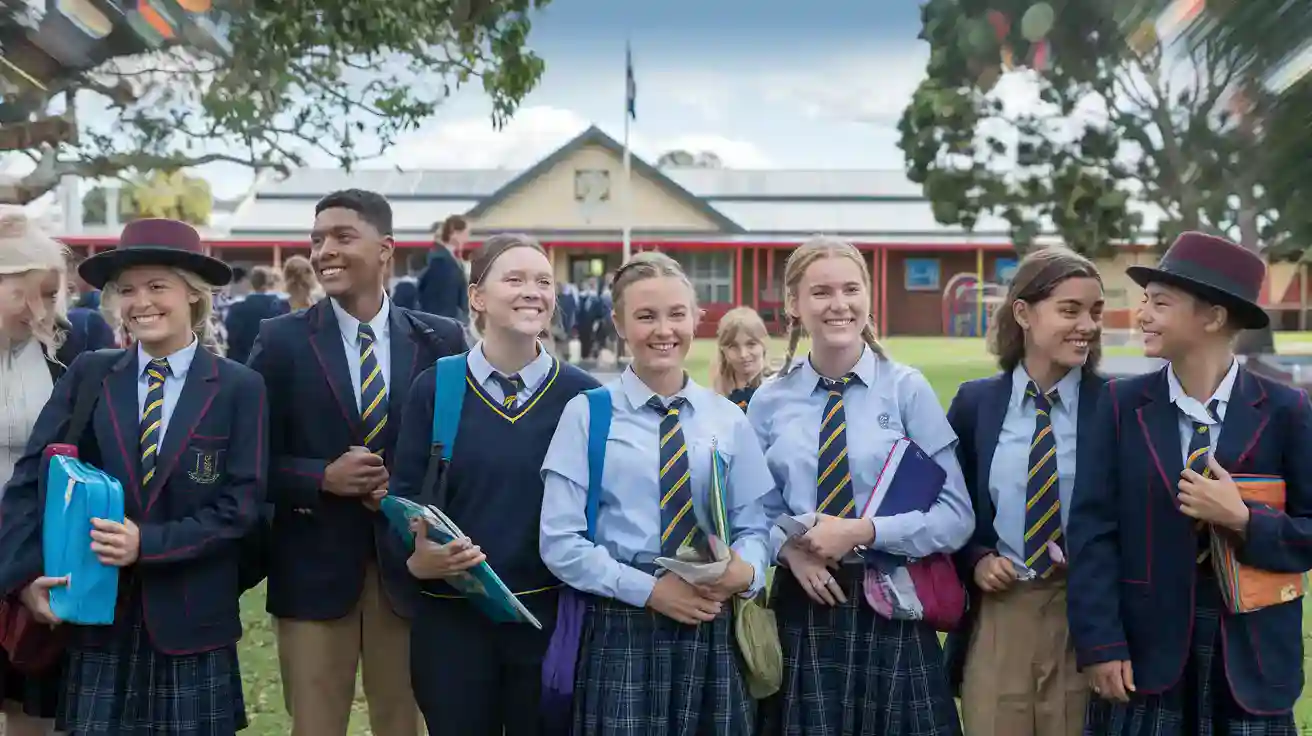
I see that most Australian schools require uniforms because they help with student identification, maintain tradition, promote equality, and encourage a sense of belonging. Wearing a uniform lets me focus on my studies instead of worrying about fashion choices or social pressures. Uniform policies often differ from school to school, but the goal stays the same. Many students prefer sports uniforms, which cost less and make it easier to stay active. Parents and teachers also support daily sports uniforms, showing how practical changes can benefit everyone.
Traditional uniforms cost about $330 for primary students and $526 for secondary students in Victoria.
Sports uniforms average $163, making them a more affordable option.
62% of primary students and 72% of secondary students prefer sports uniforms.
80% of parents and 60% of teachers want sports uniforms every day.
Australian school uniforms reflect these values and practical needs across communities.
Key Takeaways
Uniforms promote equality by reducing visible economic differences among students.
Wearing a uniform helps students focus on their studies instead of fashion choices.
Sports uniforms are often preferred for their affordability and comfort.
Uniforms create a sense of belonging and team spirit among students.
School uniforms help with easy identification, enhancing safety in public spaces.
Uniform policies can adapt to respect cultural and religious needs of students.
Schools are increasingly considering student feedback to improve uniform policies.
Mandatory uniforms can lead to better academic focus and reduced distractions in the classroom.
Equality
Reducing Socioeconomic Gaps
Minimizing Wealth Differences
When I walk into my school, I notice that everyone wears the same uniform. This simple rule makes a big difference. Uniforms help hide wealth differences between students. I do not feel pressure to wear expensive brands or keep up with the latest trends. Instead, I focus on learning and building friendships. Traditional uniforms cost more than sports uniforms, but they still create a level playing field. I see students from different backgrounds feel more comfortable because no one stands out for what they wear. Uniforms help me feel equal to my classmates, no matter what my family earns.
Preventing Fashion Competition
Fashion competition can distract students from their studies. I remember feeling anxious about what to wear on non-uniform days. Some students show off designer clothes, while others worry about fitting in. Uniforms remove this stress. I do not have to think about matching outfits or impressing others. The school uniform sets a standard for everyone. Traditional uniforms may seem strict, but they help me focus on my work instead of my wardrobe. I see less teasing and fewer cliques based on clothing. Uniforms encourage me to value people for their character, not their style.
Inclusive Environment
Uniforms create an inclusive environment for all students. I notice that wearing the same outfit helps me feel part of a team. My classmates and I share a sense of belonging. The uniform brings us together, even if we come from different cultures or religions. I see students celebrate their differences while recognizing our shared identity. Uniforms shift attention away from cultural or religious attire, which can sometimes divide students. Instead, we unite under one school symbol.
Wearing a uniform helps me feel accepted and included. I do not worry about standing out or being judged for my clothes. The school community feels stronger because everyone follows the same dress code.
Uniforms reduce visible economic differences.
They bridge cultural divisions and encourage unity.
I believe that uniforms play a key role in making my school a welcoming place for everyone.
School Identity
Sense of Belonging
When I put on my school uniform each morning, I feel a strong connection to my classmates. The uniform makes me part of something bigger than myself. I see everyone dressed the same, and I know we share a common purpose. This sense of belonging helps me feel safe and accepted. I do not worry about standing out or being judged for my clothes. Instead, I focus on learning and building friendships. The uniform brings us together, no matter where we come from or what our backgrounds are.
Wearing the same colors and crest as my peers gives me pride in my school. I notice that new students adjust more quickly because the uniform helps them fit in. The shared dress code creates a welcoming atmosphere, making it easier for everyone to feel included.
Representing Values
My school uniform does more than just create equality. It tells a story about my school’s history and values. The colors, crest, and logo on my uniform represent our traditions. I see these symbols every day, and they remind me of the standards my school sets for us. The uniform shows respect for our heritage and encourages me to act responsibly.
Australian schools use uniforms to visually embody their identity. Each school chooses specific colors and designs that reflect its unique story. I feel proud when I wear my uniform because it connects me to generations of students before me. The dress code also teaches discipline. By following the rules, I learn to respect guidelines and prepare for future workplaces where dress codes matter.
Here is a simple table showing how uniforms reflect school identity:
Uniform Element | What It Represents |
|---|---|
Colors | School tradition & pride |
Crest/Logo | School values & history |
Fabric/Design | Local culture & community |
Team Spirit
Uniforms help build team spirit in my school. When I see my classmates in the same outfit, I feel united with them. We support each other during sports events, assemblies, and group activities. The uniform reminds me that we work together toward common goals. I notice that students cheer louder and participate more when we wear our school colors.
School uniforms reduce the visibility of economic differences. This shift allows us to focus on academics and teamwork instead of personal appearance. I feel proud to represent my school during competitions. The shared identity boosts our confidence and encourages us to strive for success as a group.
Uniforms foster unity and pride.
They encourage students to support each other.
They help us concentrate on learning and collaboration.
I believe that my school uniform is more than just clothing. It is a symbol of our shared identity, values, and team spirit.
Student Identification
Easy Recognition
When I wear my school uniform, I notice that people can easily tell which school I attend. The uniform sets me apart from others in public places. Teachers and staff recognize me quickly, even in crowded areas. I feel confident knowing that my school colors and logo make me visible. This standardization helps the community identify students from different schools. I see parents and neighbors greet me because they know I belong to a local school. The uniform acts as a badge, showing my connection to my school.
Uniforms make it simple for teachers to spot students during excursions or sports events. I never worry about getting lost in a crowd because my uniform stands out. The clear distinction between students and the general public helps keep school groups organized.
School Authority
My uniform gives me a sense of responsibility. When I put it on, I know I represent my school. Teachers expect me to follow rules and behave respectfully. The uniform signals that I am under school authority, both inside and outside the campus. I notice that adults treat me differently when I wear my uniform. They know I am a student and expect me to act accordingly.
I feel proud to wear my school’s colors. The uniform reminds me to uphold the values my school teaches. I see my classmates take their roles seriously because the uniform connects us to our teachers and leaders. The dress code helps maintain discipline and order. I understand that my actions reflect on my school, so I try to make good choices.
Here is a simple table showing how uniforms support school authority:
Uniform Feature | Impact on Authority |
|---|---|
School Logo | Shows official status |
Dress Code | Sets behavior standards |
Consistent Style | Reinforces discipline |
Safety
Safety matters to me and my classmates. The uniform plays a big role in keeping us safe. When I travel to and from school, people recognize me as a student. This visibility helps protect me from strangers. School staff can quickly identify students who belong on campus. I feel secure knowing that outsiders stand out if they do not wear a uniform.
During emergencies or drills, uniforms help teachers account for everyone. I see staff check uniforms to make sure all students are present. The dress code reduces confusion and helps keep our school safe. I trust that my uniform helps adults look after me and my friends.
Uniforms make students easy to identify.
They support school authority and discipline.
They help keep students safe in public and on campus.
I believe that wearing a uniform does more than create equality. It helps me feel recognized, respected, and protected every day.
Focus on Education
Reducing Distractions
When I wear my school uniform, I notice that I spend less time thinking about what to wear each day. My mind feels clearer because I do not worry about fashion or fitting in. Uniforms help me focus on my lessons instead of my appearance. I see fewer distractions in the classroom when everyone dresses the same. Teachers spend less time managing dress code issues and more time teaching.
Research supports my experience. Studies show that uniforms can improve discipline and reduce classroom disruptions. For example, the Baumann and Winzar study found that students in uniforms listen better and teachers wait less for students to settle down. This leads to a calmer learning environment.
Study | Findings |
|---|---|
Baumann and Winzar | Students listen better, lower teacher waiting times, better discipline |
Firmin et al. | Uniform introduction reduced distractions |
Sensory Overload Study | Uniforms can cause discomfort for sensitive children, leading to distraction |
Most students benefit from fewer distractions, but I know that some students with sensory sensitivities may feel uncomfortable in certain uniforms. My school tries to address this by offering different fabric options. I appreciate that teachers listen to our feedback and make changes when needed.
I feel more focused in class when everyone wears the same uniform. The classroom feels more organized, and I can pay attention to my work.
Academic Emphasis
Uniforms help me put academics first. I see that my teachers expect us to concentrate on our studies, not our clothes. When I wear my uniform, I feel like I am in a place meant for learning. My classmates and I share the same goal: doing our best in school.
Some studies suggest that uniforms can improve academic achievement. For example, Bodine found a positive link between wearing uniforms and better grades. Gentile and Ibermann also reported higher grades and better retention after uniforms were introduced. Stockton and colleagues noticed that students attended school more often and achieved more after starting to wear uniforms.
Study | Findings |
|---|---|
Bodine (2000) | Positive correlation between uniforms and academic achievement |
Gentile and Ibermann (2012) | Positive effect on grades and retention |
Stockton et al. | Increased attendance and achievement after uniform introduction |
DaCosta | Improved concentration and security in schools with uniforms |
Baumann and Kriskova | Students settle to work faster in uniforms |
Not every study agrees. Brunsma and Rockquemore did not find a strong link between uniforms and academic outcomes. Hattie did not list uniforms among the top factors affecting education. Still, I notice that uniforms help me settle into my work routine. I feel less distracted and more ready to learn.
Wearing a uniform signals that school is a place for learning. I focus on my studies and feel proud to represent my school.
Uniforms may not guarantee better grades for everyone, but I believe they help create an environment where learning comes first. My experience matches what many teachers and students report: uniforms make it easier to concentrate and succeed in school.
Australian School Uniforms: Policy and Practice

Public Schools
I see that most public schools in Australia require students to wear a uniform. When I started at my school, the dress code was clear. The school community helped set the rules, and everyone had a say. My principal explained that the uniform policy must follow Department of Education guidelines and anti-discrimination laws. This means my school cannot suspend or expel students for uniform violations. Instead, teachers encourage us to follow the rules and reward us for compliance.
The dress code includes specifications for garment design. I wear gender-neutral options and clothing suitable for physical education. My school considers religious and cultural needs, so students can wear items like hijabs or turbans. The policy aims to treat all students fairly. I notice that the rules apply to everyone, and the school tries to make the uniform comfortable for our climate.
Garment design specifications are defined by the school.
The dress code includes gender-neutral and physical education options.
Religious and cultural requirements are respected.
I feel that australian school uniforms in public schools focus on inclusivity and fairness. The school wants every student to feel comfortable and accepted.
Private Schools
When I visit private schools, I notice that their uniform policies are stricter. Nearly all private schools in Australia require uniforms, with at least 99% adherence. These schools have more freedom to create their own rules. The enrolment agreement outlines the uniform requirements, and parents must agree before students start.
Private schools enforce uniform policies more strictly than public schools. I have seen students sent home for minor infractions, such as incorrect haircuts or missing uniform items. The school can impose reasonable punishments for non-compliance. Teachers expect students to follow the dress code exactly. I feel that traditional uniforms in private schools often include blazers, ties, and formal shoes. The school chooses the colors and designs to reflect its values and history.
Private schools set high standards for appearance. I see students take pride in wearing their uniforms, knowing they represent their school’s reputation.
Nearly all private schools require uniforms.
Uniform rules are outlined in the enrolment agreement.
Strict enforcement includes possible punishments for violations.
Traditional uniforms often feature formal attire and school symbols.
Australian school uniforms in private schools show a strong link to tradition and discipline. The school expects students to uphold these standards every day.
Policy Differences
I have compared the uniform policies between public and private schools. The differences stand out to me. Public schools must follow government regulations and anti-discrimination laws. They cannot expel students for uniform violations and must accommodate diversity. Private schools have more autonomy. They can set their own rules and enforce them strictly.
Here is a table that highlights the main differences:
Aspect | Public Schools | Private Schools |
|---|---|---|
Uniform Requirement | Require uniforms but must follow Department of Education policies and anti-discrimination laws. | Can create their own uniform policies as per their enrolment agreements. |
Enforcement Mechanism | Cannot suspend or expel students for uniform violations; must apply rules fairly. | Can impose reasonable punishments for non-compliance with uniform rules. |
Specific Rules | Can specify clothing items and appearance standards, but must accommodate diversity. | Can specify clothing items and appearance standards without the same restrictions. |
I see that australian school uniforms reflect the history and values of each school type. The tradition of uniforms began with British colonial influence. Early uniforms mirrored English styles, with long trousers and formal attire. Over time, especially after World War II, schools shifted to more casual and climate-appropriate clothing. By the 1960s and 1980s, schools introduced modern fabrics and styles, such as polo shirts and A-line skirts. Today, schools focus on diversity and comfort, offering adjustable waistbands and sun-safe designs.
Different types of schools have their own approaches:
School Type | Uniform Policy Description |
|---|---|
Government Schools | Adaptable uniform policies that accommodate religious dress; cannot discriminate against religious clothing. |
Independent Schools | Have autonomy to set their own rules regarding attire, including religious clothing. |
I believe that traditional uniforms still play a big role in australian school uniforms. Schools use them to promote equality, discipline, and school identity. The policies may differ, but the goal remains the same: to create a safe and inclusive environment for every student.
Student Choice
Personalization Options
I like that my school gives me some freedom to personalize my uniform. I see more schools moving away from strict dress codes. Kingswood College, for example, introduced a new activewear uniform. Students can choose breathable polos, compression tights, and lightweight pants or shorts. These options make me feel comfortable and let me express my style. I notice that students enjoy picking pieces that suit their activities and personalities.
Activewear uniforms include breathable polos and compression tights.
Lightweight pants and shorts replace traditional styles.
Students can mix and match items for comfort and self-expression.
I feel more confident when I can select clothing that fits my needs. The shift toward activewear also helps me stay active during the day. I appreciate that my school listens to student feedback and updates the uniform policy.
Cultural and Religious Needs
I believe that respecting cultural and religious dress is important in every school. Some students need to wear specific items, such as head coverings or unique hairstyles, to honor their beliefs. I remember reading about Sidhak Singh Arora, a five-year-old who faced challenges enrolling at Melton Christian College because he wore a patka, a Sikh head covering.
Sagardeep Singh Arora, on behalf of his five-year-old son Sidhak Singh Arora, is challenging Melton Christian College’s decision not to enrol his son unless he agrees not to wear his patka, a Sikh head covering.
Schools must balance uniform standards with respect for diversity. The Victorian Equal Opportunities Act prohibits discrimination based on religion. Schools can set uniform rules, but they must consider community views. Section 42(2) of the Act says a standard is reasonable if the school listens to the community.
Schools cannot discriminate against students for religious dress.
Uniform policies must reflect community input.
Cultural hairstyles connect students to their heritage.
Kristen Hilton, the Victorian Equal Opportunity and Human Rights commissioner, explained that cultural hairstyles have special meaning. I see schools making changes to allow students to express their identity while following the dress code.
Seasonal Variations
I notice that Australian schools adapt uniforms for different seasons. My school offers lighter fabrics in summer and warmer options in winter. This flexibility helps me stay comfortable throughout the year. I see that girls wear light cotton dresses and boater hats in summer. Boys wear blue shorts and white polo shirts. In winter, girls switch to navy skirts, white shirts, and woolen tights. Boys wear navy sweatshirts and dark trousers.
Season | Uniform Description |
|---|---|
Winter | Navy blue skirt with a white shirt and grey jumper; dark-coloured knee socks or woolen tights required. |
Boys wear a navy sweatshirt with a white polo T-shirt and dark blue or black trousers. | |
Summer | Light green and white cotton dress for girls; blue shorts and a white polo shirt for boys. |
Girls must wear a boater-style hat when traveling to school. |
I appreciate that my school considers the climate when setting uniform rules. Seasonal variations keep me comfortable and focused on my studies. I feel that these choices show how schools care about student well-being.
Debates
Criticisms
I often hear strong opinions about mandatory school uniforms. Many students and parents share concerns that challenge the benefits.
Some of the most common criticisms include:
Peer pressure around clothing choices can still exist, leading some students to rebel against the rules.
The cost of uniforms, especially items like leaver’s jumpers, can create financial stress for families.
Strict enforcement sometimes demotivates students. I have seen classmates feel frustrated or even skip school because of uniform infractions.
I notice that these issues affect students differently. Some feel uniforms limit their self-expression. Others worry about the price, especially when families must buy multiple sets for growing children. When schools enforce rules too harshly, students may lose motivation and feel disconnected from their school community.
School Responses
Schools in Australia have started to address these criticisms. I see more schools updating their policies to reflect changing values and student needs.
Since 2017, girls at Victorian government schools can wear shorts and trousers. This change supports gender equality and gives students more choice.
Schools now face pressure to make uniforms inclusive for all students, considering sex, religion, culture, disability, and gender identity.
The Equal Opportunity Act 2010 (Vic) requires schools to consult with the community before setting dress standards. Schools must listen to parents, students, and local groups to create fair policies.
I appreciate that my school asks for feedback before making changes. When students and families share their views, schools can adapt uniforms to suit everyone. I feel more included when my school respects cultural and religious needs. These responses show that schools want to balance tradition with fairness.
Trends
I have noticed several new trends in school uniform policies and practices. Sustainability and affordability have become important topics in my community.
Many parents, about 61%, now choose second-hand uniforms to reduce environmental impact.
Some parents worry about the quality and durability of second-hand items. Around 18% say these uniforms do not always meet their standards.
Schools and communities organize uniform swap events to promote eco-friendly habits.
One parent said, “I would like to know if the $250 AUD on a sports jacket is of really good quality to sustain for a long period of time with my kids.” This shows that families expect expensive items to last.
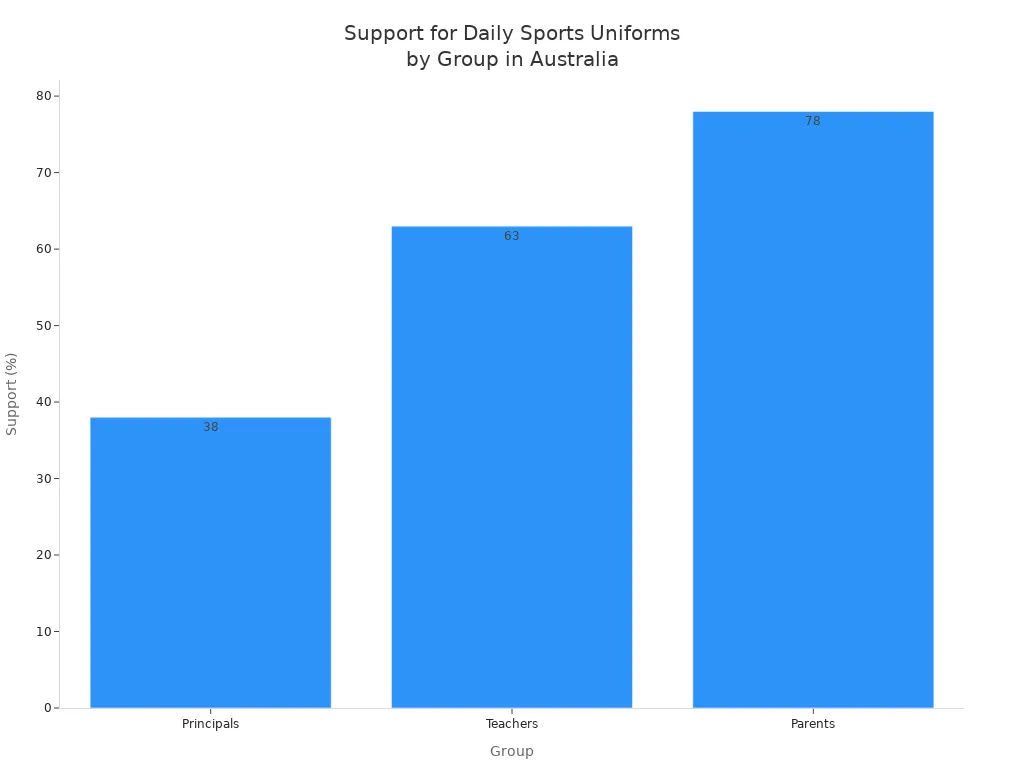
Support for daily sports uniforms has grown among principals, teachers, and parents. I see more schools offering activewear options that are comfortable and practical.
Group | Support for Daily Sports Uniforms | Total Respondents |
|---|---|---|
Principals | 38% | 52 |
Teachers | 63% | 579 |
Parents | 78% | 1231 |
I believe these trends reflect a shift toward more flexible, affordable, and sustainable uniform policies. Schools now listen to families and students, making changes that benefit everyone.
I see that mandatory uniforms in Australian schools support equality, safety, and academic focus. Families save money and students feel part of a community.
Benefit | Description |
|---|---|
Savings | Families spend less on clothes. |
Focus | Students concentrate better. |
Safety | Uniforms help identify outsiders. |
Performance | Improved behavior and attendance. |
Challenges remain, such as individuality and policy differences.
Some students feel excluded.
Uniform rules vary by state and school.
Research shows uniforms can reinforce stereotypes, so schools must listen to everyone and update policies for fairness.
FAQ
What happens if I forget to wear my school uniform?
I usually get a reminder from my teacher. My school might give me a spare uniform for the day. I do not get suspended, but I must explain why I did not wear it.
Can I wear jewelry or accessories with my uniform?
My school allows small, simple jewelry like stud earrings or a watch. Large or flashy accessories are not allowed. I always check my school’s rules before wearing anything extra.
Are uniforms comfortable in hot weather?
I find that most schools offer lighter fabrics for summer. I wear short sleeves and breathable materials. My school lets me choose hats for sun protection. Staying cool feels easier with these options.
Do uniforms help prevent bullying?
I notice less teasing about clothes when everyone wears the same uniform. Uniforms do not stop all bullying, but they reduce pressure to wear expensive brands. I feel more equal with my classmates.
How do schools handle religious or cultural dress needs?
My school respects my beliefs. I can wear items like a hijab or turban with my uniform. The school listens to my family’s needs and makes sure I feel included.
Can I buy second-hand uniforms?
Yes, I often find second-hand uniforms at school shops or community events. This helps my family save money. Many parents in my area prefer this option for affordability and sustainability.
Why do some schools have stricter uniform rules than others?
Private schools usually set stricter rules. They want to maintain tradition and discipline. Public schools follow government guidelines and focus on fairness. I see differences based on each school’s values.
What should I do if my uniform is uncomfortable?
I talk to my teacher or school office. My school offers different sizes and sometimes alternative fabrics. I know they want me to feel comfortable and ready to learn.