

How to Choose the Best Waterproof Puffer Jacket for Your Needs
Table of Contents
Display
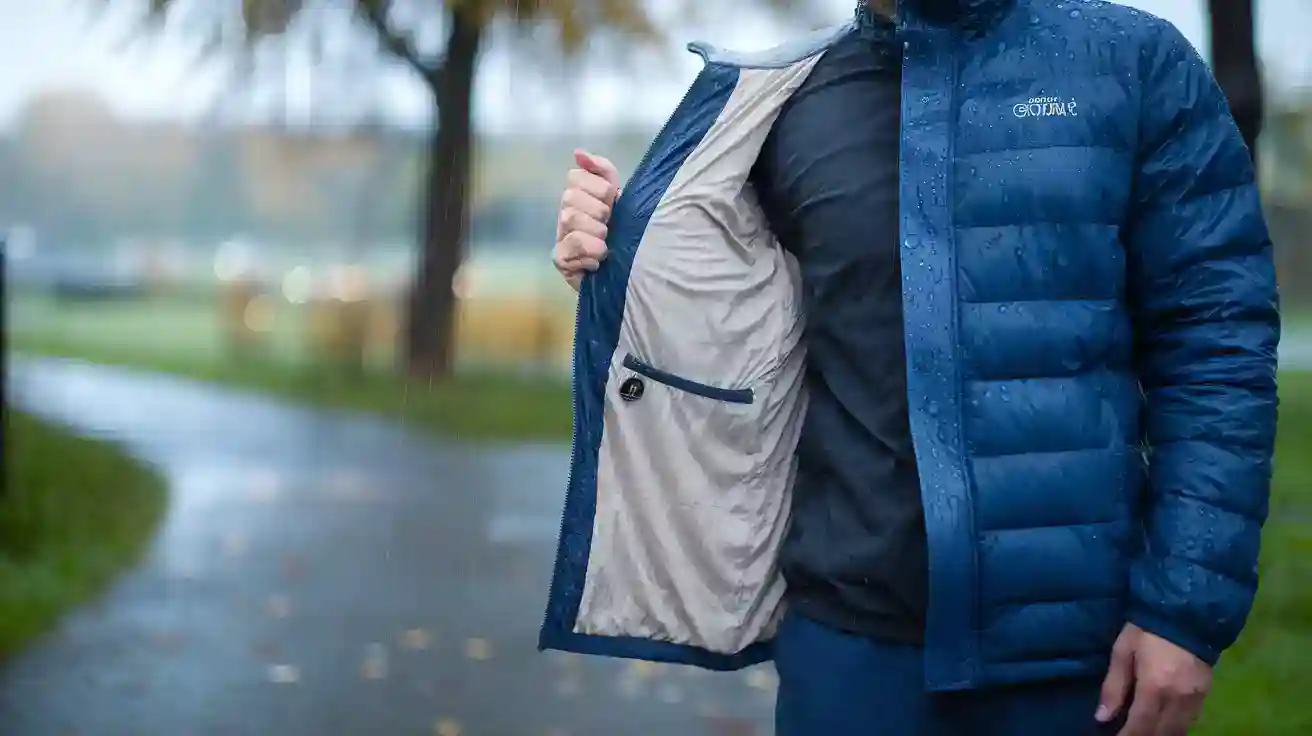
The best waterproof puffer jacket fits your activity, local climate, and comfort needs. You should think about what matters most to you—warmth, waterproof protection, or versatility. People in North America and Europe often pick a puffer jacket for cold, wet weather, while many in Asia want innovative, stylish jackets for harsh winters. Your choice depends on how you plan to use the waterproof puffer jacket and the weather you face most often.
Key Takeaways
- Match your jacket choice to your main activities and local weather for the best comfort and protection.
- Choose down insulation for dry cold climates and synthetic insulation for wet or damp conditions.
- Look for waterproof features like DWR coatings, seam taping, and high waterproof ratings to stay dry.
- Pick jackets with good breathability and ventilation if you stay active to avoid overheating.
- Try on jackets to find a comfortable fit with adjustable features that block wind and allow movement.
Your Needs
Activity & Use
When you choose a waterproof puffer jacket, start by thinking about your main activities. Outdoor enthusiasts often need jackets that handle tough conditions. Many people buy these jackets for hiking, skiing, mountaineering, or general outdoor adventures. You might also want a puffer jacket for daily wear in cold, wet weather. Outdoor sports require gear that keeps you dry and comfortable for hours. Jackets with waterproof and breathable features help you stay warm and dry during high-energy activities.
Tip:
Make a list of your favorite outdoor activities. This helps you match jacket features to your lifestyle.
Climate & Weather
Your local climate shapes your jacket choice. In dry, cold places, down insulation works best because it stays warm and breathable. If you live in a wet or damp area, synthetic insulation is better since it keeps you warm even when wet. Waterproof and windproof fabrics protect you from rain, snow, and wind. Breathability matters if you stay active, as it lets sweat escape and prevents overheating. Look for jackets with sealed seams and waterproof zippers for extra cold weather protection. Adjustable hoods and cuffs help block out wind and rain.
- Down insulation: Best for dry, cold climates
- Synthetic insulation: Best for wet, cold climates
- Waterproof features: Needed for rain, snow, and wind
- Breathability: Important for active use
Comfort Preferences
Comfort depends on how a jacket fits and feels. Adjustable hoods and hems let you seal out cold drafts. Articulated sleeves and stretchy side panels give you freedom to move, which is important for hiking or skiing. Soft materials, like brushed collar linings, feel good against your skin. Lightweight designs make it easy to move and pack your jacket. Some jackets, such as the Rab Neutrino Pro or Patagonia Down Sweater Hoody, include these ergonomic features for extra comfort.
Note:
Try on different jackets to find the best fit for your body and activities. Comfort can make a big difference during long days outdoors.
Key Features
Waterproof Puffer Jacket Materials
When you choose a waterproof puffer jacket, pay close attention to the materials. Most jackets use nylon or polyester for the outer shell. Nylon stands out for its high abrasion resistance and tear strength, making it a great choice for tough outdoor activities. Polyester offers good strength and UV resistance but does not match nylon’s tear resistance. Many brands use ripstop weaves to boost durability and prevent small tears from spreading.
| Material | Abrasion Resistance | Tear Strength | Additional Notes |
|---|---|---|---|
| Nylon | High | Superior | High strength, elasticity; ideal for outdoor adventures. |
| Polyester | Moderate | Lower than nylon | Strong, UV resistant; often treated with DWR and ripstop for more durability. |
Waterproof jackets often feature advanced fabrics like Pertex Shield or Gore-Tex. These materials combine a tough outer layer with a waterproof membrane. Manufacturers also add Durable Water Repellent (DWR) coatings to help water bead up and roll off the surface. Taped seams seal the stitching lines, blocking water from sneaking in through tiny holes.
| Feature | Role in Waterproof Performance | Additional Notes |
|---|---|---|
| DWR Coatings | Cause moisture to bead up and roll off the fabric surface, preventing soaking and maintaining breathability. | DWR wears off over time due to dirt, oils, and wear; requires maintenance and reapplication to remain effective. |
| Seam Taping | Seals stitching lines to prevent water penetration through seams, which are potential entry points for water. | Essential for full waterproofing; often found on true rain jackets but not always on water-resistant garments. |
Tip:
Check the product label for DWR coatings and taped seams. These features make a big difference in keeping you dry.
Insulation: Down vs. Synthetic
The insulation inside your jacket determines how warm you stay. Down insulation uses the soft feathers from ducks or geese. It gives you the best warmth-to-weight ratio and packs down very small, which makes it perfect for a lightweight down jacket. Down also lasts a long time if you care for it. However, down loses its warmth when it gets wet, unless treated with a hydrophobic coating.
Synthetic insulation, usually made from polyester, keeps you warm even when wet. It dries quickly and costs less than down. Synthetic jackets are also hypoallergenic. However, they tend to be heavier and bulkier, and the insulation may break down faster over time.
| Feature | Down Insulation | Synthetic Insulation |
|---|---|---|
| Warmth-to-weight ratio | Higher; superior warmth for its weight | Lower; generally less warm for the same weight |
| Compressibility | Very compressible; packs down small | Bulkier and less compressible |
| Durability | Very durable; can last decades with care | Less durable; insulation degrades with use |
| Water resistance | Loses insulating power when wet; improved by hydrophobic treatments but still vulnerable to heavy moisture | Insulates even when wet; quick-drying and water-resistant |
| Performance when wet | Poor; insulation lost when wet | Good; maintains insulation when wet |
| Cost | More expensive | Less expensive |
| Hypoallergenic | Not hypoallergenic (rarely an issue) | Hypoallergenic |
Note:
Choose down for dry, cold climates and synthetic for wet, unpredictable weather. Some waterproof puffer jackets use hydrophobic down or combine both types for better performance.
Waterproof Down Jacket Ratings
Waterproof ratings tell you how well a jacket blocks water. These ratings use millimeters (mm) to show how much water pressure the fabric can handle before it leaks. The higher the number, the more waterproof the jacket.
| Waterproof Rating (mm) | Water Resistance Level | Typical Conditions |
|---|---|---|
| 0-5,000 mm | Minimal to some moisture resistance | Very light rain, dry snow, no pressure |
| 6,000-10,000 mm | Rainproof and waterproof under light pressure | Light rain, average snow, light pressure |
| 11,000-15,000 mm | Rainproof and waterproof except under high pressure | Moderate rain, average snow, light pressure |
| 16,000-20,000 mm | Rainproof and waterproof under high pressure | Moderate rain, wet snow, some pressure (e.g., Pacific Northwest conditions) |
| 20,000 mm+ | Rainproof and waterproof under very high pressure | Heavy rain, wet snow, high pressure |
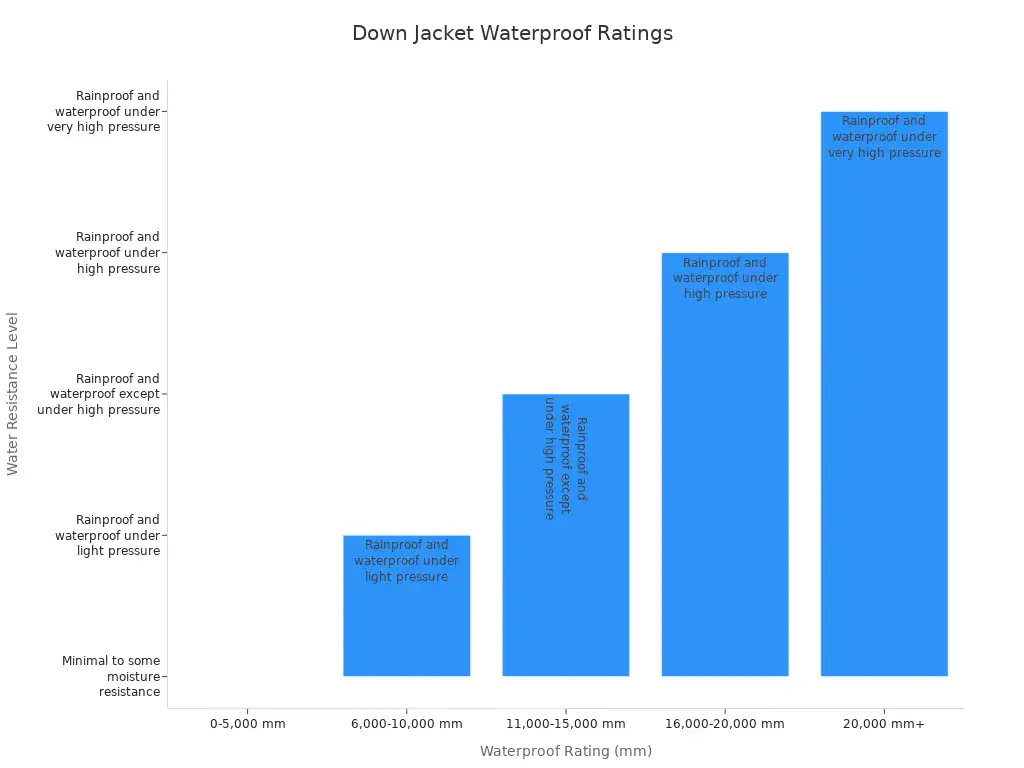
Hydrostatic head ratings measure this water pressure. Most real-world rain and wind create much less pressure than these tests. Even a jacket with a 10,000 mm rating can keep you dry in most storms. However, you should also look for features like DWR coatings, seam taping, and high-quality construction. These details matter as much as the rating itself.
- Hydrostatic head ratings show how much water pressure a fabric can resist.
- Ratings above 10,000 mm are usually enough for heavy rain.
- DWR coatings and seam taping improve real-world waterproof performance.
- The outer fabric and jacket design also affect how well you stay dry.
Warmth: Fill Power & Weight
Fill power and fill weight both affect how warm your jacket feels. Fill power measures the quality of down. Higher numbers mean the down traps more air, giving you more warmth for less weight. For example, 800-fill down is warmer and lighter than 600-fill down.
Fill weight tells you how much insulation the jacket contains. A jacket with 6 ounces of 800-fill down will be much warmer than one with only 3 ounces. More fill weight means more warmth, but also more bulk.
Down jackets lose warmth if they get wet, so many waterproof puffer jackets use hydrophobic down or synthetic insulation. Synthetic fill keeps you warm even in damp conditions, but it is heavier and less compressible.
Tip:
Look for both fill power and fill weight in the product details. High fill power with enough fill weight gives you the best warmth without extra bulk.
Breathability & Ventilation
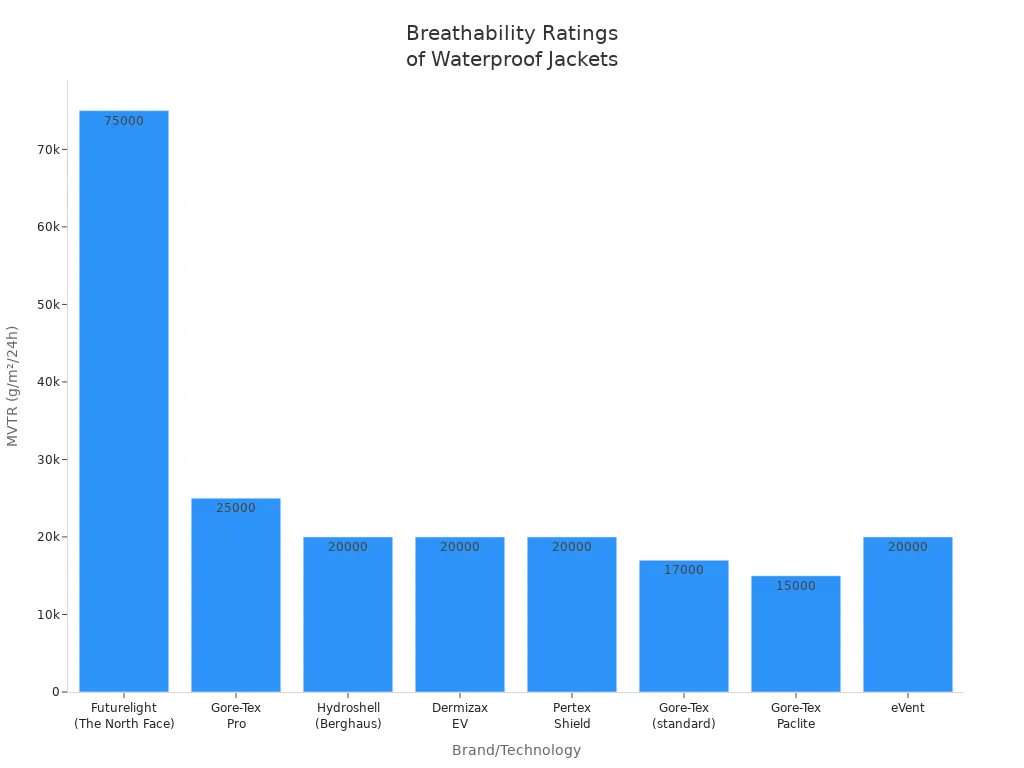
Breathability matters if you plan to stay active. It lets sweat vapor escape, so you do not get clammy inside your jacket. Manufacturers use a rating called MVTR (Moisture Vapor Transmission Rate) to measure this. Higher numbers mean better breathability.
| Brand/Technology | MVTR (g/m²/24h) | Notes on Breathability and Fabric Impact |
|---|---|---|
| Futurelight (The North Face) | 75,000 | Highest MVTR among tested membranes, indicating superior breathability. |
| Gore-Tex Pro | 25,000 | Moderate MVTR; breathability reduced when laminated to high denier fabrics. |
| Hydroshell (Berghaus) | ~20,000 | Typical breathability for waterproof membranes; official rating. |
| Dermizax EV | ~20,000 | Comparable breathability to Hydroshell; official rating. |
| Pertex Shield | ~20,000 (estimated) | Estimated breathability similar to Hydroshell and Dermizax EV. |
| Gore-Tex (standard) | ~17,000 (estimated) | Lower MVTR compared to Futurelight; affected by fabric denier. |
| Gore-Tex Paclite | ~15,000 (estimated) | Slightly lower breathability than Gore-Tex Pro. |
| eVent | 15,000 to 25,000 (estimated) | Variable breathability depending on fabric and membrane combination. |
Note:
If you hike, ski, or move a lot, pick a jacket with high breathability. Look for pit zips or mesh-lined pockets for extra ventilation.
Durability & Build
A durable waterproof puffer jacket lasts longer and protects you better. Brands use strong outer fabrics like nylon ripstop or high-denier polyester. These materials resist abrasion and tearing, which is important for rough use.
Manufacturers use several techniques to boost durability:
- Baffling: Sewn compartments keep insulation in place and prevent cold spots.
- Quality stitching and seam finishing: Prevent fraying and keep insulation evenly spread.
- Sealed seams and waterproof zippers: Block water from entering.
- DWR coatings: Add another layer of water resistance.
- Adjustable hoods, cuffs, and hems: Help you seal out wind and rain.
- Garment washing (like enzyme wash): Reduces pilling and keeps fabric soft.
Quality control checks and performance testing ensure the jacket meets high standards for warmth, water resistance, and toughness. When you choose a water-resistant puffy jacket, check for these features to get the best value.
Tip:
A well-built jacket with strong materials and smart construction will serve you well for many seasons.
Choosing a Long Puffer Jacket

Long Puffer Jacket Benefits
When you start choosing a long puffer jacket, you gain several important advantages over standard-length options:
- You get superior warmth because a long puffer jacket covers more of your body. This extra coverage helps trap heat and keeps cold air from sneaking in at your waist or legs.
- You enjoy better protection from wind and harsh weather. The waterproof design keeps you dry during rain or snowstorms.
- Your legs stay warmer in extreme cold, which shorter jackets cannot provide.
- You benefit from maximum warmth and weather protection, making a long puffer jacket ideal for harsh winter weather or long periods outdoors.
- While a shorter puffer jacket may offer more mobility and feel lighter, it cannot match the warmth and coverage of a long puffer jacket in tough winter conditions.
Tip:
If you spend a lot of time outside in cold, wet weather, choosing a long puffer jacket gives you the best defense against the elements.
Fit & Style
When choosing a long puffer jacket, you can pick from different fits and styles to match your needs. Some brands, like RAINS, offer both shorter and long puffer jacket options. You can select the coverage you want. Many long puffer jackets feature a minimalistic Scandinavian design with clean lines and calm colors such as black, white, or forest green. Details like seamless woven chambers, rubber trimmings, and stainless steel accents add a refined touch. You also get practical features, including water-repellent zippers and double-welded seams. These details make your long puffer jacket both stylish and functional. You can even pair your jacket with matching waterproof pants and accessories for a complete look.
Packability & Weight
Packability and weight matter when you consider choosing a long puffer jacket. A long puffer jacket usually weighs more than a lightweight puffer jacket because of its extra length and insulation. However, some brands design their long puffer jacket models to be as light as possible without losing warmth. If you need to travel or pack light, look for a packable down jacket version of a long puffer jacket. These jackets compress into small spaces, making them easy to carry in a backpack or suitcase. Always check the product details for weight and packability before you decide.
Note:
For city commutes or travel, a packable long puffer jacket offers warmth and convenience without taking up too much space.
Compare & Decide
Feature Checklist
Before you choose your next long puffer jacket, use this checklist to compare your options. This list helps you focus on the features that matter most for your comfort and safety:
- Insulation type and weight (down or synthetic, fill power, fill weight)
- Waterproofing level (fully waterproof, water-resistant, DWR treatment, hydrophobic down)
- Durability of face fabric (canvas, ripstop nylon, or polyester)
- Weight and packability (easy to carry, compresses into a small space)
- Heat management features (armpit zips, dual front zips for ventilation)
- Hood style (removable or fixed for added warmth)
- Ethical sourcing (RDS certification for humane down)
- Extras (zippered pockets, adjustable cuffs, reflective details)
- Fit and style (does the long puffer jacket cover your needs for warmth and movement?)
- Sustainability and warranty (eco-friendly materials, brand support)
Tip:
Check off each feature as you compare jackets. This method helps you find the long puffer jacket that matches your climate, activities, and values.
Quick Comparison Table
A side-by-side table makes it easy to see how different long puffer jacket models stack up. Use this table to match features to your needs and budget. Look for the best balance of warmth, waterproofing, and packability.
| Feature | Model A (Down) | Model B (Synthetic) | Model C (Hybrid) |
|---|---|---|---|
| Insulation | 800-fill down | High-loft synthetic | 650-fill down + synthetic |
| Waterproofing | DWR + hydrophobic down | DWR + waterproof shell | DWR + seam taping |
| Durability | Ripstop nylon | Canvas/polyester blend | Ripstop polyester |
| Weight/Packability | Very light, compresses | Moderate, less compact | Light, compresses well |
| Heat Management | Pit zips | Dual front zips | Mesh-lined pockets |
| Hood | Fixed, insulated | Removable, adjustable | Fixed, adjustable |
| Extras | RDS certified, pockets | Reflective details | Eco-friendly materials |
| Fit/Style | Long puffer jacket, slim | Long puffer jacket, relaxed | Long puffer jacket, athletic |
| Warranty | Lifetime | 2 years | 5 years |
You can use this table to compare each long puffer jacket at a glance. If you travel often, pick a long puffer jacket with high compressibility. For wet climates, choose one with hydrophobic down and a strong DWR finish. If you want a long puffer jacket for city use, focus on style and extras like reflective details. Always check the warranty and sustainability features if you care about long-term value.
Note:
Matching the right long puffer jacket to your needs saves you money and keeps you comfortable in any weather.
Choosing the best waterproof puffer jacket means matching features to your needs. Focus on insulation type, waterproof materials, and breathability. Check for quality seams, durable zippers, and a high waterproof rating for real protection. Try on jackets with layers to test comfort and fit. Look for extras like ventilation zips, secure pockets, and adjustable hoods. Before you buy, review the checklist and comparison table. This helps you stay warm, dry, and comfortable all winter.
FAQ
How do you clean a waterproof puffer jacket?
You should use a gentle detergent designed for technical outerwear. Wash your jacket in cold water on a gentle cycle. Avoid fabric softeners. Tumble dry on low with clean tennis balls to restore loft. Always check the care label first.
Can you wear a waterproof puffer jacket in heavy rain?
You can wear a waterproof puffer jacket in heavy rain if it has a high waterproof rating, taped seams, and a DWR coating. These features help keep you dry. For long exposure, use an umbrella or rain shell for extra protection.
What is the difference between water-resistant and waterproof jackets?
Water-resistant jackets repel light rain and snow. Waterproof jackets block heavy rain and wind. Waterproof jackets use special membranes, sealed seams, and DWR coatings. Always check the product label for the waterproof rating.
How do you restore the water repellency of your jacket?
You can restore water repellency by washing your jacket and applying a spray-on or wash-in DWR treatment. Dry the jacket on low heat to activate the coating. Follow the instructions on the product for best results.
Is down or synthetic insulation better for wet weather?
Synthetic insulation works better in wet weather. It keeps you warm even when damp. Down insulation loses warmth when wet unless treated with a hydrophobic coating. Choose synthetic for rainy or humid climates.
 English
 Русский
 Deutsch (Sie)
 العربية
 Español
 Français