
Food Truck Uniform OEM China | Branded Mobile Kitchen Staff Workwear
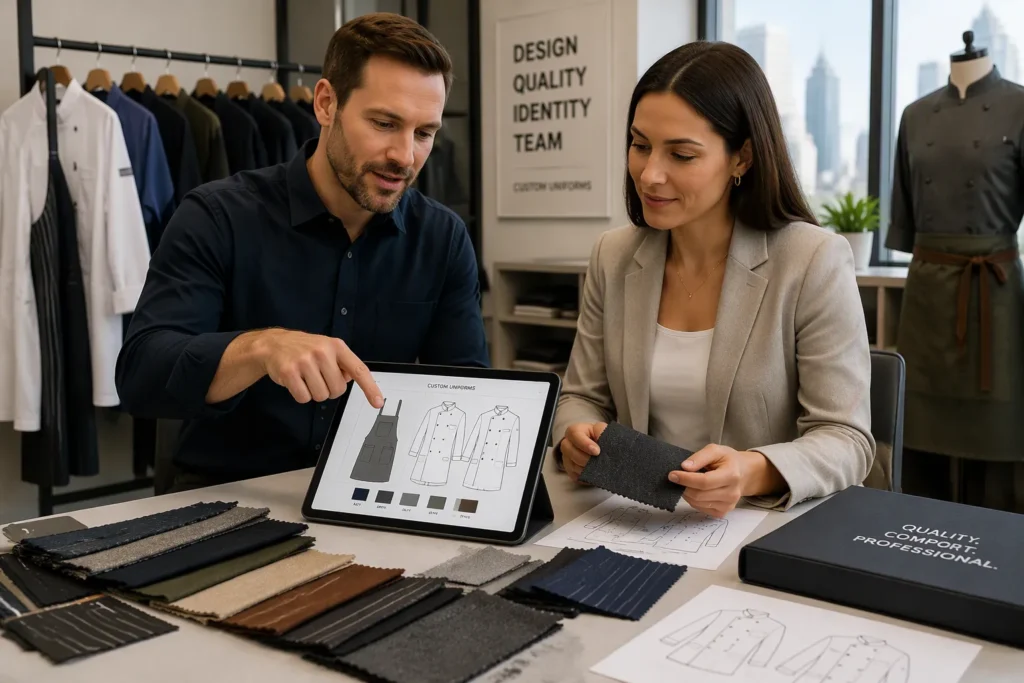
You know the problem. Local uniform suppliers charge high prices. They also offer few options for your food truck branding. Your logo, colors, and style deserve better.
So how do you start? Define your design, quantity, and budget first. Then search on platforms like Alibaba. This guide walks you through each step. You will learn how to find reliable food truck uniform OEM China manufacturers, request samples, negotiate terms, check quality, and arrange shipping. With the right approach, you can save substantially on costs. Production is typically completed within a reasonable timeframe.
Key Takeaways
You can save 30 to 50 percent on custom uniforms by ordering straight from Chinese OEM manufacturers.
Always ask for and approve a sample before full production to make sure it looks good and fits right.
Put your price, minimum order amount, and payment terms in writing. This will help protect your budget.
Use outside inspectors and AQL rules to check quality while the product is being made.
Plan for shipping and customs so you can avoid delays and extra costs.
Selecting Food Truck Uniform OEM China Suppliers
Finding the right partner starts with knowing where to look and how to tell safe factories from risky ones.
Where to Find Manufacturers
Alibaba.com is the main place to find custom food manufacturers straight from Chinese factories. Search for uniform suppliers, filter by trade assurance, and look at company profiles. Two example suppliers are Oriental Shimao, an OEM/ODM fast food truck manufacturer, and ZZKNOWN, a custom food trailer manufacturer with layout design and export support. Both can make uniforms or link you with their textile partners.
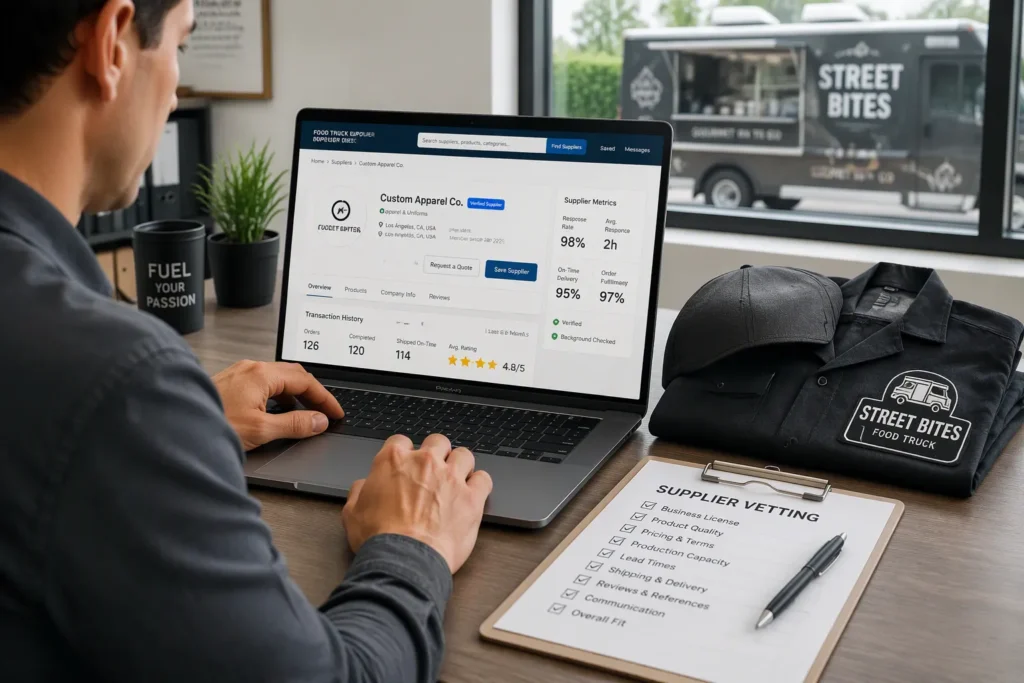
When you search for food truck uniform OEM China suppliers, check the company’s transaction history and response rate. Alibaba shows how many orders a supplier finished and their average response time. These numbers give you an early idea of how reliable they are.
The first and most important step is finding a trusted Chinese manufacturer. Some wholesale distributors let you buy in bulk with no minimum order. This flexibility lets you start small and grow later.
How to Vet Suppliers
Once you have a shortlist, check each supplier carefully. Many buyers skip this step and run into problems later. A step-by-step approach helps you avoid scams and find a real partner for your food truck uniform OEM China project.
Watch for these red flags. Avoid any supplier that:
Demands full upfront payment before any independent verification
Gives bank account details that belong to a different company or person
Refuses a physical inspection of the factory or warehouse
Cannot show verifiable export history or past shipment records
Supplies certificates you cannot independently validate
Changes bank account details at the last minute
Talks only via WhatsApp with no verifiable corporate presence
Quotes a price far below normal market levels
Claims large stock but cannot provide credible warehouse evidence
Pushes for immediate payment citing a limited allocation
Sends documents with inconsistent names, addresses, stamps, or signatures
If a supplier shows any of these signs, move on.
Beyond red flags, use a verification process:
Supplier identification — confirm the legal company name
Company verification — check business license and registration date
Ownership check — verify the legal representative
License validation — confirm the scope covers uniform manufacturing
Factory or warehouse inspection — arrange a visit or video call
Product verification — request samples to check material and workmanship
Export history review — ask for past shipment records and references
Reference checks — contact previous buyers if possible
Pre-shipment inspection — use a third-party inspector
Contract signing — ensure terms match what was discussed
Secure payment arrangement — avoid full upfront payment
Certification | What It Covers | How to Verify |
|---|---|---|
ISO 9001 | Quality management system — documented processes, internal audits, continuous improvement | Check ISO website or certifying body database |
ISO 14001 | Environmental management system — waste, emissions, energy use | Check certifying body database |
BSCI | Social compliance — working conditions, wages, hours, health and safety | Use amfori platform with factory supplier ID |
SA8000 | Social accountability — child labour, forced labour, discrimination | Check certifying body verification |
Product-specific (CE, UL, REACH) | Market compliance — electrical safety, chemical restrictions | Confirm applicability to product and market |
One reliable factory might say: “Our factories are both ISO 9001 and BSCI certified. Current certificates are available for client review.” Ask for those documents before you commit.
A careful vetting process saves you time, money, and frustration. It builds a strong base for your food truck uniform OEM China sourcing journey. With a verified supplier, you can move ahead with confidence into the design and sampling phase.
Designing Uniforms and Requesting Samples
Communicating Design and Branding
You now have a supplier you can trust. The next step is to share your ideas clearly. Chinese OEM manufacturers give you many ways to customize. You can ask for logo embroidery, specific sizes, and custom packaging. Some factories also customize internal equipment for food trailers, but for uniforms the focus stays on fabric, fit, and branding.
Prepare a design brief before you contact your food truck uniform OEM China supplier. Include your logo in vector format, your brand colors, and the exact placement of each element. State the sizes you need and the quantity per size. If you want aprons, hats, or chef coats, list each item separately. Clear instructions reduce errors and speed up production.
High-quality custom embroidered apparel gives you durable, professional results. The embroidery lasts through repeated washing and daily wear. Bulk pricing stays affordable, and shipping is fast once production ends.
Why Samples Matter
Never skip the sample stage. A sample shows you the real fabric weight, stitch quality, and color accuracy. You can check the logo placement and confirm the fit before committing to a large order. This step protects you from costly mistakes.
Expect to pay between USD 50 and USD 150 per style for a single custom embroidered uniform sample from a Chinese factory. Many factories refund or credit this fee when you place a bulk order later. Ask about this policy upfront. A refundable sample fee lowers your overall risk.
Review the sample against your design brief. Check the embroidery density, thread color, and fabric feel. Wash the sample once to test durability. If something looks wrong, request a revision before you approve mass production. A good sample becomes your quality benchmark for the entire order.
Negotiating Terms and Placing Orders
After you approve the sample, you move into the negotiation stage. This part covers pricing, minimum order quantities, and payment terms. Getting these details right protects your budget and keeps your order running smoothly.
Pricing, MOQs, and Payment
Unit prices go down as your order volume goes up. The table below shows a typical price breakdown from a Chinese factory:
Order Volume | Quoted Unit Price |
|---|---|
100 pcs | $18/pc |
500 pcs | $12/pc |
The price break happens because setup costs stay the same. Bigger orders spread those costs over more units. You can save significantly compared to local uniform suppliers when you order from a food truck uniform OEM China factory.
Every factory has a minimum order quantity, or MOQ. The MOQ helps the factory cover its setup costs. Here is the math a factory uses:
MOQ = Fixed Setup Cost ÷ Target Margin Per Unit
Example: A garment factory spends ¥4,500 in setup costs per style. Their target contribution margin is ¥15/unit. That gives an MOQ of 300 units. If you pay a 15% unit-price premium — moving margin to ¥17.25/unit — the factory can accept 260 units and still hit their floor.
Some suppliers take orders with no minimum. Others need 100 or more pieces per design. Ask about MOQ before you spend time on design talks. If your order is below their MOQ, offer a higher unit price to close the gap. This flexibility lets you start with a smaller test order before you commit to bigger volumes.
Payment terms follow a standard pattern. Most factories ask for a deposit to start production. The balance is due before shipment. Use secure payment methods like Alibaba Trade Assurance or a letter of credit. Never send full payment upfront. A clear understanding of payment terms helps you budget accurately and avoid surprises.
Finalizing Order Details
Once you agree on price and MOQ, put every term in writing. Create a purchase order that lists each uniform style, size breakdown, color code, and logo placement. Include the agreed unit price, total amount, and shipping terms like FOB or CIF.
Production typically takes a few weeks. The factory works from the approved sample and your written specifications. Schedule a mid-production check with your supplier. Ask for photos of the work in progress. This step catches errors before the whole batch is finished.
Confirm the delivery date and shipping method before you send the final payment. Choose a freight forwarder who handles customs clearance for your country. Clear communication at this stage prevents delays and extra costs. You save significantly compared to local builders when you manage this process well.
Managing Production, Shipping, and Delivery
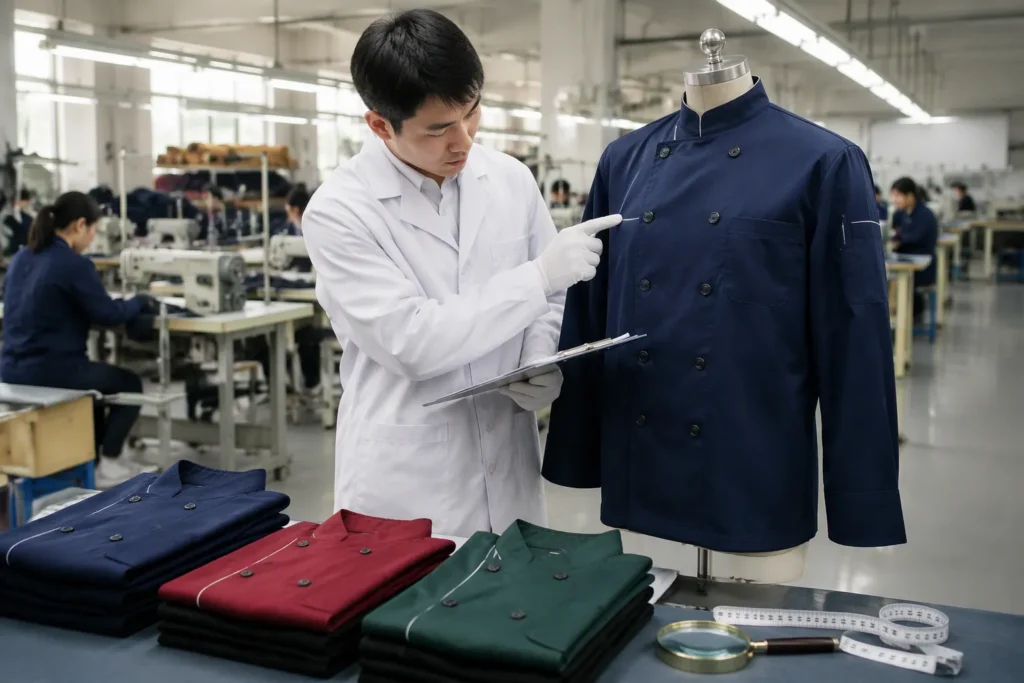
Your order is being made. Now you must protect what you spent. This part covers checking quality at the factory and getting your goods from China to you.
Quality Control During Production
Chinese OEM manufacturers like ZZKNOWN provide inspection and export help for clients around the world. You should still do your own checks. Ask your supplier for photos taken during production and a report from a check before shipping. A third-party inspector gives you extra safety.
Most Chinese uniform factories check finished items against the Acceptable Quality Limit, or AQL. This standard sorts defects into three groups:
Critical defects (AQL 0): Safety hazards and law violations, like fabric that says it is safe but burns easily, sharp objects, or toxic chemicals. Zero tolerance applies. One critical defect fails the whole batch.
Major defects (AQL 2.5): Problems that will likely make the buyer reject the items or send them back, such as wrong sizes beyond allowed limits, broken zippers, open seams, mismatched patterns, or missing parts.
Minor defects (AQL 4.0): Small cosmetic issues that probably will not affect how the item works, like light stains, small thread pulls, or slight color difference within the allowed range.
For any uniform worn in a professional setting, AQL 2.5 is the lowest quality you should accept. The table below shows how the levels compare.
AQL Level | Typical Application |
|---|---|
AQL 1.0 | Very strict—luxury goods, medical textiles, high-value items |
AQL 2.5 | Most common for clothes—balances thoroughness with practicality |
AQL 4.0 | Lower-cost, high-volume basics where some defects are okay |
AQL 6.5 | Very lenient—rarely used by quality-conscious brands |
For most clothing types, AQL 2.5 for major defects and AQL 4.0 for minor defects is the industry standard. Write this into your contract before production starts. Then your inspector has a clear benchmark to measure against.
Shipping, Customs, and Final Delivery
Shipping costs depend on weight and speed. Air freight is fast and works well for smaller uniform orders. The table below shows typical rates from China to the United States.
Shipment Weight | Air Freight Cost per Kilogram (USD) |
|---|---|
Standard service | $4.50 – $8.50 |
1–45 kg | $6.00 – $10.00 |
100–300 kg (bulk) | $4.50 – $7.20 |
Sea freight costs less per kilogram for large amounts. But it also takes much longer. Choose air freight when you need uniforms fast. Choose sea freight when your timeline is flexible and your order is heavy.
Customs clearance trips up many first-time importers. Your supplier should give you a commercial invoice, packing list, and bill of lading. Check the Harmonized System code for apparel before shipment. A freight forwarder who knows your country’s rules prevents delays and surprise fees.
Here is the cost picture that makes this effort worthwhile. Custom food trucks from China can be quite affordable. Shipping costs included are often much lower than local alternatives. The same logic applies to your food truck uniform OEM China order. Factory-direct pricing plus smart logistics keeps your total spend low.
Track your shipment from the factory door to your address. Confirm the delivery date with your forwarder. Inspect the cartons when they arrive. Count the pieces and check a few items against your approved sample. Report any problems to your supplier within the agreed window. A smooth delivery closes the loop on your sourcing project.
You now have a clear path from first search to final delivery. Research and vet suppliers with care. Design your uniforms and approve a sample before mass production. Negotiate price, MOQ, and payment terms in writing. Then manage production checks, shipping, and customs until the cartons reach your door.
Patience and clear communication carry you through every stage. Start with a small test order if international sourcing is new to you. Use the vetting steps and sample checks in this guide to build a supply chain you can trust. Your food truck branding deserves uniforms that fit, last, and save you a significant amount.
FAQ
How much can I save by ordering uniforms from China?
You can save significantly compared to local uniform suppliers. Factory-direct pricing removes middleman markups. Bulk orders lower your unit cost further. For example, a 500-piece order drops to $12 per piece from $18 at 100 pieces.
How long does production take?
Production takes a few weeks after you approve the sample and pay the deposit. Add shipping time on top of that. Air freight moves faster than sea freight. Plan your timeline with both production and transit in mind.
What is the minimum order quantity?
Some suppliers have no minimum order requirement. Others set an MOQ based on their setup costs. A factory spending ¥4,500 in setup with a ¥15/unit target margin needs 300 units. You can offer a higher unit price to lower the MOQ.
How do I pay safely?
Most factories ask for a deposit to start production. Pay the balance before shipment. Use Alibaba Trade Assurance or a letter of credit. Never send full payment upfront. These methods protect your money if problems arise.
What quality standard should I require?
Ask for AQL 2.5 for major defects and AQL 4.0 for minor defects. This is the industry standard for clothing. Write these limits into your contract before production starts. A third-party inspector measures finished items against this benchmark.
About Top Fortune: Food Truck Uniform OEM Manufacturer in China
Shanghai Top Fortune Industry Co., Ltd. (Top Fortune) is an export-only OEM/ODM uniform and workwear manufacturer founded around 2002, operating a 1,506 m² factory in Songjiang, Shanghai. We produce private-label chef coats, polos, aprons, and mobile-kitchen staff apparel for overseas B2B buyers — food-truck operators, multi-unit street-food brands, event caterers, and workwear distributors across North America, Europe, the Middle East, Australia and other markets.
Typical programs start around 1,000 pcs per style (colors and sizes split within the style). Contact rill@topfortunemail.com or WhatsApp +86 13524210501.
Fabric, Heat, and Branding Options for Food Truck Crews
- Heat-tolerant knits and wovens: breathable polyester-cotton or performance poly blends that release kitchen grease stains and survive frequent wash cycles.
- Role kits: short-sleeve chef coats or snap-front jackets for cookline; branded polos for window and cashier; bib or waist aprons; optional caps and neckerchiefs.
- Branding: embroidery or heat-transfer logos sized for small truck panels; menu-color piping; woven brand labels and care labels under your brand.
- Safety notes: if you require flame-resistant fabrics or certified PPE, name the standard in the RFQ — otherwise we quote everyday commercial kitchen workwear.
OEM Process and RFQ Checklist for Food Truck Uniforms
- Share truck brand guide, roles, garment list, and target launch date.
- Approve fabric/color (lab dips) and a sealed pre-production sample (PPS).
- Confirm size run, packing by truck/city, and Incoterm from Shanghai.
- Bulk production with in-line checks, then final inspection before shipment.
| RFQ field | What to send |
|---|---|
| Roles & garments | Cook, window, cashier — coats, polos, aprons, caps |
| Quantity | Pcs per style/color/size (MOQ ~1000 pcs/style) |
| Branding | Logo files, placement, pantone / brand colors |
| Wash routine | Home wash vs commercial laundry |
| Destination | Incoterm, port/city, needed-by date |
OEM vs Off-the-Shelf Food Truck Apparel
| Factor | OEM program (Top Fortune) | Catalog stock |
|---|---|---|
| Brand match | Your colors, logo, labels across the fleet | Mixed catalog shades |
| Role kits | Cook + window sets designed together | Piecemeal SKUs |
| Reorder | Locked PPS for repeat seasons | Style may disappear |
| MOQ / lead time | ~1000 pcs/style; plan before festival peaks | Low MOQ if in stock |
Related OEM Uniform Programs for Food & Hospitality Teams
- Pilates studio staff uniform OEM China
- Farmers market staff uniform OEM China
- Yoga studio staff uniform OEM China
- Pharmacy retail uniform OEM China
Email: rill@topfortunemail.com
WhatsApp: +86 13524210501
Address: Shanghai Top Fortune Industry Co., Ltd., Floor 3 Building 20 Haier Zhigu, No. 66 Guangfulin East Road, Songjiang, Shanghai 201600, China