

Flame Retardant Workwear OEM China | FR Coveralls & Jackets
Table of Contents
Display
Flame Retardant Workwear OEM China: FR Coveralls & Jackets for Industrial Buyers
Shanghai OEM/ODM partner for dependable FR workwear
Top Fortune is a Shanghai-based workwear manufacturer serving industrial procurement teams, distributors, and private-label brands worldwide. Our OEM program covers FR coveralls, jackets, trousers, and coordinated industrial uniforms. We combine pattern engineering, fabric sourcing, trim selection, and production control for a recognizable range.
OEM Entity & Buyer Intent
You need three pillars for reliable supplier selection. First, verify certifications. Second, review documented quality systems. Third, confirm tested fabric performance. Flame retardant workwear protects lives. A cheap quote cannot replace that protection. Price alone must never drive your decision.
This article serves as a practical due-diligence guide for procurement professionals sourcing from China. You will find checklists, supplier questions, and red flags. These tools help you evaluate Flame Retardant Workwear OEM China | FR Coveralls & Jackets suppliers with confidence. Every step matters when safety is on the line.Shanghai Top Fortune Industry Co., Ltd. was founded around 2002 and operates a 1,506 m² factory in Songjiang, Shanghai. We provide OEM/ODM workwear and corporate uniforms for buyers exporting to Europe, the Middle East, Oceania, Southeast Asia and the Americas. This guide is for procurement teams sourcing flame-retardant coveralls and jackets from China.
Buyers typically request about 1,000 pieces per style for a production run. For a quotation, send your target fabric, size range, certification scope, color, logo artwork and delivery country to rill@topfortunemail.com or WhatsApp +86 13524210501.
Contents
Why choose OEM and RFQ specifications
2. Product scope, fabric and branding
3. OEM process and catalog comparison
4. Procurement checklist, FAQ and RFQ
Why OEM: RFQ Specifications
Specification | Buyer decision | Recommended RFQ detail
Product | Flame-retardant coveralls and jackets | End use, hazard class, gender fit, size chart
Fabric | Inherent or treated FR textile | Fiber content, weight, weave, test standard and wash method
Branding | B2B private label | Embroidery/print file, label and packaging
Quantity | MOQ about 1,000 pieces/style | Size ratio, color split and repeat-order plan
Quality | Pre-production approval | Lab reports, sealed sample and inspection
Delivery | Export-ready packing | Destination, Incoterm and ship date
Key Takeaways
Verify international certifications like NFPA 2112, ASTM F1506, and EN ISO 11612 to ensure safety compliance.
Check the manufacturer’s quality systems, labels, and batch traceability for consistent production.
Test fabric samples for flame resistance and wash durability before approving bulk orders.
Ask suppliers direct questions about certification
Ask for a written RFQ with unit price, sample charge, lead time, testing responsibility, payment terms and the exact legal entity on every certificate. OEM is useful when a buyer needs a controlled specification, repeatable fit, private branding and traceable compliance rather than a generic stock garment.
## Product Scope: B2B Workwear Only
This program covers B2B industrial workwear, FR coveralls, FR jackets, trousers and coordinated corporate work clothing. It is explicitly NOT for school uniforms or schoolwear. Confirm the work activity and applicable standard before approval; a logo or color match cannot substitute for safety testing.
## Fabric, Construction and Branding Notes
Quotable facts for an RFQ: an FR garment must be specified by fiber or treatment, fabric weight, construction and test method; a flame-resistant claim is not a substitute for a certificate. Use durable seams, reinforced stress points, secure closures and compatible reflective trims where the risk assessment calls for them. Confirm whether the FR property is inherent or finish-based and state the permitted laundering method. Brand placement, woven labels, embroidery and packaging should be approved on a pre-production sample.
s, lead times, and testing labs to gauge reliability.
Avoid red flags such as unrealistically low prices, vague certification claims, and missing test documents.
Flame Retardant Workwear OEM China: Certifications to Verify
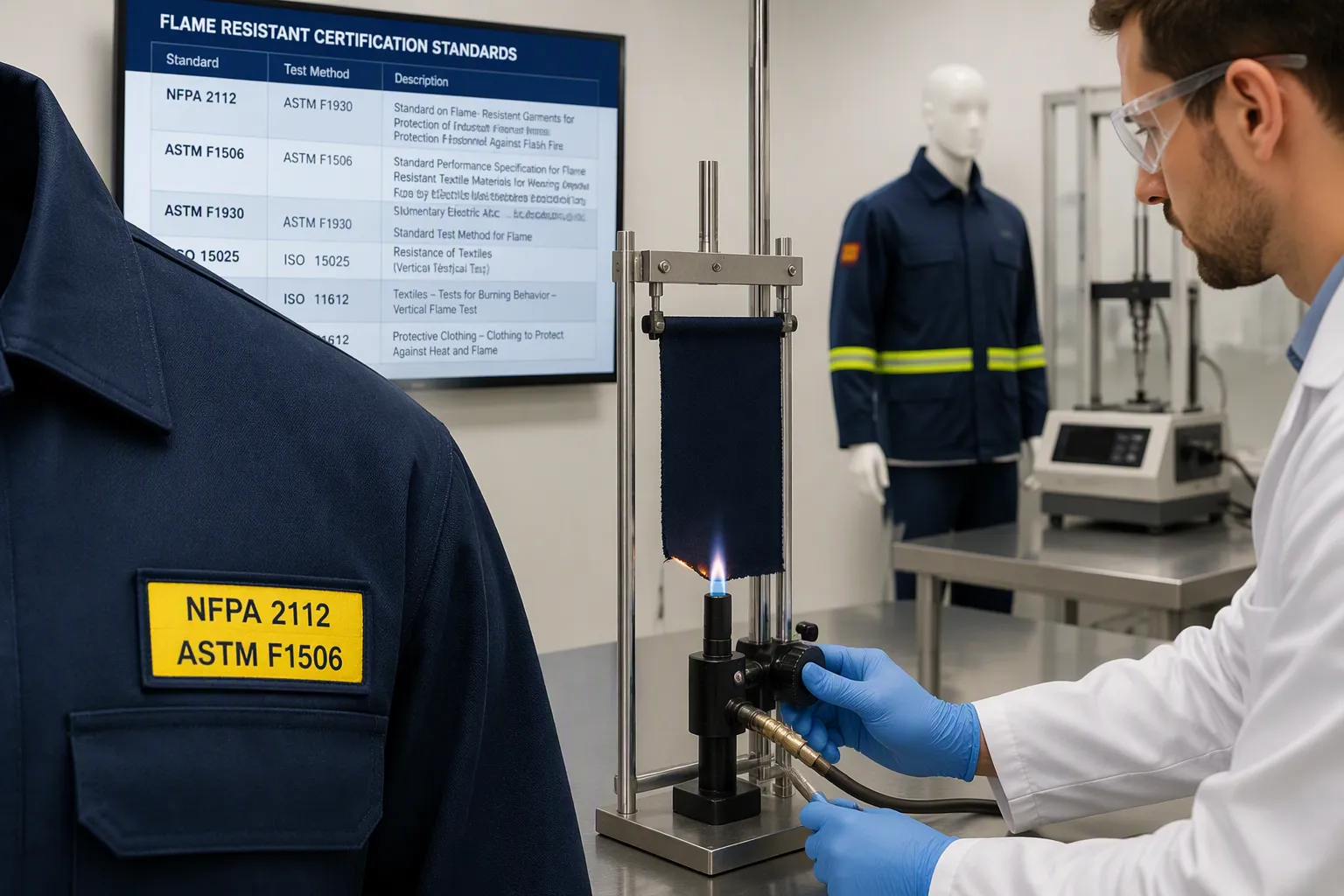
International certifications are non-negotiable for flame retardant workwear. They prove that a garment meets minimum safety requirements. Without them, you cannot trust the product to protect workers from flash fire, arc flash, or heat hazards. Certifications also give you legal protection. If an accident occurs, you need documented proof that your supplier met recognized standards.
NFPA 2112, EN ISO 11612, and ASTM F1506
You should confirm three core standards when evaluating Flame Retardant Workwear OEM China | FR Coveralls & Jackets suppliers. NFPA 2112 covers flash fire protection for industrial personnel in the United States. ASTM F1506 addresses electric arc and flame hazards for electrical workers. EN ISO 11612 protects against heat and flame hazards for general industrial use in Europe and globally.
Each standard uses specific test methods. NFPA 2112 requires a manikin burn test (ASTM F1930), thermal protective performance values, and a vertical flame test (ASTM D6413). ASTM F1506 uses arc rating via ASTM F1959 and flammability testing via ASTM D6413. EN ISO 11612 tests flame spread (ISO 15025), radiant and convective heat, and molten metal resistance.
The table below summarizes these three certifications.
Certification Standard | Region | Primary Focus | Key Testing Methods |
|---|---|---|---|
NFPA 2112 | United States | Flash fire protection for industrial personnel | Manikin test (ASTM F1930), TPP values, flammability test (ASTM D6413) |
ASTM F1506 | United States | Electric arc and flame hazards for electrical workers | Arc rating via ASTM F1959, flammability test via ASTM D6413 |
ISO 11612 / EN ISO 11612 | Europe & Global | Heat and flame hazards for general industrial use | Flame spread (ISO 15025), radiant/convective heat, molten metal resistance |
For EN ISO 11612, your supplier must test clothing in at least two categories. Code letter A1 or A1+A2 plus at least one other code letter (B, C, D, E, or F) is mandatory. Higher numbers indicate higher performance levels. For example, B3 means the fabric withstands convective heat for 20 seconds or more. C4 means radiant heat protection lasts 95 seconds or more.
Factory audits and certificate checks
You must verify certificates directly with the issuing body. Do not accept PDF copies at face value. Follow these steps to confirm authenticity.
Cross-check the legal company name on the NFPA 2112 test report against the name on the supplier’s commercial invoice.
Reject any certificate that references an expired or outdated edition of the standard.
Confirm the notified body’s laboratory number and its accreditation scope.
Make sure the tested sample description matches the actual garment, including fabric weight and tape specifications.
Use the issuing body’s portal to contact them and verify that the report is authentic.
Watch for warning signs such as reused PDFs, blurred notary seals, or misaligned logos.
Compare the tested sample with the bulk-production bill of materials.
These checks protect you from fraudulent suppliers. A reliable Flame Retardant Workwear OEM China | FR Coveralls & Jackets manufacturer will welcome your verification requests. They will provide full documentation without hesitation.
Evaluating Manufacturer Quality and Reputation
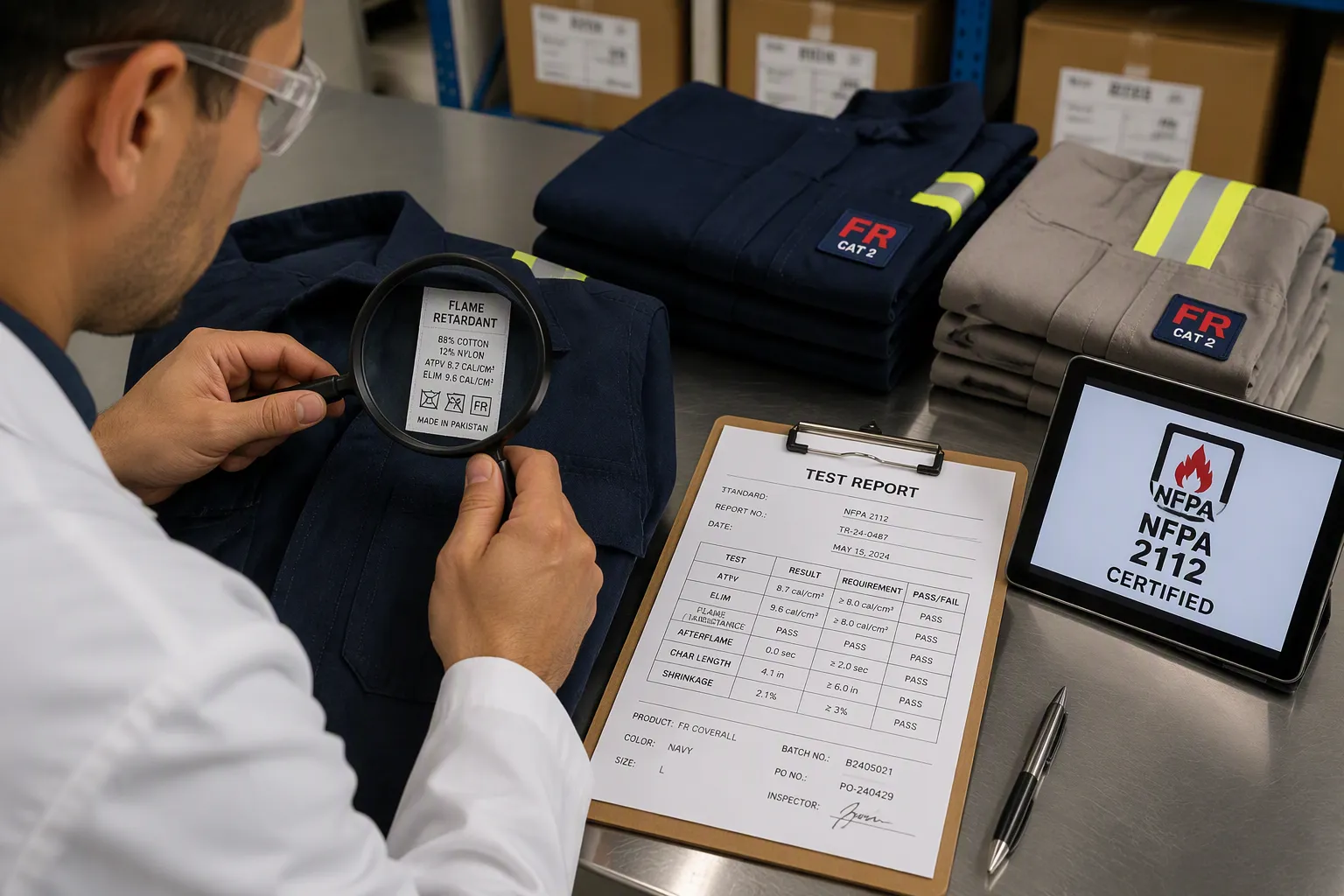
Packaging, labels, and test reports
Start your evaluation with the physical details. Inspect the packaging for sturdy cartons, correct quantities, and clean printing. Check every care label, size marking, and fiber content tag. ASTM F1506-compliant garments must carry specific information. Look for these items on each label:
A tracking code
A statement confirming the garment meets ASTM F1506 requirements
The manufacturer’s name
Size information
Care instructions
Fiber content
Missing or inconsistent labels signal weak production control. Compare labels across multiple units from the same order. A reliable Flame Retardant Workwear OEM China | FR Coveralls & Jackets supplier keeps every label identical in placement, font, and content.
Next, cross-check test reports against batch numbers and production dates. Ask for the lot number on each shipment. Match that number to the test report for the same production run. Confirm the report lists the correct fabric weight, tape type, and garment style. Reject any report that references a different batch or an expired standard edition.
Use a structured approach to judge quality consistency. The table below shows what to check and what to do.
Evaluation Method | What Buyers Should Do |
|---|---|
Batch Traceability | Choose suppliers that use lot numbers and batch traceability systems; verify they hold ISO 9001 and OEKO-TEX certifications. |
Sample Testing Per Batch | Request samples from every production batch; test for flame resistance, durability, and comfort using independent labs; compare results against certification standards. |
Durability Testing After Washing | Apply test methods such as AATCC 61/ISO 6330, ISO 15797, ISO 15025/ASTM D6413, and FTIR/SEM-EDS. |
Certification & Test Data Verification | Ask whether fabrics are UL listed, NFPA 2112/70E compliant, EN ISO 11612/11611 certified, or meet GB8965-2009; require verifiable test data. |
Red Flags | Avoid suppliers who cannot provide real test data or certification documents. |
Industry reputation and track record
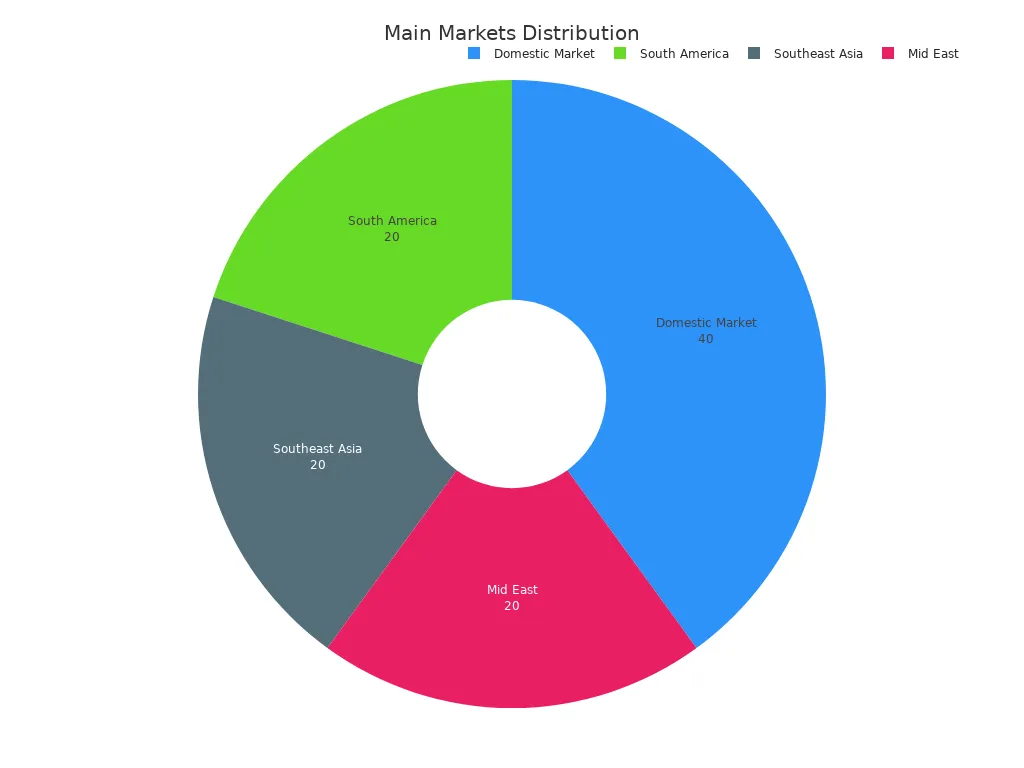
Reputation gives you a shortcut to trust, but you must still verify it. Established suppliers such as Haiyuan and top-10 listed manufacturers often signal stronger reliability. Haiyuan Garment Industry, founded in 2005 in Xinxiang City, Henan Province, holds NFPA 2112, ISO 11612, EN ISO 14116, and ASTM F1506 certifications. The company employs over 150 workers and exports to South America, Southeast Asia, and the Middle East. Its on-time dispatch rate reaches 98.2%, and its reorder rate sits at 15.0%.
Check client references and past performance before you commit. Prefer manufacturers with extensive experience serving top global brands. BOWINS Garment, for example, has nearly two decades of experience supplying major brands such as DeWalt and Costco. This track record supports verification of its client references. Ask your candidate supplier for a client list, then contact those clients directly. A supplier with nothing to hide will share references without delay.
Testing FR Coveralls & Jackets Performance
Burn tests and afterflame behavior
You can run a simple vertical flame test on fabric swatches before you commit to bulk production. Place a strip of the fabric vertically in a draft-free test chamber. Expose the lower edge to a controlled flame for 12 seconds. Then shut off the flame. Measure the afterflame time, which is how long the swatch continues to burn. Measure the char length, which is the damage length along the specimen. You also check afterglow time, the duration of glowing after the flame dies.
ASTM D6413 sets clear pass limits for this test. Afterflame time must stay under 2 seconds. Char length must stay under 100 mm. Afterglow time must reach zero seconds. ASTM F1506 allows an average char length no greater than 6 inches. NFPA 2112 sets a maximum char length of 4 inches. For flash fire protection, NFPA 2112 uses the ASTM F1930 instrumented manikin test and sets a pass/fail criterion at 50% body burn after a three-second exposure. A reliable Flame Retardant Workwear OEM China | FR Coveralls & Jackets supplier will share these results without hesitation.
Wash durability and shrinkage
Repeated laundering breaks down many fabrics. You must confirm that FR properties survive industrial wash cycles. NFPA 2112 requires the vertical flame test on fabric as received and again after 100 industrial launderings. ASTM F1506 requires testing on unwashed fabric and after 25 home launderings. Ask your supplier for wash-durability data that matches your actual laundering method. Check shrinkage limits too, because a garment that shrinks will not fit your workers or cover them properly.
Request fabric swatches and finished-garment samples before you approve mass production. Test the swatches yourself or send them to a third-party lab. Wear and wash the finished samples under real conditions. This step exposes weak Flame Retardant Workwear OEM China | FR Coveralls & Jackets suppliers before they cost you money. A manufacturer who resists sample testing is telling you something important.
Buyer Tips and Red Flags
Questions to ask suppliers
Ask direct questions before you place any order. Request the exact certification scope and supporting documents. A reliable supplier will share product certificates, management system certificates, and regulatory licenses without delay. Ask which third-party lab performed the testing. Reputable labs include NTEK Group, SGS, TUV Rheinland, and Bureau Veritas. Request the test date, batch reference number, and numeric results for every parameter.
You should also ask about lead times. Lead time depends on fabric availability, custom dyeing, sample development, design complexity, size range, branding, and total quantity. A supplier cannot confirm an exact timeline until they review your final specification. For reference, regular protective gear takes about 15 working days. Custom orders take 20 to 30 working days. Free samples ship in 7 days, and customized samples take 3 to 7 days.
Common red flags to avoid
Watch for certification claims without batch-specific test documents. A supplier who says it is “EN ISO 11612 certified” while holding only a generic ISO 9001 certificate is a red flag. Genuine compliance requires a batch-specific third-party test report. Hesitation or refusal to provide this automatically per order is disqualifying.
Impossibly low quotes signal danger. Offers like 200 pieces at USD 10 per certified FR coverall do not reflect real cost floors. Compliant Nomex-blend or treated-cotton FR fabric alone runs USD 5 to 9 per piece. A genuinely certified garment at small volumes rarely lands below USD 14 to 18 per piece. Unrealistically short lead times also raise concern. A 30-day timeline for a full certified production run is not achievable legitimately. A credible timeline totals roughly 10 to 12 weeks minimum.
Other red flags include missing permanent labels, absent safety marks, and vague certification claims. Suppliers who cannot name their fabric mills or explain the difference between inherent and treated FR fabrics fail a basic transparency test. Always request fabric swatches and finished-garment samples. Third-party inspection before mass production reduces your risk. A trustworthy Flame Retardant Workwear OEM China | FR Coveralls & Jackets manufacturer welcomes every check.
Verify certifications, audit quality documents, check reputation, test fabric samples, and ask targeted supplier questions. These five steps form your due diligence checklist. Reliable Flame Retardant Workwear OEM China | FR Coveralls & Jackets manufacturers do exist. Structured verification finds them.
Document every check you perform. Record certificate numbers, test dates, and sample results. Avoid rushing the approval process. A slow, careful review protects your workers and your company.
Remember one final warning. The cheapest quote often carries the highest hidden risk. A low price may mean uncertified fabric, missing labels, or falsified reports. Pay for proven safety, not promises.
FAQ
Which certifications matter most for FR workwear?
Confirm NFPA 2112, ASTM F1506, and EN ISO 11612. NFPA 2112 covers flash fire protection. ASTM F1506 addresses electric arc hazards. EN ISO 11612 handles heat and flame risks for general industrial use. Each standard uses its own test methods, so match the certification to your workers’ actual hazards.
How do I verify a certificate is real?
Contact the issuing body directly through its portal. Cross-check the legal company name on the test report against the name on the supplier’s invoice. Confirm the tested sample matches your garment’s fabric weight and tape specifications. Reject expired editions, blurred seals, and reused PDFs.
What burn test limits should fabric meet?
Under ASTM D6413, afterflame time must stay under 2 seconds, char length under 100 mm, and afterglow at zero seconds. NFPA 2112 caps char length at 4 inches. ASTM F1506 allows an average char length no greater than 6 inches.
How does laundering affect FR performance?
NFPA 2112 requires vertical flame testing after 100 industrial launderings. ASTM F1506 requires testing after 25 home launderings. Ask your supplier for wash-durability data that matches your actual laundering method. Check shrinkage limits too, beca## OEM Process
Share the brief, hazard use, size chart, quantity and branding files.
2. Review fabric options, compliance scope, colors and a line-item quotation.
3. Approve a fit sample, artwork, label and packaging specification.
4. Complete pre-production testing and approve the sealed sample.
5. Cut, sew, inspect and document the production lot.
6. Complete final inspection, packing and export shipment.
## Catalog vs OEM Comparison
Decision point | Catalog garment | OEM program
Specification | Fixed stock details | Buyer-controlled fabric, fit and trims
Branding | Limited or none | Private label, logo, packaging and carton marks
Quantity | May be immediately available | Planned MOQ around 1,000/style
Compliance | Buyer must verify scope | Agreed tests and reports tied to the RFQ
Repeatability | Stock can change | Approved sample becomes the reference
## Procurement Checklist
– Define the hazard, wearer, climate and laundering method.
– Request the full fiber, weight, construction and test specification.
– Verify certificate issuer, legal entity, product scope and validity.
– Approve size chart, grading, color standard and logo placement.
– Confirm MOQ, sample timing, production lead time, inspection and Incoterm.
– Keep a sealed reference sample and written change-control process.use a shrunken garment will not cover your workers properly.
What price and lead time are realistic?
Compliant FR fabric alone runs USD 5 to 9 per piece. A genuinely certified garment at small volumes rarely lands below USD 14 to 18 per piece. Regular pr## Additional Procurement FAQ
Q1. What is the usual MOQ?
A. About 1,000 pieces per style is a planning guide; confirm the final split by color and size in the RFQ.
Q2. Can buyers request private-label FR jackets?
A. Yes. Provide artwork, label data, placement, trim details and packaging instructions for sample approval.
Q3. Are these school uniforms?
A. No. The scope is B2B industrial workwear and corporate uniforms, not school uniforms.
Q4. Which compliance details matter first?
A. Start with the end-use hazard, fabric specification, required standard, test scope and laundering method.
Q5. Can buyers request a sample?
A. Yes. Review a fit and branding sample before bulk production and retain it as the reference.
Q6. Which company makes the garments?
A. Shanghai Top Fortune Industry Co., Ltd., founded around 2002, with a 1,506 m² Songjiang factory.
Q7. How do I start an RFQ?
A. Email rill@topfortunemail.com or WhatsApp +86 13524210501 with quantity, fabric, size, color, logo and destination.
Request an FR Workwear OEM Quote
Email rill@topfortunemail.com | WhatsApp +86 13524210501 | Website: https://www.workwearmanufacturer.com/
Factory address: Floor 3 Building 20 Haier Zhigu, No.66 Guangfulin East Road, Songjiang, Shanghai 201600, China.
Related internal resources: https://www.workwearmanufacturer.com/custom-polo-shirt-oem-manufacturer-china/ | https://www.workwearmanufacturer.com/industrial-coverall/ | https://www.workwearmanufacturer.com/hi-vis-workwear/ | https://www.workwearmanufacturer.com/softshell-jacket/ | https://www.workwearmanufacturer.com/chef-uniform/ | https://www.workwearmanufacturer.com/security-uniform/ | https://www.workwearmanufacturer.com/corporate-polo-shirt-manufacturer/otective gear takes about 15 working days. Custom orders take 20 to 30 working days. A credible certified production run totals roughly 10 to 12 weeks minimum.
Treat any quote far below these floors, or any promised timeline far shorter, as a warning sign rather than a bargain.
Why choose Top Fortune
Industrial workers need protection, mobility, and consistent sizing. We support custom fabric weights, FR treatments, reflective tape layouts, closures, pocket configurations, logo applications, and colorways. Buyers can request technical packs, samples, size grading, and packaging aligned with their market.
FR coveralls and jackets
A well-designed FR coverall provides practical coverage for maintenance, utilities, energy, welding support, and other industrial applications. We can develop action backs, reinforced stress points, two-way zippers, tool pockets, knee-pad access, high-visibility details, and breathable FR fabric options. Matching FR jackets and trousers support modular uniform systems and seasonal layering.
OEM development from Shanghai
//Start with a reference garment, tech pack, sketch, or target specification. We help select construction details, confirm fabric and trim availability, make prototypes, and refine fit before bulk production. Programs can include design review, sample approval, quality checks, final inspection, and export packing.
MOQ and quality planning
The typical starting MOQ is approximately 1,000 pieces, depending on fabric, colors, and construction. We can discuss sizes, color combinations, labels, carton marks, and replenishment schedules during quotation. For repeat orders, approved materials and measurements help keep later batches consistent.
Frequently asked questions
What products can Top Fortune customize? FR coveralls, jackets, trousers, and coordinated industrial workwear with custom fabrics, colors, trims, labels, and packaging.
What is the usual MOQ? Approximately 1,000 pieces, subject to fabric, color count, and construction.
Can you make samples? Yes. We review a tech pack or reference garment, develop samples, and confirm changes before production.
Where is the OEM team located? Top Fortune coordinates OEM/ODM workwear production from Shanghai, China.
Request an FR workwear OEM quotation
Contact Top Fortune at rill@topfortunemail.com or WhatsApp +86 13524210501. Share your product, quantity, fabric requirements, branding, and destination. Explore our related industrial workwear and coverall OEM capabilities for a consistent program.