

Construction Site Supervisor Apparel OEM | Branded Site Leadership Kits
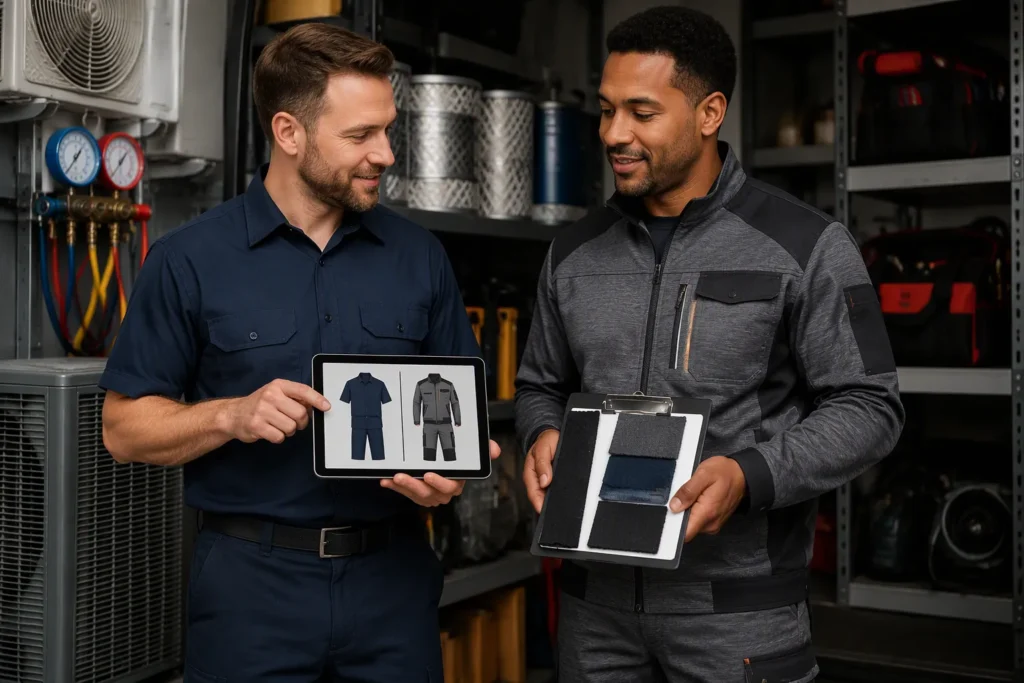
A construction site supervisor apparel OEM program gives you one branded leadership kit. That kit pairs custom polo shirts, softshells, and light jackets with role identifiers. You also get customization services: logo embroidery, color matching, and size grading across your roster.
Overseas general contractors, contractor brands, and site-ops leads use this model to source branded supervisor and foreman apparel. The kit serves leadership first. Treat it as leadership apparel, not as PPE-first gear, not as hi-vis-first gear, not as general site workwear, and not as electrical or HVAC crew uniforms.
A construction site supervisor apparel OEM program keeps your site leaders visually distinct from the crew. You control the look, the fit range, and the labeling. Your foremen wear a kit that signals authority on site.
Who The Supervisor Apparel OEM Program Serves
Overseas GCs And Contractor Brands
You buy branded site-supervisor and foreman polos, softshells, and light jackets through an OEM/ODM program. That is the buyer intent this program answers. You want your leadership team to wear a consistent, recognizable kit across projects and regions. You also want control over decoration, color, and size range.
Shanghai Top Fortune Industry Co., Ltd. runs this program. The company started around 2002 and runs a 1,506 m2 factory in Songjiang. It works as an OEM/ODM supplier and ships to Europe, the Middle East, Oceania, Southeast Asia, and the Americas. The address is Floor 3 Building 20 Haier Zhigu No.66 Guangfulin East Road Songjiang Shanghai 201600. Most programs begin at about 2,000 pieces per style, which fits rollouts across many sites.
Contractor brands take the same path to put their own label on leadership apparel. You set the product, the decoration, and the labeling. The factory makes it to your spec.
Site-Ops Leads And Foremen
Site-ops leads and foremen wear a different kit from the crew. Supervisors need apparel that reads as leadership on site. Crew gear does not send that signal. That is why the program covers leadership apparel only.
A foreman’s polo, softshell, and light jacket form one visual system. The same system repeats across every supervisor on your roster. Role-based differences stay clear without turning the kit into a PPE-first program. You keep visibility and safety items as a secondary context, not as the heart of the order.
What Branded Site Leadership Kits Include
A branded leadership kit rests on three garments. The polo, the softshell, and the light jacket form the core stack for supervisors and foremen. Each layer has a job on site. Together they give your leadership team one recognizable look across seasons and projects.
Polo, Softshell, And Light Jacket Stack
The polo is the base layer. Your supervisors wear it in warm weather and indoors. It carries your logo on the chest or sleeve and stays comfortable through a full shift of walking, checking, and directing crews.
The softshell is the mid layer. It blocks wind and light rain without bulk. Foremen wear it over the polo on cool mornings and in shoulder seasons. Stretch panels and a clean silhouette keep it sharp enough for client meetings on site.
The light jacket is the outer layer. It handles cold, wet days and adds a final branded surface. A supervisor can shed the jacket at midday and still look like leadership in the softshell or polo.
This layering logic matters for a construction site supervisor apparel OEM order. You buy one system, not three unrelated garments. Visibility and FR items stay as secondary context. Confirm them per project when a site demands them. The kit itself stays leadership apparel first.
Role Identifiers And Kit Add-Ons
Role identifiers make rank readable at a glance. Supervisor ID patches, name tabs, and site-role markers sit on the sleeve, chest, or shoulder. A visitor can spot the foreman in a crowd of crew members. New supervisors step into the role with a kit that already signals authority.
Kit add-ons round out the program. Caps and beanies extend the branded look to the head. Welcome-note inserts suit new-hire leadership kits and give a first-day touch. You can fold safety recognition support into the apparel offering as well. Award patches or recognition markers fit the same decoration workflow. Keep this as a supporting layer, not the center of the program.
One production note applies to all kit images. Show garments without logos or wordmarks on the clothing. Clean product shots keep the focus on cut, color, and construction.
Customization, Catalog, And Private Label
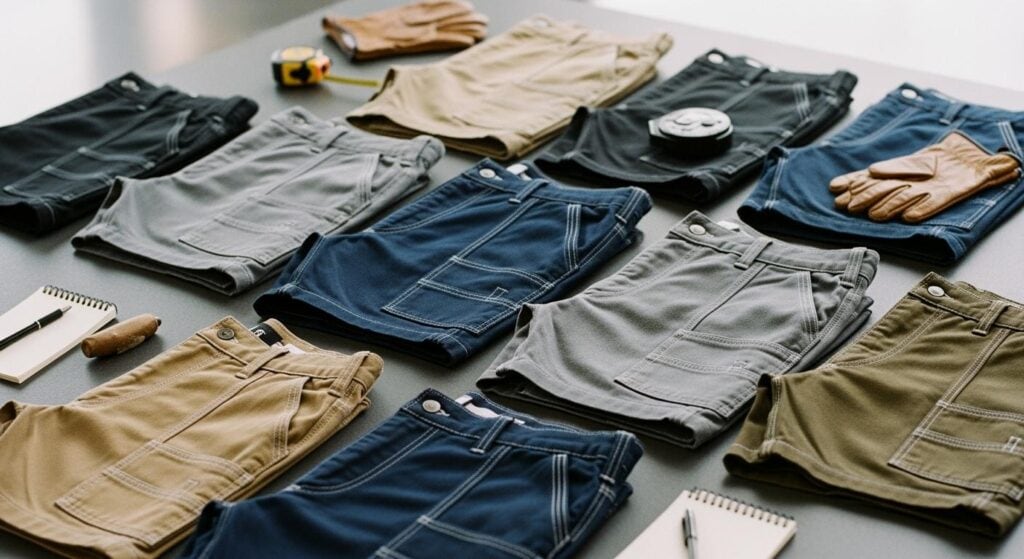
Customization turns a stock garment into your leadership uniform. Three services do most of the work: logo embroidery, color matching, and size grading. Each one shapes how your supervisors and foremen look on site. Get these three right, and the kit looks like one system on every project.
Embroidery, Color Matching, Size Grading
Logo embroidery placement follows the garment. The left chest works for the polo and the softshell. The sleeve is good for a smaller mark or a role patch. The back panel gives you room for a larger logo on the light jacket. You can mix placements across the stack so the kit looks like one system. Send vector artwork and a placement guide with measurements. The factory then sends back a stitch sample for your approval before bulk. Check stitch density and thread color on that sample. A dense stitch on a light fabric can pucker, so approve the sample on the actual garment fabric.
Color matching ties the kit to your brand guidelines. You supply Pantone references or physical swatches. The factory matches fabric dye lots and thread colors to those references. Confirm the match in daylight, not just under office lighting. Small shifts between dye lots happen, so approve one lot standard for the whole program. Keep that standard on file for repeat orders.
Size grading covers mixed supervisor and foreman rosters. Your leadership team spans a wide range of builds. A graded size run from small to larger sizes keeps every wearer in a proper fit. Share your size distribution and any tall or relaxed-fit needs. The factory builds a grade rule around that data. A good grade rule keeps the collar, sleeve, and body proportions consistent across sizes. Review the size chart against real wearers before you approve it.
Catalog Vs. Private-Label Routes
Catalog programs fit a faster start. You pick from an approved product list, choose colors and decoration, and move to sampling. The patterns already exist, so the timeline stays short. Catalog routes suit programs that need a quick rollout or a proven block across many sites. You still control decoration, color, and labeling within the approved range. A catalog route also gives you a tested block that fits most wearers without new pattern work.
Private-label programs fit full brand control. You set custom patterns, fabrics, and trim. Your label goes inside the garment. This route suits contractor brands that want a signature leadership look no one else carries. It takes more development time, and the result is yours alone. Expect more sample rounds before you lock the pattern.
Online company stores can serve distributed workforces as a program-structure option. A store lets supervisors in different regions order from an approved kit list. You keep control of the product range and the branding. Discuss the store structure with your supplier early, so the product data and size charts support it.
Both routes work inside a construction site supervisor apparel OEM program. Pick catalog for speed and private label for control. Many buyers start with catalog and move to private label as their leadership kit matures.
Technical Fit And Compliance For Construction Site Supervisor Apparel OEM
Visibility, FR, And Layering
Visibility and flame-resistant rules change from project to project. So check them for each site instead of assuming one standard fits every job. Some sites ask for ANSI/ISEA high-visibility garments. Others need FR-rated layers for certain work zones. Ask your project owners which standards apply before you finalize the kit. Then match the garment spec to that answer. This approach keeps your construction site supervisor apparel OEM order accurate. It also avoids rework after bulk production starts.
Layering follows a simple logic for supervisor roles. The polo works as the base layer against the skin. The softshell sits over it as a mid layer for wind and light rain. The light jacket goes on top as the outer layer for cold or wet days. Each layer must fit comfortably over the one beneath it. Check sleeve length and shoulder room on the mid layer with the base layer on. A tight softshell over a polo restricts movement on site.
Documentation And Labeling
Ask for a full document set with your samples. Request fabric specs that list fiber content, weight, and finish. Ask for care labeling that matches the fabric and the decoration. Get a size chart with graded measurements for every size you order. Confirm country-of-origin labeling for each garment. Review these documents before you approve the pre-production sample. A labeling error caught at that stage costs far less than one found after bulk delivery.
Keep the approved documents on file for repeat orders. Your next run then starts from a known standard. Check that care instructions account for embroidery and other decoration. A care label written for undecorated fabric may not protect the decorated garment. Confirm the label text with your supplier and lock it with the sample approval.
Cost Drivers, MOQ, And Sample-To-Bulk Path
What Moves Unit Cost
Five factors shape your unit cost, and you control all of them. Fabric choice comes first. A heavier softshell shell or a finer polo knit costs more than a basic block. Decoration method comes next. A small chest embroidery costs less than a large back panel with dense stitching. More stitch count means more machine time.
Size grading spread also moves cost. A tight run of common sizes is cheaper to cut than a wide spread with many larger sizes. Order consolidation helps your budget. Combine the polo, softshell, and light jacket into one production window. You then share setup work across the stack. Packaging rounds out the picture. A simple poly bag costs less than a branded box with inserts. Choose packaging that matches how your supervisors receive the kit.
Sample, PPS, And Bulk Production
The path runs in three stages. First comes the sample. You review fabric hand, fit, and decoration placement on a single garment. Mark every change you want. Second comes the pre-production sample, or PPS. The factory builds it to your final spec with your approved artwork and labels. PPS approval locks the specs before bulk. Nothing changes after that sign-off without a new round.
Third comes bulk production. The factory cuts and sews to the locked PPS. Keep the approved PPS on hand as your reference standard. Compare bulk output against it during inspection. Check stitch quality, color, and labeling on the first units off the line. Early checks catch drift before the full run ships. This sequence protects your schedule and your budget.
RFQ Table And Procurement Checklist
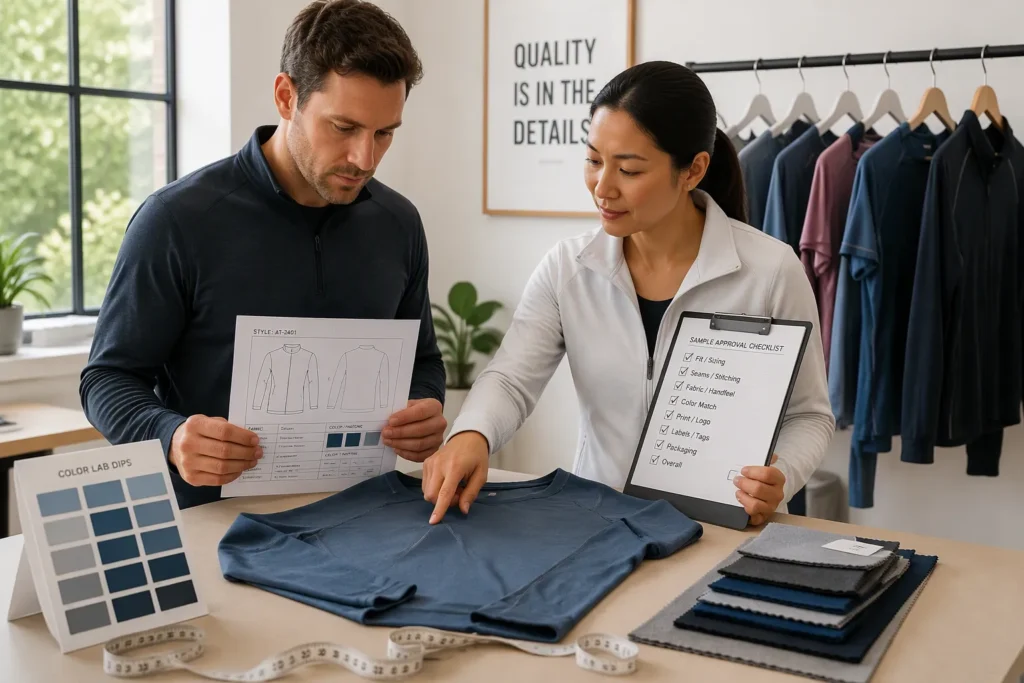
RFQ Line Items
A clear RFQ table takes the guesswork out of your first talk with a supplier. Make one row for each garment in the leadership stack. Fill in every column before you send it.
Style | Fabric | Decoration | Size range | Quantity per style | Labeling | Target ship date |
|---|---|---|---|---|---|---|
Supervisor polo | Cotton-rich knit, confirm weight | Left chest embroidery | Graded run, confirm spread | State your count | Woven main label, care label, origin | State your date |
Foreman softshell | Bonded softshell, confirm hand | Chest logo, sleeve role patch | Graded run, confirm spread | State your count | Woven main label, care label, origin | State your date |
Light jacket | Shell fabric, confirm finish | Back panel logo, name tab | Graded run, confirm spread | State your count | Woven main label, care label, origin | State your date |
Add a notes column for anything the table cannot hold. Put tall sizes, relaxed fits, or special packaging there. Attach your artwork files and Pantone references to the same message. A complete table lets the factory quote and schedule in one pass.
Pre-Award Checklist
Run this checklist before you commit to bulk. Each item protects a different part of the order.
Confirm sample and PPS approval. Keep the signed PPS as your reference standard.
Sign off the size grading. Check the chart against real wearers on your roster.
Review all labeling. Match care text to the decorated garment, not the bare fabric.
Lock the packaging spec. State bag, box, and insert details in writing.
Agree the delivery schedule. Confirm ship dates against your site rollout plan.
Walk through every line with your supplier. A gap at this stage shows up as rework later.
Ready to build your leadership kit? Reach out at rill@topfortunemail.com or WhatsApp +86 13524210501. Explore the factory at workwearmanufacturer.com, read the about-us page, and review the custom jacket, custom polo shirt, and corporate polo OEM pages. The construction site workwear buyer guide, building trades private label page, and blog cover the rest.
A set polo, softshell, and light-jacket stack gives your construction site supervisor apparel OEM program a fixed product base. Written customization steps and clear compliance rules take out the guesswork. A steady sample-to-PPS-to-bulk path cuts rework and speeds up site rollout.
Build your RFQ from the table. Run the checklist before you award. Confirm labeling and size grading early, so bulk production starts clean.
Send your RFQ to rill@topfortunemail.com or WhatsApp +86 13524210501. Visit workwearmanufacturer.com, the about-us page, the custom jacket, custom polo shirt, and corporate Factory pages: https://www.workwearmanufacturer.com/ https://www.workwearmanufacturer.com/about-us/ https://www.workwearmanufacturer.com/custom-jacket-manufacturer/ https://www.workwearmanufacturer.com/custom-polo-shirt-manufacturer/ https://www.workwearmanufacturer.com/corporate-polo-shirts-oem-china-manufacturer/ https://www.workwearmanufacturer.com/construction-site-workwear-oem-buyer-guide/ https://www.workwearmanufacturer.com/building-trades-prpolo OEM pages, plus the buyer guide, private label page, and blog.