

Chain Store Staff Uniform OEM Checklist | Multi-Location Buyers
Table of Contents
Display
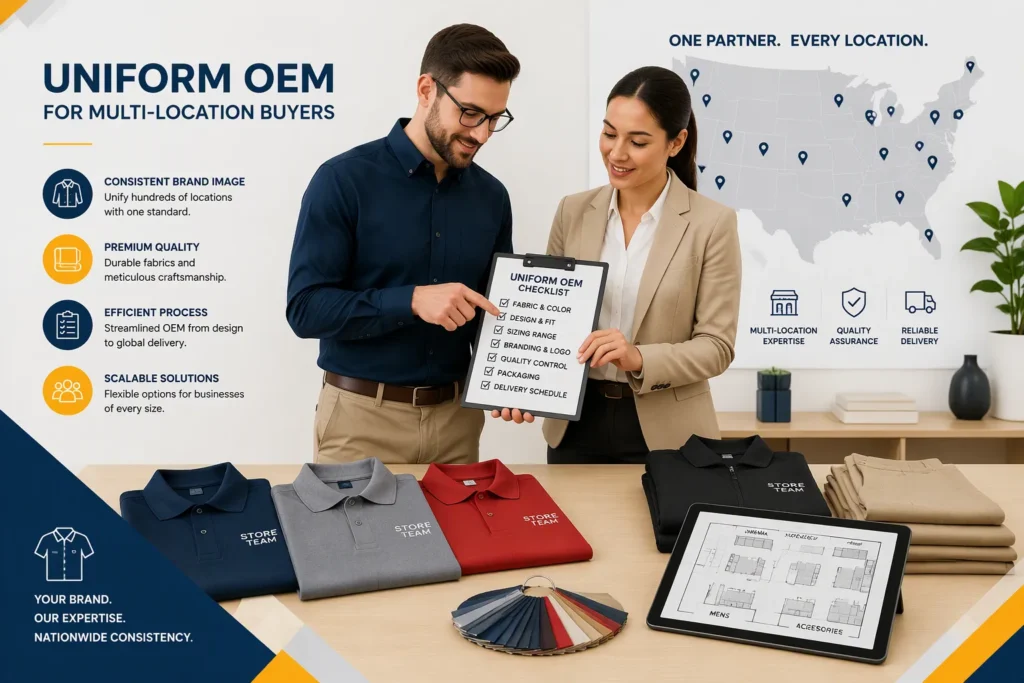
Before you sign with a uniform OEM supplier, check five areas: technical performance, application fit, regulatory compliance, cost structure, and supplier reliability. This checklist is for retail chain HQ, franchise operations, and multi-location brand procurement teams. It covers staff polos, aprons, and light outer layers, not PPE, school uniforms, or nursing uniforms. Shanghai Top Fortune Industry Co., Ltd. has done OEM/ODM workwear and retail staff apparel production since about 2002 from a 1,506 m2 Songjiang factory, exporting to Europe, the Middle East, Oceania, Southeast Asia, and the Americas. See https://www.workwearmanufacturer.com/ and https://www.workwearmanufacturer.com/about-us/. Multi-store retail and franchise buyers can ask for a chain store staff uniform quote at about 2,000 pieces per style via rill@topfortunemail.com or WhatsApp +86 13524210501.
Key Takeaways
Check five important areas before you pick a uniform supplier: technical performance, application fit, compliance, cost, and reliability.
Check the fabric quality, stitching, and wash durability. This makes sure uniforms last through repeated industrial washing.
Keep the design the same in every store. Use approved color swatches and written rules for where the logo goes.
Check that the fiber content, labels, and test reports match the actual production batch to confirm regulatory compliance.
Know the whole cost: ask for a written quote that lists each item, bulk pricing levels, and any extra fees.
Check how reliable a supplier is by looking at their production capacity, lead times, and quality control systems.
Use a three-step approval process: development sample, pre-production sample, and bulk production sign-off.
Send a detailed RFQ that includes style, fabric, quantity, size breakdown, store allocation, and timeline. This helps you get accurate quotes.
Chain Store Staff Uniform Verification Areas
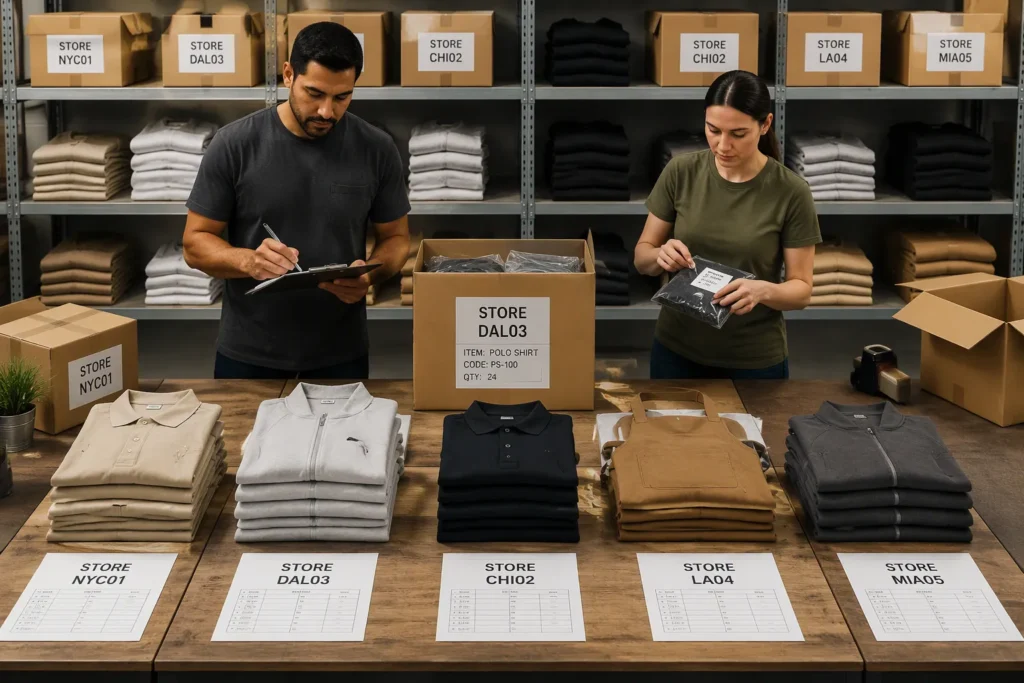
This section gives you the big picture. Each pillar below gets a full, detailed look in its own H2 later in the article. Read this part first to see the whole chain store staff uniform review at a glance, then go through the detail sections in order.
The Five Checklist Pillars
You check five areas before you commit to a uniform OEM supplier:
Technical performance — fabric quality, stitching, and how well items hold up under repeated industrial washing.
Application fit — design consistency across stores, size runs, and SKU control for busy floor teams.
Regulatory compliance — fiber content, labeling, and test documents that match the actual production batch.
Cost structure — clear quotes, volume tiers, and the hidden costs that show up after the order ships.
Supplier reliability — capacity, lead times, rollout scheduling, and quality control systems.
Each pillar covers a different risk. A supplier can pass one and fail another, so treat all five as gates, not a score.
How to Use This Checklist
Run the pillars in order for a new supplier. Start with technical performance and application fit, because a fabric or size-run failure ends the talk early. Move to compliance and cost once the product is viable. End with supplier reliability, which tells you whether the program lasts a second and third season.
For an existing supplier, you do not need the full order. Re-run the compliance and cost pillars at each reorder cycle, and spot-check technical performance with a wash trial from the current batch. This keeps the checklist a living tool instead of a one-time audit.
Who It Is For
This checklist serves retail chain HQ, franchise operations, and multi-location brand procurement teams. You manage one brand standard across many doors, and you need every location to get the same polo, apron, or outer layer.
It is not built for single-store buyers, school uniform programs, PPE procurement, or nursing uniforms. Those programs carry different standards, different size logic, and different compliance paths. If you run a multi-location retail or franchise apparel program, the sections that follow apply directly to your sourcing decision.
Product Scope
our chain store staff uniform program usually covers three kinds of clothing: staff polo shirts, aprons, and light outer layers. Each one does a different job on the sales floor. Each one also has its own fabric weight, wash durability, branding space, and size-run rules. Treat them as three separate specs, not one mixed order.
These are retail staff clothing items. They are not PPE, they are not hi-vis priority garments, and they are not school uniforms or nursing uniforms. Keep that scope clear when you brief a supplier, because it changes the fabric, trim, and labeling choices you need.
Staff Polo Shirts
The polo is the main piece in most chain store staff uniform programs. It sits closest to the body, so fabric weight matters for comfort during a full shift. A mid-weight knit keeps its shape and hides wear better than a very light jersey. Wash durability matters most here, because floor teams wash polos far more often than outer layers.
The polo also gives you the biggest branding space. You can put embroidery on the chest, a woven badge on the sleeve, or a printed mark on the back yoke. Size runs need the widest spread of the three categories. High-turnover floor teams include many body types, so plan a full graded run rather than a narrow core range.
Aprons
Aprons take the heaviest soiling and the most frequent washing. Choose a tighter weave or a coated surface that resists stains and holds color through repeated cycles. Fabric weight can run heavier than the polo, because drape matters less than coverage and strength.
Branding space is generous but often partly covered. Place your logo where it stays visible during normal wear, such as the bib or the upper pocket. Size runs are simpler than polos. Most programs need a small number of lengths and a waist or neck adjustment instead of a full graded range.
Light Outer Layers
Light outer layers include softshells, zip jackets, and lightweight overshirts. They carry the lowest wash frequency, so colorfastness and abrasion resistance matter more than repeated laundering. Weight should stay light enough for indoor wear and layering over a polo.
Branding usually lands on the chest and back, with embroidery as the common method. Size runs sit between polos and aprons. Staff often wear an outer layer over a polo, so grade the fit to allow room underneath.
Category | Fabric weight | Wash durability focus | Branding surface | Size-run need |
|---|---|---|---|---|
Staff polo shirts | Mid-weight knit | High — frequent washing | Largest, chest and sleeve | Widest graded run |
Aprons | Heavier, tighter weave | Highest — heavy soiling | Bib and upper pocket | Few lengths, adjustable fit |
Light outer layers | Light, layer-friendly | Moderate — lower wash frequency | Chest and back | Mid-range, room to layer |
Technical Performance Checks
Technical performance decides whether your chain store staff uniform survives a full season of shifts and industrial washing. You test fabric, construction, and durability before you approve bulk. Each check below gives you a question to put to the supplier and a way to read the answer.
Fabric Quality
Fiber Content and Weight
Ask for the exact fiber blend and the fabric weight in grams per square meter for every style. A polo, an apron, and a light outer layer each need a different weight. The supplier should state it per item, not per order. Compare the stated weight against a physical swatch. A swatch that feels thin against its stated weight signals a substitution risk.
Colorfastness and Shrinkage
Brand color must hold through repeated washing, especially on polos and aprons. Request colorfastness test results for washing, rubbing, and light exposure. Also ask which test method the lab used. For shrinkage, wash a production swatch several cycles and measure it before and after. Set an acceptable shrinkage range in writing, then hold bulk to that range.
Stitching and Construction
Seam and Stitch Density
Dense, even stitching resists seam failure at the shoulder, side seam, and hem. Inspect a sample under good light and look for skipped stitches, loose tension, and wavy seams. Ask the supplier to confirm stitch density per centimeter for each seam type. Consistent density across a sample batch tells you the line is calibrated.
Reinforced Stress Points
Stress points fail first. Check the armhole, pocket corners, apron ties, and the zip ends on outer layers. Look for bar tacks, double stitching, or extra fabric reinforcement at these spots. A supplier who reinforces stress points by default understands floor wear better than one who adds it only on request.
Durability Testing
Wash-Cycle Performance
Run a wash trial that mirrors your real laundry routine, including temperature and detergent. Repeat it enough cycles to represent a season of use. Record color change, shrinkage, seam integrity, and surface wear after each round. Document the results and attach them to the approved specification.
Pilling and Abrasion
Pilling makes a uniform look old before its time, and abrasion wears through collars, cuffs, and apron edges. Request pilling and abrasion test reports from a recognized method, and compare results across fabric options. Where reports are unavailable, rub a swatch against itself and inspect the surface for fuzz and fiber loss.
Application Fit Checks
A uniform program fails at the store level when one location gets a slightly different navy or a logo that sits a centimeter off. Application fit checks protect the brand standard across every location. You test three things: design consistency, size runs, and SKU control.
Design Consistency Across Stores
Color Matching and Pantone References
Give the supplier a physical color reference, not a screen image. A Pantone number helps, but you should also approve a physical swatch under the lighting your stores actually use. Ask the supplier to keep that approved swatch on file as the master reference for every production run.
Confirm how the supplier checks color across dye lots. A good answer names the reference, the lighting condition, and the person who signs off. Ask for a color approval step before bulk cutting starts.
Logo Placement and Embroidery Standards
Logo placement needs a written standard, not a verbal brief. Specify the position on each garment, the size, the thread color, and the stitch type. A polo chest mark, an apron bib mark, and an outer-layer back mark each need their own placement sheet.
Ask for a sewn sample of each logo before bulk. Measure the placement against your sheet and keep the approved sample as the reference. This single step prevents most cross-store complaints about “the logo looks different.”
Size Runs and Grading
High-turnover floor teams include many body types, so a narrow core range will leave staff in poor-fitting garments. Build a graded run that covers your real staff population, and ask the supplier to confirm the grade rules in writing. Check that the same grade rules apply to every store order.
Test fit on real staff before you approve bulk. Ask a sample group across your size range to wear the garments for a shift. Note tight armholes, short hems, and apron lengths that sit wrong. Feed those notes back into the grade before you lock it.
Customization and SKU Control
Fabric, Trim, and Label Customization
Lock the fabric, trim, and label spec for each style. Trim covers buttons, zips, thread, and apron ties. Label covers the neck label, care label, and any store-specific marking. Write each item into the specification so a reorder matches the first run.
Standardized Listings Across Locations
Give every location the same item code and the same description. A shared listing stops stores from ordering near-duplicates and keeps your reorder data clean. Ask the supplier to print the item code on the packing list for each carton.
Regulatory Compliance Checks
Compliance keeps your brand safe from rejected shipments and customs holds. You check three things: the fiber content rules for your market, the labels sewn into each garment, and the test papers behind the fabric.
Safety and Fiber Content Standards
Your destination market makes the rules. The United States, the European Union, and other regions each set their own fiber content disclosure and general product safety requirements. Tell the supplier every country where your stores sell, and ask which standard applies to each style.
Ask the supplier to confirm the fiber blend in writing for each fabric. Compare that statement against the swatch and the test report. If the stated blend and the tested blend do not match, that is a red flag. Fix it before bulk.
Labeling Requirements
Care Labels and Country of Origin
Every garment needs a care label with washing, drying, and ironing instructions that match the real fabric. A care label copied from another style can ruin garments in the wash. Ask the supplier to write care instructions for each fabric and check them against wash trial results.
Country of origin marking must appear where your market requires it. Confirm the exact wording and placement with the supplier, and check a sewn sample before bulk. Store staff rarely inspect labels, so your HQ team must own this check.
Fiber Content Disclosure
Fiber content must appear on the label in the order and wording your market accepts. Give the supplier your required label text for each style, and ask for a printed or woven label sample. Approve that sample in writing.
Keep one approved label per style on file. Reorders then match the original, and new stores get the same compliant label as existing locations.
Certifications and Test Reports
Requesting Valid Documentation
You may request documents such as OEKO-TEX or GOTS certificates, along with fiber composition and colorfastness test reports. Ask for the full document, not a logo. Check the certificate holder name, the product scope, and the validity period.
Build a simple document request list for each supplier:
Certificate or test report for each fabric used
The issuing laboratory or body named on the report
Validity dates and the products covered
A contact point for verification
Matching Certificates to Actual Production
A certificate only counts when it covers the fabric in your order. Ask the supplier to link each document to a specific fabric code and production batch. Request the mill or supplier name on the certificate and compare it with the fabric source in your spec.
Spot-check at inspection. Pull a garment from the bulk run and confirm the fabric, label, and batch reference match the approved documents. If the paperwork and the product do not match, hold the shipment until the supplier explains the gap in writing.
Cost Structure Checks
Cost checks are more than just the unit price on the quote. You need to see how the supplier builds the number, what causes it to change, and which charges show up later. A clear cost structure keeps your budget safe across every store and every reorder.
Quotation Clarity
Ask for a quote broken down by line item: fabric, cut and sew, branding, trim, labeling, packing, and freight. One lump sum hides where the money goes. With a broken quote, you can compare two suppliers on the same basis. You can also spot a fabric line that is oddly low, which hints at a substitution risk.
Confirm what the quote includes and what it leaves out. Ask whether branding, individual polybags, and carton marking are inside the price. Request the quote validity period in writing. Fabric and freight markets move, so a quote with no validity date gives you no protection when you order weeks later.
Bulk Pricing and MOQ
Volume Tiers and Sample Fees
Ask the supplier to put volume tiers in writing. Tiers usually drop as quantity goes up, and you want the break points before you plan store allocations. Confirm whether you can mix styles or colors to reach a tier, or whether each style counts on its own.
Sample fees need the same clarity. Ask what a development sample costs and what a pre-production sample costs. Ask whether the supplier credits those fees against the bulk order. Get the credit rule in writing so nobody argues about it at invoice time.
Rework and Replacement Terms
Define who pays when goods fail inspection. Ask for the rework terms, the replacement terms, and the timeline for each. A supplier who fixes defects at their own cost before shipment protects your launch date. A supplier who ships flawed goods and negotiates later puts your stores at risk.
Put the defect threshold in the contract. State which defect types trigger rework and which trigger replacement. Also state who covers the freight in each case.
Hidden Cost Checks
Freight, Duties, and Packaging
Ask for freight options with transit times, not a single rate. Confirm who pays duties and taxes at destination, and get the Incoterm named in the quote. Packaging deserves its own line: individual polybags, size stickers, and carton labels all carry a cost. Skipping them creates extra work at your distribution center.
Ongoing Program Costs
Recurring costs decide the long-term budget. Ask about reorder minimums, repeat sample charges, and any fee for holding your approved swatch or label artwork on file. Confirm the cost of replenishment packs for new store openings. A low first-order price means little if every reorder carries a surprise charge.
Request every cost in writing before you approve the first bulk order. Verbal assurances do not survive a change of account manager.
Supplier Reliability Checks
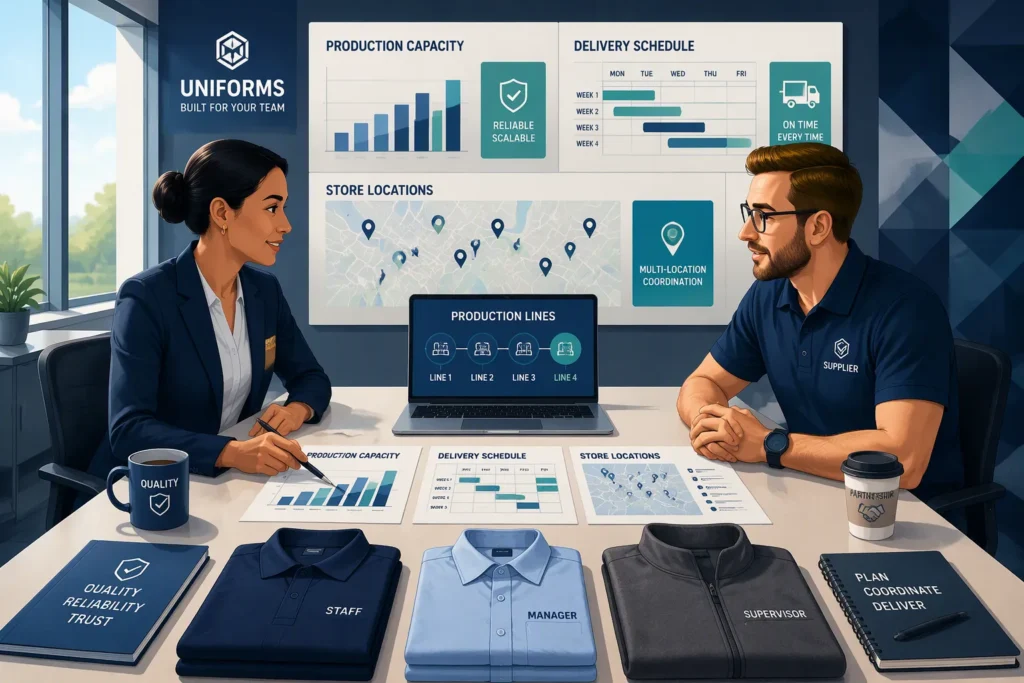
A supplier can pass every product test and still fail your program. Reliability decides whether the goods arrive on time, in good condition, and in the right amount for each store. Here you check three things: capacity, delivery scheduling, and quality control.
Production Capacity and Scalability
Ask how many production lines the supplier can give to your styles and how those lines run across a season. A factory that fills its floor with other work during your peak window will push your order back. Request a capacity statement in writing, and compare it to your total volume across all locations.
Scalability matters more than raw capacity. Your first order may cover a pilot group of stores, and later orders may double. Ask the supplier to explain how they add lines, hire and train operators, and protect quality when volume rises. A supplier with a clear scaling plan gives you a realistic answer.
Lead Times and Delivery Scheduling
Ask for lead times by stage, not one total number. Development sample, pre-production sample, bulk production, and transit each take their own time. Get each stage in writing, then build your store calendar around the longest realistic path.
Multi-Store Rollout Scheduling
A multi-store rollout needs a delivery sequence, not a single shipment date. Tell the supplier which stores open first and which can wait. Ask them to plan production so the first wave ships complete, with every size and style in the carton.
Build a simple rollout calendar with the supplier. Mark each wave, the stores inside it, and the required arrival window. Confirm the supplier can hold finished goods briefly if a store opening slips. That flexibility protects your launch without rushing production.
Replenishment Packs for New Store Openings
New stores need a standard opening pack: a set quantity per size, per style, plus spare pieces for damage and new hires. Define that pack once, then reuse it for every opening. Ask the supplier to keep your fabric and label records on file so a replenishment run matches the original.
Confirm the reorder trigger and the minimum run for a replenishment pack. A supplier who can produce a small opening pack from held materials keeps your new stores consistent with existing ones.
Quality Control Systems
Inline and Final Inspection
Ask where inspection happens. Inline inspection catches defects while the line can still fix them. Final inspection confirms the finished goods before packing. A supplier who inspects only at the end finds problems too late to fix without delay.
Request the inspection checklist for each style. It should cover measurements, stitching, logo placement, labeling, and color against the approved swatch. Ask who signs the inspection record and whether you get a copy with each shipment.
AQL Standards and Defect Handling
Ask the supplier to inspect against a named sampling standard, such as ISO 2859-1 or ANSI/ASQ Z1.4, and to state the inspection level and acceptable quality limit for major and minor defects. Put those values in the purchase order so both sides work from the same rule.
Define defect handling before bulk starts. State which defects trigger rework, which trigger replacement, and who covers freight in each case. Ask for photo evidence of any rejected lot. A written defect process turns a dispute into a routine correction.
RFQ and Specs Table
A clear RFQ turns your chain store staff uniform plan into a document a supplier can quote on, line by line. Build the table once, then use it again for every supplier you review. The format below keeps your request easy to compare across factories. It also gives your own stores one single reference point.
Style and Fabric Specifications
Start each row with the style name and a short internal code. Name the garment type — staff polo, apron, or light outer layer — so the supplier cannot mix up categories. Add the fiber content and fabric weight in grams per square meter for each style. State the finish you need, like a stain-resistant treatment on aprons or a soft feel on polos.
Color needs a physical anchor. List the Pantone reference and note that you will approve a physical swatch under store lighting before bulk. Record the branding method for each style: chest embroidery, sleeve badge, bib print, or back mark. Give the placement, size, and thread color for each mark so the supplier quotes the real work.
Quantity, Size Breakdown, and Store Allocation
Break quantity down by style, then by size. One single total hides the size mix, and the size mix drives the supplier’s cutting plan. List each size with its quantity, and note any tall or extended sizes your floor teams need. Confirm whether the supplier can mix colors within one style to reach a volume tier.
Store allocation belongs in the same table. Assign a quantity per store or per store wave, and mark which locations open first. Add a spare allowance for damage and new hires. This column lets the supplier pack by store and saves your distribution center a sorting step.
Timeline, Labeling, and Delivery Requirements
State your required delivery date per wave, not one date for the whole program. Add the labeling requirements for each style: neck label text, care label content, country of origin marking, and any store-specific code. Name the packing format — individual polybag, size sticker, carton label — so packaging costs stay visible.
Finish with the delivery terms and destination. Name the Incoterm and the receiving address for each wave. Ask the supplier to confirm each column in writing before quoting.
Style / Code | Fabric (content, gsm) | Color / Pantone | Size breakdown | Store allocation | Branding method | Labeling | Required delivery |
|---|---|---|---|---|---|---|---|
Staff polo / SP-01 | Cotton-rich knit, mid-weight | Navy, Pantone ref. | Full graded run, S–3XL | Wave 1 stores, qty per door | Chest embroidery | Neck, care, origin | Wave 1 date |
Apron / AP-02 | Tight-weave, heavier | Black, Pantone ref. | Few lengths, adjustable | All stores, qty per door | Bib print | Care, origin | Wave 1 date |
Light jacket / LJ-03 | Light woven, layer-friendly | Charcoal, Pantone ref. | Mid-range, room to layer | Wave 2 stores, qty per door | Chest and back embroidery | Neck, care, origin | Wave 2 date |
Sample to PPS to Bulk
Think of development as three approval gates. Nothing moves forward until you sign off the gate before it in writing. The steps only go one way:
Development sample approval
Bulk production and final sign-off
If you skip a gate, you give the factory permission to guess. Each gate below tells you what to check and what to lock in.
Development Sample Stage
The development sample shows the supplier can make your garment at all. You look at fabric feel, overall fit, construction, and branding method on a first real piece. Compare it to your spec sheet line by line. Write down every gap, then send one combined comment list back to the supplier.
Plan for at least one round of changes at this stage. A supplier who sends back a fixed sample with your comments handled shows a working feedback loop. Keep the approved development sample on file. It becomes the reference for everything that follows.
Pre-Production Sample Approval
The PPS is your last chance to change anything before bulk cutting starts. PPS approval locks four things: color, logo placement, size grading, and labeling. Check the PPS against your approved physical swatch under store lighting. Measure the logo position against your placement sheet. Confirm the grade rules on the size set, and read every sewn label for correct text and placement.
Sign the PPS only when all four items match. A written PPS sign-off, with the approved sample kept by both sides, stops most bulk disputes before they start. If any item is off, reject the PPS and ask for a corrected version. Do not accept a verbal promise that bulk will be fixed.
Bulk Production and Final Sign-Off
Bulk starts only after the signed PPS is on the factory floor. Ask the supplier to confirm the production batch matches the PPS fabric, trim, and label records. Request inline inspection during the run, then a final inspection before packing. Check measurements, stitching, logo placement, and labeling against the approved sample.
Final sign-off closes the gate. Review the inspection record, confirm the defect handling terms from your purchase order, and approve shipment only when the goods match the PPS. Hold the shipment if the paperwork and the product disagree. A disciplined three-gate process protects every store in your rollout.
Catalog vs OEM
Choosing between catalog supply and OEM production is about what fits your needs, not which one is better quality. Both routes give you staff apparel people can wear. Your program size, how much brand control you need, and your replenishment plan decide which one works better for you.
Option | Best fit | Brand control | Size runs | Replenishment |
|---|---|---|---|---|
Catalog | Pilot programs, fast openings, small first waves | Limited to stock colors and existing branding spots | Fixed stock range | Repeat orders from held stock |
OEM | Multi-location rollouts with fixed brand standards | Full control of fabric, color, trim, and logo placement | Graded to your staff population | Continuity from held fabric and label records |
Hybrid | Mixed ranges across store tiers or seasons | Strong on core pieces, lighter on basics | Extended where it matters | Split between stock and production runs |
Where Catalog Fits Best
Catalog supply works well for a pilot. You can test a new store concept, a seasonal look, or a small group of doors without committing to tooling and development time. Stock items arrive quickly, and you can scale back if the concept does not perform.
Catalog also works well for basic pieces where your brand standard is light. A plain apron or a neutral outer layer may need nothing more than a chest mark. Check fabric weight, colorfastness, and labeling on catalog goods exactly as you would on OEM goods. The sourcing route changes; the verification does not.
Where OEM Fits Best
OEM fits a program with many doors and one fixed standard. You control the fabric, the Pantone reference, the trim, and the logo placement on every piece. That control keeps store fifty matching store one. Explore custom polo shirt manufacturing and corporate polo OEM production as starting points for a branded core range.
OEM also protects your size runs and your replenishment. You grade to your real staff population instead of accepting a stock range. Your supplier holds the approved fabric and label records, so a new store opening pack matches the original run. Light outer layers benefit most here, since custom jacket production lets you set weight, lining, and embroidery placement together.
Hybrid Approaches
Many chains split the range. Core polos and aprons go OEM for brand consistency, while seasonal or low-volume pieces come from catalog stock. This keeps the brand standard where customers see it most and keeps cost and speed sensible elsewhere.
A second hybrid pattern extends a catalog base. You buy a stock garment and add OEM branding, a size extension, or a trim change. Confirm the supplier can hold that modified spec for reorders. Review the full uniform range before you split categories, then write the split into your program brief so every location orders from the same list.
Multi-Location Procurement Checklist
his section gives you a checklist you can actually use. Copy it into an email, a spreadsheet tab, or your supplier scorecard. Each block below covers one stage of a multi-location buy. Each item is written so you can mark it done or not done.
Pre-Qualification Documents
Collect these documents before you send an RFQ. A supplier who cannot supply them now will slow your program later.
Business license and factory profile, including the Songjiang production site and its floor area
Fabric specification sheets with fiber content and weight in grams per square meter for each style
Test reports for colorfastness, shrinkage, pilling, and abrasion, with the test method named
Sample care label and country of origin marking for each style
Certificate or test document for each fabric, with holder name and validity dates
Reference list of retail staff apparel programs in your category
Named contact for quality, production, and shipping
Score each supplier on five criteria: quality systems, reliability, cost clarity, service capability, and experience in the specific apparel category. Use a simple scale, such as one to five, and keep the scores beside the documents. A supplier who is strong on price but weak on category experience will cost you time at the sample stage.
Per-Store Allocation and Packing
Allocation turns a bulk order into store-ready cartons. Build one allocation sheet and share it with the supplier before production starts.
Store list with store codes and opening dates
Quantity per style, per size, per store
Spare allowance for damage and new hires
Packing format: individual polybag, size sticker, carton label
Carton marking with store code and item code
Wave sequence, with wave one stores listed first
Ask the supplier to pack by store, not by style. Store-packed cartons save your distribution center a sorting step and reduce mis-ships during a fast rollout. Confirm the carton label layout in writing, and ask for one photo of a packed carton before the full run ships.
Reorder and Program Continuity
A chain store staff uniform program runs for seasons, not one order. Continuity depends on records the supplier keeps after the first shipment.
Approved physical color swatch held on file
Approved logo placement sheet and sewn logo sample
Locked fabric, trim, and label specification per style
Reorder minimum and lead time in writing
Replenishment pack definition for new store openings
Named account contact and a backup contact
Ask the supplier how long they hold your approved swatch and label artwork. Confirm the reorder process in writing, including who checks the new run against the original spec. A supplier who can pull your records and match a reorder without a new sample round protects your brand standard across every opening.
Treat this checklist as a living document. Update it at each reorder cycle and each new supplier review.
Next Steps and Contact
You have the checklist. Now use it on a real supplier review. Three actions get you there fastest: ask for a quote, ask for samples, and book a program review. Each step gives you information the next step needs.
Request a Quote
Send your RFQ table with style, fabric, color reference, size breakdown, store allocation, branding method, labeling, and required delivery date. A complete table lets the supplier quote line by line instead of guessing. Ask for the quote split by fabric, cut and sew, branding, trim, labeling, packing, and freight. Confirm in writing how long the quote stays valid.
Email rill@topfortunemail.com or message WhatsApp +86 13524210501 with your RFQ attached. Add your destination markets and your wave schedule so the reply covers compliance and delivery in one pass. If your range includes a branded polo core, review the custom polo shirt program and the corporate polo OEM page before you finalize the spec.
Request Samples
Ask for a development sample in each category: one staff polo, one apron, and one light outer layer. State the fabric weight and branding method for each. Request a sewn logo sample on the polo chest and the apron bib, plus a placement sheet for the outer layer. Keep every approved sample on file as your master reference.
Include a wash trial request with the sample. A sample that looks right on day one tells you little about a full season of shifts. Send your care label text along with the sample request so the labels come out right on the first piece. For outer layers, the custom jacket page shows the weight and embroidery options you can specify.
Program Review
Book a program review once the quote and samples are in hand. Walk through the five pillars together: technical performance, application fit, compliance, cost, and reliability. Bring up your rollout calendar and your replenishment pack definition at this meeting. Confirm who keeps your approved swatch and label records for future reorders.
Use the review to agree on the three approval gates in writing. Nothing moves to bulk until the development sample and the PPS carry your signature. Browse the full uniform range to confirm category coverage before you lock the split between catalog and OEM supply.
Shanghai Top Fortune Industry Co., Ltd. welcomes chain store staff uniform programs at our Songjiang site: Floor 3 Building 20 Haier Zhigu No.66 Guangfulin East Road Songjiang Shanghai 201600. Send your RFQ today and start the sample plan this week.
Five verification areas carry your chain store staff uniform program: technical performance, application fit, regulatory compliance, cost structure, and supplier reliability. Run all five for every new supplier. Re-run compliance and cost at each reorder cycle. The checklist stays useful only when you treat it as a repeatable pre-qualification tool, not a one-time audit.
Move through development sample, PPS, and bulk approval in sequence. Each gate locks color, logo placement, size grading, and labeling before the next begins. Skipping a gate invites guesswork.
Send a structured RFQ covering style, fabric, quantity, size breakdown, store allocation, and timeline. Email rill@topfortunemail.com or message WhatsApp +86 13524210501 to request a quote and sample plan.
FAQ
What is the smallest order amount for a chain store staff uniform program?
The smallest order amount is set for each style, and you should confirm it in writing before you plan store allocations. Ask if you can mix colors within one style to reach the threshold. A clear answer here shapes your wave schedule and your budget.
What should a supplier quote include?
Ask for a quote that lists each cost: fabric, cut and sew, branding, trim, labeling, packing, and freight. Confirm how long the quote stays valid and the Incoterm. Request the sample fee credit rule in writing so nobody disputes it at invoice time.
How do I keep SKU control across many stores?
Give every location one item code and one description for each style. Lock the fabric, trim, and label spec in a written sheet. Ask the supplier to print the item code on each carton. A shared listing stops stores from ordering near-duplicates.
How do I plan replenishment for new store openings?
Define one standard opening pack: a set quantity per size, per style, plus spares for damage and new hires. Reuse that pack for every opening. Confirm the reorder trigger and smallest run, and ask the supplier to hold your approved fabric and label records.
What logo standards should I set for a chain store staff uniform?
Write a placement sheet for each garment: position, size, thread color, and stitch type. Approve a sewn logo sample before bulk. Keep that sample on file as the master reference. This single step prevents most cross-store complaints about inconsistent branding.
Can I skip the pre-production sample and go straight to bulk?
No. The pre-production sample locks color, logo placement, size grading, and labeling before cutting starts. Sign it only when all four match your approved references. A written sign-off, with the sample kept by both sides, stops most bulk disputes before they begin.
Should I choose catalog supply or OEM production?
Catalog suits pilots, fast openings, and small first waves. OEM suits multi-location rollouts with fixed brand standards, graded size runs, and replenishment continuity. Many chains split the range: OEM for core polos and aprons, catalog for seasonal or low-volume pieces.