

Construction Site Workwear OEM Buyer Guide | China Factory Checklist
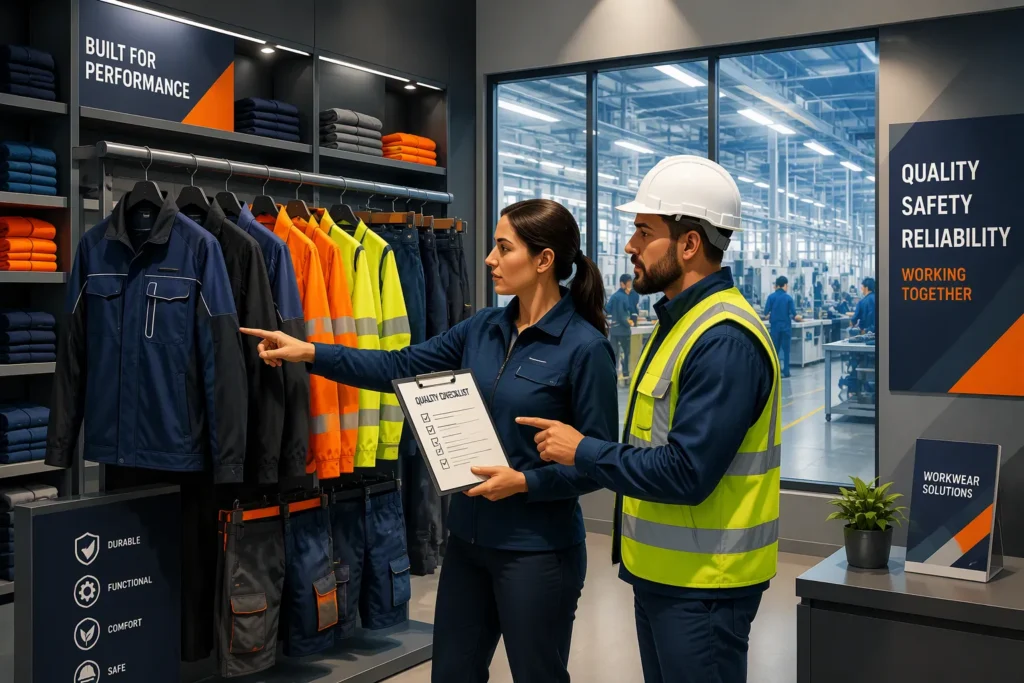
You can find construction site workwear OEM programs in five steps: define what the site needs, write technical specifications, check and audit factories, approve samples through pre-production sample (PPS) approval, and control bulk quality and logistics. This guide is for overseas general contractors, specialty subcontractors, and construction brand or crew apparel buyers. It covers site jackets, cargo pants, and branded crew layers, not PPE or hi-vis garments. Expect a step-by-step checklist with tables, a full RFQ specification set, and a copy-paste procurement checklist. The guide also uses a verified factory profile, Shanghai Top Fortune Industry Co., Ltd., to show what confirmed factory details look like.
Key Takeaways
Follow a five-step sourcing path: define what the site needs, write specifications, check out factories, approve samples, and control bulk quality.
Make a clear plan before you contact factories. Include a role matrix, a size grid, and logo files.
Don’t use unclear specs or skip sample approvals, or you may face delays and have to redo the work.
Set clear, measurable durability goals for each type of garment: jackets, cargo pants, and crew layers.
Use a detailed RFQ table that lists fabric, construction, sizing, branding, packaging, and acceptance criteria.
Pass three sample checks: fit sample, site wear trial, and written PPS approval before bulk production.
Pick OEM for custom programs that involve multiple crews. Choose catalog for fast, small orders. Or mix both to stay flexible.
Use the buying checklist to handle the steps before you order and during production, so the program runs smoothly.
Quick Takeaways
Five-Step Sourcing Path
Think of a construction site workwear OEM program as a chain of steps, not a shopping trip. Each step locks in a choice that the next step needs. Skip one, and you pay for it later with rework, delays, or garments that fail on site.
Define site requirements. List the jobs on site, the weather, the dust and wear exposure, and the logo program for each crew.
Write technical specifications. Turn those needs into fabric weights, construction details, size ranges, and acceptance criteria you can measure.
Vet and audit factories. Confirm capacity, equipment, and quality systems before you send a single specification sheet.
Validate samples through PPS. Run a fit sample, a site wear trial, and a written pre-production sample approval.
Control bulk quality and logistics. Set inspection points, carton marking, Incoterms, and a replenishment plan before production starts.
What to Prepare First
Gather your inputs before you contact any factory. A clear brief shortens quoting time and cuts back-and-forth. Start with a role matrix: which crews need site jackets, which need cargo pants, and which need branded crew layers. Add headcount per crew and per size.
Next, collect your branding assets. Confirm logo files, placement zones, and the decoration method you prefer for each garment category. Finally, decide your program horizon. A single-project order follows a different path than a rolling multi-site program with scheduled replenishment.
Where Buyers Lose Time
Most delays trace back to vague specifications. A brief that says “durable jacket” gives a factory nothing to quote against. Measurable criteria — fabric weight, stitch density, colorfastness after repeated washes, dimensional tolerance — move the process forward.
The second common loss is a skipped PPS. Buyers who rush from sample to bulk often find trim, labeling, or fit problems after the cutting tables are already running. The third is unverified capacity. Confirm the factory can hold your delivery window across all garment categories before you commit.
Durability deserves its own target set. For dusty sites, agree on abrasion performance and wash-cycle expectations with your factory, then write both into the specification.
Sizing programs also need early planning. Build a multi-crew size grid and define replenishment packs for rolling projects, so replacements match the original run.
Construction Site Workwear OEM: Entity and Buyer Intent
Factory Profile
Shanghai Top Fortune Industry Co., Ltd. is the factory behind this guide. The company started around 2002. It now runs a 1,506 m2 production site in Songjiang, Shanghai. Its main business is OEM and ODM workwear and site crew apparel. You can see the full range on the company homepage and read the background on the about-us page.
The export map covers Europe, the Middle East, Oceania, Southeast Asia, and the Americas. That spread matters for a construction site workwear OEM program. It means the factory already handles different size systems, labeling rules, and climate needs across markets. You brief one team, and that team turns your site conditions into a build sheet.
MOQ and Contacts
Plan your first order around a minimum order quantity of about 2,000 pieces per style. This threshold fits multi-crew programs, where jackets, pants, and crew layers move together. Small one-off requests work better with catalog stock.
Reach the team through these channels:
Email: rill@topfortunemail.com
WhatsApp: +86 13524210501
Address: Floor 3 Building 20 Haier Zhigu No.66 Guangfulin East Road Songjiang Shanghai 201600
Send your role matrix and size grid with the first message. A complete brief gets a faster, more accurate reply.
Buyer Intent Signals
Overseas general contractors and specialty subcontractors rarely order one garment type. They brief site jackets, cargo pants, and branded crew layers as a single package for multi-crew programs. The goal is a consistent look across trades and sites, with each garment built for its own wear pattern.
You likely share the same intent. You want one supplier who holds fabric, fit, and logo standards across every crew. You also want a replenishment path for rolling projects, so a new site opens with the same jacket as the last one. State that intent in your RFQ. Name the crews, the sites, and the timeline. The factory can then propose a program structure instead of a single price line.
Table of Contents
How to Use This Guide
Think of this guide as a tool you work with, not something you read once. If you are starting a new construction site workwear OEM program, read the sections in order. Each section gives the next one what it needs. Site requirements feed the specification table. The specification table feeds the factory audit. The audit feeds the sample gates. The sample gates feed bulk control.
If you already run a program and want to fix one weak spot, go straight to the section you need. A buyer with a good factory but repeat fit complaints can jump to the sample and PPS gates. A buyer with good samples but late deliveries can start at the procurement checklist.
Keep the procurement checklist open in a second window while you write your RFQ. Copy the items you need, delete the ones you do not, and send the result to your factory contact. The same checklist works for every new program, so you build a process you can repeat instead of starting from a blank page each season.
Section Map
The guide goes through nine sections in a set order. Each one answers a single question and closes it before the next section opens.
Quick Takeaways — the five-step sourcing path, what to prepare first, and where buyers lose time.
Entity and Buyer Intent — the verified factory profile, contact channels, and the program structure most overseas contractors brief.
Who This Guide Is For — the three buyer types, single-project versus rolling programs, and the scope boundaries of this guide.
Site Jacket vs Cargo Pants vs Crew Layers — durability and abrasion targets, pocket and fit decisions, wash cycles, logo placement standards, and multi-crew size runs.
RFQ and Specs Table — a full specification table with fabric, construction, sizing, branding, packaging, and acceptance criteria columns.
Sample to PPS to Bulk Gates — the fit sample gate, the site wear trial gate, and the written PPS approval that unlocks bulk production.
Catalog vs OEM Comparison — a neutral comparison of customization depth, size-run flexibility, lead time, and replenishment continuity, plus hybrid program options.
Procurement Checklist — a copy-paste pre-order block and a production and shipping block you can drop into an RFQ or PO template.
Next Steps and Quote Request — how to request a quote or a factory profile and what to include in the first message.
Read the map once before you start. It shows you which sections produce documents you will reuse and which ones you read for context only.
Who This Guide Is For
Overseas GCs and Subcontractors
You manage crews on sites that cover different regions, trades, and seasons. Your clothing program must dress those crews in a matching look without slowing down getting started. This guide speaks directly to that job. It treats workwear as a program you manage, not a one-time purchase you make.
General contractors usually brief the full package: site jackets, cargo pants, and branded crew layers in one brief. Specialty subcontractors often focus on one or two categories, then grow as new projects open. Both profiles gain from the same discipline. You define requirements, lock specifications, and hold the factory to measurable acceptance criteria.
Program shape matters as much as buyer type. A single-project crew needs one delivery that arrives before mobilization. A rolling multi-site program needs a size grid that repeats, plus replenishment packs that keep new hires and replacements in matching garments. Tell your factory which shape you run. The quoting structure, sampling plan, and packaging all change with it.
Construction Brand Buyers
You build a crew apparel line under your own label. Your buyers are contractors, and your reputation rests on how the garments hold up in dust, sun, and repeated washing. You need a factory partner who can hold fabric, fit, and logo standards across seasons.
Your brief usually carries more detail than a contractor’s. You specify fabric weight, construction, colorfastness targets, and logo placement zones for every style. You also plan size runs across several crews and sites. Treat the specification table in this guide as your starting template, then add your brand standards on top.
Scope Boundaries
This guide covers site jackets, cargo pants, and branded crew layers. It is not a PPE-first or hi-vis procurement piece. Safety vests and reflective gear sit outside the scope here, and so do nursing uniforms. If your program centers on those categories, use a different brief.
Compliance verification is a separate step. Your HSE team confirms OSHA and ANSI requirements before sourcing begins. This guide helps you build durable, branded site apparel around those decisions. It does not replace them.
Site Jacket vs Cargo Pants vs Crew Layers
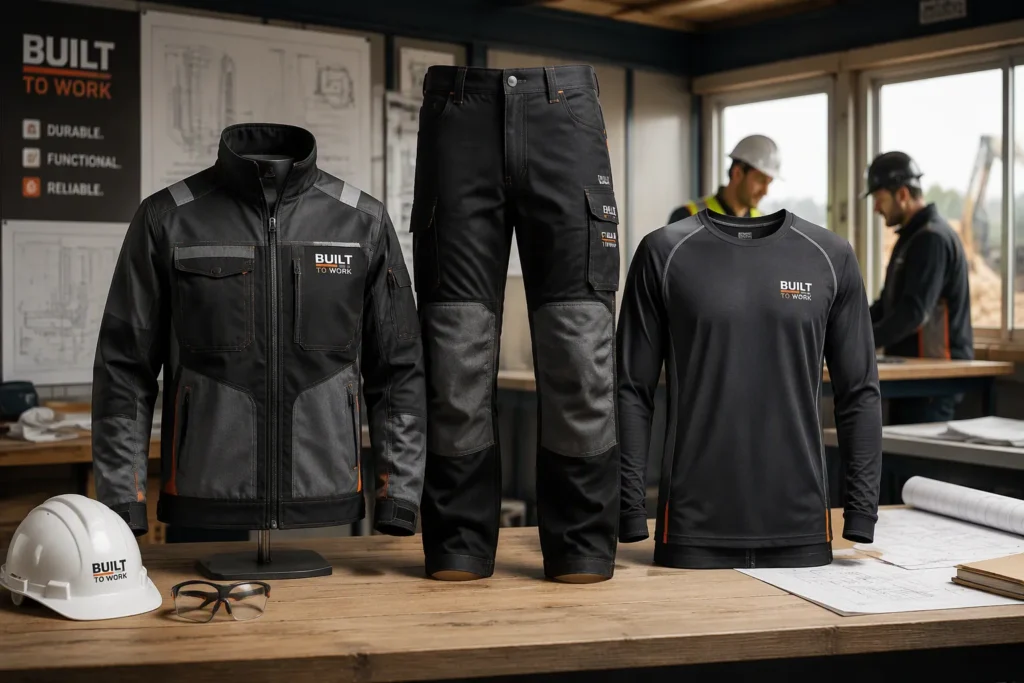
These three types of work clothes wear out in different spots on a job site. A jacket breaks down at the cuffs and hem. Cargo pants give out at the knees, seat, and pocket corners. Crew layers lose their look after many washes. Treat each type as its own spec problem within one construction site workwear OEM program. The table below sets up the comparison before the details follow.
Attribute | Site Jacket | Cargo Pants | Branded Crew Layers |
|---|---|---|---|
Main wear point | Cuffs, hem, shoulder seams | Knees, seat, pocket corners | Collar, chest, sleeve seams |
Abrasion focus | Shell face and seam joints | Reinforced panels at knee and seat | Fabric surface and print or embroidery area |
Wash expectation | Less often, spot cleaning is common | Often, heavy dirt load | Often, colorfastness is critical |
Logo zones | Chest and back | Thigh and waistband | Chest and sleeve |
Durability and Abrasion Targets
Start with the shell fabric on site jackets. Pick a weight that fits your climate and dust level, then check seam strength with your factory. Ask for reinforced stitching at every seam that carries a load. Cuff and hem reinforcement matter most, since those edges rub against tools, surfaces, and vehicle doors all day. Specify bar tacks or double stitching at pocket openings and stress points. The custom jacket manufacturer page shows the construction options you can put into a spec.
Cargo pants take the hardest wear. Knees and seats touch rough surfaces all day long. Specify reinforcement panels at both zones, and confirm how they are attached. Pocket count and placement come next. Too few pockets make workers carry loose items. Too many create snag points. Bar tacks at every pocket corner and belt loop stop the tears that cut a pant’s life short.
Branded crew layers face a different test. Abrasion matters less than colorfastness. A polo that fades after a dozen washes ruins the crew look across a whole site. Set a wash-cycle target with your factory and confirm the fabric holds color at that count. The custom polo shirt manufacturer page covers fabric and decoration choices for this category.
Pockets, Fit, and Wash Cycles
Dusty sites change the wash equation. Grit works into fabric and rubs it from the inside. Frequent washing removes the grit but stresses seams and color. Balance the two by choosing fabric that handles repeated washing without losing its shape.
Fit decisions differ by category. Site jackets need room for a mid-layer underneath, so specify chest and sleeve ease against your layering plan. Cargo pants need a rise and leg shape that let workers kneel and climb without pulling at the seat. Crew layers sit closest to the body, so size grading accuracy matters most there.
Wash-cycle expectations belong in the specification, not in a verbal agreement. State the number of wash cycles you expect the garment to survive while holding color and size. Your factory can then pick fabric and finishing to meet that target. For crew layers, confirm colorfastness after the stated cycle count. For jackets, confirm that reinforcement stitching holds after the same treatment.
Logo Placement Standards
Logo zones follow how visible the garment is on site. On site jackets, the chest and back carry the brand. The back zone gives the widest read at a distance, and the chest zone works for close conversation. Confirm placement height and width against a size run, because a logo that sits right on a medium can shift on an extra-large.
Cargo pants offer thigh and waistband zones. The thigh zone reads well when a worker kneels or stands in profile. The waistband zone stays subtle and suits smaller marks. Confirm that embroidery or print clears pocket openings and reinforcement panels.
Crew layers take chest and sleeve logos. Embroidery suits chest placement and holds up through washing. Print suits larger sleeve marks and complex artwork. The corporate polo shirts OEM China manufacturer page explains how decoration method interacts with fabric choice.
Multi-crew size runs need structure, not guesswork. Build one size grid that covers every crew and site, then map headcount to that grid. Group sizes into replenishment packs so a new hire gets a matching garment without a special order. This approach keeps a rolling construction site workwear OEM program consistent across sites and seasons.
RFQ and Specs Table
A clear RFQ table turns your brief into a document a factory can quote against, line by line. Fill in one row for each garment type, then attach your size grid and logo files. The table below shows the columns to use for any construction site workwear OEM program.
Garment Category | Fabric and Weight | Construction Details | Size Range and Grading | Logo Method and Placement | Packaging and Carton Marking | Acceptance Criteria |
|---|---|---|---|---|---|---|
Site jacket | Shell fabric and weight per square meter | Seam type, cuff and hem reinforcement, bar tacks | Size range, grading increments, layering ease | Embroidery or print; chest and back zones | Poly bag, carton count, size assortment label | Stitch density, seam strength, dimensional tolerance |
Cargo pants | Twill or canvas, weight per square meter | Knee and seat reinforcement, pocket count, bar tacks | Waist and inseam range, grading rule | Embroidery or print; thigh and waistband zones | Flat pack, carton count, size assortment label | Colorfastness after wash cycles, pocket pull strength |
Crew layer | Knit fabric, weight per square meter | Collar type, side seams, sleeve finish | Chest and sleeve grading | Embroidery on chest, print on sleeve | Poly bag, carton count, size assortment label | Colorfastness, shrinkage after wash, logo position tolerance |
Fabric and Construction Columns
The fabric column lists a weight per square meter and what fibers the fabric is made of. Both values let the factory match your climate and dust exposure without guessing. Add the finish you expect, such as a pre-shrunk treatment, and state it clearly.
Construction details describe how the garment is built, not how it looks. Name the seam type, the reinforcement zones, and where the bar tacks go. For cargo pants, list the pocket count and placement. For jackets, list cuff and hem treatment. The uniforms category page shows how these details group across a full uniform program.
Sizing and Branding Columns
The sizing column holds your size range and grading increments. State the base size and how measurements step up or down from it. For jackets, include the layering ease you need over a mid-layer. For pants, give waist and inseam ranges separately.
Branding columns record the decoration method and the placement zone for each logo. Give height and width for every mark, measured against a named base size. Confirm that placement clears pockets, seams, and reinforcement panels.
Acceptance Criteria
Acceptance criteria decide pass or fail at inspection. Write them as measurable values, never as adjectives. Stitch density belongs in stitches per inch. Colorfastness belongs to a stated wash-cycle count. Dimensional tolerance belongs to a plus-or-minus figure against the approved size spec.
Vague wording such as “strong seams” gives an inspector nothing to check. A measured value gives both sides a shared reference. Set every criterion before you approve the pre-production sample, and carry the same values into the inspection report.
Sample to PPS to Bulk Gates
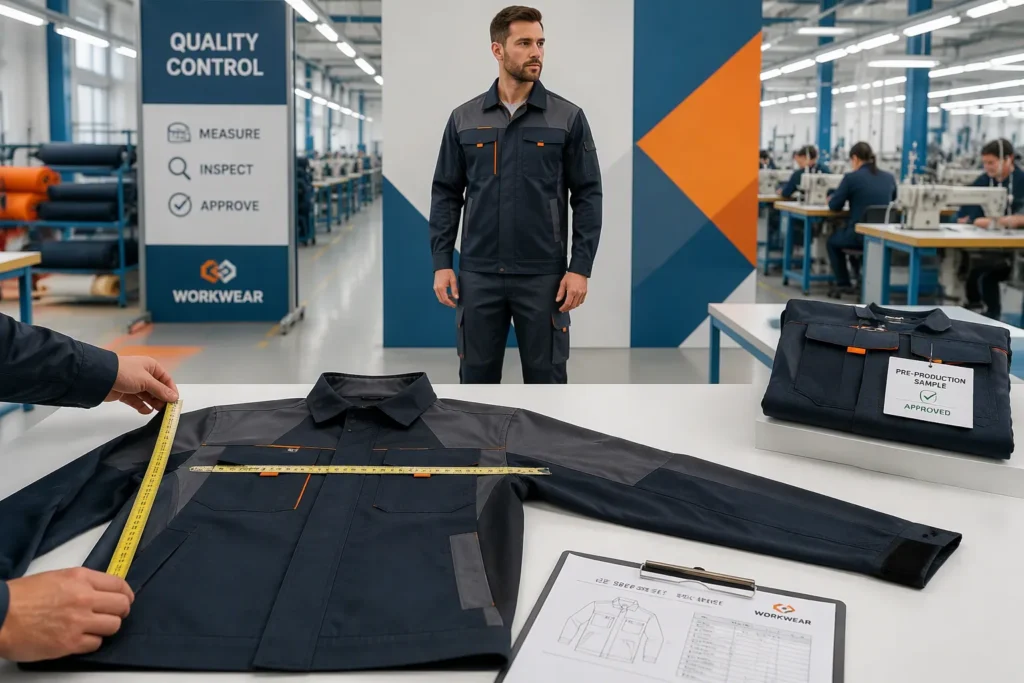
You pass through three gates before bulk production: the fit sample, the site wear trial, and the pre-production sample (PPS) approval. Each gate answers a different question. The fit sample asks whether the garment fits real bodies. The wear trial asks whether it survives real site conditions. The PPS asks whether the factory can reproduce the approved garment exactly, every time. Treat each gate as a stop-or-go decision, not a formality.
Fit Sample Gate
The fit sample gate checks measurements and fit blocks. Your factory builds one sample per garment category in a base size, then grades a set of sizes around it. You measure every sample against the size spec you signed off in the RFQ table. Check chest, waist, inseam, sleeve length, and the layering ease you specified for site jackets.
Fit blocks matter as much as tape measurements. Put the sample on people who match your crew profiles. A jacket that measures correctly can still bind at the shoulder when a worker reaches overhead. Cargo pants can pass a waist check and still pull at the seat during a kneel. Note every correction in writing and send it back as a marked-up spec sheet. The factory adjusts the pattern, and you review the revised sample. Do not advance to the wear trial until the fit sample passes on real bodies, not just on paper.
Wear Trial Gate
The wear trial gate tests abrasion and wash performance plus logo placement. Send the approved fit samples to a live site for a set period. Ask the crew to wear them through normal work: climbing, kneeling, loading, and cleaning. Then inspect the garments for wear at the stress points you specified — cuffs and hem on jackets, knees and seat on cargo pants, collar and seams on crew layers.
Run the wash cycles you wrote into the specification. Check colorfastness at the stated cycle count and confirm that reinforcement stitching still holds. Measure shrinkage against the dimensional tolerance in your acceptance criteria. Inspect every logo zone. Confirm that embroidery or print sits at the approved height and width on each size, and that it clears pockets and seams. A logo that drifts on an extra-large shows up here, before bulk cutting begins.
PPS Approval Gate
The PPS approval gate locks the final specification, trims, and labeling. Your factory produces the pre-production sample in the final fabric, with the final trims, thread, and labels. You compare it against the corrected fit sample and the wear trial findings. Check the main label, care label, size label, and any hangtag against your branding requirements. Confirm the carton marking and size assortment match your packaging column.
Bulk production starts only after written PPS approval. Sign the approval sheet, attach the sealed sample as the reference standard, and state that the sealed sample governs any dispute. Verbal approval invites drift. A written record protects both sides.
PPS approval also feeds replenishment packs for rolling projects. The sealed sample and approved spec become the reference for every future run. When a new site opens or a crew grows, the factory reproduces the same garment against the same standard. That continuity is the real value of a disciplined construction site workwear OEM program. Your second order matches your first, and your tenth matches both. For construction-specific program structures, see the construction site uniform OEM China page.
Catalog vs OEM Comparison
Catalog and OEM are two good ways to reach the same goal: dressing your crews in tough, branded site clothing. Neither way is best at everything. The right choice depends on how much you need to customize, how many crews you dress, and how long your program lasts. The table below compares both ways on the points that decide most programs.
Criterion | Catalog | OEM |
|---|---|---|
Customization depth | Stock designs with limited changes | Full control of fabric, construction, and fit |
Logo options | Standard placement zones | Any approved zone, method, and size |
Size-run flexibility | Fixed stock size assortment | Custom size grid across crews and sites |
MOQ | Low, suits trial orders | Higher, suits multi-crew programs |
Lead time | Short, ships from stock | Longer, includes sampling and PPS gates |
Replenishment continuity | Depends on stock availability | Repeatable against a sealed PPS sample |
Total cost structure | Lower upfront, less control | Higher upfront, predictable across runs |
When Catalog Fits Best
Catalog works best for fast, small, or one-time needs. You may need jackets for one crew before work starts, or a short order for a site that closes in a season. Stock garments ship fast and skip the sampling cycle. A catalog order also works well as a test. You try a fabric and fit on site before you commit to a full program.
Catalog limits show up in branding and sizing. You pick from standard logo zones and stock size runs. That works for a small crew with average sizes. It gets hard when your crews cover a wide size range or your brand rules demand exact placement.
When OEM Fits Best
OEM works best for branded, multi-crew, ongoing programs. You control fabric weight, reinforcement zones, pocket layout, and logo placement on every garment. You also build one size grid that covers every crew and site. A construction site workwear OEM program then repeats against a sealed PPS sample, so your tenth run matches your first.
The trade-off is time and commitment. OEM adds a sampling cycle and a higher starting quantity. Plan for both before you start. The payoff comes over seasons, when replenishment packs keep new hires in matching garments without a special order.
Hybrid Programs
You do not have to pick one way for everything. Many buyers run hybrid programs. Catalog crew layers cover fast needs and small crews, while OEM site jackets and cargo pants carry the brand and the durability load. This split keeps your main outerwear consistent and your inner layers flexible.
Set the split by wear pattern. Garments that take heavy abrasion and carry your main logo belong in the OEM track. Garments that wear lightly and change often fit the catalog track. Write both tracks in one program brief, so your supplier sees the full picture.
Procurement Checklist
Use this section as a tool you can work with. Copy the items into your RFQ or purchase order template, delete what does not apply, and send the result to your factory contact. The two blocks below follow the order of a real program, so you can track each item against a date and an owner.
Pre-Order Checklist
Close every item in this block before you release a purchase order. Each one protects a decision you already made in the specification and sampling stages.
Signed specification sheet for every garment category, with fabric weight and construction details.
Factory audit completed, with capacity confirmed against your delivery window.
Written PPS approval on file, with the sealed sample stored as the reference standard.
Size grid and replenishment pack structure agreed across all crews and sites.
Logo files approved, with placement height and width confirmed per size.
Payment terms, deposit percentage, and balance trigger set in the contract.
Total landed cost calculated: unit price, tooling, sampling, freight, duties, and replenishment logistics.
That last line deserves attention. Buyers often compare unit prices alone and miss the cost of tooling, sampling rounds, and the freight that carries replacement packs to a new site. Build the full landed cost into your budget before you sign.
Watch for three common mistakes at this stage. Vague specifications leave the factory guessing. A skipped PPS pushes problems into bulk. Unverified capacity turns a confirmed date into a hopeful one. Any construction site workwear OEM program that avoids these three starts on solid ground.
Production and Shipping Checklist
Track this block weekly once bulk production begins. Small issues caught early stay small.
Inspection points scheduled at cutting, in-line, and final stages.
AQL level agreed in writing for each inspection point.
Carton marking and size assortment labels confirmed against the packaging column.
Incoterm selected and stated on the order, with the named place.
Shipping mode chosen, with a booking date that matches your site mobilization.
Replenishment trigger defined, so the next pack ships before stock runs low.
Set the AQL level with your factory and write it into the order. An agreed level gives both sides a shared pass-or-fail reference at final inspection. Confirm carton marking early as well, because a mislabeled carton slows receiving at the site.
Shipping mode follows your timeline, not habit. A mobilization date that cannot move needs a mode that protects it. A rolling program with buffer stock can trade speed for cost. State the choice plainly on the order, and confirm the booking before the final inspection closes.
Next Steps and Quote Request
Request a Quote
You now have a full sourcing path: requirements, specifications, factory checks, sample gates, and bulk control. The next step is a quote. Send your role matrix, size grid, and logo files to rill@topfortunemail.com or message WhatsApp +86 13524210501. Name the garment categories you need and the sites you dress. A complete brief gets a faster, more accurate reply.
Put your timeline in the first message. State your mobilization date and your expected delivery window. Add the size breakdown per crew, so the factory can build the quote around your real size run. Mention whether you run a single-project order or a rolling program. That one detail shapes the sampling plan, the packaging, and the replenishment structure.
Keep the quote request specific. Ask for a line-by-line breakdown by garment category, not one blended figure. Ask how the factory handles sampling rounds and what the PPS approval step looks like. These questions show you understand the process, and they bring up any gaps before they cost you time.
Request a Factory Profile
Ask for the factory profile along with the quote. The profile confirms capacity, equipment, and quality systems before you commit. Shanghai Top Fortune Industry Co., Ltd. runs a 1,506 m2 production site in Songjiang, Shanghai, and has built OEM and ODM site crew apparel since about 2002. Request the profile at rill@topfortunemail.com or through WhatsApp +86 13524210501.
Use the profile to check one thing above all: capacity against your delivery window. A factory that fits your volume and your date is worth more than a lower unit price. Confirm the address for any samples you ship: Floor 3 Building 20 Haier Zhigu No.66 Guangfulin East Road Songjiang Shanghai 201600.
For construction-specific programs, start at the construction site uniform OEM China page. It shows how a construction site workwear OEM program comes together from brief to bulk. Pair it with the company homepage for the full range. Then send your brief and let the factory build the program around your crews.
You can now check your sourcing plan against seven steps: define site needs, write specifications, check the factory, run the fit sample, complete the wear trial, approve the PPS, and control bulk quality and logistics. Keep that order. Needs come first, specifications second, factory checks third, sampling fourth, and bulk control last.
Use the procurement checklist again for every new program. It turns each launch into a process you can repeat instead of a fresh scramble.
Ready to start? Contact Shanghai Top Fortune Industry Co., Ltd. at rill@topfortunemail.com or WhatsApp +86 13524210501. Visit workwearmanufacturer.com and the construction site uniform OEM China page for next steps.
FAQ
What is the minimum order quantity for a construction site workwear OEM program?
The factory sets its minimum order quantity per style, and the buyer-intent section above states the exact figure. Plan your first order around a multi-crew program, because jackets, pants, and crew layers move together. Small one-off requests fit catalog stock better than an OEM run.
How do I request a quote?
Send your role matrix, size grid, and logo files to rill@topfortunemail.com or WhatsApp +86 13524210501. Name the garment categories and your mobilization date. Ask for a line-by-line breakdown by category, not one blended figure. A complete brief gets a faster, more accurate reply.
How durable are site jackets and cargo pants for dusty sites?
Durability depends on the specification you write. Set abrasion and wash-cycle targets with your factory, then confirm reinforcement at cuffs, hem, knees, and seat. Bar tacks at pocket corners and belt loops extend garment life. Measurable acceptance criteria protect those targets through bulk production.
Where should I place logos on site workwear?
Site jackets take chest and back zones. Cargo pants take thigh and waistband zones. Crew layers take chest and sleeve zones. Confirm height and width against a named base size, and check that every mark clears pockets, seams, and reinforcement panels across the full size run.
How do I build a size grid across multiple crews and sites?
Build one size grid that covers every crew and site, then map headcount to that grid. Group sizes into replenishment packs, so a new hire gets a matching garment without a special order. This approach keeps a rolling program consistent across sites and seasons.
Does this guide cover PPE or hi-vis garments?
No. This guide covers site jackets, cargo pants, and branded crew layers. Safety vests and reflective gear sit outside its scope. Your HSE team confirms OSHA and ANSI requirements separately before sourcing begins. Use a different brief for PPE-first programs.
How long does sampling take before bulk production?
The sampling cycle runs through three gates: fit sample, site wear trial, and written PPS approval. Each gate takes time, and bulk production starts only after written PPS approval. Plan the cycle into your mobilization date. Rushing a gate pushes problems into bulk.
Can I mix catalog crew layers with OEM outerwear?
Yes. Many buyers run hybrid programs. Catalog crew layers cover fast needs and small crews, while OEM site jackets and cargo pants carry the brand and the durability load. Write both tracks in one program brief, so your supplier sees the full picture.